Episode 8: “Unlocking Success with Anne Marie Sabbath: Mastering Professional Etiquette”
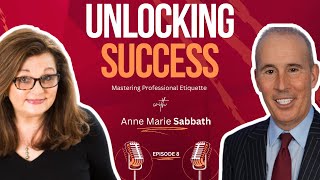
Anne Marie Sabbath discusses wealth-building through habit and long-term investing. She recommends maxing employer matches, keeping three months in emergency savings, and holding stocks for 10+ years. She warns against get-rich-quick schemes and pitches her book The Wannabe Investor.
Chapters
And here's a reason. People who can manage their time can manage their finances. I will put money on that theory.
Buy this, sell this. They're making money on every trade. They want you to follow every little nuance.
I love Tony Robbins. I quote him. There's no competition. There's more than enough. There are more than enough ears who want to learn something.
Because when I hear someone say, oh, I own a duplex, I love my passive income. I, I cannot stop laughing in their face. I mean I was, I didn't grow up rich, but I grew up, I guess you would call solidly middle class. My father was an engineer, my mother had been a schoolteacher. I was maybe one of the poorest kids in my college.
My dad was a carpenter. My mom was in banking. Listen, I'm red blooded. There's no blue blood going on here.
Our author who has joined us today, she is a world renowned expert on finance and she literally wrote the book on what self made millionaires do that most people don't.
Apple has a moat. Disney, no matter what the share price is, no matter what it's going through, it has a moat. If you want your money to be easily accessible so you keep it in a bank. Are you kidding? Yes. I did that for 30 years, TJ because I know your listeners. Readers are going to love this. If you have children in your life, or grandchildren, or nieces or nephews, stop buying them all kinds of crap, excuse my French. Instead, what I've done with my grandchildren, four years ago they were 7 and 11. I said no more toys, no more clothes. Every single Christmas, every single birthday, they get a share of stock. And if it stocks expensive, maybe $500. They're not getting a $500 gift from me. I might buy a partial share which is called a fractionated share.
Do you ever wonder why certain self made millionaires become millionaires? What they did differently from you? It can't just be as simple as they didn't order Starbucks coffee, they made homes coffee and saved a few. It can't be that simple, right? Yet that's what we hear constantly in the media. Well, wouldn't you like to know the real reason? I'm very, very excited about our author who has joined us today. She is a world renowned expert on finance and she literally wrote the book on what self made millionaires do that most people don't. She's written nearly a dozen books on finance. Her most recent book is the Wannabe Investor. I'm very happy to bring to our stage. Ann Marie Sabbath Ann Marie, how are you today?
Great, T.J. thank you for having me. I'm thrilled to be here.
Thanks for being here. Now we are helping a show about helping people be more successful in all aspects of life. And, and it's very hard to be successful if you can't pay for last month's rent. It's very hard to be successful if you can't afford the lifestyle that you want, that your family wants. And we're primarily about helping people communicate more effectively and having more confidence in communication. And when it comes to finance, there's so much miscommunication out there. People, people are constantly hearing, well, you know, you got to invest everything in Bitcoin and if it goes down 80%, well, tough. Or you got to be born to wealth. There is a lot of inherited wealth in this country. You got to go, if you don't get into Harvard, your career's over and you'll be poor and you'll be a dishwasher the rest of your life. So many messages, many of them conflicting about how to build wealth, how to invest. Tell us what are the, the biggest lessons you learned in all of your research on what self made millionaires do differently from average people?
I sure will, T.J. first of all, if anyone tells your listeners any of those things, I'm going to say one thing to them. Choose new friends. That is absolutely wrong. It's very, let me tell you, every thing I have written about I have had to learn on my own. And so it's very easy becoming a millionaire. A self made millionaire is not about money, it's about the habits. This is what is amazing. And when I assessed it, I recognized something. I'll give you a quick example. I had a friend who was a producer with a major television show. I won't tell you what it is. However, it has numbers in it. And she complained about money all the time and she was always late. And then I observed people who were self made millionaires and I put two and two together. And so one of the things I have made a point of including in this particular book, what self made millionaires do that most people don't is never be on time, be early. And here's a reason. People who can manage their time can manage their finances. I will put money on that theory. You have five friends. Someone is always running late. Guess what? I understand once in a while, however, it doesn't work. I was late for 35 years and so I'm an expert at having been late. However, I learned and this is what I want to tell your viewers, your listeners, you write down the time you have to leave. You don't write down the time you have to be somewhere. That is the secret for mastering. So the reason I'm telling saying all this, it's so essential and it's really easy. It's not a quick rich theme, it's changing habits. That's what it's all about. Money is. Your friend.
Emory, you mentioned habits. And one of the things, because I read a lot of books about finance and investing and every book has different nuances but at some level they all deal with human nature and the problem with human nature because it's human nature to want more, to want today to discount future self in exchange for today self. It's always going to be more fun to spend every penny you have today for today. If you knew you were dying today, it's more fun to spend today. There's no doubt about it. And yet every investor book says, okay, the way to wealth is save 20, maybe 30% of every dollar that comes. And it doesn't even matter if you make minimum wage. If you don't spend 20, 30% of every dollar you make and you invest it just in an index fund and you never pick a winning stock in your life, you will be a multimillionaire at some point. And yet it's not fun to not spend.
Well, here's the deal, TJ Coffins do not have pockets. That's number one. So it's essential to enjoy your life along the way. However, the most important thing, and let me tell you, I didn't listen when I was 20. I thought I was smarter than the rest of the world and I wasn't. The most important thing is pay yourself first. You do not have to make a lot. People who make very little are often become self made millionaires for one reason, because they pay themselves first and it's how they use their money. I'll give you an example. An example is they pack their lunch rather than spending $15 a day for lunch. There you are. 15 times 30, are you kidding me? $450 a month where you can use that? So it's not how much you make. Don't blame it on your boss for not giving you additional money. It's you and how you manage it. The most important thing is more, more, more. Listen, there are a lot of things to do for fun. So the key if we want to talk about the most important thing is passive income means money that's working for you, me and your listeners of yours right now, as we are doing this, what is it that we're doing? Do we own a piece of real estate and is it appreciating over time? Do we have our money in the stock market and we wait a minimum of 10 years? If Warren Buffett has said that I'm going to his conference this weekend, I can't wait. Warren Buffett says, if you're not going to keep a stock for 10 years, don't keep it for 10 minutes. If it starts fast, it ends fast. And so this is called long term approach. So we're going to get into that when you're ready. However, it's not a quick witch scheme. There are no scams going on. And I can't wait to tell you why. I love my competition like Dave Ramsey so much.
Okay, now you mentioned Warren Buffett. And Warren Buffett is, you know, by most accounts the most successful investor of all time. He is a great communicator. One of the things he attempts to communicate and I would say he fails at, which is he says his biggest piece of advice to most investors these days or certainly young people starting out, is do not pick a single stock. Instead, put your money in an index fund, an s and P500 index fund, and forget about it for 30, 40, 50 years. You can't help but be a multi millionaire. And I never hear anyone quoting that. Basically, certainly when he goes on cnbc, that's the last thing anyone wants to hear. Because every single player, every advertiser, every other guest has an incentive, buy this, sell this. They're making money on every trade. They want you to follow every little nuance. What do you think of his basic advice? Which is it's foolish for most individuals to even pick a stock. They should just buy an index fund.
Well, Warren Buffett's right. I mean, come on and I'll tell you why. And it's not because I'm going. It's not because I'm going to be leaving Thursday. The reason is when people don't know what they're doing, they should choose an index fund. And I'm not going to advise people what to buy. That's why I tell you it took me 10 years to study under someone. And I'm not an advisor. I'm a real person who learned to be going from a wannabe to a seasoned investor. And I'm learning every single day. However, the key is you always want to diversify. So if people choose to put their money in index fund, set it and forget it. That's the way to do it. Now, I will tell you something, TJ Warren Buffett more than 42%. And I might be off a percentage more than 40 some percent of the holdings of Warren Buffett as far as stocks is in Apple stock. And the reason he didn't buy 42%, it continued to grow. So what I'm saying to you is it might not be the right thing for you or me, although I love what he's done. The most important thing is to recognize what is it that your end goal is. You have to start a trip, whether it's a financial trip or anything. What is your end goal? That's the key. How long do you have? What is your risk tolerance? Now remember, I'm not an advisor. I'm an ordinary person who learned an extraordinary thing.
And if you don't mind, let's tease that out a little bit because there are so many people who write books about finance and they're either directly or indirectly using it as a marketing tool to get all of your net worth so they can get that one and a half, 2% forever. And I believe Dave Ramsey has a financial services where he gets you in and. And you know, Anthony Robbins wrote a book on money, but he was affiliated with a financial company where. Come on in. And that's not your revenue model, Correct?
My revenue model is helping other people be successful. And here's the reason. I get anything I want in my life by helping others. Now, this is not a church. This is not a synagogue. I help people for the sake of it. So if you ask what differentiates me from everyone else and I love Dave Ramsey, I quote him. I love Tony Robbins. I quote him. I. There's no competition. There's more than enough. There are no more than enough ears who want to learn something. I have every book you can imagine on investing things I didn't even understand for decades. Now I understand them. I doing this because I want to help people create their own success. There is no hidden agenda. So again, you know what? This is what it's about. I love helping people. And I'm not a trust fund baby. I don't have a sugar daddy. However, I have earned every cent because of helping people. And I get everything back when I need a favor. Trust me, they're all in line waiting. That's the bottom line.
Earlier you mentioned passive income. And I always sort of. My back stiffens up when I hear that phrase because you. Yes, of course, there's such a thing as passive income. If you put $10,000 in Berkshire in 1965. You're, if not a billionaire, close to it. And you didn't have to do any extra work. You didn't even have to go to his conferences. So there is such a thing as passive income, but there's also such a thing as every single day, everyone's email box is full of scams that all say, hey, you're going to get rich with passive income. I'm going to teach you how. Buy my $2,000 program. So I always sort of grab my wallet quickly when I hear someone talk about passive income. What is your. How are you actually defining it? Because when I hear someone say, oh, I own a duplex, I love my passive income. I cannot stop laughing in their face because I've owned real estate before. I lost money to me real estate. In most cases, there can be exceptions, but no one ever goes to a cocktail party say, oh yeah, I bought this property and I lost. You know, I lost $50,000. I would have made 200,000 more if I just stuck the money in an index fund three years. No one brags about that. They only brag about, well, I bought it at this and I made a huge profit. It's so often not passive. So I want to hear what is your definition, actual passive income? Passive investments.
Passive is letting something work for you while you're doing something else. And I will tell you, I've owned real estate over and above my home. And guess what? There were some where I broke even. There were some where I made a lot of money. And so the most important thing is to know you have to be right more than wrong. That's the most important thing. Passive income is your money, my money, any, your listeners, viewers money, any stocks, whatever you want. Passive income means it is working for you while you are not expending any energy on it. That's passive income. And it's very important. If I can say this, if I may, I don't want your viewers, your listeners, to realize it's a snap of the finger. Because what I say in my book, the most recent book that came out, the Wannabe Investor, you are not allowed. If you were with me, I would say to you, you are not allowed to put one penny in you one, have a 401k, that's a retirement fund that an organization typically makes available to you. Or if you own your own business, no excuse, you then must have a Roth ira. And how do you do it? Well, you know what? Pick up my book. I mean, for goodness sake, go online, how to open a Roth IRA. Go to fidelity.com Merrill Lynch.com Schwab etc. And call their 800 number and tell them you want to know how to do it. In many, with many of those organizations you don't need to put in a penny. You simply need your Social Security. So you're not allowed to do any of this until you start investing through your fund. And you have to max it to the most. You have to max it because companies, typically organizations match a certain percentage. This is something else I have to say, if you don't mind. Before my manuscript was published, I was so glad to find out that there is a law that's been passed through legislation called the Secure Seceware 2.0 Act. What that does is that allows organizations to be able to match a certain percentage of the student loan debt that individuals pay off on their student loans. I mean this is like a no brainer. So people should reach out to their human resource manager, say, to be able to say, do you, does our organization, are they part of or are they going to be part of this SEC or Secure 2.0 Act? That's in my book. I mean, are you kidding me? Why not open a retirement account and let your organization match a certain percentage of, of what you're paying off in student debt? So I'm saying to you, this is important. You can't just jump in and buy a stock. If you do, if it starts fast, it ends fast. Don't get a hot tip from someone who said they made a million to tj. Your your point? People don't say what they didn't do. They only brag about what they do. Those are the people that you want to run away from fast. And it's important. If I may say one more thing, have a minimum of three months of an emergency fund. Did I have that at 20? Are you kidding? No. I was glad to pay my bills. Are you kidding me? So I speak with authority. This is important.
TJ Amory, our show is about communication skills and you're obviously a passionate communicator. You speak clearly. You're not using jargon and buzzwords. You're not saying like, well, you should mitigate losses and all. You're good, clear, simple speaker. I am curious as to how you consciously try to craft your communication style in a wildly crowded field. You've got Dave Ramsey who has, you know, gazillion books. Susie Orman who was so dominant for years. But you've got thousands and thousands of people putting out books, many of them with Massive promotional budgets because they're using the book just as a hook to get people in to manage their money, to charge, you know, 1, 2% sometime. So I'm not asking you to badmouth your competitors. That's not a bad look on anyone. But how do you differentiate yourself from, you know, the Dave Ramsey's, the Susan Orman's of the world, Susie Orman, I.
Should say I love Susie. I've met Susie, I've attended her seminars. As I mentioned before, I quote Dave, I quote Tony Robbins. What differentiates me is I am accessible anytime somebody texts me. 5132-0044-9513-2004 anytime somebody texts me a question, and it better be legitimate because I'll block you if it's not. Anytime or anytime someone emails me and you'll get the email soon, I respond, I am accessible. I attainable. I do not live in the clouds. Yes, we all have the same amount of time each day. People do it differently. You don't need to go through my assistant. Guess what? I will respond. This is important. So text or emails, you have me anytime. I received an email this morning and I responded ASAP because this is essential. The most important thing when communicating is being transparent and being responsive. So that's what differentiates me. Real person, been there, done that. Transparent and responsive. Try me. You'll get something after the show.
Now, you were candid and admitted when you were 20, you didn't have three months savings. What really was the turning point for you when you said I gotta get my financial house in order?
The turning point for me was to stop being a blockhead and to start listening. And I was 42 before I started funding my retirement plan. I'm being honest. And then I maxed it like no one else. That's number one. The second thing I did is as I said at the very beginning, I learned money and scarcity do not go hand in hand. Money and abundance go hand in hand. And it begins with a mindset set. That's number two. Number three, I surrounded myself with people I wanted to be like. Because my mindset, my level awareness, my financial bank account eventually didn't just happen, became like them. And this is why I love to be accessible for people. Because I want to help, to raise them to do exactly what you do and TJ to give them the confidence to be able to accomplish their goal. For you, it's presentation, media training. For me, it's assisting them in creating their own success, whether it's financially, whether it is Beginning a business, teaching them how to do it. And this is as a gift. I don't have a seminar that they can take. Yes, I do an eventbrite every few months for $39. Are you kidding me? That's like two lunches. They're welcome to join. And I'm only saying to you, I am not somebody who digs into somebody's pockets. I give to people because I get it back tenfold.
What's your advice to people who say I don't have a circle of friends who are already wealthy and successful? I mean I was like, I didn't grow up rich, but I grew up, I guess you would call solidly middle class. My father was an engineer, my mother had been a schoolteacher. I was maybe one of the poorest kids in my college. I went to a fancy college. But all of a sudden I'm around a lot of people who do have generational wealth and some of them were nice enough to fund some of my earlier media projects. But we have a lot of viewers for this show in India and Asia and South America where it may be that no one in their village has what you and I might consider real wealth. What's your recommendation to them?
That's easy. My dad was a carpenter, my mom was in banking. Listen, I'm red blooded. There's no blue blood going on here. And what I did example when I started my 33 year old business in 1987 is every single day, even if it were 20 minutes before I go to bed, I'd have a meeting with somebody I wanted to be like by reading one page of a book about how to start a business. Today to this day I read something at midnight. I read one page about Warren Buffett's advice, some book that I absolutely love that he wrote. My point is you don't have to know someone. Get online and I call it, have a meeting with your brain trust advisor, someone who you want to aspire to be like. So there's no excuse if people say I don't know someone, come on, give me a break. Quit making excuses. Losers make excuses. Winners find solutions. And I want to give you one investor.
How do you back to the communication challenges. How do you come up with new stuff to say about finance? And I'll say something here, you might not like it, but I do sometimes put finance in the category of, you know, weight loss in this sense that really everything you need to know about weight loss you could put on a three by five card, eat fewer calories, avoid processed food, certainly Avoid real and artificial sugars. Exercise every day. Eat a lot of green vegetables. That fits on a three by five card. If you do that, chances are you'll be what most people would consider a healthy weight. But you can't sell a book that says that with finance. If you tell people, spend less than you make, invest 20 or 30% of every dollar. And whether it's an index fund or some long term thing where you're not taking it out, live below your means. Constantly. Build skills to improve your value in the marketplace. Build your mind so you can work doing stuff you like till the day you die. You will become wealthy if you do that. That fits on a three by five card. If I tried to publish a book with just that, I'd be laughed out of every major publisher. I wouldn't sell anything because people for the most part don't want to hear that. So that's my, my challenge. How do you keep writing new books when so much of the core truth is known and people at some level don't want to accept it? The same way I want to think I can lose weight eating chocolate sundaes every day and drinking more beer, as the case is for many people. How do you fight that fundamental human nature to not really want to listen to the core messages?
Well, first of all, tj, you don't need to lose an ounce. Have that hot fudge sundae. You look great, number one. Number two, the way you do it, people love stories. And so the key is, yes, there are only so many words in the dictionary, whatever your language is. The most important thing is share experiences. I have three more books in my mind. I never tell people what I'm going to Write until I'm 75% finished. And the reason is because of the experiences. The reason is because I watch what people do write wrong. I learn what I could be doing better. And being human, continuing to succeed is always figuring out ways how to do it better while accepting what you do right and accepting other people. Let me tell you, it's so easy, I have to say everybody has a book inside of them. And so the question is, what have you observed that you can share with others? Every one of my books is based on what I've learned, what I've experienced, what I've done wrong, what I've learned to do right. And remember, that's how it works. This is essential. Think of anyone. I'm going to give you an example. There's a stock. I'm not saying buy it. I love it myself anyway. It's not for you. Called Nvidia. Nvda. Jensen Huang is the CEO. He's the godfather of artificial intelligence. Well, I say that because, guess what? I read something on a CNBC interview that he began when he was in college and maybe before washing dishes at Denny's, he washed more toilets. This is a quote from him than anyone you know. And you know, what I'm saying is, and he learned how to make it happen little by little in Spanish. If anyone speaks Spanish, there's a saying called little by little. You go far. Poco apoco seva alejos. I didn't. I wasn't raised with Spanish. I. I learn Spanish. And so I'm saying to you, you can learn the language of success. You can learn. It's a matter of what you want to do and then making it happen one step at a time. A scam, to your point, TJ Is if it starts fast, it ends fast. Run as far as you can. That's the most important thing.
Well, the problem is sometimes you don't know when scams are going to end. And if it lasts for hundreds of years, sometimes it's debatable whether it is a scam. I have been extraordinarily skeptical of cryptocurrency and bitcoin, and I've been telling my friends for years, stay away. I agree with Warren Buffett, who says it's essentially toxic sludge and garbage, and he wouldn't give $5 for every Bitcoin in the world. But here we are, you know, what is it, 12, 14 years later? And I do know a lot of people who've made money now. A lot of people lose money. They don't like to talk about it. But what do you do when someone comes to you and says, well, you know, everyone I know has made money from this, and I want it to be a part of my portfolio. And even BlackRock has. Has funds that take it into. What's your advice on that? I do. I do think of bitcoin, for that matter, even gold. I can't remember if it's Warren Buffett or Charlie Munger who says civilized people invest in real businesses. That's why he doesn't invest in gold or bitcoin. He doesn't consider it a real business, meaning it's got some service it provides to people where there's actual benefit.
Well, the key is this. I have an entire chapter in the Wannabe Investor on cryptocurrency. I'm very transparent and say at the beginning, I don't own It. However, I want you to learn about it. And here's the case. No FOMO going on. Fear of missing out. People have said it. Warren Buffett has said it. People with logic know you do not buy something you do not understand. So the key is, look, I know people who've made a lot of money in crypto. However, it's not for me. Does it mean they're wrong? No, that's their choice. So the key is, rather than negating that it's bad, it's not necessarily bad. It's a matter of us having to learn it and then decide, is this something we want to do? So that's really what it's about, rather than judging. It's listening. Listening and learning and then making our decisions. That's the bottom line.
But let me question you on this idea that you should only invest in things you know. I mean, I have information technology funds. I have no idea what half of these things do. But, you know, the fund has been up 13.9% for. Oh, that's the average for 20 years. It's been up 19% for the last decade. A large holding is Apple. I don't really know how this thing works, and yet I know how McDonald's works. But if I had invested, if I had significant holdings in McDonald's over the last 10 years, I would not have beaten the index. So is it really true you should only invest in things you know?
Yes. The answer is yes. Are you kidding me? Yes. When you go on vacation, you close your eyes and say, I'm going here. You want to know what? What is there? What is the benefit? Understanding. The answer is absolutely yes. And I'll give an example. You need my book. TJ I have to tell you, we're going to have to sit down and meet. And I'm not an advisor. It's important. And I go back to Warren Buffett. Not because I want to say Warren Buffett all the time, but he's absolutely right. And I have my own Alan Buffett, who's been in the market 65 years. That's how I have learned. Listen. So the key is, when I buy a stock, I make sure that I buy a stock with a moat. M O A T. Do you know.
What a moat is, TJ Something that protects you. Keeps the evil forces out.
Exactly.
And investing something where you're hoping the downside is so minimal you're not going to lose your money.
Exactly. A moat is something. So give an example. Apple has a moat. Disney, no matter what the share price is no matter what it's going through, it has a moat and has, the reason is because its competition doesn't have theme parks, it doesn't have all the ip, it doesn't have the name recognition, it doesn't have top management. That's about Apple.
But, but let me challenge you there for a minute and I. Full disclosure for everyone. This is not a financial show. We are not giving any financial investment advice. You're not a registered advisor seeking clients. I'm not, yeah. I've got a Series 7, Series 63, but I'm not a financial advisor active. No one's trying to raise money or sell any securities on this show today. But let's just look at Apple. I mean, I have significant holdings in Apple in my index funds. But, but they have, I mean they have competition all over the place. Other people are trying to sell phones. Android is competing with them every day. You've got Federal Trade Commissions and governments in the United States and throughout Europe constantly saying they're guilty of restraint of trade. They could have major regulatory actions against them. Is it really true that they are destined to have continued trillion dollar growth the way they've been on for the last decade or so?
Yes, yes and yes. And here's the reason. If you have an Apple phone, you're not going to switch to Samsung because Apple has a network. Your iPad's not going to be connecting with it. This is important. Apple has name recognition. This is, it's so essential. Apple, there's a very high barrier to entry. So what that means is you're going to have to do a lot of switching. It's going to be a lot of work to go from Apple to, to competition. Now granted, my daughter has a Samsung because that's what her company has given her and she thinks that's as good as anything else. And that's terrific. The point is it has intangible assets. How much intellectual property does this have? The key is there are certain stocks that have wide moats. And the only reason I say it means it, it's wide. Tesla. We're not even going to Tesla. However, Tesla has brand recognition. The founder has plenty of money and could do what he wants when he wants. It doesn't mean it's a wide moat. Maybe it's a narrow moat. However, it still differentiates itself from its competition. And these battery, these EV charge centers is most likely going to be one of the major hooks for Tesla. So the key is, it's important to understand, what is it? Who are you? What's your Risk tolerance. And again, I'm not an advisor. I'm simply telling you this is. I want people to at least understand the language of investing so when they have a financial advisor, they can at least understand that the person's not speaking Greek. They can have some fluency and be able to ask questions, be able to feel smart rather than say, yes, yes, yes, and not understand. That's what this is about.
Mm. Okay, in a moment, we're gonna do a couple of segments that I try to do in every interview, and one is it's gonna be infomercial time. And I don't mean that in a negative way. I'm going to actually step off for a minute. We're gonna put up Ann Marie next to her book, and I want us. I want her to pitch us. I want her to get us excited about buying the book, and I want to give her two, three minutes to really give the elevator pitch and beyond. To get us excited about this book and to do it in an unrestrained way, regardless of whether the interviewer asks great questions, dumb questions, no questions. So I'm going to give her the opportunity to do that. The other thing I'm going to do with Ann Marie is I'm going to ask her every financial advisor's I find least favorite. I have a question I ask people in the finance world, and they hate me for asking it. And I'm not sure I've ever had anyone really give me a straight answer. So you're going to want to stay tuned for that question because we're going to give Annemarie ample time for both of those. But. So right now, Anne Marie, I'm actually going to. Let's bring up your book. This is your 11th book. Am I understanding correctly? Yes, 11th book. So a wealth of knowledge here. This is not someone who just said, oh, I want to be an author today. Let me just cook up something and go to chat GPT and spit out something. This is someone who spent decades and decades and decades immersed in the field of personal finance and sharing her expertise and her tips with you and with people who are. Do you have a target market? I mean, it's not billionaires, presumably. It's not people who have literally no income. Who is your target market for?
The target market is someone who wants to prepare for their financial future one day at a time. Somebody who has a nickel in their hands, someone who has a dime in their hands, someone who wants to know how to make their money work for them, who's a wannabe, who's Curious and wants to learn. And I actually have people who are seasoned investors who go on my event break because they want to know what's the one thing they can do and they've learned, oh, maybe I should reinvest my dividends and excuse me one minute.
I'm actually going to take myself off the screen and we're going to put you on. And I want you just to say everything you want to say about this book as if you've been invited to give a mini TED Talk on it. And then we'll talk about what you were trying to do and why you hit those buttons. And then I'm going to go to the big tough question.
Okay, let's ready to do it. Well, first of all, thank you TJ for having me on. My name is Ann Marie Sabbath and this is my 11th book. It took me 10 years of spending time with an individual who's retired from the New York Philharmonic. He was a violinist and he still plays for us and he knows how to do much more than pizzicato. For 65 years, he has been investing one step at a time. He knew very little and he learned every day he reads. And so I was fortunate enough to meet him and for every single day I spent time with him on the phone, via email, in person. And I learned what I'm sharing with you in this book. The wannabe investor. Seven years after spending these 10 years with him, seven years into it, I said, I have to write this and here's why. Approximately 40% of people are not invested in the stock market. And I'm going to see if that's you. One, you live paycheck to paycheck and think you don't have enough money to invest. Well, by the time I get finished with you, you'll know you do. It's a matter of how you spend what you make. You have student debt. Well, let me tell you, you may have student debt and yes, you should pay it off. However, if you know your interest rate is 3% and the average over a 20 year period in this market is 6%, then you know what, Pay your student debt. However, pay a certain percentage, take a certain percentage of that money and invest it in the market through what you're going to see in the book, a whole chapter dollar cost averaging. And you could be doing that through your retirement fund that your organization has or that you may have, you can open through your 401 through a Roth IRA. A third reason is you don't have enough money to set aside. You know What? I saw you out to dinner. You could have had people over for dinner and had appetizers and everybody bring something. So don't go there with me. You're not sure how to open a brokerage account? No longer an excuse. It's in the book, a whole chapter. Another reason is that people use for not investing in the market is you want your money to be easily accessible, so you keep it in a bank. Are you kidding? Yes. I did that for 30 years. I did that for 30 years because I did not know how to invest in the market. And then I finally realized, after meeting my language of investing guru, who's not a financial advisor, who's again a violinist, he knew. He knew how to do it through trial and error. And let me tell you, believe me, he knows how to do it. So what happened is, you see that if inflation is X percent and the money in the bank is not even making a percent. Are you really kidding me? You're losing money every single day. The last thing you want is to have your money in a savings account or a money market. Sure, you want to keep a minimum of three months, minimum of three months in that type of fund. However, not all of your funds. Otherwise you're going to be working until kingdom come. And another reason is you put your money in the stock market. If you do, you think it's a form of gambling. It is a form of gambling. When you don't know what you're doing, don't take the first tip from someone and buy a stock stock. You have to research it. This is essential. You don't eat something unless you know the ingredients. And if you do, shame on you. And the last reason is you think you don't have enough money to invest. You know what you do? As I said before, it's how you use the money you have. Listen, I live in New York. I go shopping every day in my closet. Got the picture? So that's what I have to say.
Wow. Fantastic. Very articulate. And that's the mark of a real pro, a real. The amateur says, well, I hope this interview goes well. I hope they ask me the right questions or what? I hope that the host is nice to me. What Ann Marie Sabbath just demonstrated is it's not about the questions. You come prepared, ready to deliver, ready to deliver your value, passionate about your message. And if the interviewer asks great questions, fine. If the interview walks off the set, you couldn't care less. You're gonna deliver a great message. And I didn't walk off. I just wanted to give her that opportunity. So fantastic messaging. Really very, very compelling, Anne Marie. Oh, and we lost your microphone a minute there.
Oh, I'm here.
Okay, great.
I was whispering. Thank you.
Okay, great, thanks. Okay, here's. And forgive me, this is a bit of a long winded question and I'm going to give you as much time as you want to respond. But my question is where am I wrong? I'm going to lay out a thesis and I want you to tell me where I'm wrong. And it requires a little background. So I have worked with dozens and dozens and dozens of many of the top fund managers, mostly mutual fund managers. Some of them have been fund manager for the decade and invariably they may be up 70%. One literally had the fund of the decade down 70% the next year. What I have come to the conclusion of is no one fund manager really knows anything more than anyone else. Some people can get lucky one year, five years, seven, even 10 years. But I go into investing with the idea of it's about long term. Even though I'm over 60 now, I'm still trying to think of not how can I make a quick buck tomorrow or a stock market go up or do well for the quarter, but how can I accumulate long term wealth. And I do think that's most people's history. Long term financial stability, long term family wealth, ideally generational wealth. And I think a lot of people really do want that. So here's my thesis. If you actually look at the track record of the, of the most credentialed, most successful fund managers over a long period of time, 30 years by numerous studies, at least 95% of them do not beat the market.
There you go.
To me that says that. And I'm going to give you time to pick apart any one of my facts or assumptions. To me that really says that the second you buy an individual stock, what you're essentially saying is you are smarter than that Harvard mba, that Stanford MBA who's got three Bloombergs on their desk, who's going to lunch with Marie Bartiroma getting inside information. You think that your ability to pick a stock and research is going to be better than, than not one of those guys. And these days it's still about 95 guys. You're saying when you buy a stock and you, and if you're buying a lot of stocks for your, your whole portfolio, you're not saying you think you can outsmart one of these Harvard MBAs who's managing a fund with billions of dollars in BlackRock. You, you're not saying you can do better than half of them, you're saying you can outdo 95% of them. To me that is essentially an absurdity. So I personally do not invest in, I do not buy a single stock. I only invest in index funds because of that very reason. Yes, it could do well in any week or month or year. But as you mentioned, I'm interested in the, you know, the more than 10 year period. And I think most people would be far better off never looking at cnbc, never looking at the financial reports, never listening to stock tips. If they simply every single month, whether it's 20 or 30%, they put it into an S&P 500 index fund. They, they would save a fortune on fees and they wouldn't be buying and selling and losing. And you know, when people buy stocks, they panic and they sell and they lose. They say they won't, but they do. If you just put it in and never think about it, you would by definition, and this has been proven, you would over the long run do better than 95% of the most successful financial managers in the world. So plus you'd have all that time to build a different skill, create content where you're selling things, spend more time doing hobbies rather than, I mean I know so many people who waste all this time day trading and doing things and over a five year period they forget beating the market, they lost money. And again you mentioned Warren Buffett. This is what he recommends and yet for the most part no one talks about it. So tell me where I'm wrong in my logic. Again, my thesis is it is completely irrational for anyone other than someone who has a seven figure income with a major Wall street firm to ever do anything other than put their money into an index fund, a broad market S P500 index fund, or as I do, information technology index fund. Because most people blow their money on fees and they waste their money on fees and they waste their money on trading and they're, they're, everyone knows you're supposed to buy low and sell high. It's very hard to change human nature. People buy high and sell low. If you stick it in index fund and never look at it till 30 or 40 years ago, you avoid all that. So now I'd be quiet and I'm going to listen to you.
Well, first of all, number one, there are three different types of people. There are people with low risk, medium risk and high risk. That's tolerance levels. So that's number one, everybody has to be comfortable about what they do. I do not like cnbc. I love cnbc. Before I even have my first cup of coffee, I turn on CNBC because I have learned so much. Do I agree with them? Not always. I could have changed half their diapers. They're so young now. Yes, they have something behind them. They have experts behind them. However, I have someone. And this is why I wrote the wannabe investor who's been in the market 65 years and the proof is in his bottom line. I'm telling you, he is my Alan Buffett. I mean, what is, what is it? You tell me. Somebody who, you hear who's been in the market 65 years. Successfully. Successfully. And so I tell you, yes, you have to be right more than wrong. Now, stocks go up, stocks go down. There are three things you have to do to be successful. Number one, you have to diversify. You should not put more than 10% in any one stock. Do you? Do I do that? Not all the time. Sometimes I break that rule. However, that is the guideline. Two, you must have again, 10%. No more than 10%. So you have 10 stocks, 10%. That's number one. Number three or number two? Three. Keep your stocks a minimum of 10 years. In my book, in the must know facts of the wannabe Investor, there is a woman who's 92 years old. She was told that 92 is the first 62. She was so panicked thinking, I don't have enough money to to live another 20 years. I planned to have my funds last until probably 85. And now I'm 92, I have some left. So what she did is she listened to somebody who was in the retirement center who had a background. He said, Take 25% and invest it for 10 years. No more than 10% in each stock. And make sure you only buy one of each sector. Because there are 10 business sectors. There's a whole section in the book on that. Well, guess what? Stella did exactly that. And what you will see is there's a chart. Exactly what she did. She didn't make millions of dollars. However, she ended up buying after 10 years. Three of her stocks were down, were negative after 10 years. However, the other ones were up and she ended up with a 4.75, 433,000 after putting in 100,000. Now that doesn't count taxes, et cetera. Her bracket was low. Needless to say. The point is those are the formulas for success. Diversify. No more than 10% in any one stock. And in this case, I did business sector and keep it a minimum of 10 years. You know, be careful. Be careful who you're listening to.
But I'm sorry, I'm confused because, please, if you're buying the entire s and P500, you have 500 stocks. So are diversified. If you get an index fund, number one. And if you're focused on long term, long term, the s and P500, the stock market in general has gone up about 10% a year. So I'm not seeing how you've negated my premise.
I guess I did not negate it. Here's the case. Thank you for saying that. And I love a good debate, TJ Number one, if you are low risk or medium risk, you might invest in an index fund. If you are high risk and I am high risk, that I don't jump off a bridge. I don't do these things. However, I enjoy managing my portfolio by stocks. By investing in stocks and following this premise, you. It's not right for everyone. You have to determine what's right for you. Now, the one thing I'm going to say to you, T.J. because I know your listeners, readers are going to love this. If you have children in your life or grandchildren or nieces or nephews, stop buying them all kinds of crap. Excuse my French. Instead, what I've done with my grandchildren, four years ago, they were 7 and 11. I said no more toys, no more clothes. Every single Christmas, every single birthday, they get a share of stock. And if it stocks expensive, maybe $500. They're not getting a 500 gift from me. I might buy a partial share, which is called a fractionate share. They also have a charm bracelet, a sterling silver charm bracelet with a stock with a symbol. Apple, Minnie Mouse, Starbucks cup, plane for GE. And they have actually 19 stock. They have 19 stocks in their portfolio and they have 19 charms. So I say think, diversify. Map things out. Understand?
That is a fascinating tip. The book the Wannabe Investor by Ann Marie Sabbath. It's available on Amazon bookstores everywhere. I just love that tip about giving a stock as a present and a bracelet commemorating it. We have time for a couple of more interesting tidbits. Anything else like that that people get when they read your book?
Oh, my goodness. Well, they get access to me. Again, they're not charged. It's a gift of knowledge. Because again, my goal is to help people pay it forward. Everyone's not going to have access to someone who's been in the market 65 years. And at the end of every section there's an Alanism, meaning I made the Word up. Yes. You add an ism, a prefix or suffix and you have a word. So an Alanism example is buy a stock like you would. Choose a mate, keep it long term. Well, again that happens. Or you can't have everything to your point. If you want several stocks in particular sector, invest in an ETF that focuses on that sector or an index fund. So you get there so much in here. It's everything I've learned. It took me three years to write three editors. One of them is an independent contractor with the Motley Fool. If you don't know about that, great newsletter. So the most important thing is I'm not. There's no scam going on here. I'm not going to give you an advisor. I don't even have an advisor. I have somebody who I work with once a year to make sure that I am on the right track. However, I'm saying to you, recognize what you're doing and learn from this. Understand. Understand what you're doing. This is so essential. And again, I'm a wannabe. I can relate. There are no foolish questions. The only foolish question is the one you don't ask. So that's what it's about. Dave Ramsey, you keep going. Tony Robbins and Susie, let's keep doing it. You're at a different level. I'm an everyday person who wants to teach and extraordinary thing.
Ann Marie Sabbath, thank you for being our guest. If you have questions for Ann Marie, my suggestion would be buy the book first. It couldn't hurt. And she's probably answered the question there. But also reach out to her. We're posting to your social media links and you're all over the place. You're on Twitter, LinkedIn, Facebook, and you just search for Ann Marie Sabitt. Thank you so much for being our guest today. Today. Take care.
Thank you. TJ.
More from TJ





The Breakout Cases - What Actually Caused Famous Speaking Career Breakthroughs | Ultamize

The Red Circle Sessions Finale - Build the Speaking Career You Came Here For | Ultamize

Two Stages, One Logo, Two Completely Different Realities - Main Stage vs Independent Events | Ult...

Pre-Reset - Why Repetition Builds Better Speaking Decisions | The Red Circle Sessions | Ultamize

Your Decision, Your Framework, and What Happens After - Build Your Speaking Career First | Ultamize

The Red Circle Sessions Trailer - The Speaking Career Truth Nobody on That Stage Will Tell You | ...

The Two-Minute Ultamize Reset - Your Platform, Your Audience, Your Voice | The Red Circle Sessions