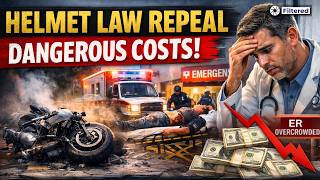
In this commentary, TJ Walker reviews a Michigan study on the effects of repealing the state’s universal motorcycle‑helmet law in 2012. He reports that hospital costs for crash victims rose 26%—about $5,785 per patient—and that injury severity increased compared with states that kept helmet mandates. The study estimates an extra $4.5 million in annual hospital spending and notes that 9.5% of crash patients were uninsured, meaning trauma centers and the public absorb unpaid bills and long‑term disability costs. Walker uses these data to argue that personal‑choice rhetoric masks a substantial public financial burden, likening helmet laws to seat‑belt mandates and drawing a line at more intrusive regulations such as banning sugary drinks. He contends that helmet laws are a low‑cost, high‑benefit safety rule that prevents preventable injuries and the downstream tax and Medicaid expenses that fall on society. Throughout, he blends statistical evidence with moral reasoning, emphasizing that the right to self‑harm should not impose costs on the collective.
Chapters
Motorcycle helmet laws. A new study out of Michigan offers a blunt reminder that so-called freedom can come with a very expensive public bill. After Michigan repealed its universal motorcycle helmet law in 2012, hospital costs for crash victims jumped— they soared— 26%, or about $5,785 more per patient. Injury severity also rose more sharply than in comparison states where helmet laws stayed the same. Researchers say the damage does not stop with the rider. Trauma centers absorb unpaid costs, especially when uninsured patients arrive with devastating head injuries that require immediate care. That means hospitals, insurers, and ultimately the public end up carrying part of the burden. The larger point is simple. When government weakens basic safety rules, the consequences do not remain private. They spread. The rhetoric is personal choice, but the real-world outcome is more severe injuries, more financial strain on emergency care, and a healthcare system forced to subsidize preventable harm. Okay, so this is an issue that people get very emotional on, and there are plenty of states, I think I'm in one, where people think, ah, it's my, god-given right to scramble my brains and become a vegetable if I want to. Look, I do think that in a free society, you should have the right to kill yourself slowly if you want to smoke cigarettes, for example, if you're an adult. But the idea that in a society, we can't come together and come up with some rules that just make us not slaughter ourselves needlessly that that's really a crazy idea. I don't buy that. I don't think it is a horrible, horrible abridgment of my rights that I have to wear a seatbelt. Seatbelts save thousands of lives every year. And there is a line. Should you be able to buy one Coca-Cola? Yes, even though it's bad for you, even though it can lead to diabetes, even though it can lead to death, early death. I'm not prepared to tell you that the government should be such a nanny state that we should ban buying a Coca-Cola. But some things are just so easy to do. It requires so little of someone and saves so many lives. I just have a hard time justifying not having a law like helmet laws, in part because I don't want to pay for you idiots and imbeciles who say, well, I have the right to not wear a helmet. Then you get in a crash. What would have been a minor scratch, now your brain doesn't work for the rest of your life. And I, as a taxpayer, have to pay your $100,000 tax bill. Now I got to pay for your Medicaid the rest of your life. I got to pay for your disability insurance the rest of life because now you can't work because you can't think. So if someone could truly, truly opt out of that, you could make a case people have the right to do that. But are we going to live in a society where we say to someone, okay, you made a mistake, you didn't wear a safety helmet at age 18, so now we're just going to let you die in the streets because we don't want to pay for your health care. I'm not comfortable with that either. And I don't think people who are actually in that situation are comfortable with it. Let's look at the facts again. Michigan repealed their helmet law in 2012, so it's been 14 years and they had a lot of crashes to analyze around the country. 5,000 280 patients were from Michigan. They looked at 14,405 patients from other comparison states. So when they compared it, the hospital costs, the medical costs went up 26%. I don't think that's even fair though, based on the true cost. Let's say your hospital costs were $5,000 more, but you're never able to work again because you can't think because you broke your brain. What kind of cost is that? They added it all up. It was $4.5 million in extra hospital spending annually just because people were so stupid as to not wear a helmet. 9.5% of crash patients were uninsured. So if you have insurance, okay, maybe someone else paid the hospital bills, but what about your disability insurance that you got to have Uncle Sam pay for, for the rest of your life? So count me in on being in favor of helmet laws. It's such an easy, easy thing to do. It takes 2 seconds to put a helmet on your head. And if you're anyone who has a similar haircut to mine, shall we say, it's also a great way of reducing your chances of getting skin cancer on the top of your head. So there's a win-win there.