Football Rules TV, Meta Retreats, Job Market Confuses, Coaches Cash Out
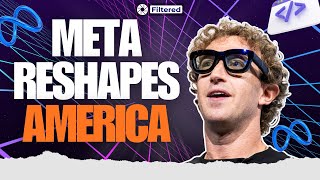
TJ Walker’s Filtered episode is a single-host YouTube commentary covering five main stories: Meta’s retreat from the Metaverse toward AI and lighter AR hardware (reports of heavy Reality Labs losses and planned cuts); a contradictory U.S. jobs picture (record announcements of layoffs alongside low weekly jobless claims), with analysis of AI-driven concentration in markets; record NFL viewership (Cowboys–Chiefs Thanksgiving game) and the cultural/economic power of live sports; large college coaching buyouts financed in part via tax-deductible donations and the resulting taxpayer subsidy concerns; and neuroscientific concerns about nonstop podcast listening reducing internal reflection. The episode blends cited data, personal anecdotes, prescriptive advice (career resilience, quiet time), sponsor plugs, and an audience Q&A on presentation storytelling.
Chapters
Foreign. Mark Zuckerberg is turning the Metaverse from the next big thing into the next write off. We'll look at why Meta is slashing its virtual reality ambitions after burning through tens of billions of dollars, and what that pivot to artificial intelligence really tells us about tech hype. We'll also dig into America's very strange job picture. Layoff announcements have blasted past the million mark for the year, yet jobless claims are near a three year low. Is this a slowdown or just a reshuffle then football's grip on American life? The Cowboys Chiefs Thanksgiving game just became the most watched regular season NFL matchup in history. In history. We'll talk about what that kind of audience power means for politics, advertising and culture. After that, the sleazy tax dodge behind giant college coaching buyouts, how so called charitable donations are helping fire losing coaches and sending taxpayers the bill, at least indirectly. And finally, what non stop podcasts are doing to your brain. Oh no, not this one, but other podcasts. And what happens when you pull the AirPods out and give your own thoughts a little room. All that and more today right now on Filtered. Welcome to Filtered with TJ Walker. Hi and welcome. I'm TJ Walker. Thanks so much for joining me today. Great. Glad you're with us. This show is a little bit different. Typically I do the shows live the day of, so you're seeing news that has happened just in the last 24 hours. I am traveling on assignment in Asia for the next couple of weeks, so you caught me on a couple of transition days, but everything is all newsworthy within the last five days or so. So that's what we're all about. If you're new to the program, my name is TJ Walker. We look at the top five business, technology, economic and culture stories of the day and then filter it through the lens of communication skills. Let's dive right in. Meta's Metaverse Retreat Meta is quietly backing away from the Metaverse dream it once renamed. The entire company for Metaverse, was sold as the next version of the Internet, a shared virtual three dimensional world where you would work, shop, socialize and spend money through a persistent avatar. But according to reporting on Meta's internal plans, Reality Labs has already burned through more than 70 billion not billion, not 700 million, but $70 billion and lost more than just than $4 billion in just the last quarter. User numbers in horizon worlds never match. The marketing, after years of over promising leadership, reportedly had what insiders call a reality check moment. Now Meta is weighing cuts of up to 30% of its Metaverse division. Why it's not 100%, I'm not quite sure, but they're looking at cutting 30% while shifting capital toward artificial intelligence models and AI first hardware llama meta AI and lighter, smarter devices like the Ray Ban glasses now sit at the center of the strategy. Guided by former Apple design leadership, the company that once tried to drag us into virtual worlds is now betting its future on escaping them. Okay, so what's the real message here? Finally, begrudgingly, Mark Zuckerberg is admitting, at least tacitly, it was kind of a stupid idea to rename the company Meta. This Metaverse thing turned out to be a big nothing burger. Let's go a little deeper here. So you know, if you've created a trillion dollar company, which Mark Zuckerberg does, has done, 70 billion isn't the end of the world. So I'm not going to be one of these who says Mark Zuckerberg is the dumbest guy ever. He does some bad things to our society. He's done a lot of unethical things. You could say he hasn't kept his promises, but he is a shrewd businessman. I mean, let's give the devil his due. He created something and really made it big the way others tried and failed. Let's not forget this wasn't the first social media platform. There was MySpace, there was Friendster, there were all kinds of social media platforms. This was about the 12th or 13th. This was the first one to really, really become a big deal. He gets the credit for that. He's been there since day one. He's the founder, he's the originator, and you can say he took the idea from someone else. But as the old saying goes, ideas are easy. It's never the idea alone that makes you a billionaire. It is the implementation. So he does get a lot of credit. But wow, did he sure go off on a tangent with this whole Metaverse thing. Now, I'll be candid with you. I thought I was too stupid to get this. I'll never forget, I was at the south by Southwest Technology convention in Austin, Texas, a little less than three years ago, and that was peak Metaverse. Zuckerberg was there, and every big tech company was there, and every Metaverse company was there. And they had all these big tents and free drinks and parties and beautiful people, everyone talking a language that frankly I didn't understand, and everyone talking about how this is the next big thing. Giant parties, taking over houses, blocks. Money was free flowing. Every celebrity in the world was there. And the whole time I'm thinking, wow, tj, maybe you're getting old. You're just not understanding this metaverse thing. Well, I might be getting old, and I might not be the quickest to figure out everything, but my hunch on the metaverse turned out to be a lot closer to reality than Mark Zuckerberg's. Again, I'm not as successful as Mark Zuckerberg is. I'm not worth hundreds of billions of dollars. But this metaverse thing, wow, is it bizarre? It's as if the whole thing were a bad dream. A bad dream that costs collectively, hundreds and hundreds of billions of dollars across various companies. So is this going to actually bring down Facebook? No. They're such a cash cow with their advertising. They're so great at extracting our attention, extracting our money from our pockets, and extracting money from the pockets of corporations. They can afford to lose a lot of money and place a lot of bets. Now, that's just the nature of being an entrepreneur, being someone who's a risk taker. If every risk you took succeeded, it wouldn't really be a risk, now, would it? So I'm not going to knock Mark Zuckerberg for taking big, bold risk. He took a risk dropping out of Harvard when I'm sure at least some family members thought, sure, that's a good idea. So he's been a proven risk taker. It's worked out well. Now they are doing some other things that I do think are interesting. I have not. These are not the Ray Bans with the. The Meta devices on them that I'm wearing now. But I have to tell you, every time I go to the mall, I stop in the LensCrafters and I ask the people working there, what are people saying about these Ray Ban smart glasses by Meta? Frankly, I'm kind of hoping people say, well, they're not that happy. It's a lot of hype. People don't end up using it. After a while it sits on the desk. I'll confess, we all have biases. I was kind of sort of thinking that might be the reaction. No. I've done this with a number of malls in South Florida a number of times, and each time people who work in the store are telling me, people like these things. We're on backorder. If I want to buy some today, I can't because they're sold out. And it's been that way for a long time now. And I think I have a pretty good ear for when someone's trying to sell me something and just get my money. These salespeople seem to be very genuine, that the devices are popular, customers are happy. I said, what about returns? We're not really getting any returns. So I think these Ray Ban. I don't know about the Ray Ban brand, but some kind of a glass where you can get anything from a regular TV screen, a cell phone screen, a laptop screen right in your glass is going to be a big deal. I see so many applications. The overlay of artificial reality on real reality. There's another word for that, extended reality. I think that's going to be huge. Imagine you're a politician and you're a fundraiser and there's a thousand people there and some of them have given you $1,000 and you've only met them once. Wouldn't it be nice to have the glasses on and instantly see the person name, their spouse, their kids. Oh, hi, Charlie, how are you? How's your wife? Wilma, thanks so much again for that fundraiser you did last year where we brought in 10,000. And best luck to Jimmy in his first semester at Princeton. You know, politicians are going to do that, but it could be helpful for almost anyone. Now, those of you who know me know that my primary background is in media training, presentation training. I can certainly see people attempting to give presentations where the teleprompter is right on their glasses. Now, I'm not ready to endorse that because my fear would be all of a sudden people would look like this and they would be reading across their glasses and not moving in a natural way and sounding monotone and boring. So that would not be good. But like with any tool, it could be used well or it could be used in a way that's ineffectual. So I personally do not like many of Facebook's practices and I think that they extract way too much attention and they share too much rage. And the idea that he's just going to throw away all the fact checkers, no matter how much nonsense someone spews on Facebook, I think is a real problem for democracy. But the fact that they failed with this metaverse, I don't put in that category. It seemed like the next big thing. And if you're someone like a Mark Zuckerberg, remember probably everyone was telling you 20 some years ago this Internet thing would be a fad. Don't quit your job or don't quit your, your college. Stay in school, son. Be a dentist like your father. He must have received some comments like that. He said, no, I'm all in on this Internet thing turned out to be right. Now you can be right on one thing one time and be completely wrong the next time or the next 10 times. We've seen that throughout the history of business. But at least finally some of these publicly traded companies are realizing this Metaverse thing was an absolute pile of nonsense. What I'm hoping for, what I'm praying for, if I believed in prayer, would be for people to finally realize this whole crypto coin thing is also nonsense. It's also completely worthless. I do note with a great amount of joy, frankly, that that bitcoin has gone down 30% in just the last few weeks from highs where people said, oh, it can't go below this. Well, it can so Metaverse crypto. I put a lot of these in the same camp whereby they seem new, they seem exciting, they seem shiny, they seem like they're going to reinvent the world. Well, sometimes the world is reinvented, but sometimes there's a whole bunch of hype over something that's just a little tiny piffle of nothing. Want a shortcut to powerful communication skills? Download the TJ Walker Success Library, five of my best selling books for only $9.95. Go to tjwalker.combooks Instant Access Big Impact I've had entire YouTube channels wiped out overnight, so if you enjoy this show, don't lose track of me. The safest way is my newsletter. Substack.com J WalkerSuccess Sign up for free and you'll get exclusive commentary, live session alerts, and first access to new tools. Again, that's substack.com just search for TJ Walker or go to substack.com jwalkersuccess your direct line to everything I do layoffs versus jobless claims the American job story depends entirely on which numbers you choose to look at. According to Challenger, Gray and Christmas, companies have announced more than 1.1 million layoffs so far this year. That is the highest total since the pandemic of 2020, and more than 50% higher than the same period last year. November alone saw more than 70,000 planned cuts with restructuring, artificial intelligence and tariffs, all cited as reasons. At the same time, federal data shows that weekly jobless claims have fallen to around 191,000. This is the lowest level in more than three years. Now, if you're a little confused, if you're scratching your head, you're not alone. Employers are slowly hiring and they're trimming certain divisions, but they're still holding tightly to the workers they Already have. So this is not a mass firing crisis in every workplace. It's something subtler, a cooling job market where opportunities shrink, certain sectors take the hits, and once you lose a job, you face much tougher competition finding the next one. Okay, so what's the real message here? If you're looking for economic bad news, you will find it. If you're looking for good economic news, you'll find it too. There's economic data everywhere. Be very careful. If you go into this with a bias, saying, I don't like this politician or that politician, therefore I want to find data that will back up my thesis, you will find it. Confirmation bias could distort your vision of the world dramatically. Let's dig a little bit deeper here. So, as I mentioned to you, it's a good news, bad news situation. You know, 1.17 million layoffs in the year, so far, the highest since 2020. That certainly doesn't sound good. 54% higher than last year. Sounds awful. But then you look at the jobless claims. Only 191,000 in the last month, lowest in three years. That sounds like it's great news. So what is it? I'm going to give it to you straight. I'm here as a sane, sensible centrist. I'm not trying to spin things one way or the other. Our economy is kind of humming along. If you want a negative scenario, I'll give you one. If you want a positive scenario, I'll give you one. It is, in fact, a mixed bag. The negative scenario is if it weren't for the massive, massive, massive AI spending bubble, we would already be in a recession. Almost all the growth in our entire economy because of people excited. Some would say there's irrational exuberance for all things AI and if it weren't for that, we would already be in a recession. Now. The stock market is not the economy. The economy is not the stock market. But if you just took the 10 largest tech companies that are all gorging on money from AI investments, if you took them out of the the s and P500, our stock market would be completely flat. All the growth is really coming from 10 companies, so our stock market would be flat. If you took out all the new hires going to build things like data centers and electricity to fuel all this AI, our unemployment rate would be dramatically higher. There's no doubt about it. We would clearly, clearly be in a recession. To be clear, we're not in a recession now. But many economic experts believe there's a fragility in this economy that is new, that is different because it's so dependent on just 10 companies, any one of which could see a drop in their stock price by 60, 70%. Because all big tech companies have drops like that from time to time. Any one of those could pull the plug on the entire stock market. Let's not forget that 10 technology companies now account for 40% of the entire publicly traded markets of US companies. 40% from 10 companies. If you look at the entire worldwide economy of publicly traded companies in every country, United states, the top 10 US tech companies make up 20% of the entire worldwide market. So all of us are kind of dependent on a handful of companies. Number one, two, continued belief, faith, hope that this AI thing keeps taking off and keeps doing well and the money keeps coming. I mean, one of the fears is frankly that OpenAI or someone does really well. They create a general intelligence AI. It's wildly successful, it makes trillions of dollars. But all the other companies suddenly become irrelevant and all of their employees get fired. The market cap of all of those companies go to zero. Yeah, there's one big winner. And if you don't have all your stock, all your portfolio, all your investment in that one company, you are sol. I mean, that is one of the legitimate fears that serious people are worried about right now. Let's go through some more of the facts. November plans more than 71,000 job cuts. Again, this is coming from the U.S. labor Department. The October cuts reported at 153,000, a 22 year cut, November record. So mixed data. Tariffs are linked to nearly 8,000 job cuts so far. I'm frankly surprised it's not more, and I find it a little difficult to believe that that could be measured precisely. The announced hires for the whole year are 497,000, well below the previous year. But as I mentioned, the weekly jobless claims came in at 191,000, very low. So we're seeing mixed signals. And again, to be fair, inflation is not off the charts. It's at around 3% now. Historically not our first choice. 2% is what the Fed likes. That's their benchmark. But compared to a lot of countries or compared to the United states in the 70s, 3% is almost nirvana. True, it is higher than the 2.4% inflation we had in November 2024 when there was another leader in the White House. But it's not been hugely, hugely changed. So what is my advice to you? You and I can't control the economy. You know, there's an old expression, it's a recession when your neighbor's lost his job, It's a depression when you've lost your job. Now, I want you thinking about your town, your community, your state, your country, the world economy. But I also want you to think of it just as they do on the airplane in the event of an emergency. You got to give yourself oxygen before you can help anyone else. You've got to help yourself. The economy is changing. More and more things in our economy are being changed by artificial intelligence. If your industry has not been radically changed, revamped, if your industry hasn't already seen massive layoffs because of AI, it's only a matter of time. Technology always changes. There's always going to be winners and losers. Can government sometimes soften the blow for the losers or put up barriers to create people who would otherwise would win not winning as quickly? Yeah, but you and I can't count on that. And that's why I want you thinking every single day, how do you make yourself more valuable? How do you create more value for your customers, people in your industry, your clients, associates you work with. That's ultimately the only key to being viable in our economy and not ending up one of these statistics of being laid off. Now you can be a great worker and be laid off. Personally, I've been fired many times, but I've never been laid off. You can be great at your job and be laid off. But if you're constantly trying to meet as many people in your industry as possible, if you're constantly building bridges, constantly networking, constantly forming alliances with people in your industry on LinkedIn and elsewhere, you're not going to be unemployed for very long because you're going to be in demand. That's what I want for you. And I hope that that's really what you take away from these statistics. Yeah, things are choppy, things are up and down. Nobody really knows the future. Well, I'm telling you, I do know the future. If you can consistently learn new hard skills and use those skills to deliver value to people, you always have a job that is is my or at least until general AI makes every single job irrelevant. But until then, you will in fact have a job. Back in a moment like what you heard. Don't let the algorithm bury us. Subscribe now@substack.com J. WalkerSuccess Want direct access to me live? Want to unlock bonus episodes, behind the scenes takes and full access to my premium courses? Then become a member today. Just go to tjwalker.com members and choose your preferred platform, YouTube Patreon whatever works for you. This isn't just another subscription. It's a full access pass to the tools, coaching and content that can transform your communication and career. Tjwalker.com members, I'll see you inside. Before we dive in, quick question. Are your communication skills helping or hurting your career? Fix that in 20 minutes a day. Visit mediatrainingworldwide.com Real skills, real results Football owns the screen CBS Sports says its Thanksgiving broadcast of the Cowboys Chiefs matchup has set a new television record. It's now the most watched regular NFL game in American history. Nielsen data shows the game averaged more than 57 million viewers and peaked above 61 million as Dallas edged Kansas City 31 28. Paramount also recorded its biggest NFL streaming audience ever. This is not a one off. In recent seasons, live sports, and especially the NFL have completely dominated American television. In a recent year, more than 90 of the hundred most watched broadcasts are, believe it or not, NFL games or NFL related shows. The old cultural landmarks such as the MASH series finale. I remember that I watched it. That drew more than 100 million viewers in 1983. Those have been replaced these days by football games almost every week. If you want to see what actually unites the American audience in real time, you don't look at cable news or scripted entertainment. You look at the NFL schedule. So what's the real message here? CBS and the NFL, they're bragging about how their shows are the most watched shows on TV. They just had 57 million people watching watch a football game. And yet these are the very same people who say, oh, I'm so poor. Give me billions of dollars to build a stadium that I can use for a few years and then sell you out to go to another city. This is ridiculous. You can't be the most successful, most watched, most profitable thing ever and then cry poor looking for tax handouts. Okay, this is. Let's go a little deeper. This is a pet peeve of mine. And it's not just professional sports, as we'll talk about in an upcoming segment. It's college sports, too. Feasting at the public trough, being piggies with public tax money directly and indirectly. So again, the facts. The broadcast peaks. About 61 million people were watching this most recent show and a lot of people like it. Look, have I ever watched a football game? Yes, I do typically like to watch the Super Bowl. I enjoy the commercials and the halftime specials and then I go to bed before the second half starts. That's just me. You're not a bad person if you Love watching professional football. And for those of you watching in India and the rest of the world, when I say football, I'm talking about the American style. And to quote, to paraphrase George Will, he says American football embodies the absolute worst of American culture. It's lots and lots of committee meetings punctuated by short bouts of violence. So it's not the continuous action of rugby or soccer. It's basically stopping and looking at people sitting around, huddled around, talking most of the time. But there is lots of violence. There's broken bones, occasionally really serious injuries. And I guess a lot of people like that. It's a big world. Not really my thing, but a lot of people like it. There are some statistics here that are fascinating to me because you've heard me and others bemoan how traditional broadcast networks are losing all of their audiences. People aren't watching news anymore on broadcast TV or even cable. They're not watching sitcoms. This is the one exception. Live sports in general and live football in particular. So I do get it in the sense that it's suspenseful. When you're watching a live show, you can't just fast forward. You can't just read the review on Rotten Tomatoes and find out if it was a good game. You have to be watching live. And that's what is attracting people. And advertisers are willing to pay for it. The advertisers in the super bowl pay millions and millions of dollars for every 30 second commercial. So for now, we're going to see the biggest communications companies and the biggest tech companies continue to bid and outbid each other for the rights to these games. So if you own a football team, well, congratulations. You were probably born wealthy, but you're definitely a billionaire before you ever bought a team. And you're only going to get richer because of how all of the spoils of this league are shared. Some would say in a kind of a form of socialism, the way revenues are split among owners in the NFL. But they're making tons of money. Good for them. Not my form of entertainment. That's okay, it's a big world. But I do resent this constant rubbing in the face of look how popular we are. Look how good our ratings are. Look how much money we make. TV networks. And oh, by the way, we're too cheap to pay for our own place of business, the football stadium. So you sucker, I mean you fans in these various cities have got to buy and pay for our stadium. That is, it's socialism, but it's socialism for the wealthy. I'm an honest conservative of sorts on some issues. I actually believe that most economic decisions, most industries, should be in the private sector unless there is an overwhelming compelling reason for it to be controlled by the government. I don't want the private sector deciding where stoplights go. I want government, one government entity to do that. I want one government entity to plan a federal highway system. Okay, I do want the federal government to be involved in certain industries like public schools or the state government, local government. But why in the world we need government handouts for a private sector business where if it disappeared tomorrow, there would be no discernible problem for society. And if it didn't disappear, if just every one of these subsidies disappeared. Tax breaks, tax advantages out and out, subsidies for football stadiums. If they all disappeared tomorrow, what's the worst that could happen? A football coach somehow gets by on $15 million a year instead of 20 million a year. A billionaire owner has to sell his team for $2 billion profit instead of a 3 billion dollar profit because he had to spend a billion on his own state. Is that really so bad? I don't think so. More in a Moment unfortunately, more sports news in just a moment. Filtered is brought to you by the Want to advertise here? You better be legit. No crypto, no junk food, no supplements. Go to tjwalker.com advertise want to become a better speaker, leader or communicator? Start with the TJ Walker Success Library. It's five of my most practical books, covering everything from public speaking to media interviews and persuasive messaging, all for only $9.95. I've trained presidents and Fortune 500 CEOs, and now you can get the same wisdom in a fast, affordable format. Go to tjwalker.com books and download your copies instantly. Thanks for listening. If you liked today's episode, you'll love my online courses@mediatrainingworldwide.com check them out now and level up your skills. College Coaching Buyouts and Tax Dodges Giant college football buyouts are being sold to the public as, get this, philanthropy. But they function in a way that's not at all like philanthropy at all. This story is even worse than the last one, and it is profoundly, profoundly annoying to me what goes on. Anytime someone mentions sports, it seems like people say, oh, all my brain cells, let me just blow them out. Let's just stop thinking. Because that is essentially what happens. They're functioning like sleazy tax dodges. Scott Hodge, writing in the Washington Post this past week Notes that universities already owe about $228 million this season alone to 15 fired football coaches. That pushes total severance since 2012 past $1 billion. Let's wrap our heads around this. Colleges give gigantic salaries to these football players. Excuse me, these football coaches, but unlike you or me, if you get fired, if your boss gets sick of you, it's most likely an at will situation. They can fire you at will. They can say, hey, TJ don't like the cut of your jib any longer. Bye, bye, and walk you out the door. That's what happens to most people, not these football coaches. They can be told, hey, you've lost every game for the past two years. We know we told you we wanted you for 10 years, but now we're just going to pay you tens of millions of dollars to go sit on the beach for the next eight years. That's what happens. And it's happening courtesy of suckers like you and me. That's right. Taxpayers are subsidizing this in a lot of different ways. So as I mentioned, it's a billion dollars of this severance pay in the last decade. LSU reportedly owes Brian Kelly about $54 million after firing him, while Texas A and M paid Jimbo Fisher Roughly $76 million in 2023 at LSU. Donations, many of them tax deductible. Here's the rubber made up about 37% of the athletic department's $220 million in revenue last year. So here's the dirty little secret. Wealthy boosters write these checks to the athletic association of these schools. Donations, they call them. They claim a charitable deduction and they shift part of the cost on to taxpayers because they don't have to pay tax. Athletic departments behave like professional entertainment businesses while hiding under the non profit umbrella of universities. If you believe in free markets, as I do, this is the opposite. Losses are socialized through tax breaks, while private bragging rights stay with a few big donors. Okay, what's the real message here? It is an obscenity that college coaches are paid tens of millions of dollars quite often for doing nothing. And the money is coming through charitable donations to the school's foundation and nobody has to pay any tax on it. This is an absurdity. It is an indirect propping up. It's a payout to wealthy colleges and their coaches. And it needs to stop. Let's dig a little bit deeper. Now, I realize there's some complexity here. It's not as simple as the federal government writing a $10 million check to a Coach and say, now go sit on the beach. But when you make certain things tax deductible, you put in all sorts of perverse incentives to people. You think of a non profit organization, you think of the United Way, you think of something that's going to help needy people or perhaps the Boy Scouts or a homeless shelter. Well, it's hard to imagine anything less homeless shelter like than a college football coach who's a top 10 coach or top 20 coach. Because not only are they not homeless, they make enough Money to have five or 10 homes if they want it. They make so much money they can buy homes that they've never stepped foot in and don't even know how many homes they have when you ask them. And it's coming in part because of the charitable donations that wealthy alumni give to the school. So that needs to be stopped. There should be absolutely no tax benefit to giving money to a university that's going to turn around and give the money to a football coach. Now, I've talked about this before in the show and I'll say it again, that football coaches, basketball coaches, any coach at a public university is a public employee. Absolutely nothing bad would happen at a societal level if we simply said no public employee should be paid more than the President of the United states, which is $400,000 a year. I'm guessing statistically speaking, you could live quite well on 400,000 a year because that is five, six times more than what the average family in America makes. So, yeah, you could get by on that. But LSU, no, they want to pay Brian Kelly $54 million to go to the beach for the next eight years. It is an absolute obscenity. Now, top conferences generated nearly 110 billion in the last decade. LSU's athletics revenue, roughly 220 million in 2024. Donations supply 37% of the LSU athletic revenue. It's time more people started asking serious questions about this. Senator Maria Cantwell has asked questions about nonprofit status of big time athletics. I hope she continues to do so. This is a tough problem for reform because the very same people who are the big wealthy fat cat boosters they call them at these colleges are quite often the very same people writing campaign checks to politicians. And so when something like this comes up for a vote, if it even got that far, the person could say, hey, I've given you $20,000 for all your elections the last 20 years. All I'm asking is don't change the tax deductible status of my contribution. My donation to my State University. Because that's really important. It's very hard for politicians to say no to that. So look, folks, I'm here on this show to put a spotlight on what's in the news, analyze it, filter it so you understand the real messages behind the story, and so you understand the honest philosophical debates going on in stories so that you can be more successful in your own communication. One of the things that frustrates me is we constantly see people who call themselves conservatives bemoaning what they think of as government waste. Wow. Can you believe that poor person bought a Coca Cola with a food stamp? Isn't that an outrage? Well, it might not be a good thing, but it's absolutely nothing compared to the indirect funneling of tax dollars through these tax breaks to someone like a Brian Kelly getting $54 million to do nothing. If you really want to make money as a coach, fine. Go work in a professional league, the NFL. And ideally, do it in a way where you're not asking taxpayers to pay for your stadium. That would be a free market system. Now this does apply to private colleges too, because guess what? Almost every student at a private college, or a very high percentage of them, they have subsidies from the federal government, they have aid from the foreign government, federal government, they have loans backed by the federal government. So there's just grants flowing to these private universities. So anyone involved with any college in America, you are completely awash in tax dollars. That's okay, but don't try to have it both ways. Say, yes, I'm just a public servant. Give me more money, give me taxpayer money, give me government backed loans. I want all this money, money, money, money. But oh, I'm a private sector person. I want to make $20 million a year. That disconnect is simply too much to stomach, at least for me. What do you think? We're doing this show on demand today because I am traveling and on my way to Vietnam, as you're probably watching this, but I do read every comment, I respond to every question. So please let me know how you feel. I would love to hear from you. Back in a moment. Hey, if you're enjoying this kind of take and want to hear more stories filtered through the lens of communication, make sure you're following the show whether you're watching or listening. New episodes drop every single day, and if there's a little notification option where you are now, go ahead and turn it on. It helps you stay in the loop. Welcome back. What Podcasts do to Our Brains. Technology journalist Adam Clark Estes describes Something many of us experience. Something that happens all the time, without us even realizing it, without us noticing. He realized that every quiet moment, walking the dog, riding the subway, doing chores, was filled with podcasts. When he quit for a month, he suddenly heard crickets in his Brooklyn neighborhood for the first time. Talking with neuroscientists, he learns the brain cannot truly multitask what feels like. Multitasking is constant task switching, which trains mental resources. The brain's default mode network, which supports self reflection, daydreaming and planning, activates in silence and simple environments. Not when you're constantly listening to someone else's story. This is also evidence that quiet time and natural sounds can lower stress and even support brain growth. Podcasts aren't evil, certainly not this one. And I hope you do continue watching this one and listening to it every day. But when they fill every gap, they effectively rent out your inner narration. Turning them off occasionally is less about rejecting technology and more about giving your own thoughts room to breathe. Okay, what's the real message here? New research shows that if you listen to podcasts every second of the day, even this one, after a while it rots your brain away. You lose your ability to think your own thoughts. So yes, listen to quality podcasts, Please listen to this one. But you need to spend some time every day, preferably hours a day where nothing's going into your ears and eyes. Instead you can think, reflect, go for a walk, have quiet and think your own thoughts. Let's dig a little deeper here. Now, this is probably not a story you're going to hear talked about a lot on podcast because it's not what we want you to know. We want you thinking, wow, I need to listen to TJ's podcast every second of the day. In fact, I've recently started a so called fast TV network, free ad supported TV network. If you go to my YouTube channel or most social media platforms, you'll see at the top of it a live feed from me. And it just pushes out the last three hours of three days of shows I've done. I'm not expecting you to watch it 24 hours a day. Please don't do it. What I am asking you to do every day is spend some time not only not listening to podcasts, but not looking at a screen and not having a screen nearby. There's been a lot of research showing that if you simply have a cell phone on a table when you're having dinner with family or friends, it alters the experience. If you are in a meeting and a Cell phone is on the table. It alters the experience. You're not able to give 100% focus to the moment, to the conversation your brain subconsciously is thinking about. Oh, there might be something more interesting there. Oh, there could be a text. Let me check. Oh, there could be a notification. Let me check. Your brain needs downtime. It really does. We all think we can multitask. All the best neuroscientists say, no, it's not. You're really focusing on one thing at a time now. Sure, everyone occasionally does two things at once that don't require a lot of thought. I brush my teeth and I take a shower at the same time. So you could say I'm multitasking. But if I miss one spot of water on my body, it's going to get wet the next second, so it doesn't really matter. But if you're constantly bombarding your brain with other people's ideas, there's nothing left for you. I could tell you the most significant daily habit that I did that personally made more money for me, more fulfillment, made me happier, was about 10 years ago when I started a practice of going for a long walk each day. And I left my cell phone at home, and all I took was a notepad with notes this big. Why was that so important? Because it allowed me to think about what I wanted. It allowed me to plot out online courses. I was going to create videos. I would make marketing campaigns. It allowed me to think deeply. Well, T.J. i like to write on my cell phone. The problem with taking your cell phone with you is you may start to dictate a note to yourself, and there's a text from your best friend, there's a call from your spouse. There's something going on all the time. And that's really the problem with having a cell phone around. It just happened to me right there. I forgot to put my phone on airplane mode. I'm using my phone to talk to my friends right now on TikTok a TikTok Live. And my friend Peter just called. So now I'm even guilty of it right now because I'm thinking, oh, Peter's ready to go to the pool and the gym, his family and my family. I got to get back to him. So it took me out of the flow. That's not a good thing. I want to be focused on you, and I want to leave you with this piece of advice, which is, if you want to be more productive, if you want to make more money, you've got to create more. The Easiest way to create more, or at least the starting point is you've got to give your own brain time to think and have ideas come out. If you're receiving ideas all day long, even if they're good ideas, even if they're my ideas, and I hope you think some of my ideas are good ideas. If you're receiving ideas all the time, you don't have any coming out. You're not getting your ideas down on paper or on video or in software. So you've got to give yourself time away from other people's ideas. The author of Sapience Yuval Harari. I think I'm getting his name right. He famously does meditation for two hours a day and he's one of the best selling authors of all time. Every book he does is this thick and sells seemingly tens of millions of copies. If he can meditate for two hours a day, believe me, he's got no podcast. It's not a podcast. Meditation. He does it where there's no electronics around. If he can do it for two hours a day, can't you start off with at least 10 minutes a day of silence, thinking your own thoughts, perhaps just having a pencil and paper around? That's what I want you to take away from this story. Not that podcasts are bad, it's the proportion. You know, water's not bad. You need water. You need water to drink every day. But if you drank water all day long, it would in fact kill you. That concludes the main section of our show today, our top five stories. But let's switch now to you. At the end of every show, I take questions from you that relate to issues not in the news. We all got to get away from the news from time to time. These are students. These are questions from my students in my personal development and communication skills courses. This question comes from Nelson, who's a student in my complete storytelling course for speaking and presenting. The question is, why should every presentation begin with a strong, relatable story? He's referencing something I say at the beginning of the course. And the short answer is, it doesn't have to. You don't have to start with a story. But the reason I recommend that you do is it's frankly easy. It's easy for you because you can just tell a story you've told before. It's also easier for your audience. Human beings are programmed to want to hear stories. It's more interesting. They don't want to hear your life history. They don't want to hear the typical beginning of the speech. Good morning. I'm happy to be here today. My name is TJ Walker and before we begin my. Before I begin my presentation today, let me tell you about the boring history of my company and where I went to college and blah blah, blah, blah, blah. That's how most people start their presentations. Great speakers don't do that. Anytime you go to a conference and see some highly paid professional speaker, they typically start with a story, lures people in and allows your audience to visualize what you're talking about, relate to you at not just an intellectual level, but an emotional level. And by telling a story where you're talking about where you were in the setting, you're painting pictures in the mind of your audience. So that's why I recommend Whether it's a PowerPoint presentation, any other presentation, start off by telling a story. But it needs to be relevant to your audience. It can't just be a funny thing happened to me or my kids did the cutest thing at breakfast. No, it should not be self serving. It doesn't have to paint you in a favorable light. It just has to be interesting and relevant to your audience. If you do that, your audience will pay attention to you for the rest of your speech. I'm TJ Walker and I appreciate you paying attention to me for this entire podcast, this entire video. Thank you so much. If you got any value out of it, please subscribe. Whether you are watching on TikTok or YouTube or Facebook or LinkedIn or any of the other dozen or so platforms we're on on Substack. Wherever you're watching this or listening to it, please subscribe. We're relatively new on audio podcasting platforms, so please it's especially important there for you to subscribe, follow and leave a review. I'm TJ Walker. This is Filtered. See you tomorrow.
More from TJ





The Breakout Cases - What Actually Caused Famous Speaking Career Breakthroughs | Ultamize

The Red Circle Sessions Finale - Build the Speaking Career You Came Here For | Ultamize

Two Stages, One Logo, Two Completely Different Realities - Main Stage vs Independent Events | Ult...

Pre-Reset - Why Repetition Builds Better Speaking Decisions | The Red Circle Sessions | Ultamize

Your Decision, Your Framework, and What Happens After - Build Your Speaking Career First | Ultamize

The Red Circle Sessions Trailer - The Speaking Career Truth Nobody on That Stage Will Tell You | ...

The Two-Minute Ultamize Reset - Your Platform, Your Audience, Your Voice | The Red Circle Sessions