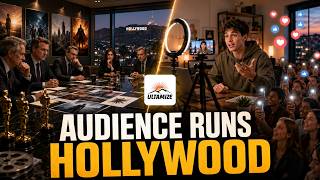
In this 20‑minute monologue, TJ Walker argues that the current crisis in Hollywood and Broadway is not a lack of imagination but a systemic aversion to affordable risk. He contrasts the bold, low‑budget gamble of 1977’s original Star Wars with today’s $200 million studio bets, showing how massive budgets turn originality into a financial liability. Walker explains that the traditional gate‑keeping model—studios, agents, producers—now demands proof of audience demand before funding, pushing the industry toward sequels, revivals, and franchise extensions. The rise of creator‑driven platforms like YouTube and TikTok offers a new path: creators must become their own marketers, distributors, and test labs, iterating content like stand‑up comedians—testing, bombing, rewriting, and repeating until they build a loyal audience. This audience‑first proof replaces the old dream of being discovered by a studio. Walker concludes with practical advice: adopt the “stand‑up mindset,” produce relentlessly, and use his Ultimize courses to develop communication and habit‑building skills, positioning creators to become “undeniable” before the gatekeepers even notice them.
Chapters
Ultimize. Hollywood is not out of ideas. Hollywood is out of affordable risk. In 1977, the top movie was a weird space opera called Star Wars. Not yet a religion, not yet a lunchbox empire, just George Lucas asking America to care about a farm boy, a princess, a wizard, and a heavy-breathing guy in a helmet. That same year, audiences also made hits out of Smokey and the Bandit, Close Encounters, and Saturday Night Fever. Today, the top of the box office and Broadway look less like a creative culture and more like a museum gift shop. Sequels, revivals, toys, games, pop star biographies, old movies and new costumes. The message is brutal. Nobody is coming to discover you. Build your own audience. That's the real story behind this sudden YouTube invasion of Hollywood. Yeah, it's exciting that young creators are breaking into the box office. Yes, it's thrilling that someone can start with short films online, build a following, and then suddenly end up with a theatrical release that makes real money. But let's not fool ourselves into thinking this means Hollywood has suddenly rediscovered courage. Hollywood has not rediscovered courage. Hollywood has discovered a cheaper way to buy proof. That's the whole game now. In 1977, Star Wars was risky. Today everyone forgets that because Star Wars became the safest thing on Earth. But at the time, it was strange, it was new, it wasn't a sequel, it wasn't based on a beloved toy line, it wasn't a Broadway jukebox musical, it was not Darth Vader: The Authorized Biography featuring the songs of Billy Joel. It was a new world. Could that movie get greenlit today as a $200 million original studio bet from a relatively young filmmaker? I doubt it. And not because executives are stupid. That's the easy, lazy answer. Oh, Hollywood executives are all idiots. No, a lot of them are smart. A lot of them went to fancier colleges than I did. A lot of them can read a script and know what is good. The problem is they are trapped inside a financial machine that punishes, absolutely punishes originality. If you're risking $5 million, you can afford to be brave. If you're risking $200 million plus another $100 million or $150 million to market the thing globally, bravery starts to look like malpractice. Nobody wants to be the executive who walks into the boardroom and says, great news, We lost the GDP of a small island nation because I believed in a fresh new voice. So what do they do? They retreat to what looks safe. Mario, Marvel, Michael Jackson, The Devil Wears Prada again, Toy Story again, a movie based on a game, a movie based on a ride, a musical based on a movie based on a catalog based on a dead celebrity's estate. Broadway has the same disease. The top of Broadway is not some explosion of new unknown stories. It's The Lion King, MJ, Death of a Salesman, Chess, Hamilton. Now, I love some of these shows, most of them. This is not an attack on quality. Hamilton is brilliant. The Lion King is brilliant. Death of a Salesman is one of the great American plays. But that's exactly the point. The system increasingly wants proof before it wants art. A Broadway producer doesn't want to hear, "Here is a completely original musical from a composer nobody has heard of." The producer wants to hear this: "Here is a known title with a known fan base, with a known songbook, with a known movie audience, with a known star, with a known nostalgia trigger, and if we can just charge tourists to $287 a ticket, maybe we survive. That's not evil, that is math. But it's also cultural suffocation. The romantic old dream was this: move to Hollywood, work your way up, write the great script, get discovered, become the next great filmmaker. Or move to New York, write the great musical, find the big producer, become the next Andrew Lloyd Webber. I'm not saying this is impossible. I'm saying it's now about as practical as planning your retirement around winning the Powerball while being struck by lightning and adopted by Beyoncé. The new dream is uglier, lonelier, and much more democratic. Sit in your apartment, open your laptop, turn on your phone, make something today. Put it out, watch what happens. Make something tomorrow, put it out, watch what happens. Do that 500 times, do that 1,000 times. Build your own audience one joke, one sketch, one short film, one song, one scene, one weird little horror concept at a time. That is the new film school. That's the new Broadway Workshop. That's the new studio system. And in a strange way, this isn't new at all. This is what stand-up comedians have always had to do. Nobody hands a new stand-up comedian $200 million and says, "Here, go be brilliant." They go to an open mic at 11:45 at night in front of 9 people, 4 of whom are other comedians waiting to go on, 2 of whom are drunk, 1 of whom is the bartender, and one of whom is asleep. They test a joke, it dies, they rewrite it, they test it again, it gets cough, they rewrite it, they test it 5 more times. Eventually it gets a laugh, then a bigger laugh, then they learn where the pause goes, then they learn which word is wrong, then they learn that the second sentence should be first, then after years of humiliation they look effortless. That is the future of Hollywood. That's the future of Broadway. That's the future of media. The winners will be the people with the stand-up comedian's mindset. Not necessarily comedians, but their mindset. You test, bomb, rewrite, repeat, test, bomb, rewrite, repeat. No entitlement. No waiting for permission. No fantasy that some agent in Beverly Hills is going to reach page 47 of your genius screenplay and burst into tears and send a helicopter to rescue you from your temp job. The agent is already drowning in scripts. The studio executive is already drowning in risk. The producer is already drowning in costs. And the audience is drowning in choices. So the burden shifts to you. You have to become not just the creator, but the marketer, the distributor, the testing lab, the focus group, the development executive, and the opening act. You have to build the audience before the gatekeepers care. Would you like to be the sort of successful person who is dominating news, at least in your industry? Well, if so, it's time to up your skills. At ultimize.com, I've created online courses to help you do that. Now, here's the thing: no obligation. You can get a free course on communication skills, a free course on how to build better habits. All you have to do is go to ultimize ultamize.com. That's ultamize.com. No obligation. Go there now. That's why the YouTube horror wave matters. It's not simply that young creators had good ideas. Lots of people have good ideas. Every coffee shop in Los Angeles has 6 people with good ideas and 1 person explaining why his vampire divorce comedy is really about late-stage capitalism. The difference is these creators build proof. They build audiences, they build language, they build trust, they build an aesthetic. They built a relationship with viewers before asking Hollywood to write a check. That's why this moment is both inspiring and terrifying. It's inspiring because the tools have never been cheaper. You don't need a studio lot, you don't need a soundstage, you don't need a mogul smoking a cigar saying, "Kid, you got something." You need a phone, a laptop, taste, discipline, and the willingness to look bad in public for a long time. It's terrifying because there's no one left to blame. For decades, creative people could say the system won't let me in, and often they were right. The system was closed. The system was biased. The system was expensive. The system was run by people who liked people who looked like them. Talked like them, and went to the same schools. But now the system may still be unfair, but the front door is no longer the only door. You can go around it. You can build your own door. You can build your own audience standing on the sidewalk outside the building while the executives are still arguing about whether the world needs Flubber 3: The Reckoning. The future belongs to creators who stop asking How do I get discovered? That's the wrong question. The right question is, how do I become undeniable? Hollywood will still exist. Broadway will still exist. Big producers will still exist. Studios will still spend absurd amounts of money making movies where apes fight robots in front of collapsing purple skies. Tourists will still come to New York and pay hundreds of dollars to see titles they already recognize. But the new creative class will not be formed inside the old machine. It will be formed by relentless daily public experimentation. The next great filmmaker may not be at USC Film School. She may be in a studio apartment in Queens making 90-second horror films between shifts. The next great Broadway composer may not be waiting outside a producer's office. He may be posting one song a day online until strangers start singing the hooks back to him. The next great media empire may not start with a network deal. It may start with one person, one camera, one point of view, and the discipline to publish for years when nobody cares. That's the real jolt of creativity Hollywood just got. Not YouTube, not TikTok, not horror, not Gen Z. The jolt is this: the audience is now the green light. Not the studio, not the producer, not the agent, not the critic, not the development committee, but the audience. And if you want that audience, you can't wait for permission. You have to earn it the hard way, one post at a time, one laugh at a time, one failed experiment at a time. One tiny piece of proof at a time. It's not glamorous, it's not romantic, it's not the old Hollywood dream, but it is the most exciting creative opportunity in human history. Because for the first time, the nobody with the weird idea doesn't have to wait for the somebody with the checkbook. The nobody can become the somebody first, then Hollywood will call. I'm TJ Walker. This is Filtered. Ultimize.