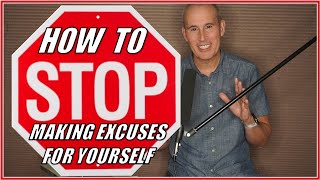
A YouTube talk by TJ Walker about overcoming the habit of making excuses, using personal stories appropriately when speaking, and practical tips for public speaking and persistence. Walker argues that prolonged excuses are self-defeating because others won’t care; he recommends mining personal life for relevant stories, reducing filler words with a simple sticker-reminder technique, and learning when to pivot rather than blindly persist. The piece blends anecdote, audience Q&A, and pragmatic coaching.
Chapters
You may have great excuses, but do you realize nobody else cares about your excuses? We've all had situations. I know I have. Something goes wrong and I've got a perfect excuse and it's why I failed. Some reflection is good, but if it's six months, a year later, then it's time to get over it. Realize nobody else cares if something happened or didn't happen that makes you unhappy. Realize, yes, your friends and family, they love you, want you to be happy, but the particular excuse you're lugging around, nobody else really cares. So I do want you to think about that. The more I learn about experts, authors and trainers is no matter how many good ideas they have, they have problems in their lives too. One I'm not going to mention his name, but there's one extraordinarily popular. In fact, I like him. Wildly influential expert, peak performance expert in the news today, extraordinarily salacious scandals regarding some things that happened several decades ago. I don't want to talk about others like that, but it just to yet another reminder. Ideals can be great. Principles are great. Insights are great. You can't confuse the two. So let's go to Facebook. I'm going to need that a little closer to me. Marceau. I'm not going to be able to read it. Muhammad writes in and says hello. Muhammad Eshan, thanks for joining us today. Please guide about sharing our personal stories with audiences should we share our personal life? Maybe it's not inspirational, but has lessons for some. What do you say about that? Well, Muhammad, the starting point anytime you're speaking to an audience is what message do you have that's going to help them be relevant to them, be interesting to them? Once you figured out that message and it's a good message and you're convinced it's useful and interesting to your audience, then I think it's fine to mine your own personal life to make it is interesting and as memorable as possible for your audience. Of course you have to use judgment. If I I am in a meeting with you and I'm pitching you on being your investment advisor, you asked me a question about how do you overcome adversity? And I start going on and on and say, well, I was a heroin addict until last month, but I got over it. It might be an interesting story, but I think most people would say that's too and by the way, it's not true with me too personal. If it's a professional financial relationship, no one wants to hear about a problem like that. If you're a Professional keynote speaker. That may be different. The more you can personalize a message in a way that seems relevant, people with your own stories just makes it more interesting to people. So rather than me, just talk about. There's a new movie out, Mr. Rogers. I wanted to share with you my own personal story. The very first famous person I ever saw in person was Fred Rogers. And many of you outside the US Might not have heard of him. But for more than 30 years he was the host of an extraordinarily popular children's program where he talked in a very slow, soothing voice like he was talking to one child. And he was caring and earnest. But there was always a moral lesson. Celebrate diversity. Learn new lessons. Learn from mistakes. In my mind, he was kind of an expert. He didn't call himself that. He was actually an ordained minister. But he never talked about religion on his show. But he did talk about moral principles, ethical principles, and ways of making people live more fulfilled lives. So Fred Rogers was someone very important in my life really. The first TV show I ever saw. This was way back in 1967 or 68 in Pittsburgh, Pennsylvania. I went to Fred Rogers TV studio. He wasn't there at that day. A month or two later, he came and actually spoke to to my kindergarten class. Believe it or not, Fred Rogers so awed and inspired I couldn't even look at him. I felt like I was in the presence of greatness. I thought of him as such a great man. His legacy lives on. I have not yet seen the new Tom Hanks movie. Post your comment. I'd love to hear about it. Alex writes in can't believe you're doing a two hours a day show. We'll see how. It's an experiment. I might do this for a month and it turns out nobody wants to hear me for more than 20 minutes. I'll adjust. I don't mind failing. What I mind is coming up with ideas and not starting them. It's cliche to say, but I do think when you. When you look at people 80, 90 years old, they never say, I regretted doing that TV talk show that never quite panned out. That's not what they regret. They regret not doing things. So I'm going to give it a try. I do think that there is a void. There's so much great personal development information, books, live workshops, live seminars. But when it comes to a community right here where we can talk, learn together, have an exchange, build a real community in a live environment, maybe it exists, but I haven't found it anyplace. Else. So that's why I'm giving that a try. Alex writes, my public speaking issue is with too many uhs and ums. So, Alex, I want to share with you a simple trick. This is a great way of eliminating the uhs and ums. I do this with all of my clients. I type up the word uh and um on a little piece of paper, and then I cut it out, and then I draw a red circle around it with a slash through it, the international red no sign. And then I just tape it. In my case, I have stickers for my clients. I tape it to the top of their watch and their cell phone. You look at your cell phone hundreds of times a day, if you're like most people. So after a day when you see the uhs and the ums show up, you still say it, but you have this mental image now telling you, don't say it, don't say it. After two or three days, your mouth and lips and tongue almost prevent you from saying ah or um, but it still comes out. But after a week, if you've kept the stickers on your cell phone, your watch, when you're about to say uh or um, the image will come up and you can simply pause. But I want to redirect your thought process just a little. I hear so often when people tell me their biggest problem is ums and uhs, and I. I haven't seen you speak, so I don't mean to pass judgment just blindly. But when I ask audiences, what's the biggest problem with the speakers here at your convention, your industry, your company, I never hear anyone say, I hate the way so many of our speakers say odds and ums. Do you know what I hear? I hear people say, we hate the way so many speakers are boring and do these data dumps and put us all to sleep and kind of force us to check out and check our own email, because it's death by PowerPoint. That's what I hear. So my challenge to you, Alex, is to, first and foremost, before even worrying about the ums and ahs, make sure you're really delivering a valuable message to your audience. That's the far bigger problem. If you're saying something really interesting to people, you're giving them ideas that are useful to them. They won't even care or notice that you say ah. And on the other hand, you can say once or never, but if you don't have anything interesting to say, no one's going to care. No one is going to like you. Another comment from Seifu I know a theory that 7 times down, 8 times up. So I wish I will speak like you. Okay. When it comes to overcoming adversity, sure. It's not about being successful right out of the gate. I've certainly not been successful right out of the gate with most things I do in life. And it is about getting back up. But here's the. Here's the part that gets missed a lot. And Seth Godin, many of you may be familiar with him, writes brilliantly on this subject. The dip. It's not about never give up, never give up, never give up. You do need to give up a lot of times. If you're trying something that doesn't work and isn't going to work, the key is change, recalibrate. Figure out how to do something similar that you still have a passion for. Make an improvement. Don't keep digging a ditch. I know people who say, I'll never give up. I'm an entrepreneur and they're 50 years old and they've done nothing but lose money for 35 years. I hate to tell them they're not an entrepreneur, they're just someone who can't, doesn't want to work at a job and make money. Not saying money is the only thing, but if you keep doing the same thing, saying, I just want to try and you get back up again, there's nothing particularly admirable from that. You have to learn as well. But it's relevant here. The quote, people always say, Einstein says the definition of insanity is doing the same thing over and over again and expecting different results. There's actually no evidence Einstein said that. And that, that's why I don't think it's about just trying, trying again and again. No matter what, you've got to change. I see people all the time try to do online courses. It doesn't make a lot of money right away and they give up. I make a lot of money for my online courses, but the first 20 years I made online courses, I lost money, but I kept on changing. Sometimes I'd take two years off, so I can't stand losing any more money on online training. Part of it, it was just the timing had to be right. As I started way back in 1998, it was just too early. So sometimes it's about timing, sometimes it's about trying again, sometimes it's about changing something you do. It's not enough to just say, I get back each time I get knocked down, it's, do you get back up, learn from your situation. So you can do something a little different, a little better, a little smarter. That's about all for now. If you like me and any of the content you've heard and seen today, go ahead and follow me on any of these platforms down below. I'll see you soon.