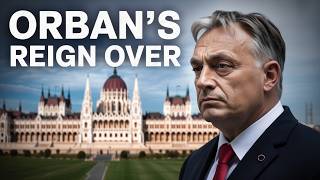
In this commentary, TJ Walker celebrates Viktor Orbán’s unexpected electoral defeat after 16 years in power, emphasizing its global significance as a triumph for democracy and a warning to authoritarian aspirants. He frames Orbán’s Hungary as the model that American conservatives, including Donald Trump and J.D. Vance, have idolized, highlighting how the regime weakened courts, co‑opted media, and aligned with Vladimir Putin. Walker contrasts Hungary’s per‑capita income (~$28k) with Mississippi’s (~$47k) to debunk the myth that Orbán’s model delivers economic prosperity, noting that importing it to the U.S. would mean a 40% pay cut. He distinguishes democratic systems—where corruption can be exposed and elections can reset power—from “illiberal democracy,” where corruption is entrenched. Walker argues that authoritarian control of media and rule‑making can only last until citizens feel poorer and the system feels rigged, as demonstrated by Hungary’s vote. He extends the lesson to the United States, asserting that Trump’s supporters are not permanent and that democratic voters can oust “amateur authoritarians.” A personal‑development analogy follows: branding and spin can mask a flawed product, but the underlying reality eventually surfaces. Walker briefly notes that Orbán’s early economic growth gave his regime legitimacy, a condition absent for Trump. The video concludes with a promotional plug for Ultimize.com, encouraging viewers to take free courses on communication and habit building.
Chapters
Ultimis. Hungary just did something spectacular. After 16 years in power, Viktor Orbán is out. Voters handed the opposition a decisive victory, and even more important, Orbán conceded. No tantrum, no rigged election tour, just done. And let's be clear about what this means. This is spectacularly good news for the world. And it's very bad news for dictators, aspiring dictators, and every strongman fan club on earth, especially Donald Trump. Because Orbán wasn't just some foreign leader Trump vaguely liked. Orbán was the model, the blueprint, the guy conservatives in America invited to CPAC, applauded, and held up as proof that you could weaken democracy and call it patriotism. This is who they admired. A leader who systematically weakened the courts. A leader who helped friendly oligarchs dominate the media. A leader who cozied up to Vladimir Putin. A leader whose government was widely criticized for corruption and cronyism. It's not strength. That's a franchise model for decline. And yes, this is especially humiliating for J.D. Vance. He went to Hungary just last week and praised and endorsed Orbán. He treated him like a visionary. And then Hungarian voters looked at all of that and said, no thanks. That's not just a loss, that's a rejection of the entire brand. Now, here's where it gets almost comical. For years, Orbán's Hungary was sold as the shining example of what America should become. Really? Let's talk about the economy. Hungary's output per person is roughly $28,000 a year. Mississippi, the poorest state in America, is about $47,000 per person in income. So, yes, these are very different measures, GDP versus income, not perfect apples to apples, but still, the gap is massive. We're talking roughly a 40% difference, lower standard of living in Hungary. So, if you actually imported Orbán's model to the United States, you're not getting some patriotic economic miracle, you're getting something closer to a 40% pay cut. That's the dream? That's what we're applauding at CPAC? Make America hungry again doesn't exactly test well in a focus group. Now let's be fair, no political system is perfect. Democracies have corruption, democracies have incompetence, democracies have people who probably shouldn't be in charge of anything more complicated than a toaster. But here's the difference: In a democracy, corruption can be exposed. There's a free press. There are opposition parties. There are elections where voters can say enough. In Orbán's so-called illiberal democracy, corruption doesn't get fixed. It lingers. It gets protected. It becomes the system. That's why he stayed in power long past his expiration date. He stayed in power for 16 years, not because everything was working so beautifully, but because the system was tilted to keep him there. And eventually voters said, "We're done." That's the lesson. You can control the media for a while. You can rewrite the rules. You can reward your friends and punish your enemies, but you can't indefinitely hide reality. If people feel poor, if the system feels rigged, if the same insiders keep winning, Eventually the brand stops working. And here's why this matters beyond Hungary, because it shows something important. It's not impossible to build an authoritarian-style system in the modern world. We're seeing parts of it creep into our own society now, but it's not as easy to keep it. This isn't the 1940s. People talk, people organize, people notice when their lives aren't improving, and eventually they do vote. So yes, this should give hope to anyone who believes in democracy. Even after years of erosion, even after manipulation, even after corruption becomes normalized, the system can snap back. And here's a message for the people surrounding Trump: you are not permanent, you are not inevitable. And if Hungarian voters can remove a leader who spent 16 years building a corrupt system designed to protect himself, then American voters can certainly handle a few amateur authoritarians with social media accounts. And let me give you the personal development version of this. You can spin reality for a long time. You can market yourself. You can build a brand. You can have little flag lapel thingies or your pocket square. But if the underlying product is bad, if it's corruption, incompetence, and ego dressed up as leadership, eventually people figure it out. Hungary just figured out, and that's a win for democracy everywhere. One other important thing to note that's difference between Viktor Orbán's style of, as he calls, illiberal democracy and what Trump did, is people forget, I sometimes forget, but when Orbán first came to power, He really did make the economy of Hungary grow. It did get better. So, you do have an advantage if you're a dictator early on in your stages of dictatorship. If people feel like their society is getting better, if they're personally richer, if there's less chaos, okay, they will back you. They will reward you. But who in America today feels like there's less chaos? American citizens shot and killed in cold blood by people who work for our government, as happened in Minnesota. Nobody really feels like things are safer today. How many people are feeling richer, especially when they go to the gas pump? Nobody. How many people feel like it's so much easier to get a job now? Pretty much nobody. How many people at the moment are happy with their stock returns? Nobody. So that's the big problem for Trump comparing himself to Orbán. Orbán did have economic growth early in his reign. Here we are only, what, 16 months, less than that, 14 months into the Trump regime, the second term, and we've seen nothing but economic chaos, and the average person's pocketbook is feeling leaner than ever. So it's almost like we're at year 16 of a dictatorship, not year 1. So Hungary, I didn't used to think you were a role model for Americans, but now I do. Here's something I've learned after years of doing this: the people who actually improve don't necessarily hear better advice. They just stay around it longer. They keep exposing themselves to the same useful ideas until it finally clicks. Most people don't do that. So if you want to be in the small group that actually follows through, go to ultimize.com, that's ultimize.com, and get the free course. There's one on communication, one on building better habits, nothing fancy, just something you can keep coming back to. If you're already there, you're doing the hard part. Just go to ultimize.com and build on it. Ultimize.