Justin Trudeau Speech - Reaction from Communication Coach
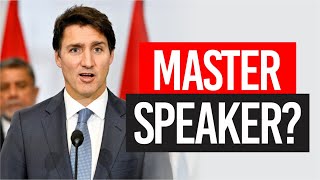
Communication coach TJ Walker breaks down Justin Trudeau's parliamentary speech on foreign interference, analyzing his pacing, eye contact, word choice, and how he handled notes. Walker praises Trudeau's measured delivery and pulls out specific techniques you can use in your own high-stakes presentations.
Chapters
Prime Minister Justin Tarot of Canada gave one of the most significant speeches of his career, addressing Parliament earlier this week and delivering serious allegations about the government of India. I'm going to analyze this speech now purely from the standpoint of communication. So I'm not getting into the political debate here, but analyzing his speaking skills, see what we can learn from it.
Mr. Speaker, today I'm rising to inform the House.
So he's starting off very somber. It is indeed a somber occasion. He's talking about extraordinarily serious allegations against the government of another country and the largest democracy in the world. So he's starting off slow, somber. You can see he's conservatively dressed. It appears to be a white shirt, which is the most conservative and serious symbol you could send for dress. The one thing a little bit off is his tie as a skew. And that to me seems a little off considering this is a very, very high profile, legal, international legal case he's bringing up. But otherwise he has an extraordinarily professional.
Telegenic appearance of an extremely serious matter. I just informed the leaders of the opposition directly. I want now to speak with all Canadians.
He's not rushed. I want now to speak to all Canadians. So he's not rushing. Very important now. He's clearly reading the speech. Those of you who've come to this channel regularly know I don't recommend reading speeches 99 of the time, but this is one of the 1% of times when it is critical to read a speech actually on paper. He's addressing his Parliament. He can't bring in, it would be against protocol to bring in a teleprompter. And he's making a case, essentially an international law case. He's speaking to the international community where every single word out of his mouth is going to be parsed, scrutinized, held up. One wrong word, one wrong phrase could cause its own international incident and blowback. So he's got to get every word just right. And that's why it is crucial for him to read.
Over the past number of weeks, Canadian security agencies have been actively pursuing credible allegations of a potential link.
Even though he's reading, he is looking up, he's giving eye contact to the members of Parliament and indirectly the people watching at home, wherever they are, around the world. So he's not just head buried, putting on glasses, holding papers, looking down, he is engaging the audience exactly as you.
Should between agents of the government of India and the killing of a Canadian citizen, Hardeep Singh Nija.
He's coming across as very measured because this is an extraordinarily serious matter. It's perhaps the most serious matter a prime minister could deal with regarding relations with another country. So he's coming across somber, serious, as you would expect, as he would want for an issue like this. His reading speed is just right because he's not rushed. He's pausing to show the gravity of the matter. He's also doing something extraordinarily well with his notes. The problem many people have what amateurs do with their reading a speech. They finish a page, they're done with it, they turn it over, it calls attention to itself, and they're looking at the paper as they do it. That's what most people do. He's using a very advanced technique that I also advise my own clients to use, which is you're done with a particular page, you look up and then you slide it over and you don't call attention to it. You're not flipping the paper. So it doesn't call attention to itself and it makes it seem much more seamless. And for a lot of people, they'll be convinced he's just talking to them. So that's great. Notes management that he's using there.
Canada is a rule of law country. The protection of our citizens and defense of our sovereignty are fundamental.
He's using simple words. You can argue sovereignty isn't that simple a word. But at some point, people know that's when a country gets to do whatever it wants. In general, he's using. Using simple words, short sentences. He's not speaking like an international lawyer. He's speaking like a leader who's trying to convey with an entire country. Indeed, in this case, he's speaking to the entire international community. So his word choice is simple, clear, easy to understand.
Our top priorities have therefore been one, that our law enforcement and security agencies ensure the continued safety of all Canadians.
So he's well organized, he's listing, making it simple, easy for people to understand.
And two, that all steps be taken to hold perpetrators of this murder to account.
Murder is a very strong word and he's using it in a controlled, measured, purposeful way. You can tell he's trying to de escalate tensions between the countries and around the world. He's speaking in a calm way. He's not speaking with anger in his voice, but he does, in a moment, address the anger and the other emotions he knows some of his constituents are feeling.
Canada has declared its deep concerns to the top intelligence and security officials of the Indian government. Last week at the G20. I brought them personally and directly to Prime Minister Modi. In no uncertain terms.
In no uncertain terms. So he's punctuating certain words to show emphasis, to show that he takes this extraordinarily seriously. So even though he's reading, he clearly, clearly has practiced rehearses. This is not the first read. It wasn't like a staff member wrote this up for it and handed it to him as he walked into the Parliament. This looks easy to do. It's actually very difficult to read in front of a lot of people in a room with you also knowing TV cameras are on you. Now. He's an experienced politician. He's been in national public office for many, many years, has given thousands of speeches and thousands of media interviews. So you wouldn't expect him to show any classic signs of nervousness, voice quivering or hands shaking. But still, I've seen many politicians sort of wilt in situations like this, and they start reading, their head is down the whole time. They start reading faster and they lose the inflection in their voice. He's doing it exactly on his own time. He's not rushing. He's also very brief, as you'll see in a moment. He doesn't go on and on. He states the case and he clear, simple terms.
Any involvement of a foreign government in the killing of a Canadian citizen on Canadian soil is an unacceptable violation of our sovereignty.
So that's really probably the most important sentence in the speech. And he's looking up most of the time. He's clearly practiced it. He didn't memorize it, but he's practiced it. He's comfortable with it, and that's how he's able to infuse the words with just the right amount of emotion. He doesn't want to come across like a hothead, but he also doesn't want to make it sound like, well, this is no big deal. This is like any other resolution anyone would read in front of Parliament when no one pays attention. He's giving it gravitas and importance and putting in, I believe, the right level of emotion.
It is contrary to the fundamental rules by which free, open and democratic societies conduct themselves.
Again, he's not getting into the arcane issues of international law and subsections of violations. He's speaking in clear, simple terms that any one of his citizens could understand.
As you would expect, we've been working closely and coordinating with our allies on this very serious matter.
And I do see in the comments section we have some Canadians join us. Welcome. And Vivek is Not a fan of Trudeau. Let me step back for a moment and again clarify. What we do on this channel is we help business people, political leaders, entrepreneurs, communicate more effectively, and we give them tips, tricks, tools. So periodically, we analyze significant speeches around the world strictly through the lens of communication skills. So I may analyze someone as a speaker and I can't stand their politics or anything about them, but judge them to be an excellent, excellent communicator. On the other hand, I could see a political leader or movie star I absolutely love and adore, and I might judge a speech or presentation or interview they've given as horrible at every level. So, just so we're clear, I do want to know. Vivek, you're watching this. Not what you think of this particular politician in his career and history, but just how did he communicate here? And if you don't like it, that's fine, you can disagree with me. I want to know specifically based on what he's doing here in, in this speech, you think he could have done better or differently. So thanks for listening. Let's watch a little more.
In the strongest possible terms I can.
In the strongest possible terms. So he's punctuating the word strongest. He's actually bringing strength to his voice so that it matches. It's in sync. The word strongest matches. His tone matched his eye contact, matched his body language. So I'm seeing everything in sync here in a masterful way.
Continue to urge the government of India to cooperate with Canada to get to the bottom of this matter. I also expect it to reiterate that.
So what he did there was very interesting. He actually stumbled. He stumbled on the word reiterate. He started it, went back and said it again. But he did something really well. He didn't wince or apologize. Nothing flashed across his face to suggest that he was annoyed with himself. The problem most people make when they give speeches or presentations or media interviews is not that they make mistakes. It's that when they do make a mistake, they do something like this, oh, sorry. Oh, I'm embarrassed. They call attention to their mistakes. Everybody makes a stumble occasionally. I make stumbles occasionally. The key is to do exactly what Justin Turreau just did there. He kept on going and nothing registered on his face that there was a mistake that way. Most people will never, ever realize there was a mistake because it didn't become noticeable. It's our reactions to our mistakes that make them noticeable, not the mistake itself. By the way, if you're getting any value out of this video, this analysis, please, like the video, Share it, click the bell for notifications and tell your friends and colleagues about this channel would.
Be much appreciated that its position on extrajudicial operations in another country is clearly and unequivocally in line with international law.
Clearly and unequivocally. He's saying clearly and unequivocally in a clear and unequivocal manner. So again, there's great sinking of the words and his message and how he's delivering it.
I know many Canadians, particularly members of the Indo Canadian community, are feeling angry or perhaps frightened right now.
So now he's surfacing the feelings of certain constituents. He's talking about the fact that they're angry, frustrated, but very important for someone who's trying to influence the international community. He's not coming across as an angry person himself. He does not seem like he's trying to inflame the situation and make it worse, but he does want people to know it's very serious. I see Roger stopped by. Thanks for saying hello. And says p I'm not quite sure what you wanted to say there, but please post another comment. Roger.
Let us not allow this to change us. Let us remain calm and steadfast enough.
Let us remain calm and steadfast. So he's not just saying calm and steadfast. He actually sounds calm. By bringing down the volume and the speed, he is exuding a calmness. Now, for a lot of speeches in different situations, I would say this is maybe too low energy, but given the explosiveness of this issue, I think his volume and his energy level is just right. And Vivek has pointed out other things it says, I don't mean to be arrogant. Well, Vivec, no offense is taken. Again, I know very little about Canadian politics, so in that sense, I'm the typical ugly American. I. I know a lot more about American politics. But again, we're just here judging the communication skills and I would love to know what you think of Prime Minister Trudeau's communication skills in this speech. If you could post your comment there, we'd love to hear it. Let's watch only a few seconds more.
Our commitment to our democratic principles and our adherence to the rule of law. This is who we are and what we do as Canadians.
That part very important. And notice he wasn't reading there. That is who we are and what we do as Canadians. So very forceful. He wanted to really land that. He clearly took the time to rehearse that. Whether he's got a great memory or he had to practice it five Times, it doesn't matter. But he nailed that part without having to be buried in notes. So when you really want to hit important points, when you are delivering a speech that is written, you need to get some element, not all of it, but some elements in your head so you can say them. Really looking at people, it comes across as in a much more powerful manner. Again, no rush. See, he finished his statement, pushed the paper aside, now he's ready for the next point, and now he's doing the whole thing again in French. So this whole speech was less than three minutes long. And believe me, I love to pick people apart. I find very little error there, very little to critique. It was polished and yet he brought humanity to it. He seemed like a human being. Very strong communication. Roger writes potential link is that. Is that code? We have nothing. Modi made me look like a fool, so I'm going to feed the Canadian people a bunch of stuff so I don't look to. So Roger, you clearly know a lot more about Canadian politics than I do. And certainly any speech can be interpreted different ways by different audience members based on the context. They're looking at this. So I'm not in any way trying to criticize your analysis and I'm not, I'm not trying to be pro trudeau here. I'm simply looking at this from the perspective of communication skills and giving a speech in a high stakes situation. And I think by that measure he's done extraordinarily well. Now, he certainly had a lot of bad publicity over various scandals and other issues in the past. Happy to critique those as well. But this is in the news. That's why we're there today. But Roger, I would like to know in terms of just the technical, because that's what we're about here, in terms of the technical way he delivered the speech, how he sounded, how he moved, how he spoke, how do you judge it? Please post your comments there. By the way, if you're trying to improve your own presentation skills, you may want to check out high stakespresenter.com it's in the description. You'll see it below. I'll post that as soon as we we finish. And that is a place where I coach along with some of my colleagues, people like you, business people, sometimes political figures, consultants, entrepreneurs, experts on how to communicate more effectively when you're giving speeches, when you're talking on YouTube, when you're being interviewed by others. So if you want to improve your own speaking skills, I urge you check out highstakespresenter.com. thanks so much for joining me today. Thanks to Roger and Vivek and Ben and all the others. And if you're watching On Demand, please post your comments and your questions. I do answer every single comment and question. Thanks so much. Please like this video, subscribe to the channel and sign up for notifications. See you next time.
More from TJ





The Breakout Cases - What Actually Caused Famous Speaking Career Breakthroughs | Ultamize

The Red Circle Sessions Finale - Build the Speaking Career You Came Here For | Ultamize

Two Stages, One Logo, Two Completely Different Realities - Main Stage vs Independent Events | Ult...

Pre-Reset - Why Repetition Builds Better Speaking Decisions | The Red Circle Sessions | Ultamize

Your Decision, Your Framework, and What Happens After - Build Your Speaking Career First | Ultamize

The Red Circle Sessions Trailer - The Speaking Career Truth Nobody on That Stage Will Tell You | ...

The Two-Minute Ultamize Reset - Your Platform, Your Audience, Your Voice | The Red Circle Sessions