Layoffs Surge, Retirees Return to Work, Crypto Crashes: Warning Signs Everywhere
TJ Walker surveys January's highest layoffs since 2009, the return of retirees to work out of financial need, and Bitcoin's crash. He argues that financialization has warped the economy, and warns that erosion of election legitimacy threatens democracy.
Chapters
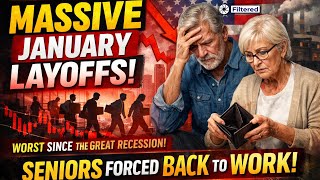
Foreign. The job market is flashing warning signs most people aren't paying attention to. Yet more older Americans are coming out of retirement not because they necessarily want to, but because they have to. The Olympics are opening with a message of global harmony at a moment when the world feels anything but harmonious. A conservative economist is warning that capitalism itself has been warped by Wall Street Games. Another conservative voice is warning that the next election may be declared illegitimate before it even happens. And finally, what looks like bad news for crypto may actually be very good news for the rest of us. All that and more today on Filtered. Welcome to Filtered with TJ Walker. Hi, and welcome to Filtered. I'm TJ Walker. Thanks so much for joining me. If you're new to the program, this is where we look at the top news stories of the day and then filter it through the lens of personal development skills and communication skills so that you can be as successful as possible. Let's dive right into issue one. January Layoffs Hit Worst Start Since 2009 According to CNBC, layoffs in January were the highest for the start of any year since 2009. Right in the middle of the global financial crisis, US employers announced more than 108,000 job cuts in a single month, more than double last year's pace and more than triple December's number. At the same time, hiring plans collapsed. Companies announced just over 5,000 new hires nationwide, the lowest January figure ever recorded by Challenger Gray and Christmas. That combination rising layoffs and vanishing hiring is exactly what economists watch for when companies quietly lose confidence in the future. Official government jobs data still looks relatively calm, which is why this is easy to miss. But Challengers data captures what companies plan to do, not what they've already been forced to admit publicly. And those plans suggest that many executives entered 2026 expecting a tougher year ahead. Transportation and technology led to cuts driven by massive layoffs at major firms. Job openings are also shrinking fast, with fewer available jobs per unemployed worker than at any point since 2020. This doesn't look like panic yet, but it does look like preparation. Okay, let's dive in here. What does this really mean? Let me not over sell this. Let me not be guilty of the number one bias crime of people in the media. And that's not a bias towards the left or the right or libertarian or anything. It's the number one bias is just in favor of something looks like historically bad news. We are not in historically bad economic times now let's be fair. But it is troubling again. 108,000 layoffs announced in January. That's a pretty big number. Highest number in 17 years. Layoffs up 118% over the year. Layoffs up 205% since December. Only 5,306 people hired, according to official data. Now, all of this data can be a little rough. It's not precise. No one's literally counting every single job. Nothing is that precise. These are estimates and they often do change and are recalibrated over time. But it's still not good. Job openings fell to 6.54 million jobs. I mean, that's still a lot of jobs, but it's much lower than what people are used to. The openings are down 900,000 job since October. The jobs to unemployed ratio is now at 0.87. And UPS just announced that they're cutting 30,000 workers. And let's not forget UPS, it has a special place in the hearts of many Americans because it's essentially what you would call blue collar work, but it's highly paid. They have high salaries, benefits, perks for people who work at ups. So if you lose your job there and you've got to go work at just a local grocery store, chances are your income will plummet, your benefits will plummet, your health care will plummet. So it's a bit tricky. According to Andy Challenger, who is the chief revenue officer at Challenger Grand Christmas, this is a high total for January. Employers are less than optimistic about the outlook for 2026. Now, it certainly doesn't surprise me that employers are not optimistic. I mean, I'm an employer. I certainly could not imagine hiring workers in this particular environment when, who knows when the mad king in Washington will just, you know, he could declare anything. He could declare that no one will do any work or sell any product outside of America. He could declare that no one's allowed to import anything into America. So you never really know these tariff policies. The idea, oh, let's just invade Greenland. How do you plan as a business owner to employ no more people? If you think, well, maybe will half of them be drafted to go fight a war or Panama or Greenland or wherever? Now you could say, T.J. that's bizarre. Hysterical, but, well, is it? There's so many bizarre things going on by the people who have their hands on the control buttons and levers of our economy. So I can certainly understand why executives who have a lot more people working for them than I do would be extraordinarily nervous about hiring people in this environment. Let's look at some other facts right now. Corporations are prioritizing stock prices over workplace stability. I mean, it's a reality, a sad reality, that the number one way to make more money as a CEO these days, fire a bunch of people. Your stock price will shoot up because Wall street will say, hey, you're more efficient. And if you're a CEO of a large publicly traded company, most of your compensation will come from stock. So anything you do to juice the stock is going to go right into your pocket, most likely. And if you got to fire 30,000 people to do it, many executives take the attitude of what's the catch? So it's a tough time for many people who are not the Bill Gates of the world, the Elon Musk of the world, and the Jeff Bezos of the world and the Mark Zuckerberg. Things are great for them. Yeah. And don't feel too sorry for Jeff Bezos having to lose money in the Washington Post. He's doing fine. Automation and consolidation is accelerating job loss. Transportation and tax cuts reflect structural industry shifts. So there's a lot going on here. I don't want to be irresponsible and say, oh, my goodness, because I don't happen to favor the particular administration in charge. Now I'm just going to say the economy is worse than ever before. No others have played that game. When other politicians of different parties are in office. I'm not doing that. In fact, many economists were wrong a year or so ago when they predicted that our economy would just be absolutely devastated because of new policies emanating from Washington. It is not devastated our economy yet. I'm not making any absolute predictions here. But when you combine the fact that more and more corporations and countries around the world are saying we're tired of the US being bullies and ripping up agreements, treating us like dirt, badmouthing us, telling us we should be one of their states, when you combine that with the fact that so many people have left the United States and we're not getting that replenishing of new people wanting to immigrate here the way we used to. It adds up. And it's causing, I won't say deflation, I won't say is causing the economy to go down dramatically, but it's certainly not the go, go years we had in, I don't know, 2021 to 2025. I'll be monitoring the economy closely here for you. I think the only thing you can do and I can do as we're plotting our own economic future is we have to assume that, that things could get worse. And because of that, we have to be even more focused on delivering great value, distinguishing ourselves from the competition. I try to be the absolute best personal development trainer and media trainer in the world so that if demand goes down, doesn't have an impact on me. Because people, there's always going to be someone who wants the best. So that's really my only advice to you is you can't necessarily count on another job. Make the best of the current job you have and spend what other free time you have that isn't needed for sleep and for rest and relaxation with friends and family. Spend that time that you would otherwise spend just playing video games or watching Netflix. Spend that time creating something new, learning new skills. Because no one, including myself, can really predict the economy. No one really knows when AI is going to put half of us or all of us out of business. So all we can really do is hone our own skills. Make ourselves as useful and as relevant and as valuable to other people by focusing our energy, time and resources. Resources. I'm TJ Walker. There is lots more to come.
We'll be right back after this break.
Want to advertise here?
You better be legit.
No crypto, no junk food, no supplements.
Go to tjwalker.com advertise.
Most people can't.
Afford a full time coach and even if you could, good luck finding one who's available when you need them. That's why I created the TJ Walker AI clone. It's built on my 40 plus years of real world coaching and training. You get my exact advice, style and frameworks instantly.
Ask it how to handle a tough question.
Get feedback on your elevator pitch. Rehearse your next big talk. This is the next generation of communication coaching. It's smarter than an apple, more personal than a course, and always ready. Start using it today at TJ Walker.
AI, you'll wonder how you ever did without it. Older Americans are unretiring to pay the bills A new AARP survey shows that more Americans over 50 are leaving retirement and returning to work, and not just because they're bored. 7% of retirees re entered the labor force in the past six months, up from last summer, and nearly half say the reason is simple. They need the money. Daily living costs. Housing, health care and food prices are stretching fixed incomes past the breaking point. Social Security cost of living increases haven't kept up, and market volatility has made retirement savings less reliable than many people expected. What makes this more troubling is that older Americans are walking back into a job market that doesn't necessarily Want them. Two thirds of older workers say it would be difficult to find a new job, and nearly one quarter worry they could lose their current one within a year. This isn't a story about people choosing to stay active. It's a story about retirement no longer functioning as a stable phase of life for millions of Americans. And that insecurity is growing, not shrinking. Okay, let's dive a little deeper here. As mentioned, 7% of retirees have reentered the workforce in the last six months. That's up not a lot, but it's up 6% since the summer of 2025. The survey included 2,083 adults over the age of 50. 48% unretired, they claim, due to financial necessity. So it wasn't simply people saying, oh, I'm bored. I want to go back to the office and have fascinating conversation with colleagues I love and admire. No, they're going back for the money. So I have several thoughts for that. It does say 15% did unretire due to boredom. That I can certainly relate to because I see it all the time with people bored. They try to fill their days with golf. And it turns out a lot of people in the world love golfing once a week because it breaks up the monotony of the other six days. If you, if you can golf every day, seven days a week, all of a sudden that becomes a job and it's tedious and no one's paying you. So I'll talk more in a moment about the 15% who are unretiring due to boredom. But back to the people who are retiring or unretiring because they need the money. I would ask you to think about, why did you retire in the first place? Now I get it. Not everyone gets to talk for a living like I do. Not everyone gets to do fun stuff the way I do. And sorry if that sounds like humble bragging, but I. I like my work. I hope to never, ever, ever retire. But I understand for other people it's not quite like that. And so they want a chance to relax, play with the grandkids, give back to the community. I would just challenge you to think about it, though. The days are gone when you either worked a full time, 40 hour a week job with commute time and prep time 50 hours a week, or did nothing at all. There is in between. You can in fact work 20 or 30 hours a week. There are indeed weeks when I don't work 40 hours, much less 50 or 60 or 70 that I perhaps did when I was younger. So there are other options. But I do think that I'm speaking to you as an individual now, not as a public policy issue. From your own standpoint, you need to assume a couple of things. Number one, I'm hoping you're assuming that you live to at least a hundred. The idea of just dying a couple of years after retirement, that used to be the norm. It's not anymore for a lot of people. And this is especially skewed for the wealthy. Wealthy people live on average about 10 years longer in America than poor people. So a continue making money, boost your wealth, and chances are you'll live another 10 years. It's not a guaranteed thing. I'm not suggesting that, but there is a high correlation. Now, people forget when Social Security was started a century ago in the United States or a little less than a century ago, the full retirement age was 65 and people died at around 64. So most people never saw a penny of it. These days, the average American lives to about 79. And if you're a wealthy American well into the 80s and some places, I believe Monaco now, people are living to 90 on average. On average. Which means some people are living to, you know, 95, 97, 99. So the idea of not doing anything economically productive for now, 30 years of your life, sometimes for people who retire in their 50s, 40 years of their life, I think that needs to be readjusted. I am not saying the only thing that matters in life is work, work, work, work, work, and making money, money, money, money. I'm not saying that, but it could certainly be a part of Life. There are 160 some hours in every week. Why not spend 20 hours doing something productive in the marketplace where people are compensating you? I want you to give more thought to that. Now, you may be a young person thinking, well, teacher, why are you even talking about this? Of course I'll never retire. Those old boomers like you aren't going to leave any Social Security left for us. Okay, maybe. But I do want you at any age to think about how can you constantly be moving closer and closer to your version of a dream job? A job where you feel like you're using all of your talents, all of your skills, you're helping people and being compensated in the way you like. That doesn't mean we all have to be a rock star. Doesn't mean we all have to be movie stars. You may absolutely love being the best plumber in your community. Knowing you're solving people's problems, they're so relief when you Come and help them. And you're paid fairly in a way that supports a lifestyle you want. You could be a plumber for 20 hours a week if you want to, from age 65 to 85 if you want to. So I want you to give some thought to lifelong professional development. And yes, I understand you may want to spend some or all, most of your time working in the community as a nonprofit volunteer, that's perfectly fine. But this idea that every human being is simply entitled to not work the last 30 years of their life and deserves to be supported by the rest of society, I'm not sure it's sustainable. That's certainly a part of a lot of cultures, the French in particular, at age 62 and for many before that, they expect to not have to make any money and to have a pension for the rest of their life, even if they live another 40 years. Okay, that's the social compact there, but it's not the social compact in most countries and it's certainly not the social compact in the United States. Now here in the United States, you can start getting Social Security at age 62. And for most Americans it's now age 67 to get full benefits. But for many, it's not really supporting the lifestyle they want. And if you were not able to save enough money, build enough financial worth, enough cushion during your working years, then why not consider working as a senior? Now let me address the issue that was brought up by the newsread at the beginning, which is that some seniors believe that they're not wanted, that there is discrimination. I have no doubt that there is discrimination against older people. But let's ask why, why is that? And I'm not, I'm not endorsing discrimination, but let's face it, if you are, let's say a 35 year old president of a small marketing firm and you're looking for new employees, new account representatives, and you've got a 25 year old, a 26 year old, a 27 year old and a 67 year old. And you want someone to run accounts managing social media and TikTok and Facebook and YouTube. Who are you going to pick? You as a 67 year old may know more than the 25 year old, but in general, maybe not. You better be prepared to demonstrate it. I know as I get older, I try to continue learning and I read books all the time and I learn new skills and I learn how to podcast. But still my ability to grasp new technology is not as fast as it once was. I have to really, really Be highly motivated and focus if I'm going to learn things. Whereas I still remember perhaps one of the, the best employee I ever hired about 20 years ago, gentleman by the name of Chris Gentile. He was right out of school, 22 years old. Every single thing I ever asked him to do, if he didn't know how to do it, he says, oh, I don't know how to do it. Let me find out and I'll handle it. And if he had to stay on the phone calling an 800 number or on a website till midnight, he would just do whatever it took to learn that new skill. So he learned video editing, he learned website design, he learned a million things, none of which he studied in college. He had a general business degree in college. But he did have something that people can have at any age. But unfortunately, many people lose as they get older and it is the ability to learn any new skill. So, yes, if you're a senior citizen and you are thrust out in the job market, there are going to be biases against you. I'm telling you, like it is not the way it should be. Not the way is legal, perhaps in every context, but I'm telling you the way it is. There is a bias against you. Don't hold me accountable. I'm not hiring anyone at the moment, so you can't accuse me of discrimination. But you're going to have to demonstrate a willingness to learn new technologies. We live in an increasingly high tech world. Everything is infused with AI and technology and apps. And if you want a job, you're going to have to be really, really conversant in that. So that's my biggest suggestion for you. For those of you over or past the normal retirement age in your community or for your industry, I want you to think long and hard before you do retire. Because David Letterman summed this up quite nicely. He said, because he had initially retired from his TV talk show, claiming he wanted to spend more time with his wife and children. And a few years went by and he announced he was coming back to do a new talk show on Netflix. He said, you know, people who claim to retire to spend more time with their wife or their spouse and children should first consult with their spouse and children. The implication, of course, being too much time. If you're around the house all the time, chances are you may just be annoying your family members. They're probably happy with you being away from the house, away from your dwelling, doing other things, productive in the world. So I hope no one suffers age discrimination. I don't endorse it. I hope seniors are not living in poverty, but let's fact check here for a moment, because senior citizens in the United States are far and away it's not even close the wealthiest demographic in the entire country. Are there some hungry seniors? Yes, there are. But proportionally a lot more hungry children in America. More in a moment Filtered is brought to you by the following Want to advertise here?
You better be legit.
No crypto, no junk food, no supplements.
Go to tjwalker.com advertise.
Want to become.
A better speaker, leader or communicator? Start with the TJ Walker Success Library. It's five of my most practical books, covering everything from public speaking to media interviews and persuasive messaging, all for only $9.95. I've trained presidents and Fortune 500 CEOs, and now you can get the same wisdom in a fast, affordable format. Go to tjwalker.com books and download your copies instantly.
Thanks for listening.
If you like today's episode, you'll love my online courses@mediatrainingworldwide.com check them out now and level up your skills.
Welcome back. The Olympics promise unity, but the world is fractured The Winter Olympics are opening in Italy, with all the traditional symbolism of global cooperation, fair play and shared rules. But according to the Times, these games are arriving at one of the most geopolitically tense moments in Olympic history. Athletes from more than 90 countries will march together even as wars rage, alliances fray and major powers openly disregard international norms. Experts say the contrast between Olympic ideals and global reality has rarely felt so sharp. The Olympics have always claimed to stand above politics, but history tells a different story. Games have been canceled by world wars, marred by terrorism, boycotted during the Cold War and reshaped by pandemics. This year, the dissonance feels unavoidable. Even climate change looms over the Games, with scientists warning that without artificial snowmaking, only a handful of cities will be able to host Winter Olympics in the coming decades. The Olympics still offer beauty and inspiration, but they also now function as a reminder of how fragile global cooperation has become. So it makes me sad to talk about this. Frankly, I I'm not a huge sports fan. I was more of a sports fan as a child. As an adult, I don't really watch many sports. In fact, just today I got an account at Peacock so I could watch the Super Bowl. I'm having a Super bowl party this Sunday. I haven't watched a football game all year, so I'm I'm on sort of the one extreme of very little sports consumption. But I do like to watch the Olympics. It's only every couple of years. It's a short window, typically a couple of weeks, you can really look at it, and then no one's asking you to watch that sport again for another two years. Or if it's the Winter Olympics, you've got four more years before you see the guys on and the women on ice, pushing around with a broom, sweeping and doing those fun sports. You got another four years in between the long jump and the shot put. It's scattered. So I have a very fond memory of watching Olympics, but there's been some bad ones, no doubt about it. I do remember the 1972 Olympics where Israeli athletes were killed. It was absolutely horrific. Jim McKay of ABC News moderating that. It still sticks in my brain. I remember the 1980 Olympics. I had friends who were about to be on the team, on the track and field, and couldn't go because the United States involvement was canceled by President Carter because of what Russia, the host, was doing in Afghanistan. So now we have a situation where the whole international order is disrupted. I'm going to dissent with some of the mainstream opinion there. The news reporting makes it sound like the whole world is kind of fractured and people aren't really uncertain. I don't think that's true. I have personally worked in 45 nations around the world, and I've spent a lot of time in other countries. I could tell you virtually everybody I meet likes to cooperate with people from other countries. They like to sell their products and services with other countries. They like athletes in their country competing against athletes in other countries. So I think there's overwhelming consensus today for internationalism, for globalism, even though people don't like that word. There's really a problem in two main areas. There is a particular political faction in the United States that has gained power that wants to tear apart everything that has made this world in the last 80 years a safer, more prosperous place. A safer, more prosperous place than at any time in the last 200,000 years of human beings on this planet. So there's one relatively small minority faction in the United States. And then you have Putin in Russia. If you could simply let me choose my words carefully. I don't want to say eliminate. Some people might take the wrong impression there. If we could somehow take power away from those two factions, I think the vast majority of the world would love to continue cooperating on the playing field and in the arena of capitalism and selling products and services now, it is absolutely true. More people in the world are against immigration than perhaps ever before. There's more free flowing or attempted free flow of people leaving one conflict area to go to another. And that has caused a lot of political turmoil in Europe, throughout Europe and in the United States. So I'm not discounting the rise of nationalism, but you can be more nationalistic in your perspective and still want to cooperate in the Olympics, still want to cooperate in worldwide capitalism. Let's look at some more of the facts here. So the Games are in Cortina, Italy. These are the first scheduled Games ever in Cortina. They were supposed to have it in 1944, but it was canceled because of World War II. Athletes are participating from 90 different delegations, basically 90 different countries. But experts are saying this is a very fractious moment in Olympic history. You've got Russia and Belarus athletes competing as national athletes because there are sanctions against Russia. And the International Olympic Committee has said you can be an athlete from Russia, but we're not letting Russia as a country compete because of its violation of the Ukrainian sovereignty because of waging war. I'm glad to see the Olympics taking a stand there. There have been five Olympics canceled during world wars. We're not in a world war now, technically, but sometimes that's an issue of semantics. When you look at how many people are involved in the Ukrainian war and the various factions, it could easily become a world war. The other factor, as I mentioned at the beginning, was because of global warming, because of climate change, regardless of whether you think it's man made or not. And I concur with scientists, the vast majority of scientists who believe that climate change is primarily a result of how humans are altering our environment through carbon consumption. But we'll leave that for another day. That debate, there's really not much debate over the fact that there are fewer and fewer and fewer resorts that have enough snow to actually host the Winter Olympics. Now, just earlier this week, I was in Winter Park, Winter park in, or excuse me, Park City in Utah, where they hosted the Olympics. And I was able to walk around some of the Olympic Village there in Park City, Utah. Beautiful place. But you know what? We're in the dead of winter. I saw a lot of bare slopes. Fortunately, I was skiing over in Alta, and they had plenty of snow there, although significantly less than they normally do. But when you look at the trends, when you look at meteorologists are looking at for mountainous regions, ski regions around the world, the prediction is there might by 2050, which is not that far off, only be literally a handful of cities and countries that could potentially host the Winter Olympics. That's kind of sad. So the opening ceremonies are tonight. I hope to watch some of those, and I do hope to spend some time with my family watching sports. I'm especially a fan of skiing. Not the ones where they're just doing the loops in the air like skateboarders and bicyclists, but downhill racing, slalom racing. Those are some of my favorites. I would love to hear from you. What races do you like or what competitive events do you like in the Winter Olympics? Feel free to post right here on the comments section if you're watching this on YouTube or any other social media platform. If you are listening on any podcast platform, please come on over to my YouTube channel and post your comments. I would love to hear from you on that. I do hope the Olympics can survive. I do hope the nationalist fervor that is sweeping the globe doesn't destroy one of the few things that really unites many people worldwide. That is the thrill of competition. Sporting competition. More in a moment. Hey, if you're enjoying this kind of take and want to hear more stories filtered through the lens of communication, make sure you're following the show whether you're watching or listening.
New episodes drop every single day and.
If there's a little notification option where you are now, go ahead and turn it on. It helps you stay in the loop. Hi and welcome back to Filtered How Financialization Broke Capitalism In a widely discussed opinion piece, economist Oren Cass argues that modern capitalism has been warped by financialization, the process of turning money itself into the main product rather than using money to build useful things. Now, this is a little more esoteric than some topics we discuss here, but bear with me. I do think it's important. Cass works for a conservative think tank, which matters because critique is shared by liberals and progressives as well. The core argument is simple. Instead of funding factories, research and workers, much of today's financial system makes money by slicing, trading and repackaging assets while collecting fees. Banks invest very little in building new businesses. Companies use profits to buy back their own shares instead of upgrading equipment or raising wages. Private equity loads hospitals, nursing homes, and even veterinary clinics with debt cut staff and raises prices. The result is slower wage growth, weaker innovation, higher cost, and fragile communities. Workers absorb the risk, investors collect the upside. Cass's point isn't anti capitalist, it's pro capitalism. Done correctly, when finance stops stops supporting the real economy and starts feeding on it, capitalism itself is undermined. Okay, let's dive a Little deeper here. This is complex economic issues and it's hard for a lot of people to grasp it, but they can see the results in their own communities. When you see private equity coming in and taking over hospital chains and all of a sudden everyone's prices are through the roof and the quality of service goes down, somebody, probably somebody who lives in New York City who already makes a seven figure income, is going to make more money. That's what happens with private equity. And we're seeing it sliced and diced in so many different areas. Hospitals and nursing homes continually being bought up by private equity firms where they loaded up with debt, cut the nurses, cut the staff, raise prices, the investors make more money. But patient care gets worse. Workers are burned out. Another thing that happens is subscriptions for everything. There was a time when you could simply buy a product, buy a piece of software. Now everybody wants that subscription revenue forever. It's not necessarily good for you. I mean, I just experienced that today. I already subscribed sometimes to YouTube. I pay for HBO, I pay for for Netflix, I pay for Amazon Prime, I pay for all, I pay for Apple Plus. And I just wanted to watch one football game in the whole year, Sunday. Because of that, I ended up spending another 19 bucks on a peacock network so I can watch a football game. Something that I used to be able to watch just over the year. I was smart enough to figure out how to configure my tv. I'd still be able to do that, but it's made so complex it's hard to do. So that's a part of this financialization. You've got to take every little asset and create recurring revenue. But it's not really creating new shows or new products. It's just helping financiers make more money. So why is this financialization of everything so bad? Money stops flowing into building new things. Companies focus on short term profits, not long term growth. Workers are treated as cost to cut, not people to invest in. And prices rise while quality often fails. And the risk gets pushed onto workers and consumers, not investors, the investors. And hey, I'm an investor, I hope you're an investor. We can benefit as investors, but also lose as consumers. And we really all have to look at it from both perspectives and you see just more and more ways. To me, the most odious are all of these gambling rackets. And they are gambling rackets. They're called prediction markets. It's a way of financializing dumb opinions. Basically, you can have an opinion on how many minutes the White House press Secretary will speak at a press briefing. Okay, first of all, who cares? Number one, two, you're making a stupid guess. Maybe you're right, maybe you're wrong. It's luck. But now you're putting money on that. That's financializing stupid opinions is really what it is. And all this money is going in, not to mention all the sports gambling. Now, I'm not a prude. I'm not saying we should ban all gambling and go back to the days where you had to go into a dark alley, find a guy smoking a stogie with a trench coat, and go into some dank place to place a bet with your bookie. That's one thing. I'm not ready to go all the way back to that. But this idea that every single kid in the world has a casino right here in their phone, where they're encouraged, actively encouraged through every ad on every TV show and every sporting event. Gamble, gamble, gamble, gamble. FanDuel, place your bet. Now everyone's a winner. No, everyone is not a winner. You had to make a blanket statement. You could say everybody loses. Yeah. Every once in a while, someone will win a game and they gamble it back. They put it back in the pot because the house always wins. And that's the problem with this financialization of everything. The cowshes, the vandals, they're part of it. But through private equity and most of Wall street, it's affecting everything. And so many things we think of as big banks really aren't doing banking as we commonly associate that term. The idea of banks saying, oh, you want to build this new shopping center, here's money for it. That's a relatively small percentage of it. That's not what people do when they're going to Goldman Sachs. Very little money at a bank like Goldman Sachs is going to invest in new business. Now, it is true the venture capital industry is separate. They are literally putting money into new businesses. But venture capital is a remarkably small percentage of the entire financial sector. And I'm glad to see that in this case, this conservative economist was willing to put a spotlight on it. Because so often conservatives believe that, oh, you can't question anything anyone can do to make money is good. Well, not necessarily. You can say, okay, legally, someone should be able to do this. But we're stepping back. Maybe this isn't how we want our economy run. Maybe this isn't really creating the most flourishing for an economy. If more and more people are spending all of their time trying to essentially game the system to make more money off of money as opposed to making money off of creating products and services that people actually value to the point of being willing to pay for it.
We'll be right back after this break.
Want to advertise here?
You better be legit.
No crypto, no junk food, no supplements.
Go to tjwalker.com advertise.
Most people can't.
Afford a full time coach and even if you could, good luck finding one who's available when you need them. That's why I created the TJ Walker AI clone. It's built on my 40 plus years of real world coaching and training. You get my exact advice, style and frameworks instantly. Ask it how to handle a tough question. Get feedback on your elevator pitch. Rehearse your next big talk. This is the next generation of communication coaching. It's smarter than an app, more personal than a course, and always ready. Start using it today@tjwalker.com you'll wonder how.
You ever did without it. Conservative columnist David French is issuing a stark warning in the New York Times today. He wrote a column asserting that the groundwork is being laid to reject the legitimacy of the next election if it doesn't produce a specific outcome. French argues that claims of widespread fraud, especially accusations that undocumented immigrants are voting illegal legally, are not random rhetoric. Oh no, they create a sense of emergency that can later be used to justify extraordinary interventions. The pattern is familiar. Declare the system is rigged in advance. Assert that only one outcome is legitimate, and if that outcome doesn't happen, claim fraud and obstruct acceptance of reality. This is not a liberal critique. Again, David French is a Republican. He's a legal expert. He's a well known conservative. He's devoted his life to fighting for conservative causes. His concern is that institutions are being tested by a strategy that depends on misinformation and impunity. He also warns that many Democrats are falling victim to normalcy bias. He didn't say it in those terms. Those are my terms. But it's the belief that because elections have always been held before, they will hold again automatically. History shows that assumption is dangerous. So David French is one of those conservatives I find essential reading, especially in these times. Let's go a little bit deeper. He's making the case that all the Democrats who think, okay, Donald Trump is extreme, he's dangerous, he's crazy. But we don't have to worry about it because history shows that when one party is in power and they take the White House, they lose, typically a bunch of seats in the next House race. So the Historical patterns are such that it would be a wild historical anomaly for the Democrats not to take back control of the House, especially given the extraordinarily low approval ratings of this president. So there are a lot of Democrats saying, hey, we just gotta chill out, relax, because it's only a matter of time. We'll take back the House, and then we will control the purse. We'll be able to put a stop to this. We'll be able to start impeachments, investigations, and Trump will be stopped in his tracks. And, and what French is saying is, no, this is not going to be a normal time, because we do not have a normal president. In the past, the United States has had politicians of the Republican Party, the Democratic Party say, okay, I may have a particular set of views, I may have a philosophy, but we're all in agreement. Elections have to be fair and free, and we all have to respect the results. That was the past. That's not a reality anymore. President Trump has been remarkably consistent on this issue. Now, we've heard people say, well, he doesn't really stand for anything, or he lies about stuff all the time. You can make the case about that and a lot of things, but not on this issue. Candidate Trump, way back in 2016, said point blank that if he wins the 2016 election, that's great. If he doesn't, he'll just assert that it was fraud. He said that what happened in 2020, he didn't win. What did he do? He asserted fraud and created an insurrection. People died because of his actions. And now he's going again and again and again, laying the groundwork, saying, just this past week, we need to nationalize the elections in 15 states. He doesn't mean any 15 states. He means states where people tend to vote more Democratically. And as David French said, again, a conservative Republican is said, you know, the number of illegal, undocumented, whatever you want to call that, immigrants, non citizens who have voted in American elections ever are so minuscule. We're Talking about maybe 20 people in a year. And as close as the presidential election was In Florida in 2020, even 20 votes would not have made a difference. There is simply no demonstrable evidence whatsoever that more than a handful of undocumented non citizens ever vote in America. Yet Trump is laying the case every single day in his rhetoric that, oh, my gosh, there's all this fraud. The Democrats are going to steal the election. So he's creating hysteria, he's creating an environment which will then give him, at least in his own mind, the justification for sending in troops, whether it's ice, whether it's some other modern Gestapo, he's going to send in troops to harass American citizens from voting. So if you happen to look like an Alex Preddy or a Virginia good, you know, a white American citizen, but you kind of sort of look like you might not be a Trump supporter, guess what? Maybe you'll be knocked to the ground on election day 2026. Maybe they'll just say you were a crazy radical extremist terrorist about to shoot them and they'll just take care of you. Nothing can be taken for granted against this administration regarding this administration. And French, to his credit, is pointing this out. I do think the Democrats are deluding themselves, fooling themselves. They are guilty of wishful thinking if they think the election in 2026, this fall, is going to be handled the way it has in the past, that it's simply going to be fair, honest and honest accounting, and whoever wins the most votes will win. I do not think that's the case. And I appreciate French pointing this out because that is not a partisan perspective. Yes, it is true. Obviously, more Democrats worry about this than Republicans, but here we have Republican, the commentator David French pointing it out as well, and it has a lot of credibility. Let's look at some more facts. Trump has said specifically, they vote illegally, meaning at scale. It's simply not true. Certain states and places are, quote, so crooked they can't be trusted to count votes. Again, he's creating a pretext for sending in troops to take over the ballot. The ballot boxes where he would count. Do you trust him to count his own votes? And talking about nationalizing voting, this is profoundly un American. We live in a federalist society, a republic, where each state, even each county, each precinct, they get to run their own elections. That has been the American way for a quarter of a thousand years. We're about to hit our 250th year birthday and Trump wants to change all that. And really, all he's saying is, heads I win, tails you lose. He wants to rig elections so that it's impossible for him and his minions, his accolades, his henchmen cannot lose. That's not America, my friends. It's not democracy. It's not a republic. It's not anything other than an autocracy, a dictatorship, a kingdom. And if you want to live in a kingdom, there's plenty of kingdoms still left in the world. You can go live in Saudi Arabia if you want to go live in Hungary. Now, Hungary is a nice place. I enjoy visiting there, but I wouldn't want to live there permanently because if you criticize the Dear Leader there, you end up disappearing. Do we want that really to happen here? He's also said voting machines are bogus. So Trump doesn't like voting machines if the votes allow people to vote for his opposition. He doesn't like mail in voting voting, even though the US Military largely votes through mail in ballots and they overwhelmingly support him. He simply doesn't like if people mail in a vote against him or his team. My friends, I don't think we're that far away. This administration and Stephen Miller leading it and Trump doing what he's suggested of simply outlawing the Democratic Party. I don't think we're that far away from Trump asserting without a single shred of evidence that the Democratic Party is a radical, extremist, terrorist organization, it's hereby outlawed and oh, we'll have elections. If you want to run for office as a Green candidate, as a Libertarian candidate, as a Whig, by all means do so. We'll have free and fair elections. But that just there won't be any Democrats because it's been proclaimed to be a terrorist organization. And anyone running for office as a Democrat will be indicted, arrested, imprisoned. Guess what? That's going to lead to Republicans not only holding the House of Representatives, but winning in a landslide and perhaps taking 3/4 of the seats. There's not, maybe all of them. Because let's face it, if there's no Democrats and the Republicans only have to run against Libertarians and Greens and Whigs, they'll Probably win all 435 seats in the House and win their 33 or some in the Senate. So I hope I'm wrong, but we'll see. The Democrats, I believe, are guilty of several cognitive biases. So here at Filtered, we try to look at issues in the news and see how is it filtered through the typical brain and how do our biases impede our ability to understand reality? One of them is just there's a normalcy bias. People think, well, this election has to be normal. Well, ask yourself, has there been anything that appear to be normal going on in the White House for the last 14 months? The answer is no. So to assume things are going to snap back is to be guilty of normalcy bias. It's closely related to status quo bias, preferring familiar procedures over urgent reform. People think, well, if we just, if I just go vote, my vote will count. No, it won't. Not if we have this administration using its henchmen and in this case, henchwoman at the Department of Justice to simply grab ballot boxes from places that the administration thinks might vote for Democrats. There's an anchoring bias, assuming that, well, this election has to be anchored to the reality of how things were done in 2018 or 2022. No, they don't. They can be completely different. There's an optimism bias. There's this idea of, well, I want things to change. I want this regime to be put in its place, therefore it must happen. Well, no, it doesn't. That is an optimism bias. There's the availability bias. The most recent elections for dozens, arguably hundreds of years have been conducted in more or less fair, open process, democratic process. So that's what people are comparing it to. Well, it doesn't mean this one is going to be so that's the bias. There is motivated reasoning. You want there to be change in Washington. You want this administration to be put in its place. Therefore, you start to see things. You look at polls. You look at this polling data that tells you you're going to win, and you ignore the fact that the President is basically telling you he's not going to respect any outcome in this election. That means his supporters in the Republican Party don't control the House. He's telling us that. So you're guilty of motivated reasoning. If you ignore that and you're just focusing on public opinion polls, guess what? Public opinion polls on who people are going to vote for. They don't matter if the votes for one party aren't counted. If they're simply thrown in the garbage can. That is essentially what this administration has told us it's going to do. So I'm glad that this particular conversation is spilling out into the open. It's on the front page of the New York Times. I've been talking about it for a long time, certainly for the last year, and I've been written off as sort of, oh, that's not mainstream tj. Well, now it's the New York Times. It's the conservatives in the New York Times talking about it. So it can no longer be dismissed.
Want a shortcut to powerful communication skills? Download the TJ Walker Success Library. Five of my bestselling books for only 9.95. Go to TJ Walker.com books instant access.
Big impact.
I've had entire YouTube channels wiped out overnight. So if you enjoy this show, don't lose track of me.
The Safest Way is my newsletter. Substack.com.
J. WalkerSuccess Sign up for free and you'll get exclusive commentary, live session alerts, and first access to new tools. Again, that's substack.com just search for TJ Walker or go to substack.com J. Walker Success, your direct line to everything I do.
Bitcoin prices have fallen sharply again, wiping out much of the industry's recent gains. Despite unusually friendly rhetoric from political leaders, major crypto firms are laying off workers. Prices are down across the board and hopes of permanent legitimacy are fading. This may sound like bad news, but in the long run, it's healthy. Bitcoin has no intrinsic value, extreme volatility, weak consumer protections, and a long history of fraud, manipulation and insider advantage. About 3/4 of people who have ever bought bitcoin are estimated to have lost money. Let me say that again, because there are a lot of people scratching their tj. How can that be? It started off at nothing and look how much it is. That's not the way up and down pyramid schemes and Ponzi schemes work. It's not even the way a lot of successful mutual funds work. But let me say it again. It's estimated that 3/4, that's 75% of people who've ever bought bitcoin have lost money, largely because they bought during the hype cycles when things are going up and everyone's all excited, and then they sold during the crashes. Crypto drains capital and talent from productive work and into speculative games. Its decline frees resources to flow back into real businesses, real innovation and real jobs. This isn't anti technology, it's a correction. When speculation stops masquerading as progress, the economy becomes more stable, fair and resilient. Now, excuse me if I seem like I'm doing a tap dance on other people's misfortune, but guess what? I am. I am sick and tired of these bloviating bitcoin bros. And it's typically bros going on and on and on. Oh, fiat currency is so awful. And yet what's the first thing that happens when they lose money because they put money in Silicon Valley bank? They want big government to bail them out. If they lose all their money on bitcoin and they're 70 years old, they still want their Social Security check. They still want their Medicare. They love big government. They just love to bash big government. So let's look at some more of the facts. Bitcoin is now under $64,000. It's 50% off of its peak. The major exchanges have cut staff aggressively. Crypto firm stocks are down as much as 75% and people are starting to panic. I would say it's a good thing. Fortunately, the percentage of bitcoin and all cryptocurrency of the overall economy is still small enough that most respected economists do not feel like this is going to throw us into a recession. Now, if it continues to grow and grow and grow, regardless of the fact that I think it's utterly useless, it could get to the point where it's too, either too big to fail, or if it does fail, it could bring down the whole economy with it. But again, let's look at the basic facts. Bitcoin produces nothing, doesn't produce goods, it doesn't produce services or cash flow. It's all dependent on the greater fool theory. Profits depend entirely on selling to someone else later at a higher price. That's what Ponzi schemes are all about. There's extreme volatility. Currency swings 30 to 50%. When things do that, you can't really function as money. You're pure speculation. It's not actually used for commerce. And I know you can cherry pick and you know, one out of 10,000 people you meet will say, well, I bought a car with bitcoin, okay, I would scratch a little further and verify that they did that. For the most part, it's not used for actual commerce. It's used for pure speculation. Or it is used for drug deals, fraudulent behavior, ransom, things like that. Things we hardly need to be encouraging. It acts like a tech stock, not money. And even analysts admit it tracks tech sell off. So the idea many people thought was, okay, this is going to be this place to hold value. So when the stock market melts down, people are going to flock to bitcoin. Well, no, it was going to be the new gold. Turns out gold is the new gold. Gold is going up at the same time cryptocurrencies are crashing. It's all built on leverage and speculation. That's not creating more stability. It demonstrably facilitates fraud and crime. No serious person doubts that. No consumer protection. You lose your, your coins, you get hacked. Tough luck, you're on your own. And it's all, it's well, all well and good to be a 29 year old Bitcoin bro and think you're the smartest guy ever. But then what happens if someone 49 today, who's sharp and with it all of a sudden is 69, has Alzheimer's and they're your mom, your grandmother. You were counting on that nice $3 million inheritance from them and oops, they can't find their Crypto key. They don't remember their code or even that they bought it. You get nothing. You get absolutely nothing. We've seen repeated catastrophic failures. Ftx, Celsius Voyager collapse is a feature, it is not a bug. There's a tiny, tiny concentration of ownership. Part of the message here is this is democratizing finance. It's not the big boys on Wall street, it's not the Wall street fat cats controlling things the way they do. So called fiat currency. Well, bitcoin in particular and most cryptocurrencies are controlled by very, very tiny percentage of people. A few whales. Market manipulation is rampant with all of these things. There is a false decentralization narrative. Control is very much concentrated in exchanges and in mining pools and it's destroying trust in actual innovation. Now remember, this has been around since 2009. Bitcoin, they're not continuing to innovate anything and they're tricking retail investors. People are buying high and they're selling low. Now in fairness, Peter lynch, who ran the Fidelity Fund, which was by most accounts the most profitable, most successful mutual fund of all time, he did 30% a year for years and years and years and years he was up. He said his own research showed a huge percentage of his people who invested in his fund, the most successful of all time, still lost money because they bought when things were going up. They sold in the dips. And that's a horrible way of doing it. We can have a conversation on another day for why you should not be buying and selling stocks, but it's even more of a problem with this bitcoin because it, the fluctuation is so much more extreme than it is certainly for most stocks. So there's so many other problems. I could, I could literally spend all day long talking about the problems with cryptocurrency in general and bitcoin in particular. But I'm happy, I'm so happy to see it going down. And if you have a substantial amount of your net worth invested in cryptocurrency or bitcoin, please realize I don't hold any ill will towards you. I think you've been suckered. I think you've been sold a bill of goods. I think you've been defrauded. It might not be fraud in a legal sense at this moment, but there is nothing preventing the Chinese have done it. There's nothing preventing governments from officially declaring cryptocurrency frank fraud, which I hope they do. I would be happier if it simply died a natural death where ultimately not all but most bad ideas do. Most bad ideas people with ideas of how to get money out of you. If they can't prove any way of helping you make money, solve a problem, creating a product or service that people value, they do go out of business. I'm not predicting the ultimate demise of bitcoin this week, or this month, or this year, or maybe ever hope it does die. Because that is ultimately what I believe is best for capitalism and will help divert needed capital to real businesses. Rather than spend that money on bitcoin and hope some suckers buys it for a higher price, why don't you invest that money in a real business? Maybe a stock of a company where you use their products, Maybe you support a family member who wants to start a new business themselves. That and if you lose money there, at least you've helped people try something new and enter the world of capitalism. Because that's not really what's happening when you do speculate on any cryptocurrency. I'm T.J. walker. It's Friday. I'm hoping you have a great weekend. I'm taking the weekend off as I now do, and I'm looking forward to having the weekend, having a big party for the super bowl, something we watch here in the United States. I did miss I did miss some comments coming in, PJ writes, and hopefully we can find us recorded on LinkedIn. I've got many of your great value programs. Thank you and PJ, I'm typically not putting the full show on LinkedIn. I'm typically leaving that on YouTube. But I'm glad you could watch today and I know you can see this. As soon as I finish recording this live session, it will be available in its entirety on YouTube. I'm TJ Walker. If you got any value out of this show, please like it. Subscribe to it. Sign up for Notifications Notifications Leave Reviews Whether you're watching on any social media platform or listening on any podcast platform, thanks so much. See you Monday.
More from TJ





The Breakout Cases - What Actually Caused Famous Speaking Career Breakthroughs | Ultamize

The Red Circle Sessions Finale - Build the Speaking Career You Came Here For | Ultamize

Two Stages, One Logo, Two Completely Different Realities - Main Stage vs Independent Events | Ult...

Pre-Reset - Why Repetition Builds Better Speaking Decisions | The Red Circle Sessions | Ultamize

Your Decision, Your Framework, and What Happens After - Build Your Speaking Career First | Ultamize

The Red Circle Sessions Trailer - The Speaking Career Truth Nobody on That Stage Will Tell You | ...

The Two-Minute Ultamize Reset - Your Platform, Your Audience, Your Voice | The Red Circle Sessions