Markets Shaken: Housing Pullbacks, Media Mega-Merger & Middle East Escalation
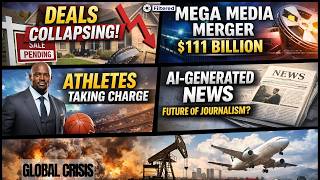
TJ Walker covers five major stories: 40,000 home-purchase cancellations in January as mortgage rates stay high, the $111 billion Paramount-Skydance-Warner Bros. merger facing regulatory scrutiny, former athletes like Mark Teixeira entering politics, the Cleveland Plain Dealer using AI to write hyper-local news, and escalating Israel-Iran conflict with U.S. involvement.
Chapters
Ultimize. 1 in 7 homebuyers are walking away at the last minute in the United States. Is this 2008 all over again? Paramount wins the $111 billion Warner Brothers battle, but now regulators step in. Sports stars are running for office, from NFL kickers to Yankees. An Ohio newspaper is letting AI write the news. The Middle East war widens—oil, drones, and global escalation risk. And an NPR investigation finds Epstein files tied to Trump may have been withheld. All that and more today on Filtered. Welcome to Filtered with TJ Walker. Panic as 1 in 7 buyers ditch home purchases. According to reporting based on new Redfin data, nearly 40,000 40,000 home purchase agreements collapsed in January, about 14% of all homes that went under contract. That's up 13% from a year ago and marks the highest January cancellation rate in nearly a decade. Several major metro areas are feeling especially high fallout rates. San Antonio topped the list at 21.2%, followed by Atlanta at 18.5%, Cleveland at 17.9%, Riverside at 17.5% in Orlando, right here in nearby Florida at 17.3%. Analysts say this reflects a shift in buyer's market territory in many regions where supply now exceeds demand. High mortgage rates and economic uncertainty are prompting buyers to rethink major financial commitments. While prices have cooled from pandemic peaks, the median home price remains around $423,000, far above the roughly $300,000 median a decade ago. So this has got a lot of people nervous, shall we say, in the real estate industry. Look, some of my best friends are in the real estate industry, but be careful when you listen to people talk about real estate. If they're in the industry, they will always tell you it's never been a better time to buy. Things are so good, you gotta get in now. Don't believe them. Do not believe. Don't rush into this. Unfortunately, many people do rush into something and realize, hmm, maybe I don't need this house twice as big as my last house or current house. That's an hour and a half from my office when you put in the commute. Maybe I don't need it. Maybe I can't afford it. Maybe from the time I signed for it, and the time to close, I lost my job. That is happening. Maybe I was anticipating getting a job because I had 4 job offers and all of a sudden every one of them went poof. That's happening to people as well. Now let me not be hyperbolic. We are not in an economic recession now, but there is a force of stagnation, a sense of malaise, with so many Americans these days. So, if you're not feeling confident about the future, why should you place a bet on something that may only appreciate if you hold on to it 20 or 30 years? Why place a big bet on something that could go down in value? Again, let's look at the facts. 40,000 home contracts were canceled in January. That's a lot. Highest rate in more than a decade. Median prices continue to go way up. Here's what Alan Glover, a Redfin Premier Agent in Los Angeles, says: More buyers are backing out. They're second-guessing the wisdom of making a huge purchase when there's a fear in the back of their mind about the state of the economy and the uncertainty of their finances. According to Realtor.com senior economist, as inventory grows and the pace of sales slows, that means these buyers in those markets have more homes to choose from and fewer other buyers to compete with. So if you signed a contract for, let's say, a 2,000-square-foot home for $400,000, now you're supposed to close 2, 3 months later, and all of a sudden there's a house just like it next door that's 2,400 square feet and it's $380,000. A lot of people are thinking, oh, wait a minute, why do I have to stick with this? Why don't I go with this thing over here? So that's a part of the issue. There is the concern that interest rates, while not at historical highs, are certainly higher than they were over much of the last decade. And I have to think many people are looking at the total chaos in the world the collapse of the rule of law in America and wondering, can I really put my faith in the American economy? Could I put my faith in my company? Yeah, maybe I have a good employment record and I've had a great job and steady income for 10 years, but when I see AI over my shoulder and I see every other company in my industry have their stock price go up 10% just because they fire 10,000 people, It's got to make a lot of people a bit nervous. Okay, I have some contrarian views, as those of you who are regular viewers and listeners of this show know, about housing. I happen to think that our entire American economy is based on this myth that you have to own a home, that if you own a home, you're guaranteed wealth, that if you don't own a home, you're guaranteed poverty and social exclusion. It's not true. You don't need a home to gain wealth in America. What you do need to do is to spend less than you make each month, and you do need to invest in something that appreciates in value. It is true a home could do that. Statistically, historically, in the last 100 years, it's done it a lot less than the S&P 500. I realize many of you don't believe me. 'But TJ Walker, that's not true.' It is true. Sorry. It's of course true that in certain markets, if you buy a home, it could appreciate radically. A friend of mine told me just the other day, his family bought a house or an old lot in the Hamptons in the '70s for $60,000, sold it for $25 million. Yeah, it worked out nicely for them. That's not you and that's not me. Yes. If you bought a home in the San Francisco region in the 1970s for $25,000, you're probably selling it for $5, $6, $7, $10 million today. It's not you. That's not what happens in Cleveland. It's not what happens in Charlotte. That's not what happens in Anniston, Alabama. So I'm a big believer that you should buy a home because you want to live there and You think that buying this home is going to be more comfortable for you, your family, more enjoyable than renting something comparable. And that's if you can't really find anything comparable to rent. Because let's be honest here, and I don't want to sound like a snob, but most homes in America really aren't that different from other homes. For example, in a place like Manhattan, if you bought a home 10 years ago, on average, it's had zero appreciation in the last 10 years. So anyone who rented a home, and most homes in New York City are pretty similar until you start talking about the $3, $4, $5, $10, $20 million apartments, you would've been much, much, much richer if you'd simply paid rent, taken the money that you would've put in that down payment into an S&P 500 index fund, and the money that you would've spent on taxes and so many other fees associated with the home, if you had put that in the market, you'd be vastly richer. People don't believe me. They don't do it. They think I'm crazy, but it's true. So, I think it's fantastic that more and more people are deciding not to own a home. However, I am concerned about the fact that people are buying a home or attempting to buy a home, putting some money down, losing their money because they're backing out at the last minute. That's certainly not a good idea. But are you comfortable or confident about our economy, the state of rule of law in America? If you're not, I don't know why you would place a bet really putting roots in any one area, because you might have to flee to another part of your state for more economic opportunity, for a job, another part of the country, and who knows, maybe another part of the world. I hope not, but it's something we all have to think about. More in a moment. We'll be right back after this break. Want to advertise here? You better be legit. No crypto, no junk food, no supplements. Go to tjwalker.com/advertise.
Most people can't afford a full-time coach, and even if you could, good luck finding one who's available when you need them. That's why I created the TJ Walker AI Clone. It's built on my 40+ years of real-world coaching and training. You get my exact advice, style, and frameworks instantly. Ask it how to handle a tough question, get feedback on your elevator pitch, rehearse your next big talk. This is the next generation of communication coaching. It's smarter than an app, more personal than a course, and always ready. Start using it today at tjwalker.ai. AI.
You'll wonder how you ever did without it.
Want to advertise to ambitious upscale professionals who actually care about communication success and results? Go to tjwalker.com/advertise. And no, we don't take ads for crypto, supplements, or junk food. If you've ever struggled with nerves, unclear messaging, or just not being taken seriously, this is for you. I created the TJ Walker Success Library as a crash course in professional-level communication. You get 5 downloadable books for just $9.95 that walk you through public speaking, media training, persuasive communication, confidence building, and daily practice routines. This is the same training I've delivered to presidents, CEOs, and leaders in 45 nations. Boiled down and instantly accessible. Go to tjwalker.com/books and download them now.
Hi and welcome back to Filtered. I'm TJ Walker. Thanks for joining me today. It is Monday, March 2nd. I'm glad to be here with you. Hope you had a great weekend. I had a fantastic weekend. Did take Friday's show off, was traveling with friends to Jacksonville, Florida. Had sort of a mini reunion with friends from college, some I hadn't seen in more than 40 years. And it's amazing how time passes. And in some ways, you're right back where you were, and the memories come back. And it was so much fun. It's a good reminder to attend reunions. Some people think they're cheesy. Some people think they're tacky. Some people, it triggers old insecurities. It's still worth it. Try to connect with friends as often as possible. Spend less time with this thing. And those listening on the podcast, I'm holding up a cell phone. Spend less time on screens. And if you have to, you can even spend less time with Filtered with TJ Walker. It will be an excused absence if you spend more time with friends, talking, laughing, reliving old times and reliving new times. That is the best way to spend time. Let's dive right in now to issue 2. Paramount won over Warner Brothers. Now for the regulators. Paramount Skydance has won its $11 million battle for Warner Bros. Discovery, defeating Netflix in a sense. We'll talk about that in a minute, who really won, but at least superficially beating Netflix in a heated bidding war. Now, according to The Times, regulators in the United States, Europe, and Britain will review the merger over competition concerns. The deal would combine 2 of the 5 major movie studios and unite Paramount Plus and HBO Max under one corporate umbrella. It would also bring CBS and CNN under shared ownership. A lot of people not too excited about that. State attorneys general have pledged scrutiny. The Writers Guild has criticized the merger. Warner shareholders must still vote, and executives say closing could take up to 18 months. Okay, let's dive a little different. A little deeper into this. I think there's no doubt that Warner shareholders are going to approve this. I also think there's very little doubt over whether the regulators in the United States are going to approve this. The owners of Paramount are staunch, staunch allies of President Trump. They make no bones about the fact that they're trying to help him, and they've already done that by appointing Trump-friendly editorial directors at CBS. And Trump has been very clear that when it comes to mergers and acquisitions, if it's something that benefits him either personally or politically or ideally both, he's all in. And any regulator who were to stand up to him would find themselves walked out the door and become a pariah very quickly, would probably become unemployable. Now, what can the attorney generals or attorneys general of various states do to slow this down, or European regulators? They can have an impact, but nothing like the federal United States government. Let's dive into more of the facts about this. The deal was valued at $111 billion, and Paramount essentially said, look, we'll pay any price for this. Many astute observers are saying that Ted Sarandos and the leadership of Netflix really won. They didn't overpay. They didn't get tricked. This happens sometimes with mergers. You've seen it at auctions and TV movies and sitcoms where people get so emotional and so excited, they start bidding up, up, up, up, up, and they finally— the person who wins thinks, what did I do? I overpaid drastically. What am I going to do with this thing? There are serious concerns that is exactly what could happen with Paramount in, in getting their hands on Warner for this much money and this much debt. Paramount said in a statement, we're confident that this transaction is indeed pro-competitive, right? Nobody really believes that, and look forward to continued constructive engagement with regulators around the world. According to Bill Berry, former top antitrust official at the Justice Department, says, I don't think they're out of the woods yet. Well, again, as I mentioned, with the current administration, it doesn't seem like they're going to face a lot of opposition in Washington, D.C. Now, that's assuming it happens before the end of this year. If there's a new Congress —things could be very different. The California Attorney General Rob Bonta told the Times, "The two Hollywood titans have not cleared regulatory scrutiny. We intend to be vigorous in our review." So that's what the state level is doing. So let's look at some more details of this case. Netflix walked away. Sometimes the smarter thing to do is walk away from a deal. Sometimes the best deal for you is no deal. And the reason I wanted to spotlight on, put a spotlight on this is I think it is so relevant to you and me in our personal life. You may be negotiating a vacation with a family member, and before you realize it, they're getting you just because they're agreeing to where you want to go on a vacation this year, you have to give them the picks for a vacation for the next 10 years. You may say, you know what, 'Let's compromise on a different vacation. It's just not worth it. It's creating too much debt in the vacation space for the next decade.' So it's important to look at these things and human psychology and how we can all sometimes get too emotional in this. So again, Netflix is looking good. They preserve shareholder capital. They actually got paid $2 billion because when they initially signed a deal, with Warner Brothers, there was a breakup fee saying, okay, we're all agreeing if you want to break up with us and get a better deal, you got to pay us $2 billion. So Netflix is a big winner here. They got $2 billion and they don't have to take on any risk, any debt. It's cash infusion without any integration risk. And there's some who think that Paramount was played as a sucker. The CEO of Warner Brothers is a skilled negotiator. He hasn't actually created a lot of new revenue for his company as far as making Warner Brothers really profitable, but he's great at making deals, and he ran a fantastic auction. And he's going to make a ton of money. But is this good for Paramount? Let's look at the specific situation for Paramount. Paramount's already heavily leveraged. That's a polite way of saying they got bills to pay. They got a lot of debt. Warner Bros. Discovery carries large debt load. You put the two together, substantial liabilities. The debt service eats into free cash flow. Streaming profitability is still uncertain. The legacy cable revenues are continuing to decline, places like CNN. Integration, bringing all these corporate cultures together and figuring how to work together, costs billions of dollars. Advertising markets remain soft, especially for broadcast TV. High interest rates amplify refinancing risk. Now you've got all these creative tensions between the various workforces that could raise costs. And the debt could prevent them from future acquisitions when something becomes really attractive. Let's say MrBeast all of a sudden wants to sell and it looks like it's a great fair price. They might not have any money left for things like this. Now, anytime media companies get together, everybody likes to talk about synergy. I've been guilty of this in the past. Okay, the sum of the parts are— the new whole thing we create is greater than the sum of the parts. Maybe, maybe not. Merger synergies are often overstated. Other complications here. It's one thing for a buddy of the president to take over CBS, because frankly, between you and me, watches CBS anymore. That's a bit of an overstatement, but it doesn't have the cultural impact of something like CNN, which is on in every hotel in the world for the most part. It's, it's in congressional offices, it's in the White House, it's monitored. CNN has a much more important political significance. And now you've got an ally of the president, and the president has attacked CNN constantly. So it makes people wonder, is Bari Weiss, the anti-woke, anti-Democrat, anti-liberal henchwoman for President Trump who's taken over CBS, is she now going to take over CNN? Anderson Cooper recently left CBS's 60 Minutes. Is he going to leave either voluntarily or being forced out of CNN? A lot of people at CNN right now, nervous, dusting off resumes, frantically making calls, frantically calling other networks, frantically calling PR agencies saying, hey, I'm thinking about making that switch from media to PR, do you have any job openings right now? A lot of that is going on. So be careful when you just look at the headlines of stories like this, because again, superficially it looks like Paramount won. We won't really know for maybe a year or two or 5 or 10 years who won, because it may be that Netflix is the big winner and that this is the beginning of a massive, massive implosion where debt just completely overwhelms and takes out CBS and Warner Brothers and Paramount, and they all disappear. Filtered is brought to you by the following.
Get the deeper takes I don't post anywhere else. Subscribe now at substack.com/@TJWalker69. Success and stay in the loop. For years, people have asked how they could get one-on-one coaching from me inexpensively. Well, now you can, anytime, anywhere, with the TJ Walker AI clone. It's like having me in your pocket, ready to help you prep for a speech, polish a pitch, or calm your nerves before a big meeting. You talk to it, it responds like I would, based on my real-world coaching of thousands of leaders and communicators. Check it out at tjwalker.ai.
It's not just smart, it's personal. Want to support the show? Skip the ads and buy me a coffee. That's buymeacoffee.com/tjwalker. An NFL kicker, a Yankee, and a sports reporter walk into the midterms. According to the New York Times, professional athletes Sports personalities and others are increasingly entering politics this midterm cycle. Former New York Yankee Mark Teixeira is running for a House seat in Texas. Former NFL kicker Jay Feely is competing in a Republican primary in Arizona. Longtime NFL sideline reporter Michele Tafoya has entered a Minnesota Senate primary. The field also includes former NBA player Royce White, former coach Tommy Tuberville, now a senator running for governor, and other sports-linked candidates seeking endorsements and visibility. Strategists say sports fame provides instant name recognition and fundraising advantages, but political veterans caution that celebrity opens doors, it does not guarantee electoral success. So in a sense, there's nothing new here. There are perhaps a few more big-time athletes running this time. But it's not at all surprising because in politics, there's tremendous value in name identification. Because if you run for the first time and you're just, let's say, a successful attorney and nobody knows who you are outside those in the legal world, you've gotta raise millions of dollars or spend millions of dollars of your own money on TV ads or social media ads or direct mail. If you're already well known because of sports, that's worth millions of dollars in name recognition. Beyond that, quite often people have such positive associations with you that they'll vote for you regardless of your position on issues. That is a huge, huge advantage. So let's look at some more of the facts we've got. Chris Dudley, former NBA player running for Oregon governor. Derrick Dooley, former Tennessee football coach in a Georgia Senate primary. Collin Allred, a former NFL linebacker, was looking at running for the Senate. He's going to stick with the House. So it's not at all uncommon for athletes, former athletes, to run for office because of the huge advantage I mentioned, but not always. Herschel Walker, no relation to me, famously ran for the US Senate a few years ago, and it was just awful because everything out of his mouth seemed idiotic. That's not a partisan position. That was the view of pretty much the consensus across the ideological spectrum and according to all commentators. But let's be clear, there are a lot of former athletes who have taken the skills they learned in sports and put it into politics. Because here's the thing about athletes, they have tremendous media skills, or at least media experience, because if you're a great athlete, you start getting interviewed in junior high school, middle school, high school, college. So by the time you're running for office, even if you're young, you're 30 years old, you've probably done thousands of media interviews. You've already gone through saying something stupid, having a bad soundbite come out. You've learned through trial and error, and you did it when the political stakes were non-existent because you weren't a politician. So it's not simply the name ID, it's owning your ability to communicate effectively, which is a fantastic, fantastic skill. So some other examples of people who've done this, former Representative Jack Kemp, he was a vice presidential nominee. He's no longer with us, but he was a star NFL quarterback for the Buffalo Bills. He had a lengthy, lengthy career. Bill Bradley, the former Democratic senator from New Jersey, was an NBA All-Star, and he served 3 terms in the Senate, did run for president. He was an interesting case in that he really wasn't that great with the media. He had a very low-key, sort of non-charismatic speaking tone and voice, but still had a very well-respected and had a lengthy career and is still seen as a bit of an elder statesman throughout the country. Jim Bunning was a Hall of Fame pitcher. He served in the House and Senate. Steve Largent, NFL Hall of Fame, served in the U.S. House. Tom Osborne was a national champion coach, got into the U.S. House. Tom McMillen was an NBA player. He served 3 terms from the House in Maryland. I well remember when I was working, not as a House member, but I was working for the House in the early '90s in Washington, D.C., and it was pretty hard to miss Tom McMillen. He was a foot taller than pretty much everyone else, had this giant shock of white hair. Tommy Tuberville is kind of the, I guess, quintessential example of the value of high name ID from sports. He was a former Auburn football coach, got into the United States Senate, continually regularly says things that would destroy most other campaigns. And I'm saying that not because he's saying things one party doesn't agree with, He is a Republican and he's in a very Republican state, Alabama. So saying conservative things, saying pro-Trump things, saying pro-MAGA things will help you in a state like that. But he says so many other just bizarre things that strike people across the political spectrum as frankly idiotic. And yet he coasted relatively easily to the United States Senate and is now expected to become the next governor of Alabama. What is interesting is now as we're seeing podcasters jump into the fray— I mentioned this before, I'll say it again— I think we're not that far off from every major House race, Senate race having at least one serious podcaster in the mix. It's such an important political way of honing communication skills, building support, potential fundraising base, and just getting in front of people that— I certainly think that those who are recruiting candidates, whether it's for the Republican National Senate Committee or Republican Congressional Committee or the Democratic National Senate Committee or the Democratic Campaign Committee, they are quite often going to look at raw numbers. In this district, which podcasters have the biggest numbers? Could be sports podcasters, could be political commentators, could be people talking about completely apolitical things like antiques. They are going to be looking at who has the largest audience in a district and nationwide because it's transferable to money, it's transferable to supporters, it's transferable to name ID. And so I don't think that's going away. I think that's only going to increase. So what does this mean if you do want a political career and you're not a star athlete? Because let's face it, I'm not, you're not. You can at least do the things that star athletes did to give themselves a huge advantage. Being a star athlete in and of itself doesn't help you politically. If you're the the world's best double squash player and you're just— or badminton player outside of the US, not going to help you politically in the United States because no one knows who you are because you're not going to be in the media. So it's not the sports excellence that necessarily helps you politically. It's the fact that you're in the media a lot. People see you and experience you and hear your name and hear your voice and hear your ideas. And start to form bonds with you. That's the attraction. That's what's a transferable skillset to the world of politics. And of course, these days you don't have to be a star athlete. I think I got maybe 4 points a game in Pop Warner basketball when I played competitively at age 14. And that was probably the highlight of my basketball career. So, You don't have to be a star athlete anymore, but you can be a media figure. Maybe you're not going to be on a major TV network. Maybe you're not going to be the star of the World Cup or the star commentator or analyst for the Super Bowl, but you can host a podcast, perhaps on politics, perhaps on fishing. I well remember a state senator I worked for in the state of Florida who had a fishing show that made him prominent, that made him famous. Now, you can argue whether fishing is a sport or not. I'll leave that to another day. The point is, this was pre-podcast days. He was in the media. He created a show. He created a show where people liked what he talked about, liked him, and it built identity. So it's yet another reason where you should try to create something. You don't have to do a daily show like I do. You don't have to have hundreds of online courses and millions of videos. But I do want you to think about, if you ever, ever think there's a slight chance of wanting to run for office one day, commit to public service, then start some kind of a media vehicle. Vehicle, whether it is a Substack newsletter, whether it is a talk radio show on old-timey AM radio, I think the more logical choice would be to start a podcast, audio and video. Start posting videos on YouTube, Facebook, TikTok, or any other platform, because this trend is not going away. Being in the media It's going to be a huge jump up, a huge advantage for anyone seeking political office. Filtered is brought to you by the following. You don't need a new degree.
You don't need another expensive coach. You need the right communication habits, and I'll teach them to you in just a few minutes a day at MediaTrainingWorldwide.com. I've created the most comprehensive library of online communication and personal development courses anywhere. You'll learn public speaking, media training, persuasion, executive presence, and more. These are the same methods I've taught to world leaders, but now they're affordable and accessible to everyone. You can start for free and upgrade anytime. Go now to MediaTrainingWorldwide.com. Confidence isn't a personality trait, it's a skill, and it's trainable. Most people can't afford a full-time coach, and even if you could, good luck finding one who's available when you need them. That's why I created the TJ Walker AI clone. It's built on my 40+ years of real-world coaching and training. You get my exact advice, style, and frameworks instantly. Ask it how to handle a tough question, get feedback on your elevator pitch, rehearse your next big talk. This is the next generation of communication coaching.
It's smarter than an app, more personal than a course, and always ready.
Start using it today at tjwalker.ai.
You'll wonder how you ever did without it. An Ohio newspaper has a new star writer. It isn't human, according to the Washington Post. The 184-year-old Cleveland plane dealer is publishing articles drafted by artificial intelligence under the byline Advance Local Express Desk. Seems a bit euphemistic. Editor Chris Quinn says AI tools help the paper's much smaller newsroom, now 71 staffers down from 400 in the 1990s, will help them produce more hyperlocal coverage. AI is being used to transcribe meetings. Scan public records, draft articles from reporters' notes, and convert podcasts into written stories. Quinn says AI-assisted podcast summaries generated more than 10 million page views last year. But some newsroom staffers call the shift existential, warning that automated writing risks eroding editorial nuance and training for young journalists. Okay, let's dive deeper here. I'll admit, when I saw this headline, I thought, uh-oh, this is big trouble. This sounds like the Cleveland Plain Dealer's going out of business in about 6 months. And then I read deeper and it occurred to me, this is exactly what not only newspapers, but every business in the world should be doing, which is figuring out how do you use AI to do what you already do, but deeper, better, faster, and more effectively. The idea that it's taking transcripts from, let's say, a school board meeting and then turning it into a story that's digestible is brilliant. Because I have to confess, I saw this story and I thought, okay, they're just going to use AI to get to go to AP, gather AP stories, repackage it a little, and then their local readers can think, well, what do I need the Cleveland Plain Dealer for? I can just get this off of AP. Well, that's wrong of me to have made that assumption. If you're using AI not simply to aggregate and organize other previously reported stuff, but instead you're digging out raw data that could be useful to people, now we're getting somewhere. Now you're giving me a reason to read the paper because let's say I live in Cleveland and I don't. And I know I want to know what happened at last night's school board. Maybe I've got 3 kids in the public schools and I'm concerned about certain policies. I probably don't have time to read the transcript of a 3-hour meeting, and I probably didn't have time to go to the school board meeting. But as I understand it, what the Cleveland Plain Dealer is doing is they can take that transcript from the school board meeting and turn it into a traditional 500-700-word article that gets to the most important points and perhaps shows how votes were taken. Same for county commissions. I got to tell you, this is, I think, good news. Good news is hard to come by when it comes to local media. As I mentioned to you, their newsroom had 400 reporters. A decade ago down to 71 today. So they're shrinking, shrinking, shrinking. I was having a conversation with a former editor of the Florida Times-Union, the major newspaper in Jacksonville, over the weekend, and he was telling me about the glory days of hundreds of reporters and now shrinking to really just a few dozen. And That's a pretty significant city as well. Perhaps these AI-generated summaries can work. Now, the other thing it's doing is it's summarizing podcasts. Now, I don't know if they mean their own podcast or they are looking at local members of the community, local politicians, others that have podcasts, and then summarizing those podcasts, turning it into stories, and it generated 10 million page views. Unfortunately, with Google and Facebook controlling so much of online advertising, it makes you wonder, is 10 million page views worth more than $20 a year? I mean, right now it is. I'm being a little facetious, but not much. Now they are labeling these stories with, you know, the fact that there's AI used, so I give them credit for that. Regulators are not involved yet. I don't know why they should be. We're supposed to have freedom of the press. There's no broadcast license involved. So in theory, someone could start a newspaper that's 100% AI-generated. That would be an interesting sort of vibe coding concept. Could you create an entire local newspaper online that has zero reporters and yet has original reporting because it's somehow going to all the various government agencies, the school board, the county commission, the water commission, the city council, the mayor's office, aggregating every single press release that comes out, aggregating the minutes of every meeting, aggregating every vote cast, and then packaging it in a way that's interesting to readers. Now that's clearly not the ideal world to be in, but we don't live in an ideal world, and local journalism has basically been destroyed by Craigslist. And, you know, Craig Newmark is a good guy and he donates to journalism, but it's a fact. And it's been decimated by Facebook and Google. Is this their lifeline? We'll see. I'm not aware of how my own local news situation is using AI, but I'm going to report on it once I find it, give you an assessment of what I think. Let me give you some broader industry context to what's going on here. AI is already used for transcription and data analysis everywhere. I use it, you use it. Sometimes you might see an hour-long filter with TJ Walker and download the transcript, and put it in your own ChatGPT and say, hey, sounds like TJ talked a lot. Tell me in 200 words the most interesting things he said today. You could do that right now if you wanted to. A lot of outlets are experimenting with this. Now, it's caused some problems. Business Insider has had to retract various AI-generated articles. The trade publication or the technology publication Wired has retracted articles because of AI concerns. Public surveys show people prefer human journalism, but you know what, people don't prefer to pay for it. And I'm as guilty of that as the next. I pay for some newspaper subscriptions, but I certainly don't pay for the majority of newspapers and online publications that I consume. Other news in the media world: Pittsburgh Post-Gazette, as we reported in the last month, is closing this spring, and it's a big, big rough time for anyone in so-called traditional print journalism or text-based journalism. But I at least applaud this organization, the Cleveland Plain Dealer, for attempting to use AI. There is an expression you've heard, I've said it, others have said it, it's not original to me. You're not going to be replaced by an AI, you're going to be replaced by someone who uses AI more effectively than you do. At least the Cleveland Plain Dealer is attempting to use AI effectively and in a way that adds value to their readers and ideally their subscribers as well as their advertisers. Whether that's enough to stop the hemorrhaging of money, I don't know, but it does pose an interesting question of, can someone start a new local media outfit with no legacy costs, no pensions to pay, no drivers that are still expecting a pension, no rent at all? Could you start a local paper, a hyperlocal paper using the power of AI and using, you know, various software creation programs where you simply tell it, check everything new coming from the local police department to, you know, 2 times a day, check the transcript of every school board. Could you cobble together something that is as accurate or more accurate as what a real reporter would do, and can you do it for essentially zero cost? If that happens, maybe it will all be a little more informed about what's going on in our communities, but it could further the erosion of revenues for news media. I'll be following this closely because if you care about democracy, it's built upon the premise that there is a free press, letting us know what our elected officials are doing. Not just presidents, not just senators, not just governors, not just the glamour positions, but the unglamorous positions of local city commissioners and county commissioners and school board members. Because if we don't know what they're doing, they can do anything, and that's not going to be good for you or me. Filtered is brought to you by the following.
Get the deeper takes I don't post anywhere else. Subscribe now at substack.com/@tjwalkersuccess and stay in the loop. For years, people have asked how they could get one-on-one coaching from me inexpensively. Well, now you can anytime, anywhere with the TJ Walker AI clone. It's like having me in your pocket. Ready to help you prep for a speech, polish a pitch, or calm your nerves before a big meeting. You talk to it, it responds like I would based on my real-world coaching of thousands of leaders and communicators. Check it out at tjwalker.ai.
It's not just smart, it's personal. Want to support the show? Skip the ads and buy me a coffee. That's buymeacoffee.com/tjwalker. War widens as U.S. and Israel strike Iran. According to the Associated Press, the Israel-Iran war has expanded across multiple fronts. Iranian and Iranian-backed forces launched missiles and drones at Israel, U.S. targets, and Gulf states, while American and Israeli forces struck Iranian missile sites and naval assets. Kuwait mistakenly shot down 3 American F- F-15E warplanes during active operations. Oil prices surged after drone attacks targeted Saudi infrastructure. Qatar halted liquefied natural gas production amid the conflict. Hezbollah has launched attacks from Lebanon. Iraqi militias have targeted U.S. bases, and threats to shipping near the Strait of Hormuz are raising fears of global economic disruption. With Iranian leadership eliminated and no clear exit strategy, the risk of broader regional escalation remains high. Okay, this happened since our last show last week. A lot going on here. Let me give you the obligatory, uh, yes, I'm not a fan of Iran. They are horrible. It was a horrible regime, repressive regime, killed untold members of that country, citizens. No one's mourning that. It's a separate issue as to whether it was a good idea for the United States to just preemptively go to war and take out the leadership of another country. I happen to believe that our founding fathers in the United States wisely put a lot of time and effort and thought into how do we make the United States not like a monarchy? How do we make it not like England? Because they realized of all the things that really wreak havoc in people's lives is the ability for one person, a king, a dictator, a monarch, whatever you want to call this person, to say, Hey, let's mobilize all the resources of a country and go to war against another country because lives are destroyed, economies are destroyed, people end up dead. And it's never as simple as it seems. It's never that cakewalk. It's never that 3-day war, that 5-day war. It's never quite, we'll be greeted as liberators and this will be over quickly. I don't purport to be an international relations military expert, but I am very much concerned about how this war started and all of the unintentional ramifications. Great Britain said, we don't want to have anything to do with this, but then they let a United States jet on one of their bases, and now that's been attacked. So now they're kind of in it. Let's look at some more facts here. Uh, when you have multiple fronts as we do going on in the Middle East right now— Iran, Israel, Lebanon— now so many countries are involved, there's lots of accidental war possibilities that can pop up. Now, I've been to the exact spot in Serbia. I stood on the corner where World War II was— excuse me, World War I was— began, begun. Sometimes things start and they filter out, and no one really knows at that moment this is what's starting, but it's just hard to end. The one thing we all know is that the American people were not given any rationale for this war. The one thing we know is the American people did not get to weigh in by giving advice to their representatives in the US Congress, as is outlined in our Constitution. Members of the United States Congress did not have an opportunity to vote for or against war. As is outlined by our Constitution. It's especially interesting given the fact that the current administration said, hey, we're not going to be the policemen of the world anymore. Other people want to do bad things, you know, that's on them. The United States isn't going to get involved in all these wars anymore. And now we're involved in more wars than ever. Americans were sold this idea that American lives, American money, American soldiers would not be squandered away unless there's a direct threat to American interest and American lives. That has not been demonstrated in this case at all. Let's look at some more facts. So as I mentioned, there's friendly fire incidents like what happened with Kuwait. Already there are U.S. casualties. So if your son or daughter was killed by this war, I would hate to be the one to have to explain to you why it was necessary for them to die, because I don't know how I would do that. I think I'm a pretty good communicator. I don't know how I'd come up with a rationale for that. U.S. casualties will raise pressure for wider strikes, wider objectives. British bases hit risk direct United Kingdom escalation and alliance commitments. Now, is everyone who's ever supported America going to have to begrudgingly say, well, I guess we got to get into this war? There are strikes on nuclear sites which raise global alarm and red line dynamics. Always tricky. Now, they, according to the best research, did not have nuclear capabilities. In fact, this administration told us a few months ago that the nuclear capabilities have been completely wiped out. Now we're told the reason for his strikes over the weekend is to be— because they have all these nukes that are about to launch, and so we have to go get them again. So a lot of very contradictory information we're getting from the top leadership. Now, Iran attacks Gulf states, regional coalition war could be expanding quickly. Israel-Hezbollah front forces larger ground air campaigns in Lebanon. Iraq militias attack bases, Iraq becomes a main battlefield Again, this is causing some disruption to energy. Now, I don't think this is going to put us into a worldwide depression. I don't think it's going to make oil prices go to $200 a gallon because— or barrel— because the overall percentage of oil produced by Iraq is less than 6%, as I understand, but it's still significant. It's still disruptive, and no one in the world really has a sense of why the United States did this. Some people are happy about it. Apparently Saudi Arabia is happy about it. Few other countries are, but there's just a lot of confusion. Now, what happens when you just start bombing countries and killing their leaders? Well, refugees surge. This destabilizes neighbors, increases cross-border conflict. And again, the people doing the bombing are the ones saying, you know, we got to stop refugees, nobody wants refugees, we have to protect our own borders. Well, when you destroy a country, guess what? A lot of people are going to flee because they're starving to death, or the new regime may be 10 times worse than the old regime. So it could be easy sometimes just taking out a leader. Didn't work very well in Libya. Yeah, Gaddafi wasn't a great guy. We got rid of him and then that entire society imploded. Did we get something better for human rights and civil rights in Libya by getting rid of their leadership? No, we got open market selling of slaves. That's what we got in Libya. So there's so many potential problems with this, it's hard to really know where to begin. If you're thinking, you know, I don't really know much about this, guess what? You're not the only one, because by all accounts, the person leading this war doesn't really know much about it either. It just seemed like a nice tough guy thing to do. I'm going to keep you updated on this. Again, the real personal development lesson here is just because you can be a tough guy doesn't mean you should act the tough guy. Anytime something seems simple just by using force, maybe it's not. Maybe it's actually wildly complex. Anytime you think, here's something I don't like, I'm just going to stamp it out, you've got to think 2, 3, 4, 5, 6 moves away and think about how it could actually escalate and become 1,000 times worse than the current situation. Just because you at the moment might have a bigger gun or a bigger bullet doesn't mean you should use it.
Want to communicate like a pro? Go to mediatrainingworldwide.com. Millions have already transformed their speaking skills. Why not you?
This show doesn't run on a lot of corporate sponsorships or big media backing. It runs on caffeine and your support.
If you like what you're hearing and want to say thanks, you can buy me a coffee.
Really, just go to buymeacoffee.com/tjwalker. It's quick, it's easy, It's easy, and yes, it helps cover editing, hosting, and staying relatively ad-free for as long as possible. BuyMeACoffee.com/TJWalker.
Your $3.95 makes a real difference.
Justice Department withheld some Epstein files related to Trump, according to an NPR investigation. The Justice Department withheld and removed certain Epstein-related documents referencing allegations involving President Trump. NPR reports that more than 50 pages of FBI interview records appear to be cataloged in internal logs but are not publicly available in the Department of Justice's online database. Some documents were temporarily removed and later restored. Others remain offline. The Justice Department says unpublished documents may be privileged, duplicates, or tied to ongoing investigations. House Oversight Democrats say they are investigating whether any files were improperly withheld. The White House maintains that the president has been fully exonerated— no, nobody believes that— in matters related to Epstein and supports transparency efforts. Again, Nobody believes that. The controversy now centers on whether the document release process has been handled consistently and transparently. Okay, this is a story that came out last week. It got a little coverage, but for the most part was buried, and I think it deserves a lot more scrutiny. So here's the situation. This is what, as reported by NPR, the Justice Department— this is a direct quote— has withheld some Epstein files related to allegations that President Trump sexually abused a minor. According to Representative Robert Garcia, oversight Democrats can confirm that the Department of Justice appears to have illegally withheld FBI interviews with this survivor. Any documents not published are privileged or duplicates or related to an ongoing federalization, said the Department of Justice spokesperson. But it's not adding up. Now, you don't have to be a conspiracy theorist to smell something off here. And yes, I understand that anybody can say anything. Anybody could have called up the Department of Justice and said that any famous celebrity somehow abused them with Jeffrey Epstein. I get that. No, no one is contending that that's not true. It's certainly possible that Trump could have been the victim of a smear campaign, but it doesn't explain why there is evidence that the Department of Justice investigated this woman. She claimed to have been 13. I'm trying to keep this family-friendly, folks, but we're talking about horrific crimes. The woman alleges that she was 13, forced to give oral sex to President Trump before he was president, bit him, and he then knocked her upside the head. I'm not saying it's true. I'm saying those are the allegations. So we know those are the allegations. We know that the Department of Justice interviewed her. We don't know what happened in their interview. It may have been they concluded that she was delusional and she was in a mental institution and it was physically impossible for the event to have happened, but they're not telling us. Why is that? Certainly, if there are allegations against Obama or George W. Bush or Biden about this, and all of a sudden the investigation report disappeared, it is the only thing anyone would be talking about on Fox News Channel, old broadcasters, traditional talk. It would be talked about nonstop, nonstop, nonstop. But here in America, in the current regime, it's too easy to change the subject. And let's just start a war, no one will notice. So let me go over a few more of the facts. So again, NPR found the Department of Justice did withhold Epstein-related files mentioning President Trump. The United States Congress passed a law saying you can't do that. NPR says some files were removed from the Department of Justice public database. You're not supposed to be able to do that. The missing materials include over 50 pages of FBI interview-related records. What's in them? If we have to blot out the name of a victim, that's easy to do. You don't have to delete 50 pages. NPR used serial numbers to identify cataloged but unpublished pages. Now, you don't have to be a wild conspiracy theorist to come to the conclusion, oh, there must be all sorts of horrible information about Trump committing crimes and atrocities. We've been ordered by our bosses, including Attorney General Bondi, to delete any of that. We don't want to make the boss look bad. And they just quickly deleted things, and they forgot to delete the other things that reference these documents. I can't prove that, but I don't know how any sane person looking at this objectively wouldn't conclude that. Again, NPR used the serial numbers to identify cataloged but unpublished pages. The Department of Justice declined on-the-record answers about specific missing files. That's suspicious. It doesn't prove guilt, but it's suspicious when they're confronted. Okay, here's a record that this file exists. Here's how long it is. It's gone. Tell us why it's not there. And they're refusing to comment. Representative Robert Garcia says the Department of Justice appears to have illegally withheld interviews. He's making an allegation. Seems like it'd be pretty easy to rebut by the Department of Justice, but they're not doing it. The House Oversight Democrats now plan a parallel investigation of Department of Justice investigations. Good for him. Good for them. The files include notes from a woman alleging specific abuse when she was a minor. So this is not just Trump and Epstein at a party with a bunch of hot 25-year-olds bebopping around. We've seen videos of that. This is a specific allegation of pedophilia, of illegal sexual conduct with a minor, alleged against the incumbent president of the United States. No one seems to be taking it seriously, in part because Trump burying this and launching wars for no reason seems to get it off the headlines. So again, NPR estimates there are 53 pages of interview documents and notes that are currently missing. Another file referenced a victim who alleged abuse but refused cooperation. A second accuser described meeting Trump at Mar-a-Lago, at Mar-a-Lago, in the interview summary. One interview report was removed after January 30th, then republished February 19th. So again, there's all sorts of changes and edits going on with what's being released publicly. It's not supposed to happen that way. A witness's mother recalled hearing a prince and Donald Trump visited Epstein. Department of Justice admitted other redaction errors, including victims' names. And NPR, NPR is reporting they claim they're working around the clock to fix sensitive disclosures. But it seems like the only thing they're really interested in doing is not make Trump look bad. Abigail Johnson, a White House— but I'll be fair here, I'm presenting to you what the White House says. Just as President Trump says he's been totally exonerated on anything related to Epstein, he'll be okay here. Just saying you're innocent all the time doesn't make you innocent. So again, the fact that they're missing pages is not a rumor. I'm not here rumor-mongering. There are serial numbers saying these reports existed. There, there's evidence that the Department of Justice interviewed this woman about what happened to her when she's 13. And again, she may have said enough things that made them think she has zero credibility. She says that Mar-a-Lago is based in Iowa. If she said that, I live in Iowa and I went to Mar-a-Lago in Iowa, and this— okay, let's see that. We don't have to have the, the woman's name, but let's see what was in the interview, and then a reasonable person would conclude that there's no there there. But until then, Reasonable people can conclude when damaging information and documents and investigations regarding serious crimes suddenly disappear, that there's a reason to protect the guilty. I'm TJ Walker. Thanks for joining me today. Please leave your comments on YouTube or any social media platform you're watching this. If you're listening on any podcast platform, Thank you. Please make sure to subscribe and follow, tell your friends, and join me here tomorrow. Thanks.
More from TJ





The Breakout Cases - What Actually Caused Famous Speaking Career Breakthroughs | Ultamize

The Red Circle Sessions Finale - Build the Speaking Career You Came Here For | Ultamize

Two Stages, One Logo, Two Completely Different Realities - Main Stage vs Independent Events | Ult...

Pre-Reset - Why Repetition Builds Better Speaking Decisions | The Red Circle Sessions | Ultamize

Your Decision, Your Framework, and What Happens After - Build Your Speaking Career First | Ultamize

The Red Circle Sessions Trailer - The Speaking Career Truth Nobody on That Stage Will Tell You | ...

The Two-Minute Ultamize Reset - Your Platform, Your Audience, Your Voice | The Red Circle Sessions