Matthew McConaughey 2014 Oscar Acceptance Speech - Communication Coach Reaction
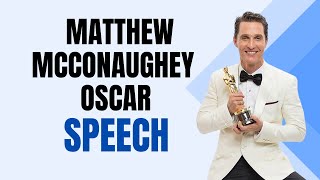
Communication coach TJ Walker breaks down Matthew McConaughey's 2014 Oscar speech, analyzing his eye contact, pacing, and three-part structure. McConaughey's sincerity and specific thanks feel rehearsed but natural, offering lessons for your own presentations.
Chapters
Matthew McConaughey is an Oscar award winning actor known for giving great emotional presentations, not only in movies, but in real life when he is winning awards and speaking in other situations. Let's take a look at him now and see how he does.
Thank you. Thank you. Thank you. Thank you to the Academy for this, all 6,000 members. Thank you to the other nominees. All these performances were impeccable.
So he doesn't seem rushed. He's clearly touched. He's coming across with positive emotion, but he's not crying or blubbering. Some people become so overwhelmed by the moment that it's a little too much. So he seems appropriately touched, very thankful, but not rushed at all. And what I really like is he doesn't say, oh my gosh, I didn't think I was going to win. I didn't prepare anything. Some people make that mistake. And he also didn't waste time by talking about the fact that he doesn't have a lot of time. Let's see where he goes from here.
I didn't see a false note anywhere. I want to thank Jean Marc Vallee, our director.
So when he's thanking someone, it's not generic. He's not looking at notes. Sometimes at the Academy Awards you'll say, I like to thank the director, the producer, my accountant, my tax lawyer. And it just seems very insincere and rote and boring. He actually is looking into the audience to thank his director. You can tell he's really trying to connect and be meaningful and sincere with his thanks.
I want to thank Jared Leto, Jennifer Garner, who I worked with daily. There's a few things about three things.
Really taking the time to thank his co stars, look them right in the eye. Now, that required some planning. He had to know where they were. He clearly gave this some thought. He understands he's a performer. He didn't just get up and wing it. He's not reading a teleprompter. But he clearly gave this thought and preparation.
There's a few things about three things to my account that I need each day. One of them is something to look up to, another is something to look forward to, and another is someone to chase.
So he gave some real thought to this presentation. He had a three part structure. That's fantastic. Whether you're speaking for an hour and doing a corporate training or doing a three minute acceptance speech, it's always a good idea to have some structure, a roadmap, and to not be greedy and not try to communicate more than three ideas.
Now, first off, I Want to thank God because that's who I look up to. He has graced my life with opportunities that I know are not of my hand or any other human hand. He has shown me that it's a scientific fact that gratitude reciprocates. In the words the late Charlie Lawton who said, when you got God, you got a friend and that friend is you.
Across is very sincere and is expressing gratitude regardless of one's beliefs of deities. I think he comes across clearly as sincere and someone who's grateful and humble as opposed to this is all about me and I am the greatest. Thank you for recognizing how great I am. So he comes across humble.
To my family. That's who and what I look forward to. To my father, who I know he's up there right now with a big pot of gumbo. He's got a lemon meringue pie over there. He's probably in his underwear and he's got a cold can of Miller Light and he's dancing right now to you, dad, you taught me what it means to be a man.
Look at the act out. He's Dan. He doesn't talk, dancing, he actually dances. The gestures, the movement. He's using the full range of his body. He's using the full range of his voice, his expressions. He's acting, not somebody else's part, but he is acting. He's acting genuinely excited, passionate, grateful, giving thanks to his father. He's using all of his body parts. He's using his hands, his feet. Everything is moving, all of it in sync in a way that does not in any way seem nervous or actor ish or contrived or phony.
Really very powerful man. To my mother who's here tonight, who.
Taught me and taught his father's to see. So he's looking up at his father. So again, he's thinking about this. He's not reading his teleprompter. He's not fixated on a speech he memorized, although he clearly practiced this and thought about it. He's acting it out, not just saying it out. And it's always surprising to me, a lot of actors who are world class actors with a script and a director, they have an opportunity like this to get in front of millions more than ever saw their show. And they can come across as wooden, flat, just like they're going through the motions. He's really putting on a great performance here and I don't mean that in any way to suggest being insincere. He's coming across very sincere, but Everything is in sync.
Me and my two older brothers demanded that we respect ourselves. And what we in turn learned was then we were better able to respect others.
So he clearly knew where his mother was. When he talked about his mother, he looked at his mother. That came across as very compelling, very emotional. Also makes it, frankly, easy for the director of the show. And the Academy Awards is a show to say to the camera person, you know, pull up the clip where we're showing the mom. So it made for great television, which is so much of what this is all about. Very, very compelling selves.
Thank you for that, mama. To my wife, Camilla, and my kids, Levi, Peter. Mr. Stone, the courage and significance you give me every day I go out the door is unparalleled. You are the four.
So he's covering a lot of ground with his thanks, but he's doing it in an interesting way. He's not just thanking people generically. He's being highly, highly specific in his thanks. And that's why it's coming across as interesting, as compelling, and as meaningful. Very powerful.
Four people in my life that I want to make the most proud of me. Thank you. And to my hero.
Smiles coming across very genuine. He's really looking at people. Always a good thing when you're thanking people. Not to be staring at a script or notes or a teleprompter, but to actually be looking at the people. And he's doing that quite well.
Thank you. And two, a little bit of a.
Pause, then changing directions to someone else. So he's not rushing now. He clearly knows if he goes on too long, the music's gonna come on, drown him out. A hook will come to pull him off. Although they do typically give more time to the major award winners and this is the best actor, it doesn't get much more major than that. But still, it's limited time. It's only four minutes from the time they even talk about the nominees until it's over. And he's using his time for maximum effect, thanking the most important people and being highly specific in the way he's doing it and completely natural.
My hero, that's who I chase now. When I was 15 years old, I had a very important person in my life come to me and say, who's your hero? And I said, I don't know. I got to think about that.
Give me a couple telling stories. The average person says, oh, my gosh, there's no time to tell a story. I just want to thank everybody. Oh, this is wonderful. He understands it doesn't take a long time to tell a story. When I was 15 year old. And he noticed the dialogue. Notice the change of speed. Notice the change of tone in his voice. That's the beauty of telling stories. He's doing it beautifully here. The hands are insane. Now he's holding this award, but his other hand is moving forward freely for emphasis.
Give me a couple of weeks. I come back two weeks later. This person comes up and says, who's your hero? I said, I thought about it. You know who it is.
I said, okay, dialogue. Who's your hero? Changes the tone, changes the speed, changes the angle of his face, makes it interesting, draws us in. No one's getting bored yet. The director's not telling the symphony. Start playing music to get this guy off. He's losing the crowd. No, it's interesting.
It's me in 10 years. So I turned 25. Ten years later, that same person comes to me and goes, so, are you a hero? And I was like, not even close. No, no.
Notice the full range of his voice. A lot of people think, oh, I'm hearing this big speech. I have to sound important, keep my voice low. So are you the hero? Not even close. He's not afraid to have his voice go high. He's using the full range of his voice and talking about essentially being humble. He realizes he's nobody's hero at age 25.
No, no, no.
She said, why?
I said, because my hero is me at 35. So you see every day, every week, every month and every year of my life, my hero's always 10 years away. I'm never going to be my hero. I'm not going to obtain that. I know I'm not. And that's just fine with me because that keeps me with somebody to keep on chasing. So to any of us, whatever those things are, whatever it is we look up to, whatever it is we look forward to and whoever it is we're chasing. To that I say, amen. To that I say, all right, all right, all right.
That's a phrase he made very famous. I believe it was from one of his first big movies. The. Well, it's the one that had the Led Zeppelin songs in it. And it was a. It was a movie about the 1970s that came out in the 90s. One of my favorite movies, and I just forgot the name of it. But that phrase, all right, all right, all right is something people associate with him. He's not afraid to sort of make fun of himself and realize people have that stereotype. And he also, I think it's a nice transition. Realizing, okay, no one can ever mock my acting abilities again. I've got the absolute ultimate award in the acting. So it tied it together quite nicely, his whole career path.
Just keep living. Thank you.
Not rushed, not. Oh, I'm out of time. I gotta go. It's just. He finished. He paused. Keep living. Thank you. And he walked off. All in all, an extraordinarily masterful presentation. And it is a presentation. He clearly thought about it. He planned it, he rehearsed it, he executed it perfectly. Guess what? You can do that, too, in every one of your presentations.
More from TJ





The Breakout Cases - What Actually Caused Famous Speaking Career Breakthroughs | Ultamize

The Red Circle Sessions Finale - Build the Speaking Career You Came Here For | Ultamize

Two Stages, One Logo, Two Completely Different Realities - Main Stage vs Independent Events | Ult...

Pre-Reset - Why Repetition Builds Better Speaking Decisions | The Red Circle Sessions | Ultamize

Your Decision, Your Framework, and What Happens After - Build Your Speaking Career First | Ultamize

The Red Circle Sessions Trailer - The Speaking Career Truth Nobody on That Stage Will Tell You | ...

The Two-Minute Ultamize Reset - Your Platform, Your Audience, Your Voice | The Red Circle Sessions