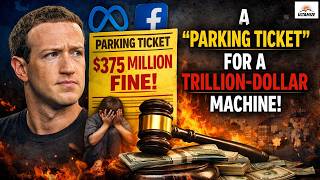
TJ Walker argues Meta's $375 million fine is negligible for a $1.5 trillion company. He calls Facebook an "emotional slot machine" designed to maximize outrage, cites the UN's claim it played a role in the Rohingya genocide, and references Frances Haugen's research showing Meta knew about harms to teen mental health. A real deterrent, Walker says, would be a $150 billion fine.
Chapters
Ultimize. There are bad companies in the world, and there are companies so powerful, so optimized, they don't just sell a product, they reshape human behavior. According to the New York Times, a New Mexico jury just ordered Meta, you know, Facebook, to pay $375 million for misleading users about safety and enabling the sexual exploitation of minors. Yeah, sick stuff. Now, $375 million sounds like a big number until you realize for Meta, it's basically what falls out of the couch cushions in their lobby. That's not a penalty, that's a rounding error with a press release. And this is the first thing to understand about Facebook. Mark Zuckerberg is not clueless, he's not lazy, he's not in over his head. He is extremely smart, extremely disciplined, extremely effective. Which is exactly why this is so dangerous, because the system is not broken. The system is working perfectly. Facebook doesn't accidentally promote outrage, it engineers it. It doesn't accidentally divide people, it studies what divides people and feeds it right back to them over and over and over again, because calm people don't scroll, angry people don't log off. Facebook isn't really a social network, it's It's an emotional slot machine, and the jackpot is rage. We've seen what happens when you scale that globally. In Myanmar, Facebook wasn't just part of the conversation. The United Nations said it played a determining role. Facebook played a determining role in the Rohingya genocide. Think about that. A social media platform helped accelerate genocide. That's not a moderation problem. That's a product problem. And internally, they know it. Knew. Whistleblower Frances Haugen revealed internal research showing Facebook knew its platforms were damaging teenage mental health, amplifying extremism, and rewarding outrage over truth. They had the data, they had the research, they had the warnings, and they chose engagement. Because every time you make the platform safer, you make it less addictive. And every time you make it less addictive, you make less money. So when Zuckerberg says we're working hard to keep people safe, what he really means is we're working very hard to keep people scrolling. Now, let's get back to that fine, $375 million. If you actually wanted to change behavior, you wouldn't fine Meta $375 million. You'd fine them something like 10% of their market cap. Now, as of this recording today, their market cap is more than $1.5 trillion. Trillion dollars. So if you really wanted to stick it to them, if you wanted to send a message, if you wanted to give them a disincentive, you would really need to fine them more like $150 billion. You'd make it so painful that executives wake up at 3 AM in a cold sweat. Right now, this isn't punishment. This is a parking ticket for a private jet. And here's where the story hits home, because people like to think this kind of damage only happens somewhere else. It doesn't. It happens here. You don't get the current political environment in the United States without Facebook. You don't get the same rise of Trump without Facebook because Facebook gave campaigns the ability to micro-target people based on emotional triggers, not policies, not ideas, emotional vulnerabilities. Here's what makes you angry. Here's what makes you afraid. Here's what makes you hit share without thinking or even reading. That's not communication. That's psychological manipulation at scale. Zuckerberg says, "We just connect people." Right. And if I connect a flamethrower to a gasoline tank, I'm just facilitating a connection. This is what drives me crazy about Zuckerberg. He wants the credit of being one of the great innovators in history, but he refuses to acknowledge the obvious truth. The more successful Facebook becomes, the more damage it does. Because the core metric is engagement, and the easiest way to increase engagement is to push people toward their most extreme emotions: fear, anger, outrage, especially outrage. And when you do that to billions of people, you don't just change a platform, you change society. Here's the reality about communication. You don't control how your message is received. You only control what you put out. And over time, people decide whether they trust you. And that's where Facebook is now. Not everyone distrusts it, but a lot of people do. The tide is starting to turn. And once trust starts collapsing, no algorithm can fix that. No PR campaign can fix that. No carefully worded apology video can fix that because trust isn't built on statements. It's built on behavior repeated over time. And Facebook's behavior has been incredibly consistent. They know this is harmful. They know this is dangerous. We know this is hurting people, but it's also very profitable. And look, every company wants growth. I get it. Every CEO wants success. That's normal. But most companies don't have a product that can influence elections, destabilize societies, and contribute to real-world violence. Facebook does. And that comes with responsibility, or it should come with responsibility. Responsibility Zuckerberg has spent years avoiding. Now the lawsuits are piling up, the verdicts are starting, the narrative is shifting from brilliant tech innovator to the guy who built the most efficient outrage machine in human history and pretended not to notice. And here's the final irony. Zuckerberg didn't set out to destroy trust. He set out to maximize engagement. But when you optimize for attention at all costs, you eventually destroy the very thing that makes communication possible in the first place, shared reality. And without that, you don't just lose users, you lose a society that can even agree on what's real. And that is a lot more expensive than $375 million. Ultimize.