MrBeast Enters Banking, Meta Smart Glasses Privacy Shock, AI Layoffs Explained
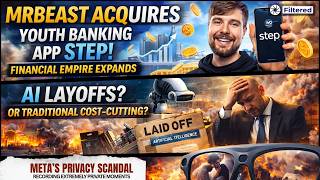
In this March 4 2026 episode of the Filtered podcast, host TJ Walker delivers a rapid‑fire roundup of six major news stories, each filtered through a personal‑development lens. He begins by examining YouTube star MrBeast’s purchase of the teen‑banking app Step, questioning the wisdom of a creator‑led financial service and the potential for crypto‑related gambling among youths. He then critiques the massive AI‑cited layoffs at Block (formerly Square), arguing the AI narrative is a thin veneer for investor‑signaling and cost‑cutting, and urges listeners to upskill with AI tools. Next, Walker exposes privacy concerns around Meta’s Ray‑Ban smart glasses, citing contractor testimony that first‑person footage of intimate moments is being reviewed for AI training. He moves on to the DOJ’s antitrust case against Live Nation/Ticketmaster, explaining the monopoly dynamics, historical parallels, and why breaking up the company could benefit consumers. The episode shifts to U.S. politics, detailing the Texas Senate primary where Democrat James Talarico’s faith‑based campaign upset expectations and Republican Senator John Cornyn now faces a runoff with Attorney General Ken Paxton, highlighting the strategic implications for the 2026 midterms. Walker then tackles Health Secretary Robert F. Kennedy Jr.’s push to mandate extensive nutrition education in medical schools, separating his controversial political persona from the merit of the proposal. Throughout, Walker intersperses personal‑development advice—advocating AI adoption, diversification of career risk, and communication skills—while also delivering promotional spots for his courses and AI clone. The episode ends with a call for listener engagement.
Chapters
Ultimize. A YouTube star wants to become your teenager's banker and maybe even introduce them to crypto. A former executive says the huge AI layoffs at Block may not be about artificial intelligence at all, but about convincing Wall Street the company is keeping up. Workers reviewing footage from Meta's smart glasses say they're seeing deeply private moments, including people undressing.— and using the bathroom. The Justice Department is taking on Live Nation, arguing the concert giant and Ticketmaster operate like a monopoly, driving up ticket prices. A surprising Senate primary result in Texas sets up a Republican civil war that could reshape the 2026 election map. And Health Secretary Robert F. Kennedy is pressuring medical schools to teach more nutrition, raising questions about whether he's improving medical education or politicizing it. All that and more today on Filtered. Welcome to Filtered with TJ Walker. Hi and welcome to Filtered. Thanks so much for joining me today. This is the show where we look at the top business news, technology, economic news, culture news, and filter it through the lens of personal development skills. Let's dive right in. MrBeast moves into banking. YouTube superstar MrBeast is expanding his empire beyond viral videos and chocolate bars and into financial services. According to the New York Times, his company Beast Industries has acquired Step, a banking-style app used by more than 7 million teenagers and young adults. The platform offers spending accounts, savings tools, and investment features supervised by parents for users under the age of 18. Company executives say the long-term plan could include loans, credit products, and even cryptocurrency services. MrBeast says his motivation is simple: he wants to teach young people the financial lessons he never learned growing up. But critics say the move raises new questions about whether one of the world's most influential online personalities, whose audience includes millions of teenagers, should also be guiding them on investing and financial management. Let's dive into this story a little bit deeper. Now, MrBeast is by all accounts the most successful YouTuber ever. Let's look at some basic facts. He has 469 million YouTube subscribers. 1.4 billion people have watched his content in the last 3 months. I know I've seen it. Near teenage daughter has seen it. He's gotten involved in other businesses. Some have gone well, some not so well. His Feastables chocolate bars apparently are a huge success. His MrBeast Burger, that was kind of a disaster. Now, MrBeast does strike me as different from a lot of the social influencers. He seems much more public-spirited. He does a lot more charity work than so many other people who are really big-time podcasters and YouTubers. So I look at him through the lens of, okay, there's a positive halo around him. And by the way, that is not his picture. That's if you're watching on our YouTube channel, apologies for that. But is this a good idea? Because by his own account, MrBeast never learned anything about finance. In the very story announcing this release, he says he's got to borrow money from his own mother for his wedding upcoming. So we wish him well for his wedding. MrBeast has been very— and his name is Jimmy Donaldson, let's be clear, that's his real name— he's been very transparent about the fact that he's not a financial wizard. Basically every penny that comes into his company, he spends it on the next video. So he doesn't seem like someone who's fixated on acquiring wealth and building big mansions and buying yachts. He spends all of his time apparently and money creating world-class videos. So I give him credit for this focus. The reason I wanted to spotlight this is I do think this is the real role model for people who want to become business magnets in the modern world. Do something first as a media company, build a huge audience, build a relationship with an audience. And once you do that, you can take them anywhere. You can take them to the candy store to buy your chocolate bar. You could take them to a bank and do banking with you. There's tremendous power in that relationship. So When I look at Jimmy Donaldson, I see the moguls of the future. Well, not just the future, but the moguls of today. So in the past, we saw people create platforms. Mark Zuckerberg created a platform. The Google boys created a platform for advertising, and they've had a good run. But how many more platforms do we need? We'll always need some platforms. But what's fascinating to me is MrBeast, Jimmy Donaldson, through his sheer creativity and hard work, not through a technological breakthrough, not through his ability to program AI better than anyone else, but really just through his creativity, his ability to tell a story, has created an empire. And an empire it is. Let's look at some more back here from the story in the New York Times. MrBeast is very transparent. He says, nobody taught me about investing, building credit, or managing money when I was growing up. That's exactly why we're joining forces with STEP. I want to give millions of young people the financial foundation I never had. Now, the CEO of Beast Industries, which was not MrBeast, it's Jeffrey Housenhold, says, 'The reach is unprecedented. We know how to tell stories. We know how to gamify things.' To me, that sums it up. If you can tell a story, if you can reach a huge audience, if you can gamify things, you can direct a huge customer base anywhere. You can make almost any business profitable if it has good underlying fundamentals. Now, I don't know enough about Step Financial, to know how good of a product it is. I'll be doing some more investigation of that. And if you've had dealings with them, please post in the comments. I'm a little worried when I hear the word cryptocurrency and young people. Apparently the vast, vast majority, more than 90% of all cryptocurrency purchases are by people under 30 years old. It's wildly popular among young people. You know what else is popular? You ready for this? Lottery tickets. Okay, gambling on what team is going to win the playoffs. It's another form of gambling. Now, I've already spent a lot of time on this show in the past talking about all the reasons to be wary about cryptocurrency, all the reasons why I happen to believe it will rightfully go to zero at some point. Because there's no underlying value. So I'm a little worried that someone with MrBeast's credibility could be used to entice, excite young people into essentially more gambling, which is what cryptocurrency is. Now you could say, well, TJ, any stock is crypto, is gambling. In a sense, any stock can go down, but you are investing in a real business that creates real products and real services. The people who have invested, as I understand he has taken private investors, the people who've invested in Beast Industries are investing in the talents and the skills of Jimmy Donaldson and his team to create cinematic content that is continuing to take over the internet. That's what they're investing in. What people are investing in with cryptocurrency far more nebulous. Now, from initial reports, kids who get involved with this are going to need parental controls, which is great. The last thing we want is a bunch of 16-year-olds given a credit line and running up $10,000 of the debt before they've even gone to college or before they've had their first job. That would be an unmitigated disaster. That does not appear to be what the situation is and what's going on there. So I'm going to go into this with a very open mind because I do think that, that Jimmy Donaldson is a cut above the average influencer YouTuber. He's obviously in his own realm when it comes to his ability to attract an audience and to, to really capture market share. He is a force in his own right, and with that, he does have the power to actually create and own businesses as opposed to taking slices of revenue from advertising. And certainly financial services is a wildly lucrative field. So it's not surprising to me that he has taken ownership of a small company that's kind of worked out the kinks and has established some track record. I don't know how much he paid for it, but this is not a completely new startup. It has 7 million app followers, but he's owning it now as opposed to just doing a distribution deal or a partnership. That's clearly the smarter way to go if you have the infrastructure to run it properly. And that's clearly what Jimmy Donaldson did not have with his hamburger chain. Apparently hamburgers were awful, arrived cold, everyone was just disappointed. It was a bit of a black eye. On his reputation, but now time has passed and it seems like people have forgotten that. So I'm willing to cut him a break. Let's look at some more facts on this general trend here. Social media audiences are now treated as built-in customer bases. It's just a reality that some people trust MrBeast. They are going to buy whatever he's promoting. Creator-led brands increasingly compete with traditional financial institutions. We're seeing more of this Financial gamification echoes Robinhood's controversial trading interface model. I'm not a fan of Robinhood. Those of you who listen to this show, watch this show regularly, I think it's foolish for you or me or anyone to buy individual stocks. Why do I say that? Is it because I want to put all my money under a mattress? No, I do not think that you can outbeat the marketplace in the long run, because even the most highly paid, most educated, most connected fund managers, hedge fund, mutual fund managers fail to beat the market over a 30-year period, 95% fail. So that's why I recommend no individual trading, putting your money into an index fund, an S&P 500 index fund, other index funds to spread the risk and to stop all this concentration. So I'm a big opponent of Robinhood. So if they're trying to copy aspects of Robinhood, that could be troublesome. But MrBeast, wow, does that guy have energy? And is that guy inspirational to me and others? I mean, I'm 150 years older than he is, But he's still inspirational to me how he could go from the little kid, age 12, meekly, softly whispering into a microphone, doing it year after year, not much traction, not much audience, till maybe 5 years, 6 years in, now he's building audience and he gets better and better every single day by studying it. By looking at every second of every frame, every half of a frame, whether the smile works with the teeth showing or not showing. He is a paragon of focus, determination, grit. And so if he wants to make this work, I have no doubt he can. Would you let your kid If you have a teenage kid, get involved in a bank app promoted by MrBeast. Let me hear from you. Post your comments in the discussion group.
Like what you heard? Don't let the algorithm bury us. Subscribe now at substack.com/@tjwalkersuccess. Want direct access to me live? Want to unlock bonus episodes, behind-the-scenes takes, and full access to my premium courses? Then become a member today. Just go to tjwalker.com/members and choose your preferred platform—YouTube, Patreon, whatever works for you. This isn't just another subscription. It's a full-access pass to the tools, coaching, and content that can transform your communication and career. tjwalker.com/members.
Media-training-worldwide.com/members.
I'll see you inside. Before we dive in, quick question: are your communication skills helping or hurting your career? Fix that in 20 minutes a day. Visit media-training-worldwide.com.
Real skills, real results. AI layoffs at Block. At Block, the fintech company led by Jack Dorsey, More than 4,000 employees were suddenly laid off in what executives describe as a sweeping AI-driven restructuring. But a former senior executive at the company says the artificial intelligence explanation may not tell the whole story. Writing in The New York Times, Aaron Zamost argues the layoffs resemble a familiar Silicon Valley playbook: rapid hiring during the pandemic, followed by cost-cutting and restructuring. Block had already gone through layoffs in 2024 and 2025. The AI narrative, Zamos suggests, may be less about technology replacing workers and more about signaling to investors that the company is adapting to the industry's rapidly escalating artificial intelligence arms race. Wall Street certainly liked the message. Block stock jumped 24% after the layoffs were announced. Let's look at some more facts. Again, that's a lot of employees to cut off, to get rid of. That's about half of the employment. Jack Dorsey, he's the former founder of Twitter as well, has had a lot of successes. Block used to be known as Square. This is the app and device that allows pretty much anyone to charge a credit card. You've seen them out if you've been at a farmer's market or any place, you see what they have. They've had Layoffs now 3 years in a row, and they're claiming it's because their artificial intelligence is so good. Right now, AI industry spending rivals the entire GDP of Sweden. It's big, and it's big in part because major companies can announce major layoffs. So here's what Jack Dorsey told the Times: AI is enabling a new way of working which fundamentally changes what it means to build and run a company. But the former executive writing this op-ed piece today says AI may provide a new justification for layoffs, but the playbook is familiar. It matters less whether a company knows how to deploy AI and more about whether investors believe it is on track to do so. Okay, I've seen this big companies and small companies recently when I was attending Podcast, or excuse me, Podfest, the conference of podcasters held in Orlando, Florida. I was sitting next to a pretty famous podcaster who's been in the space for more than a dozen years, has successful business shows, several of them, told me he had downsized from a dozen full-time people to one Virtual assistant, everything else was AI. So we're seeing this big companies like Block, small companies, small, fewer than 20 people companies. What's my message to you? My message to you is you've gotta learn how to use AI. Oh, but TJ, I'm not a techie. Doesn't matter. I don't know how to code, but I use AI in everything I do all day long. AI helped prepare, not what I'm saying now, but the setup for the scripts. AI helps me come up with titles for the show. AI helps me distribute my show. AI helps me take a transcript of what I've said and repackage it into newsletters for people who like to read. I use AI every single day for my online students who want to have a quick instant question answered from me, and I'm not available. They talked to my AI clone. Do I really know how the clone works? No, but I had to take the time to learn how to create a digital clone of myself that sounds like me and talks like me. That's really my message to you because it's just too easy to get comfortable in a big company or mid-sized company these days and think, well, I've worked here 15 years, they never really fire anyone. As long as you don't show up drunk and you play by the rules, you can coast another 10, 15 years and fill out your 401(k). Sorry, it might not work like that for you. Now, I'm not saying this to gloat, and I'm not saying I have it all figured out, but the one thing I know isn't going to happen is I'm not going to completely lose my livelihood because of one company saying we're switching to AI, because I don't put all my eggs in one basket. Now, I realize many of you work for one company and that provides a certain cushion. Hey, you need sick leave, you need time off, maternity leave. Working for a big company can be the greatest thing ever, but it's making you extraordinarily vulnerable right now If you do a lot of mental, if you're a home healthcare worker, you're probably not going to be replaced by AI anytime soon until the robots get really good. But if you're doing anything involving numbers, accounting, consulting, analyzing, law, a lot of medical analysis, and certainly any software creation, you're vulnerable. So We've got to look at stories like this and not filter it out and say, oh, that's just some big greedy company far away, doesn't have anything to do with us. Look, companies are supposed to— I realize this doesn't make me popular, but companies are supposed to have the smallest headcount possible so they can return the greatest amount of money to their shareholders. I realize not everyone feels that, and people feel okay, there's equal shareholders, that they're equal stakeholders that should place a claim on a CEO. Yes, you should think about return on investment. You should think about your community. You should think about your existing employees and taking care of them and try to be paternalistic and helpful. That worked for a long time. That works if you're an industrial plant in a small Midwestern town and people are going to buy your paper or buy your products, whatever. That worked for a long time. It just doesn't work in the modern world when everyone faces competition from everyone everywhere in the world. Everyone's facing price competition. So if you're a company and you have a higher headcount than your competitors and they're delivering the same product or service, they're going to be able to deliver the same level of service as you for much lower cost, and they're going to put you out of business. So it's fun to bash corporate CEOs, and hey, I'm not some big corporate CEO, some big tech CEO with thousands of employees. I'm not reflexively on their side. I criticize Mark Zuckerberg all the time, which I'm about to do in our next story. But the idea that tech workers or that tech CEOs or CEOs of any company are supposed to sit back when they are presented with information from their IT office saying, hey, there are new programs that we can purchase inexpensively using AI, and for $1,000 we can replace an employee that we currently spend $100,000 on. And we can do this with 1,000 employees. If you think the good thing to do for the CEO is to say, well, people first, okay, but I bet when you're buying and selling stocks, that's the first stock you're going to sell because they're going to be making you much less money. And if you don't buy and sell stocks, that's going to be the one in your 401(k), in your index fund if you're a schoolteacher that's bringing down the average. And there's going to be pressure from you or others saying, hey, let's get rid of those low-performing stocks. So there's simply no easy way for a CEO to say no to cost-cutting measures that AI can produce. Now, there are solutions at a societal level. Societies can create higher minimum wages, they can create more money for retraining people, they can have stronger social safety net. I'm in favor of all those things, but you and I can't control those beyond our vote. I want to focus this show primarily from the personal development angle on what you and I can control. And I do think you can control your own destiny if you're constantly trying to learn how to use AI better than anyone else in your field. Maybe not every other AI expert, but everyone in your field doing your service so that one of two things happens. You become indispensable to your firm, and if they have to lay off 50% or 90%, you're the one they keep. Or if you do get laid off, you have the ability to create your own company whether you call it freelance consulting services for hire, a few clients, you have the way to be valuable in the marketplace so that you can make the money you want to support the lifestyle you wish.
We'll be right back after this break.
Want to advertise here? You better be legit.
No crypto, no junk food, no supplements, Go to tjwalker.com/advertise. Most people can't afford a full-time coach, and even if you could, good luck finding one who's available when you need them. That's why I created the TJ Walker AI Clone. It's built on my 40+ years of real-world coaching and training. You get my exact advice, style, and frameworks in Instantly. Ask it how to handle a tough question. Get feedback on your elevator pitch. Rehearse your next big talk. This is the next generation of communication coaching.
It's smarter than an app, more personal than a course, and always ready.
Start using it today at tjwalker.ai.
You'll wonder how you ever did without it.
Want to advertise to ambitious upscale professionals who actually care about communication success and results? Go to tjwalker.com/advertise. And no, we don't take ads for crypto, supplements, or junk food. If you've ever struggled with nerves, unclear messaging, or just not being taken seriously, this is for you. I created the TJ Walker Success Library as a crash course in professional-level communication. You get 5 downloadable books for just $9.95 that walk you through public speaking, media training, persuasive communication, confidence building, and daily practice routines. This is the same training I've delivered to presidents, CEOs, and leaders in 45 nations, boiled down and instantly accessible. Go to tjwalker.com/books and download them now.
Meta smart glasses privacy concerns. Workers helping train artificial intelligence systems for Meta say they are being exposed to deeply personal footage recorded by users of the company's Ray-Ban Meta smart glasses. According to investigations by Swedish newspapers, contractors in Nairobi are reviewing first-person videos recorded through the glasses in order to label data used to train Meta's AI models. Some of the videos reportedly include extremely private moments—people undressing, using the bathroom, or engaging in sexual activity—often without realizing that the footage could later be reviewed by human contractors. The glasses sold more than 7 million units last year. But critics say the technology raises major privacy concerns. Well, that's an understatement, especially since users must agree to send recordings to Meta's servers if they want to use the AI features built into the device. So this is probably one of these, you know, 150-page memos, consent forms that you do for telephone companies, your TV company, internet, that no one ever reads. Well, it turns out that fine print, that legal fine print, means apparently people who work for Meta can watch people in your family, maybe you having sex or going to the bathroom. If it said it like that, I don't think anyone would consent to it. So let me be transparent here. I've I've given some positive coverage to these glasses over the last 6 months. They do intrigue me. It does seem like fascinating technology. I've not urged you to buy them and I have not bought them. These are just reg— for those of you listening on the podcast, I'm taking my glasses off now. These are just regular glasses. These are not Meta glasses or smart glasses. They're just regular glasses. This is significant and this story, I don't believe has gotten the attention it really deserves. This is what data annotator working for Meta contractor Sama said: In some videos, you can see someone going to the toilet or getting undressed. Another contractor says, I saw a man who puts the glasses on the bedside. His wife comes in and changes her clothes. Another contractor says, you understand that This is someone's private life you're looking at, but you're just expected to carry out the work. Clendy Serdelli is a data protection lawyer who said in the article, once the material has been fed into the models, the user in practice loses control over how it's used. Again, the fact 7 million units sold. In 2025. Only 2 million pairs sold in 2023 to 2024. So the rate of acceptance and adoption is going up. The glasses record first-person video using built-in cameras. So it looks like a regular Ray-Ban set of glasses and there's a tiny light on there and you can either touch it or I believe talk to it and get it to record typically 15-second snippets or take a photo. And a light comes on, which is supposed to alert people. But like most things, I'm sure you just get used to it or you don't pay attention to it. You're not thinking about it. So the recorded footage is sometimes sent to contractors for labeling. Data labeling is common in training AI systems. That's how it figures out this is a cat and this is a dog and that sort of thing. The contractors interviewed are based in Nairobi, Kenya, which is an inexpensive place for Meta to hire people. Beautiful city, by the way. I've loved when I was there, and the beautiful thing about Nairobi is they've got this giant wildlife preserve in the middle of the city, and you can be in your hotel snacking on breakfast and a giraffe walks up. But anyway, that's what's happening in in Kenya. The investigations were published not by Silicon Valley newspapers, not by the New York Times, but by Swedish newspapers. We'll see how much extra attention it gets in the mainstream media in America and if this is a hit to the meta glasses. Now, they're popular primarily among young people, and it's a cliché to say it, but I guess it's true. Young people don't care about privacy. But I think what they mean is you go to a party and you have a silly smile on your face or you're chugging a beer, it's not the end of the world if someone puts that picture on Facebook. But if you're getting undressed or going to the bathroom, if other people are watching that and that becomes a part of content owned by Meta, I think that's a little bit different. There's something particularly scary and weird about that. How do you feel about these Meta glasses? Would you own them? Again, I like the idea of being on an airplane, for example, not having to fumble around for an iPad, being able to sit back and just say, okay, show me such and such movie. And having quality audio from my glasses go into my ear and seeing my entire field of vision with a movie. Now, apparently it's not doing that yet, but that's not far off. I like the idea of my wife and daughter and I are on vacation somewhere and there's a beautiful sunset, and my wife doesn't have to say, "Hey everybody, let me get my camera out and let's pose for a picture." She could just blink or do this and take a nice picture of the family. That seems like that would be really nice, but the downside does seem to be extraordinary with the idea that Meta can look at anything, and apparently, like a lot of technologies, things just happen and you're not aware of it. Maybe you're accidentally touching your glasses and it's recording your spouse going to the bathroom. Maybe you say something and it triggers it. It seems that we need some more work done on the privacy here. I'm not betting on the United States to do this. This attracted the attention of Swedish media and Swedish regulators. Europeans do seem to take their privacy concerns and rights a lot more seriously than Americans, so let's see what they can do. Perhaps they will provide a good example. To the rest of us.
We'll be right back after this break. Want more? Grab my 5-book success library for $9.95 at tjwalker.com/books. It's the fastest way to level up your communication. Imagine being the most confident person in the room, whether you're on Zoom or on stage. That's what thousands of professionals are learning to do right now through my online communication courses. At Media Training Worldwide, you can access my complete training library on demand, affordable, and actually effective. Whether you're preparing for media interviews, client presentations, or TED-style talks, I've got you covered. Check it out, mediatrainingworldwide.com. You'll never wing it again. Want to advertise here?
You better be legit.
No crypto, no junk food, no supplements. Go to tjwalker.com/advertise.
The US government is now trying to prove that Live Nation, the company that owns Ticketmaster, has become a monopoly dominating the live music industry in a major antitrust trial now underway. Justice Department lawyers argue the company pressures artists and venues to use its services, limiting competition and driving up ticket prices for fans. The government says Ticketmaster controls ticketing for about 86% of major concert venues, allowing the company to charge higher fees while facing little meaningful competition. Live Nation denies the accusation, saying the concert business is highly competitive, and that the artists and venues have many choices. If the government wins, regulators could potentially break up the company, undoing the controversial merger between Live Nation and Ticketmaster that originally created the concert industry giant. This definitely bears looking into. I give credit to the Antitrust Division of this Justice Department for looking into this. I've— those of you who are regular viewers know I'm not a huge fan of the current Justice Department in the United States. And I didn't think they even cared about antitrust anymore. But I'm going to be fair here. It looks like they've done the right thing because ticket— let's face it, ticket prices are out of control. I mean, when I think of the big-name concerts I went to, I think I paid $40 to see Sting. Back in the day, maybe $30 to see Fleetwood Mac, and now my daughter wants to go to see Taylor Swift, and we're talking about the cheap, cheap, cheap seats, $1,000, $2,000. Something seems crazy. Something seems bizarre here. Now, I'm not an antitrust lawyer, but the concepts are pretty simple. When one company controls a majority of the market and they control other pieces of the market, they're vertically integrated, so they control everything, they can do what they want, and that's when the government has to step in. That's what happened to J.D. Rockefeller's Standard Oil. He controlled the vast majority of oil production and distribution and manufacturing in America. So, he could charge what he wanted. The government broke it up. That's what happened to AT&T. It controlled everything and we broke it up. So, those of you say, "Well, you know, it's the private sector. The government can stay out." No, the reason you have a private sector and free enterprise is you have rules. One of the rules is you can't become so big that you're not really competing anymore. Because then you can charge whatever you want and consumers take it on the chin. So it's not in any way inconsistent to call yourself a free market conservative and to want antitrust regulation. In fact, the two very much go hand in hand. If you're so much against big government and government regulation, then let's roll back the clock and you can pay $189 for a long-distance phone call because that's what it used to cost when one company ran things. Long-distance phone calls were wildly expensive. And if you're under the age of 30, you're probably saying, "Well, TJ, what's a long-distance phone call?" Believe it or not, there was a time when you paid for a phone to be wired into the wall in your home, you could call someone in your small town, and that was a part of your monthly fee of $20, $30, whatever it was. But if you wanted to call Grandma in Chicago or Uncle Bob in San Diego or the grandparents in the old country, Well, now you're talking about like $5 a minute of a long-distance phone call was a big thing, but the monopoly was broken up. Plus big government giving us the internet, which all the tech bros love to forget, but we wouldn't have the internet without government spending, defense projects, etc. So I'm all in favor of the government looking into this, and in fact, I'm not a not a fan of the merger that took place, Live Nation and Ticketmaster, in the first place. It's just too much concentration. And look, it's human nature. If I literally could control every single online course that dealt with communication skills training, and I don't, and I could control who could create the courses, and I could control the pricing for everyone. Well, I might charge $100,000 a course because I could, but that wouldn't be fair to the rest of the world, would it? You would want some kind of provision breaking up that monopoly, and you would be right. Let's look at some more facts here in the case and some more comments. According to David Dalquest, a Justice Department antitrust lawyer, We are here because they misuse their market power. The case is about power, the power of a monopolist to control competition. Their technology is held together by duct tape, referring to Ticketmaster's ticketing system. Now, David Marriott, an attorney for Live Nation, says Live Nation and Ticketmaster are all about bringing joy to people's lives. Right, okay. Look, the musicians bring joy to lives, but the venue, the ticket prices, and then you pay an outrageous fee and then you're told it's another 30%. It seems outrageous. It's ripe for competition. Let's look at some more facts. Now, this merger happened way back in 2010 between Live Nation and Ticketmaster. Ticketmaster has grown and grown and grown. It handles 86% of major venues. You know, when you control 86% of a market, you can pretty much do whatever you want. Live Nation disputes the figures, saying, oh, it's only 40%. The Justice Department was joined by 39 states and Washington, D.C. The trial is expected to last about 6 weeks. The venues allegedly pressured to sign Ticketmaster deals. So if you're a big coliseum, if you're a big auditorium and you want to sell your own tickets, Ticketmaster kind of comes to you and says, hint hint, nudge nudge, a nice venue you have here. Be a shame if nobody came to your concerts, wouldn't it? Now, I'm not suggesting they actually do anything that is mobster-ish, but when you have a monopoly, you don't really have to. That's, that's really the problem. Government claims fans pay $1.56 to $1.72 more per ticket because of their, of their monopoly power. I gotta tell you, that seems shocking low. Well, we're talking about ticket prices of $1,000. Who cares about $1.72? That seems bizarre. There are problems when there's a monopoly. You don't have to worry about upgrading technology. You don't really have to compete. And that's part of the problem. The Ticketmaster system failed during Taylor Swift Eras Tour sale. A lot of fans were simply shut out because they had not invested in good technology. They underinvested because when you've got a monopoly, you basically can just put everything into the profit camp. You put that all into one big pot and you keep it. You figure, why bother getting better? We don't have to compete. Other rival ticket companies claim unfair competition. The Barclays Center in Brooklyn, New York, close to where I used to live, briefly left Ticketmaster for Seatgate in 2021, but that's, that's the aberration. So hats off to the Justice Department. I can't believe I'm saying that these days, but at least they are apparently appropriately going after some abuses of the system. So I want to thank them for that. I'm TJ Walker. We have lots more to come. Do not go away.
Filtered is brought to you by the following. Want to advertise here?
You better be legit. No crypto, no junk food, no supplements. Go to tjwalker.com/advertise.
Want to become a better speaker, leader, or communicator? Start with the TJ Walker Success Library. It's 5 of my most practical books covering everything from public speaking to media interviews and persuasive messaging, all for only $9.95. I've trained presidents and Fortune 500 CEOs, and now you can get the same wisdom in a fast, affordable format. Go to tjwalker.com/books and download your copies instantly.
Thanks for listening.
If you like today's episode, you'll love my online courses at MediaTrainingWorldwide.com. Check them out now and level up your skills.
Hi, I'm TJ Walker. This is Filtered. Thanks for joining me, and special hello to Julius, has just signed on and said, hello, where do I catch from anyways? I am staying for a while. Well, thanks so much, Julius, for stopping by. I appreciate it. We're diving right into top political news. Yesterday was a big political day here in the United States. Texas, a lot going on there. Texas politics took a dramatic turn as James Talarico, a little-known state legislator, won the Democratic primary for the U.S. Senate. According to the Times, Talarico defeated Representative Jasmine Crockett after campaigning on a message centered on faith, unity, and bridging political divides. On the Republican side, Senator John Cornyn failed to secure a majority and will now face a runoff against Texas Attorney General Ken Paxton. The two Republicans finished nearly tied after more than $71 million in advertising had already been spent. The results set up months of intense campaigning in one of the country's most politically complex states, with Democrats hopeful the Republican infighting could make the race unexpectedly competitive in the 2026 midterm election. So I've heard this one before, that the Democrats were going to win big statewide in Texas. It's been about, what, 30 years since that's really— it's been a long time since the Democrats have won a governorship or a Senate race in the state of Texas. It always seems close. Beto O'Rourke seemed close. It never quite happens. Many Democrats, not only in Texas but across the country, have really taken to this young guy, James Salazar, who's only 36 years old, was a seminary student, and talks in a way you don't typically hear Democrats talking. He's talking about his faith constantly. We're used to hearing Republicans talk about religion how they want to impose specific religious values, posting the Ten Commandments, things like that. But we're not used to hearing this from Democrats. So that is what is a little bit unusual in this race. The other thing that's unusual is Ken Paxton, the Attorney General of Texas, came very close to beating John Cornyn and now may be in a runoff. There are predictions that Donald Trump, the president, may endorse the attorney general over the incumbent Senator John Cornyn. So here's one of the things we like to talk about, messaging and communication here on this show. Communication isn't always about the actual facts. It's quite often about the style and how you package the facts. John Cornyn, based on his own track record, his own voting record supports Trump 99% of the time, votes for him 99% of the time. And yet Ken Paxton is running as the true Trump fan, the true Trump ally, and is attacking Cornyn as sort of old school and out of touch. Part of it is age. John Cornyn is older, significantly older than Ken Paxton. Has grayer hair, not that there's anything wrong with gray hair. And it's a vibe. Senator John Cornyn, when he votes for Trump or when Trump says something, you often get the sense that he's one of those senators sort of biting his tongue thinking, I can't stand Trump. Trump is an idiot. But if I oppose him, I'm going to get trashed in a tweet. So I better just stick with it and hope this guy leaves the stage at some point. You get that feeling from John Cornyn, even though he votes for Trump. With Ken Paxton, you get the sense he's a true believer, or certainly that he's not bothered or troubled by anything Trump does. There's also sort of the affinity with Paxton and his background and Trump. Paxton is filled with all sorts of scandals. His wife divorced him for committing adultery on him. Not that I care, but he's also running as the big Christian, the big conservative Christian who gets to cheat on his wife. Cornyn's trying to make a deal out of that. Doesn't seem to cut. It never hurt Trump even though everyone knew he was a serial adulterer. So there's that. There's all sorts of financial scandals with Paxton. He was almost removed from office by his fellow Republicans, and yet he's the guy who's willing to attack, attack, attack. He attacks Democrats as strongly and as forcefully as Trump, and that makes him seen as quite a popular figure in the Republican Party. So at the time of this recording, the way the votes are coming in, it appears that John Cornyn is slightly ahead of Ken Paxton, but it goes to a runoff. Neither candidate got a majority. So there will be a runoff, which is good news for the Democrats because it means tens of millions of dollars more is going to have to be spent on this campaign, where normally you would expect an incumbent to be able to just save their money for a general election. That's not happening here. Here's what Democrats are hoping for, and they— when they get what they hope for. Sometimes they're really disappointed. I well remember many Democrats in the spring of 2016 were saying, please, please, please, please, Republicans nominate Donald Trump because he's going to be so easy to beat because everybody hates him and he's failed at everything in life. And yet what happened? So Democrats need to be very careful about what they hope for. But right now, The Democrats are hoping that Ken Paxton wins the primary but is so bloodied up, is so brutalized by that runoff, and has his negatives so high that when voters go to the polls, they think, okay, this is the guy who's sleazy, has committed financial scandals, has committed adultery on his wife, and is just gonna go and rubber stamp Trump for any war he wants versus this guy, James Talarico, who's running as a moderate, running as a centrist, running as someone like most Texans who believes in religion and faith. That's what Democrats are hoping happens because they believe that this is the year that Texas could go Democratic. There's also a lot of other issues there where home builders, others can't find any employees because the people who usually do the hard, hot work in the sun, putting on roofs and laying brick, they've kind of been kicked out of the country. So you see a lot of traditional small business owners put out of business because of policies of the current administration. When you factor it all together, it could be a very good year for Democrats in Texas. Here's what James Talarico said last night, "The people of our state give this country a little bit of hope, and a little bit of hope is a dangerous thing." We will see. We'll see what's going to happen there. Again, Jasmine Crockett, very articulate. I happen to think she's incredibly funny. She really gets under the skin Republicans, very forceful, dynamic communicator. But as of early Wednesday, she was down 46% to 53% for James Tallarico. So we'll be keeping an eye on that race because it's a big, expensive state. If nothing else, it drains money from the Republicans that they'd like to be spending defending other Senate seats and winning House seats to try to win this race. Now, Tallarico's gotten a lot of attention in part because Stephen Colbert interviewed him. It famously was not allowed to go on the CBS late-night show. He then posted on YouTube and it got 10 times more views than it ever would have gotten on late-night TV. He had a tremendous amount of fundraising coming in. We're going to see, it's going to be an interesting race. Other election news that came in yesterday, Democratic nominee Roy Cooper is confirmed as the Senate nominee for North Carolina. I grew up in North Carolina. I still consider that my home state. He's an extraordinarily well-regarded politician, has never lost a race. Was the Attorney General for 2 terms, was Governor for 2 terms, was heavily recruited by Washington, by the Democratic poobahs, to run for this Senate seat and is running. That's an open Senate seat. The Republican nominee is Michael Whatley, a former Republican National Committee chairman. Interestingly, former party chairmen usually don't make good candidates. They're typically more the insiders. I'll keep an open mind on him. I have not seen that candidate on the stump. The, uh, any Republican nominee for Senate in North Carolina has a better than even shot because it is a state that mostly elects Republicans to the Senate. North Carolina Democratic turnout exceeded the Republican turnout by 200,000 votes. That's encouraging news for the Democratic side of things. Other things of interest, there was a fascinating upset. Republican Representative Dan Crenshaw lost the primary to Steve Toth. Representative Dan Crenshaw, you've seen him on TV. He was a former war hero, lost an eye. He always wears an eye patch. Solidly Republican and conservative but has some independence to him, would speak out from time to time criticizing Trump. And we now live in politically correct times where if you are Republican and you ever deviate against Trump, you're instantly called a RINO, which means a Republican in name only, and you are given a primary opponent. And that's why there is such discipline. Representative Dan Crenshaw showed spine, he showed backbone, he showed some independence of thought, and he paid the price by losing his political career, which I wish more people would be willing to do that. I frankly don't know why you'd want to go to all the trouble of getting to elective office and then voting for things you think are horrible for the country just to stay in the office. Because What fun is it to be in office if you can't do anything that you think actually makes the country better? Because the hours are awful. The actual workday of most members of Congress is awful because they got to be on the phone all day long begging people for money. There's a sense that all politicians are corrupt. That's not really true, although I do think it's true of one particular one. In the White House these days. But for most politicians, if you've got the drive, the tenacity, the discipline to make 100 phone calls a day begging people for money, you could be making $1 million a year as a stockbroker or as an insurance broker. So they're actually not in it for the money. I'd like to think they're in it to try to make the world a better place, but when you see how time after time after time so many candidates who get into office then vote 100% against everything they said they stood for just because a dear leader who happens to be the head of their party is telling them to vote otherwise, it does make you question it. Okay, we're going to switch to health news in just a moment with our final segment of the day. We are going a little bit long, but we're going to try to be concise on this one and get you out on—
We'll be right back after this break. Want more? Grab my 5-book success library for $9.95 at tjwalker.com/books. It's the fastest way to level up your communication. Imagine being the most confident person in the room, whether you're on Zoom or on stage. That's what thousands of professionals are learning to do right now through my online communication courses. At Media Training Worldwide, you can access my complete training library on demand, affordable, and actually effective. Whether you're preparing for media interviews, client presentations, or TED-style talks, I've got you covered. Check it out, mediatrainingworldwide.com. You'll never wing it again.
Health Secretary Robert F. Kennedy Jr. is pushing a sweeping effort to reshape how America trains its doctors by requiring medical schools to teach significantly more about nutrition. According to the New York Times, Kennedy has spent months pressuring universities to add roughly 40 hours of nutrition education to medical school curriculums, arguing that poor poor diet is a major driver of chronic disease in the United States. Dozens of schools are now expected to adopt at least some of the recommendations. Many health experts agree that doctors currently receive very little training on nutrition, but Kennedy's approach, including threats to cut federal funding and proposals influenced by alternative medicine advocates, has alarmed some medical leaders. Critics say the federal government should not dictate what medical schools teach, while others warn some elements of the proposed curriculum drift away from established science. The result is debate— is a debate over whether Kennedy is modernizing medical education or politicizing it. Okay, I'm gonna surprise some of you. I've been a harsh critic of Robert F. Kennedy Jr. I think in general his anti-vax attitudes and sentiments over the years is crazy, that he's a nut, that he's in way over his head. However, I agree with him on this. I think it's an outrage that doctors are not taught more about nutrition. You know, one of the reasons our healthcare system is so expensive is we wait until someone has destroyed their heart, destroyed their lungs, destroyed their body with sugar, processed food garbage. They're obese, they're diabetic, and then we wanna give 'em a pill. And doctors are too scared or frankly lack the education to talk to patients about nutrition. So this is a huge problem. You don't have to buy into any of Kennedy's nonsense about vaccines or his nonsense about wearing blue jeans when doing a workout. To agree with him on this. Now, the, the proposed Surgeon General, Casey Means, is a big advocate of this. If you've read her book, she spends a lot of time talking about how nutrition is a big problem in America. And from her own education at Stanford Medical School, she received almost no education on nutrition. It's a big, big problem. And doctors need to get to more at the heart of the problem. That, you know, the whole idea of you're just going to wait until someone has a heart attack and then you go in and perform surgery. That's how, if you're a doctor, you make the most money. If you're a heart surgeon, you want to, you basically want them to eat horrible crappy food for 40 years and then boom, you get to give them a new heart and you're the hero. You're the hero. You get the $10,000 fee or whatever it is, and you saved another life. Well, life could be saved if that 40-year-old had been told at every annual physical when they're 10, 11, 12, 20, 25, 30, what are you eating? Show me your diet. Let's come up with a nutrition plan so that you can be a proper weight so that Your circumference isn't the size of a small desk. These are the conversations doctors really need to be having with Americans if they want to save lives and increase the quality of life. This is where I hope I show you I'm a sane, sensible centrist. I'm not coming at this from a pure partisan standpoint of, Oh, here's somebody on a team I don't like. They're always bad. Here's somebody on my team I like. They're always good. No, the idea that doctors need more nutrition education and they need to be empowered to talk about nutrition is 100% correct. Unfortunately, these days so many doctors feel like, oh, if I even ask a patient to step on a scale, they're gonna say I'm fat shaming, so I won't do that. That's a huge problem, and it's resulting in death. I'm TJ Walker. I want to thank you for spending time with me today. Please leave your comments. If you are new to the show, please consider subscribing, sharing the show with friends, leave comments, sign up for notifications. If you're on any podcasting platforms, please hit the subscribe button or the follow button. Thanks so much. See you tomorrow.
More from TJ





The Breakout Cases - What Actually Caused Famous Speaking Career Breakthroughs | Ultamize

The Red Circle Sessions Finale - Build the Speaking Career You Came Here For | Ultamize

Two Stages, One Logo, Two Completely Different Realities - Main Stage vs Independent Events | Ult...

Pre-Reset - Why Repetition Builds Better Speaking Decisions | The Red Circle Sessions | Ultamize

Your Decision, Your Framework, and What Happens After - Build Your Speaking Career First | Ultamize

The Red Circle Sessions Trailer - The Speaking Career Truth Nobody on That Stage Will Tell You | ...

The Two-Minute Ultamize Reset - Your Platform, Your Audience, Your Voice | The Red Circle Sessions