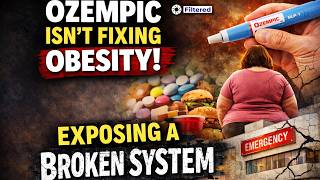
In this monologue, TJ Walker acknowledges that GLP‑1 drugs like Ozempic are medically effective for weight loss and blood‑sugar control, but argues they function only as a symptomatic, profit‑driven band‑aid that fails to address the deeper, engineered food environment and cultural habits that drive obesity. He describes how the modern food system is deliberately designed to be hyper‑palatable, constantly available, and calorie‑dense, creating a landscape where people are forced to over‑eat. Walker critiques the financial incentives of pharmaceutical companies and prescribers, noting that they profit from ongoing medication rather than from sustainable lifestyle change. He outlines the serious side‑effects listed in prescribing information—nausea, pancreatitis, gallbladder disease, kidney issues, and potential thyroid tumors—emphasizing the need for informed, cautious use. The core argument is that without altering eating patterns, food availability, and personal self‑control, reliance on Ozempic creates lifelong dependency, merely masking the problem rather than solving it. Walker frames obesity as a cultural and systemic issue, calling for a shift toward personal development and systemic reform rather than reliance on costly medication.
Chapters
According to a recent article in Slate, drugs like Ozempic and other GLP-1 medications are increasingly being used not just as medical treatments, but as a kind of a cultural shortcut. Ultimize. A way to lose weight without really changing the habits or environment that caused the problem in the first place. The article makes a simple but uncomfortable point: these drugs don't fix the system, they just make it easier to eat less inside that system. And that's exactly why we need to talk about them. Let me say something upfront before anyone gets mad. Ozempic works. I'm not trying to talk you out of Ozempic. That's not controversial. It really does work. People take it, they lose weight, they feel better, their blood sugar improves. Great. But here's the uncomfortable question nobody really wants to deal with. What problem is Ozempic actually solving? Because I don't think it's solving the real one. We're living in the most aggressively engineered food environment in human history. You're not just eating too much. You're being surrounded 24 hours a day by food designed by scientists to make you eat more, to binge. Not chefs, not grandmothers, food scientists. People whose job is to figure out how do we make this snack impossible to stop eating? And they figured it out. Sugar, salt, processed carbs, textures that, mm, melt in your mouth so your brain doesn't even register calories. Drinks that spike insulin and make you hungrier an hour later, and we're shocked people are gaining weight. It's like dumping cigarettes on every desk in America in 1962 and saying, wow, weird, everybody's smoking. So now we have Ozempic, a drug that basically says, you know that environment that's making you constantly hungry? Let's override your biology so you just don't feel like eating as much. Again, it works, but let me give you this TJ Walker version of this. This is like putting fresh paint on a moldy wall. Looks better, doesn't fix what's underneath, because the real issue isn't hunger. The real issue is what we're eating and how often we're eating. We're grazing all day long, snacking every 2 hours, drinking calories constantly, and then we act surprised when our body says, great, I guess we'll start storing energy now. Now here's where it gets interesting. And a little uncomfortable. Because if Ozempic were just a natural health food, fine, but it's not. It's a multi-billion-dollar business model. Drug companies don't make money telling you, hey, maybe just drink water, have an egg for breakfast, and stop snacking all day. There's no IPO in that. There's no Super Bowl commercial for eat an apple. Doctors, same issue. They're not bad people, but the system is what it is. They get paid to prescribe. They don't get paid to come into your house, open your refrigerator, and throw away 80% of the junk in there, which, by the way, would probably do more for your health than any injection. Let's talk about the part that really doesn't get enough attention: the side effects. I'm not talking about internet rumors. I'm talking about what's listed on the actual prescribing information, because when you read it, it's not exactly, take this and everything's perfect. You see nausea, vomiting, diarrhea, constipation, stomach pain. Okay, not great. Then you keep reading. Pancreatitis, gallbladder disease, kidney problems, possible thyroid tumors. And suddenly this starts to sound less like a wellness hack and more like something where you might wanna pause and say, oh, wait a minute, what exactly am I signing up for? And again, important, this is nuance. There are people where this drug could be incredibly helpful, life-changing, may save their lives. But here's the key issue: if you don't fix the underlying behavior, you're now dependent on this drug forever because the environment didn't change, your habits didn't change, your food didn't change. Only your chemistry changed. And this is the part no one wants to say out loud: this isn't just a health story, it's a culture story. It's a system where junk food is cheap, it's convenient, and it is everywhere. Movement is optional. No one really has to walk anywhere anymore. Screens are constant, and discipline is considered weird. And now we're shocked we need medication to cope with that environment. Let me put it in personal terms, personal development terms, because that's really what this is. Ozempic is like hiring someone to follow you around all day long and slap food out of your hand. Effective? Yeah, but it doesn't make you better. It just changes the outcome. And if you actually want long-term health, you have to become the kind of person who doesn't need someone slapping food out of your hand. That's the game. And no pharmaceutical company is going to sell you that because there's no recurring revenue in self-control. So if you're using Ozempic thoughtfully, carefully, with full awareness of the trade-offs, fine. But if you're using it to avoid dealing with the real issue, then you're not solving the problem. You're just putting a very expensive, very sophisticated, very profitable Band-Aid on a broken system. And the system is not just broken, it's designed that way. Ultimize.