Phone Bans Spread, Alex Jones’ Final InfoWars Vow, Iran War Backlash
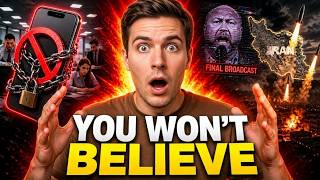
TJ Walker examines workplace phone bans, Alex Jones' $1.3 billion defamation judgment over Sandy Hook lies, and a Reuters poll showing 61% disapprove of U.S. war in Iran. He argues phones distract workers and the Jones case is about accountability.
Chapters
Ultimize. According to The Independent, phone bans are no longer just for schools, concerts, and comedy clubs where comedians don't want their jokes leaked by some guy named Bryce with 12 followers. They're now spreading into the workplace. The Independent reports that companies are locking up phones or forcing workers to use sealed pouches to reduce distractions and protect sensitive information. One company, it's called ID.me, has had about 290 support employees using locked phone pouches for more than 3 years. Employees keep the pouch with them, but they can only unlock it in a magnetic station. I gotta tell you, I love this. I think this is the greatest thing ever. One ID.me employee told The Independent the ban helped her connect with coworkers. She said, quote, it gets us to connect with each other, talk to each other. Imagine that, human beings talking to other human beings at work. What a radical concept. We used to call that having a job. Now it's treated like an Amish retreat. And JPMorgan Chase CEO Jamie Dimon reportedly called phones in meetings disrespectful and said people reading text and emails during meetings has to stop. Good for him. Diamond is exactly right on that because cell phones are the wildest, craziest distraction machines ever invented. Let's be honest. And hey, I like my cell phone. I'm having to use it right now to livestream with TikTok, but I'm not going to be checking texts while giving this news broadcast, this news analysis. Because let's face it, a smartphone is not just a phone. It's a casino, a sports bar, a gossip machine, a shopping mall, a porn theater, a dating app, a slot machine, and a tiny glowing demon whispering, "Don't listen to your boss. Check if your ex watched your story." And somehow we've normalized this. If someone came to work holding a large TV and watching soccer games all day long, everyone would say, "It looks like Gary's finally snapped." But if Gary checks his phone every 2 seconds for sports scores, text messages, fantasy football updates, dating app matches, and how much money he lost on Cash App, we call that being reachable. Well, no, that's not being reachable. That's being professionally useless with unlimited data. At my own workplace, I have a cell phone ban right now. Now, it is true I have my cell phone on, but I'm not allowing myself to touch it during this entire live broadcast and recording session. Later in the day, I will be in a recording session for 3 hours a day. I put my cell phone in another room. I'm not allowed to touch my own cell phone and I'm the boss. That's how serious I am about this. I made a rule so strict, even the dictator has to obey it because I don't trust myself either. None of us are magical productivity monks. You put that phone near me and suddenly I'm not running a business any longer. I'm checking whether a stranger in Nebraska liked my post from 2019. I'm not the only one. And the worst version of this is when someone is giving a presentation. Someone worked 2 months on it, they researched it, they rehearsed it, they made slides, they probably had 3 emotional breakdowns over whether the graph should be blue or slightly darker blue. And then some employee in the front row pulls out a phone like, hold on, I need to see if my burrito delivery is 2 minutes away. Are you kidding me? That's not multitasking. That's you announcing your 2 months of work on less import— are less important than the notification I get from Buffalo Wild Wings. If you wouldn't pull out a 65-inch TV during a meeting, plug it in and start watching Manchester United or the Miami Dolphins, then don't pull out your cell phone in a meeting. It's the same insult, smaller screen. And companies are finally realizing this. A phone policy on paper isn't enough. Please don't check your phone. Just saying that works about as well as saying don't eat the donuts in the break room. The phone has to go away. During work. A locked pouch, a drawer, a different room, volcano— I'm flexible. But this idea that every employee has a constitutional right to spend half the meeting checking TikTok is insane. You're paid to work, not to refresh sports scores, not to swipe left, not to watch your crypto portfolio slowly turn into a GoFundMe. So yeah, I applaud these companies Ban the phones. Not forever, not in emergencies, not during breaks, but when people are working, meeting, presenting, listening, thinking, put the glowing rectangle away because at some point adults had to relearn the skills toddlers already understand. Look at the person talking to you. Now, I haven't had a lot of employees in the last decade or so working in the same room, the same building as I have. But I remember even 20 years ago, I mean, this was before smartphones. I had an employee who just could not ever work on one thing. She would do some work typing at the same time she's on her phone on speaker dial making restaurant reservations all morning long. And she only worked half time. Like, look, I need your time. Put your phone away. She wouldn't do it, and she was not able to work for us any longer. So this is not a new problem, but what is new is this power of this cell phone is simply so much more addictive and more distractive. And that's why I think it's smart that more companies are saying, look, You come to work, the phone goes in a pouch. You know, there's one thing I always find interesting. People will listen to a podcast like this, get ideas, maybe even feel a little motivated, and then just move on with their day. Nothing actually changes. And I get it, information alone doesn't do it. Repetition does. That's actually why we built Ultimize. So if you're getting any value from this, just go to ultimize.com. That's spelled ultimize.com. There's a free course waiting for you there. You can start with communication skills, you can start with building better habits, but the whole idea is simple. Don't just hear something once, actually build it into your life. Again, it's free. Go to ultimize.com. After 27 years on the air, Alex Jones signed off his final, at least for now, his final Infowars broadcast. And if you only casually follow the news, you might be thinking, wait, is this a free speech issue? Is this a guy getting shut down for his opinions? Well, the answer to that is no, that's not what this is. This isn't about someone expressing a controversial opinion. This is about a long documented pattern of behavior that crossed the line from speech into targeted, repeated harm against real people. So let's be clear about the facts. Families of the Sandy Hook Elementary School shooting— where 20 children, 6 educators were murdered— let's not forget that this group won more than $1.3 billion in defamation judgments against Alex Jones. That didn't happen because he had a hot take. That happened because of what he actually did for years. Not a one-time slip of the tongue. For years, he repeatedly told his audience that the Sandy Hook shooting was a hoax. Not just once, not just speculating, but over and over again he said it was staged. He said the parents were crisis actors, whatever that is. He suggested the children never died. Now think about what that means in real life. These are parents who lost their children. They buried their kids. And then they had millions of people hearing a media figure saying, you're lying, you're part of a conspiracy, your child didn't exist the way you claim. And it didn't stay on his show. His audience acted on it. Families were harassed. They received threats. Some had to move homes multiple times. Some lived in hiding. Imagine losing your child. And then spending years trying to prove to strangers that your child was real. This is not free speech. This is sustained, repeated harm directed at private individuals. And the courts looked at this for years. This wasn't a quick decision. This wasn't one judge on a bad day. Multiple courts examined the evidence and concluded This wasn't accidental. This wasn't careless. This was reckless, and in many cases, malicious. It was also evidence presented that he continued pushing these claims even after being told they were false, even after families begged for it to stop, even after lawsuits began. And here's where it gets even more uncomfortable, because while all of this was happening, His platform was also selling products, supplements, survival gear, health formulas. And the more outrage, fear, and attention generated, the more the business grew. Now, you don't have to speculate about motives to see the pattern. The more extreme claims, the more attention, more audience engagement, more sales. That's how the internet works. So when people say, isn't this just free speech? You have to ask yourself, at what point does speech turn into something else? Because in the United States, you absolutely have the right to express opinions. You don't have the right to knowingly spread false statements that destroy the lives of specific people, especially grieving families. Now fast forward to this week. The company behind Infowars was liquidated. As a part of those judgments. There's an ongoing legal fight over who ultimately controls the brand. At one point, even The Onion— yeah, The Satirical Onion— put in a bid to take it over. But operationally, the show has shut down. The studio closed. The broadcast ended. And how did he end it? Not with an apology, not with reflection, not with acknowledgement of harm. He told his audience, the real war begins now. And from a communication standpoint, that's not random. That's how consistent, or that's consistent with how he's always framed things. Because if you frame everything as a war, then you're never wrong. You're never accountable. You're never finished. You're just moving to the next battle. But here's the reality that gets lost in that framing. This isn't a war. There are no opposing armies, there are no two sides fighting for territory. There are parents who lost children, who spent years being harassed and threatened because a powerful media figure told millions of people that they were lying. That's not abstract, that's not theoretical, that's not political, that's human. And that's why this story matters, not because a show ended, because it forces a very real question. Where's the line between speech and harm? Because once you cross that line, it's no longer about ideas, it's about consequences. Let's be here, be clear now. A lot of people think that Alex Jones is about free speech. It's not. This wasn't someone just sharing an opinion. He repeatedly told millions of people that the Sandy Hook shooting was fake and that grieving parents were actors. As a result, those families were harassed, threatened, and forced to move. Imagine losing your child and then spending years trying to convince strangers your child was real. That's why the courts ruled against him, not for speech, but for the damage that speech caused. Here's what's chilling about how Alex Jones ended his show. He did not apologize, didn't reflect. He said, the real war begins now. That's not accidental. If everything is framed as a war, then you're never wrong. You're just under attack. But this wasn't a war. There weren't two sides. There were grieving families and a media figure who made their lives exponentially worse. And that's why this case isn't about censorship. It's about accountability. I'm TJ Walker. This is Filtered. I appreciate you joining me. We're going to be looking at another issue in just a moment about communication. Each day I typically look at 3 stories in the news, analyze them through the filter of communication and personal development skills, because that's what I do for a living. I have 12 million online student enrollments. In my personal development online courses and communication skills courses. So happy to be with you today. We're live on Facebook, LinkedIn, YouTube, Twitch, X, a couple of others, plus our friends on TikTok are joining us through a separate feed. So back in a moment with more news. Here's something I've learned after years of doing this, that people who actually improve don't necessarily hear better advice. They just stay around it longer. They keep exposing themselves to the same useful ideas until it finally clicks. Most people don't do that. So if you want to be in the small group that actually follows through, go to ultimize.com, that's U-L-T-A-M-I-Z-E dot com, and get the free course. There's one on communication, one on building better habits, nothing fancy, just something you can keep coming back to If you're already there, you're doing the hard part. Just go to ultimize.com and build on it. Back in just a moment. Okay, and I had the wrong graphic up. There we go. We're going to hop right, hop right into it. Again, thanks for joining me. I'm TJ Walker. This is Filtered. According to The Mirror, The Mirror US, that's a British publication, they're citing a Reuters/Ipsos poll. 61% of Americans disapprove of the war in Iran. That doesn't just make it unpopular, it makes it, based on their analysis, the most unpopular war in the United States in the last 75 years. More unpopular than Vietnam, more unpopular than Iraq, more unpopular than Afghanistan. This is historically bad. Now let me say something important, especially if you're trying to understand why I'm looking at this from a communications standpoint. Donald Trump has been extremely effective for most of his political career when you look at his communication skills. I'm being fair here. I'm here as a sane, sensible centrist. So Donald Trump, he might not be the most eloquent orator in the traditional sense, but he is a good communicator. He understands message discipline. He picks a message. He'll repeat it relentlessly. He never leaves it. That's how you win. For the last decade, one of his core message pillars has been crystal clear. No more endless wars. America first. Stop wasting money, lives, and attention on conflicts halfway around the world. Focus on us. This was not a side message for Trump. This was one of the central reasons people supported him and voted for him. Here's the problem. This war doesn't just lack a clear message. It directly contradicts that core message he's been hammering away. Now you've got a president who spent 10 years saying, we're not going to get dragged into these endless foreign conflicts. And now we're in one. That's not a messaging gap. That's a messaging collusion. And when that happens, Everything else starts to fall apart. Let's walk through the current messaging on the war itself. Why are we in it? Depending on the day, the explanation has been: we're stopping terrorism, we're protecting American interests, we're restoring strength, we're sending a message, we had no choice, it's about global stability. And then you add the contradiction on top of that. A year ago, we were told Iran's nuclear capabilities were completely obliterated. Now the justification is we need to obliterate their nuclear capabilities. So which one is it? Because unless Iran has a nuclear program that regenerates overnight like a superhero villain, those two statements cannot both be true. This is where communication breaks down completely when your message changes. People get confused. When your message contradicts itself, people lose trust. But when your message contradicts your entire brand for the last 10 years, that's when support collapses. Because now the average person isn't just asking, why are we in this war? They're asking, oh wait, weren't you the guy who said we wouldn't do this? And then you look at the execution. No major allies. Oops. No broad coalition, no UN backing. The rest of the world is basically watching like, you didn't even try to get anyone else on board. Then Iran shuts down the Strait of Hormuz, energy prices spike, and Trump acts surprised. Strait of Hormuz? That's not surprising. It's like lighting a match in a fireworks store and acting shocked when things explode. So now you've got the most unpopular war in 75 years, messaging that changes daily, messaging that contradicts itself daily, messaging that contradicts a 10-year brand, no clear allies, rising costs, and a public that can't figure out what the actual goal is. This isn't complicated. People don't need a perfect plan. They don't even— unfortunately need a true plan. They do need a consistent plan they can understand, and right now there isn't one because the message keeps changing. And worse, it clashes with everything we're told to believe for the last decade. Now, the biggest problem with this war isn't just the strategy, it's the contradiction. For 10 years, Trump built his brand on no more endless wars, America first. That's why people supported him. And suddenly we're in a new war overseas. So people aren't just confused, they feel like the entire message they bought into just flipped overnight. And when a leader contradicts their own core identity, that's when support collapses. Here's why people don't trust the explanation for this war. It doesn't even stay consistent with itself. We are told Iran's nuclear program was already obliterated. Now we're told we need a war to obliterate it. That's not a minor detail. It's not a technicality. That's the entire reason for this war, supposedly. And when the reason keeps changing or contradicting itself, people stop trying to follow along. They assume nobody actually knows what the plan is. Okay, that's it for today's show. I appreciate all of you spending time with me, not only today but this week. I would love to get your feedback, your comments. So please go to the— the best place to comment is on YouTube, but you can comment any place you're watching this or listening to this. We're podcasting on every platform. It's often harder to leave comments on podcasting platforms. So if you are listening to this on Apple Podcast or other place, come on over to my YouTube channel. Just go to Ultimize with TJ Walker, search that, or just search TJ Walker on YouTube, and you can leave comments on this show or any other show. Those of you watching on TikTok Live, I'll be with you in just a moment. Anyway, hope everyone has a great weekend. Hope you have a great weekend. I'll be back here with you live Monday morning.
More from TJ





The Breakout Cases - What Actually Caused Famous Speaking Career Breakthroughs | Ultamize

The Red Circle Sessions Finale - Build the Speaking Career You Came Here For | Ultamize

Two Stages, One Logo, Two Completely Different Realities - Main Stage vs Independent Events | Ult...

Pre-Reset - Why Repetition Builds Better Speaking Decisions | The Red Circle Sessions | Ultamize

Your Decision, Your Framework, and What Happens After - Build Your Speaking Career First | Ultamize

The Red Circle Sessions Trailer - The Speaking Career Truth Nobody on That Stage Will Tell You | ...

The Two-Minute Ultamize Reset - Your Platform, Your Audience, Your Voice | The Red Circle Sessions