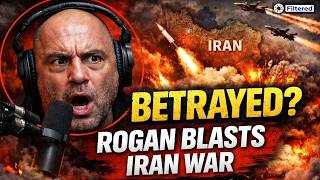
In this commentary, TJ Walker examines Joe Rogan's sharp criticism of President Donald Trump's decision to engage in a war with Iran, highlighting how Rogan's remarks—centered on the perceived betrayal of Trump's campaign promise to avoid foreign conflicts—could sway public opinion, especially among moderates and independents. Walker draws a parallel between Rogan's influence and Walter Cronkite's 1968 Vietnam War commentary, noting the power of prominent media figures to shape political narratives. He presents polling data showing that while a majority of MAGA voters (91%) and Republicans (83%) support the war, a notable minority are opposed, suggesting potential electoral repercussions for Trump in the upcoming 2026 elections. Walker also references other media voices such as Tucker Carlson and Megyn Kelly, who offer differing perspectives on the war's motivations, particularly its alignment with Israeli interests. The piece delves into strategic uncertainties surrounding the Iran conflict—its objectives, criteria for success, and possible escalation—while questioning whether Trump might attempt to downplay or deny involvement. Overall, the analysis underscores the intersection of media influence, public sentiment, and political risk in the context of the Iran war.
Chapters
Rogan blasts Trump's Iran war. Podcast giant Joe Rogan is sharply criticizing President Donald Trump over the new US war with Iran, saying the move contradicts the president's central campaign promise to avoid foreign conflicts. Speaking on his podcast with journalist Michael Schellenberger, Rogan said the decision, quote, seems so insane based on what he ran on, adding that many supporters feel betrayed. Rogan said he ran on, quote, no more wars and these stupid senseless wars, end quote. And then we have one that we can't even really clearly define why we did it. Rogan also questioned whether the United States might be acting partially in Israel's interests rather than its own. Rogan's comments matter because he commands one of the largest audiences in media. Moments like this have shaped opinion before. In 1968, trusted television anchor Walter Cronkite stunned the country when he declared the Vietnam War a stalemate. Okay, so this is not good news for President Trump when someone like a Joe Rogan who supported President Trump in his election campaign basically says this seems like betrayal. He's giving permission to a lot of people out there, a lot of voters who don't like Democrats, don't like liberals, don't think of themselves as woke, don't like progressives, and yet still, still feel betrayed by President Trump. You can be against all those other things and also be against Trump and simply stay home on Election Day this fall when the Congress is up for grabs. So this could be potentially very bad news. Now, I don't want to overstate things. As of right now, and I'm recording this March 11th, 2026, President Trump still commands the support of the vast, vast majority of Republican voters. True, his overall approval ratings are down around 35%, which are incredibly low for a president, but it's not disastrous in terms of support of his own party. But Rogan, who's not seen as an intense Republican partisan, but did end up supporting Trump, and it is seen as sort of an unbiased, fair spokesperson for a lot of moderates and independents out there in the country. So when he says, this feels like a real betrayal, this is exactly what Trump said he wouldn't do, it resonates with a lot of people in the way that another talking head on MSNOW simply doesn't connect with independents and moderates. So I want to share with you a few other things Rogan says, because I think he's calling it accurately. And this is one of these times when he's not simply being steamrolled over someone. Who can outwit him or outsmart him and present facts or alternative facts and have Rogan simply accept it. So here's what he said. It just seems so insane based on what he ran on. I mean, this is why a lot of people feel betrayed, right? He ran on no more wars and these stupid senseless wars, they're all endless. It just doesn't make sense to me unless we're acting on someone's interest, like particularly Israel's interest. Now, some members of the administration have said that Israel said they're going to do this, so you might as well join us. And Rogan says clearly Israel wanted this. Okay, so what immediately came back to me was when Walter Cronkite famously in 1968 said this about the Vietnam War. He says, it seems now more certain than ever the bloody experience of Vietnam is to end in a stalemate. To say that we are mired in stalemate seems the only realistic yet unsatisfactory conclusion. And it was around— and forgive my not having historical dates right at my fingertips— that's pretty close to the time when Johnson said, oh, I guess I can't even run for president anymore. I'm going to be so unpopular. And it essentially evaporated President Johnson's political support in the United States because so many people all of a sudden were against the Vietnam War. And no matter what Johnson did, that was the only thing anyone wanted to talk about. Forget civil rights legislation, other early accomplishments of his administration. It was war all the time. And he finally said, okay, I'm out of it. I'm not even gonna run for reelection. I'm just gonna focus on the war. Although that does give me an idea. What if Trump were to announce he's not running for reelection definitively? And focus his efforts on the war. That might strike a lot of people as, as very much a fair deal. So a little more of background on Rogan, why I'm even talking about it. He has an estimated audience of 11 million listeners per episode. That's huge. That's not quite as big as Cronkite in his heyday when basically, you know, 30, 40% of the country was watching Walter Cronkite. I was one of them, not necessarily in '68. I was at that point 5 and a half years old. But he had a huge, huge influence over the country. Rogan's influence is huge. So again, I wanna be clear, 91% of MAGA voters say today, according to a YouGov Economist poll, that they support the war. 83% of Republicans do. So 17% of Republicans are not overtly supporting this war. Now, this is unusual for wars, cuz typically when a president announces a war, there's almost universal approval. I mean, there was like 98% approval of the country going into World War II. Circumstances a little different. We had been attacked on US soil with the bombing of Pearl Harbor. Now there's some other prominent voices, perhaps not as influential to moderates and independents as Joe Rogan, but influential in their own right. Tucker Carlson has condemned the strikes on Iran's leadership. Megyn Kelly, has suggested the conflict primarily benefits Israel, not the United States. And Trump famously said, America first. Trump has famously said, we're not going to do the bidding of other countries anymore. We're not going to be the American, you know, the policemen of the world. So it's confusing a lot of people. There's simply no doubt, regardless of where you are in your support or lack of support for President Trump, that there is confusion around why we are getting into this war. Why now, as opposed to any time in the last 49 years? And how do we get out of it? What are the goals of the war? How do we know if we've won or lost? When do we retreat? When do we escalate? When do we put boots on the ground? When do we just act like the whole thing never happened? Does this become sort of another episode of the Trump Seinfeld years, similar to George walking into the office one day and acting like he hadn't quit the day before? One can easily see how Trump could simply wake up one day and say, well, what Iran war? What are you talking about? I never waged a war in Iran, and simply attempt to gaslight the entire American public. But speaking of gas, that's really the problem of why he can't do that.