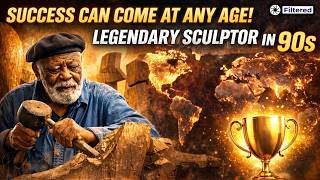
In this solo commentary, TJ Walker memorializes Thaddeus Mosley, an American sculptor who died at 99 after a seven‑decade career creating monumental abstract works from reclaimed wood while working full‑time for the U.S. Postal Service. Walker outlines Mosley’s background—first‑generation non‑coal‑miner, English/journalism student at the University of Pittsburgh, World War II Navy veteran—and his artistic influences, notably African tribal sculpture and modernist masters such as Isamu Noguchi. Despite an early solo show at the Carnegie Museum in 1968, Mosley remained largely unnoticed until age 92, when his inclusion in the Carnegie International propelled him onto the global stage, leading to major gallery and museum shows and public commissions like a piece at Rockefeller Center. Mosley’s own words emphasize that he was self‑taught, that recognition altered only the circumstances, not the work itself, and that his commitment to craft outweighed any desire for early fame or commercial success. Walker uses Mosley’s story to argue that persistent, passion‑driven practice can eventually be rewarded, contrasting this with contemporary advice to prioritize lucrative skills. The video ends by celebrating Mosley’s devotion to his art and his example of living on his own terms.
Chapters
Today, Thaddeus Mosley, the acclaimed American sculptor who finally achieved global recognition in his 90s, has died at the age of 99. His life stands as a reminder that success doesn't always arrive early. For nearly 7 decades, Mosley carved monumental abstract sculptures from reclaimed wood, often working quietly in Pittsburgh. While supporting his family with a full-time job at the U.S. Postal Service. Even when the art world largely overlooked him, he kept creating works inspired by African art traditions and modernist masters like Konstantin Bronchuski and Isamu Noguchi. And forgive me, those of you who are real artists and know that I probably botched those names. His breakthrough finally came late in life at age 92. He was included in the prestigious Carnegie International Exhibition, launching a wave of attention from major galleries and museums around the world. Mosley said the recognition never changed his art. It only changed the circumstances around it. For him, the work itself has always been the goal. So this was inspirational to me at many levels. And full disclosure, disclosure, I was not familiar with his art. I do like some sculpture and go for the classics, Rodin, and been to his museums also in Pennsylvania and in Paris. I was not familiar with him, but to me, this is fascinating. He worked at the US Postal Service his entire career, his entire regular career until he was able to get full retirement. He always just did his sculpture quietly on weekends, evenings, free time, vacations. He just kept creating. And creating and creating. And apparently at one point, relatively early in his life, he was offered an opportunity to go to New York City, but he already had a family and it didn't come with any big salary. So he figured out he didn't really want to do that. He was the first man in his family in recent generations not to work in coal mines. He studied English and journalism at the University of Pittsburgh, served in the Navy at the end of World War II. So he also was a veteran of that war. He did have a solo show at the Carnegie Museum in 1968, but things really never took off until the age of 92. Fascinating public sculptures displayed at Rockefeller Center. He often created works over 10 feet tall, and he was inspired by African tribal sculpture traditions and was working in his studio until really very recently. As I mentioned, he just passed away at the age of 99. Here is what he said in his own words: every artist in the end must be self-taught because everyone must go beyond the lessons of other people. So no, he didn't have the traditional degree in art and the master's in fine art. He studied journalism in college and was a post office worker. I don't know if he actually delivered mail door-to-door, but he worked for the U.S. Postal Service and was able to finally spend more time in his art after retiring at presumably the early '60s. So it's not the kind of career young artists aspire to. Everyone wants to be rich and famous right away. Did not happen for him. But this shows, I think, what does happen or can happen if you really follow your passion. Now, these days, everyone from Scott Galloway and others say, no, no, don't follow your passion, do what you're good at that makes a lot of money. Now, he presumably could have done something to make more money than being a postal official, but he did that so he could then spend all the rest of his time making his art and not worrying about how to be more commercial, how to make more money. And he walked to the beat of his own drummer. So I think you have to respect that. The point he was making when the quote I just read, I think, is something widely accepted in the art world. You can have a PhD in art, but if you really want to be seen as a Picasso, as a Dalí, you have to break new ground. You can't simply copy what everyone else is doing. If Impressionism is in vogue, you can't be the 122nd best Impressionist. You have to be the one who creates some new genre or does something different. And that's what he's given credit for doing. He also says, I knew that I wasn't going to get the same recognition, have the same opportunity— presumably he means by staying in Pittsburgh— but I tried because it's something I wanted to do. He also says, reflecting on his late-life fame, well, it feels good. I don't feel the work has improved, but the situation has tremendously. So I guess it was obviously very nice to receive recognition, more money, more attention late in his life, at 90s, in his 90s. But he said it didn't really change the work because he did the work because he loved the work. That I think is the real message, is find a craft that you really enjoy and do it. Maybe you don't get any lucky breaks. Doesn't sound like this guy had any lucky breaks till he was 92 years old. The point is, didn't matter if you enjoy doing it and you can control the means of production. Now, it's one thing to say my passion is making movies, I'm going to make movies till I'm 92. Well, making movies even today is expensive and there's a lot of collaboration, even if you do things cheaply digitally. But sculpture is something you can do really basically just with your time. I'm sure there's some minimal expenses finding driftwood,. But if that's your artistic passion, for that matter, writing novels— I mean, there's certainly been people who've written novels their whole lives. I'm not aware of anyone having their first breakthrough novel at age 92, but writing novels is another one of these things. You can do it without spending money if you really enjoy it. So congratulations to the lengthy career and the life of Thaddeus Mosley. You are a testament to devotion to a craft, devotion to your art, and living life your own way. Congratulations.