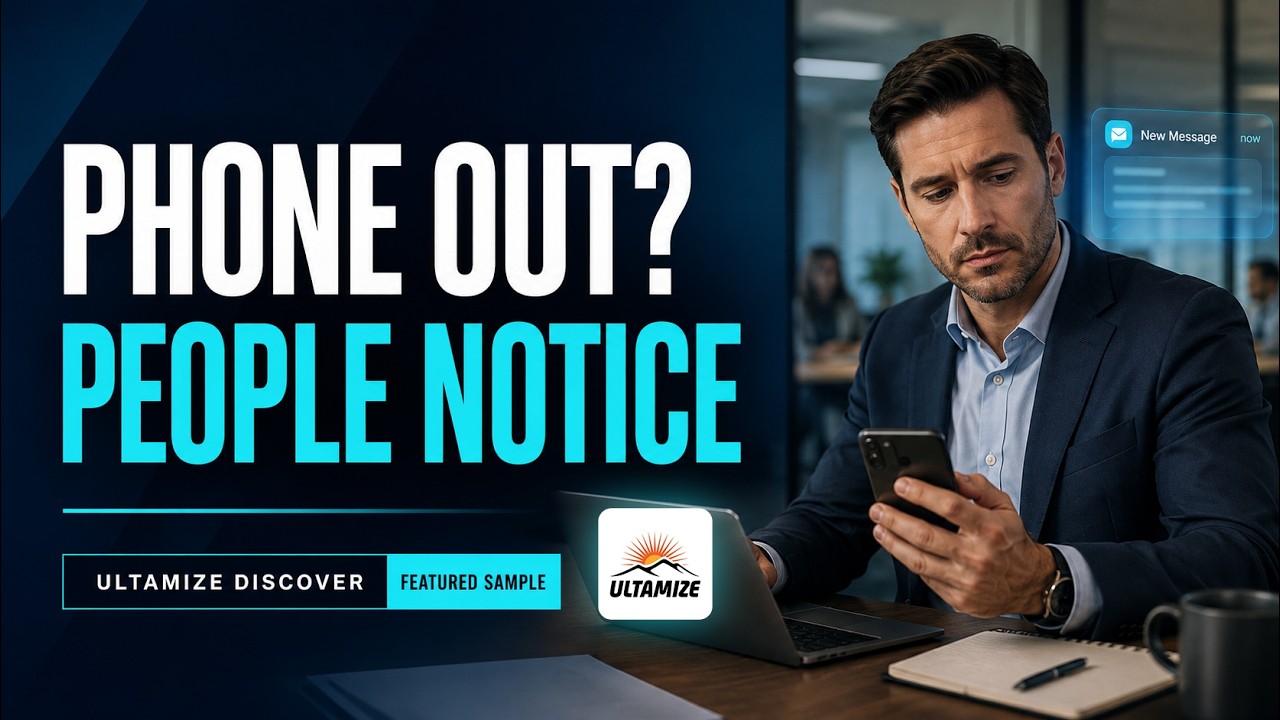
TJ Walker explains how phone habits damage your professional reputation. Keep your phone hidden in meetings and meals to show you're present. Use pen and paper for notes, craft thoughtful messages before sending, and explain if your phone must be visible.
Chapters
Today on Ultimize Discover, you're getting a short practical sample from the Ultimize universe. Use this on its own, take one idea and apply it today, or go deeper at ultimize.com. Ultimize is the world's largest personal development podcast, audiobook, and online learning network. Ultimize. Here's something you can do today that will instantly make you more professional than almost everyone you work with. Record yourself for 60 seconds explaining what you do, then watch it and ask one question: Would I trust this person in an important situation? You'll immediately see things that no one's ever told you— where you might ramble, where you sound unsure, where you lose people. And more important, you'll know exactly what to fix. Almost nobody does this. That's why almost nobody improves quickly. Hi, I'm your instructor, TJ Walker, and what you're about to learn is how people are actually judged in the real world. Because here's the truth: people are constantly deciding something about you, not just based on your work, but based on how you come across in meetings, in conversations, in everyday interactions. They're asking themselves, would I feel comfortable putting this person in a high-stakes situation? The highest level of professionalism isn't impressing people. It's making them feel comfortable. When people feel at ease with you, they trust you. When they trust you, they include you. And when they include you, your career moves forward. That's what this course is all about, helping you communicate and show up in a way that makes people feel confident in you even before you have a title. So go ahead and enroll now. Here's something you can do today that will instantly make you look more professional. In your next meeting, don't put your phone on the table. Really, not face down, not on silent, not in your hand just in case. Put it away. That one move will make you seem more present, more respectful, and more senior. Because one of the clearest etiquette signals in business today is this: are you fully here or only half here? And nothing says half here more quickly than a phone sitting on the table like a little emergency flare. You may think, well, I'm not even looking at it. It's no problem. Everybody else does it. Doesn't matter. Everyone else can see it. And what they feel is simple. This person might check out at any second. This person thinks something else might be more important than the people in this room. That creates tension, believe it or not. It might be slight tension, but it is tension. And etiquette at the highest level is about reducing tension. Let me give you another example. You're meeting with your boss, your boss's boss, and two people from another department. One person has a notebook open and is taking occasional notes. Another has a phone next to their coffee. Even if both people are equally intelligent, equally engaged, equally prepared, The person with the notebook usually looks more serious, more respectful, more ready. Well, why is that? Because there's no ambiguity. Nobody thinks the notebook owner is secretly checking sports scores or text or Instagram. The phone creates doubt, and doubt hurts you. Now let's go to the business meal, because this is where people really damage themselves. You're out at lunch with a client, a manager, or a senior executive at a conference. You sit down, put your phone on the table, and say, "Sorry, I'm just super busy today." What you think you're communicating is importance. What the other person often feels is this: you're prepared to be distracted. You're telling me in advance that I may lose your attention. You're telling me in advance I'm not very important. This is not a power move. This is a comfort killer. And once again, the issue isn't whether you actually look at the phone. Its mere presence changes the atmosphere. Now, of course, there are exceptions. If you're the on-call trauma surgeon, the CEO in the middle of a live acquisition, or the parent of a child in the emergency room, well, yes, say so briefly and keep the phone accessible. But that works precisely because it's the exception. You name the reason, you make it clear, you remove the ambiguity. That's etiquette too. If you need your phone visible for a legitimate reason, explain it quickly so the other person doesn't have to guess. Otherwise, put it away. And here's my practical recommendation: in most business meetings, if you want to take notes, use a pen and paper. I realize it sounds old-fashioned, but use the pen and paper unless there's a clear reason not to. It's not because paper is morally superior, it's because it sends the cleanest signal: attention, prepared, present, no confusion. That's the standard you want, because in professional life, people are not just judging whether you're smart, They're judging whether being with you feels respectful and easy. A visible phone makes it harder. A hidden phone makes it easier. That's why the best practice is simple. If you want to look fully engaged, be fully engaged. And if you want people to feel important when they're with you, don't put a glowing rectangle between you and them. Here's something you can check today that most people never think about very much. Look at your last 10 messages on any platform, email, Slack, text, LinkedIn. Now ask one question. If someone senior reviewed these, would they see someone thoughtful and professional or someone rushed and inconsistent? Because your reputation today is not built all at once. It's built message by message, and people are forming opinions about you based on patterns. Here's a very specific example. You send a LinkedIn message to someone you've never met. Hi, I'd love to connect and learn more about your work. Sounds polite, but it's also vague and very common. Now compare that to, I saw your recent post about pricing strategy. I'm working on something similar and found your point about customer segmentation really helpful. Would you be open to a quick call sometime? Now you've shown relevance. Now you've shown attention. You've made it easy to say yes. That's better etiquette. Here's another situation. You comment on someone's post. Instead of saying, "Great post," you add something specific. "Really liked your point about simplifying the message. I've seen the same issue in meetings where too much detail actually slows things down." So now you're contributing. You're not just signaling presence, you're adding value. Let's talk about something that quietly damages people: inconsistency. One day your messages are clear and professional, the next day they're rushed, incomplete, or overly casual. That inconsistency creates uncertainty. People don't know what to expect from you, and uncertainty reduces trust. Now, Here's another real-world situation. You're frustrated. You respond quickly, maybe a little sarcastic, maybe a little sharper than you intended. You think it's a small moment, but digital communication has a memory. People can scroll back. They can reread. They can share, and those moments can define you more than you realize. Here's another simple guideline: before you send anything, Read it once as if you were the recipient, not as the sender. Does it feel clear? Does it feel respectful to you, the receiver? Does it feel easy to respond to? If not, adjust it. It usually takes 10 extra seconds, but it changes the entire experience. Now, here's another detail people overlook. Timing and visibility. If you're constantly active online but slow to respond to direct messages, people notice. If you engage publicly but ignore private communication, people notice. Again, not a huge mistake, but it creates a pattern, and patterns shape reputation. So the goal is simple: be consistent, be clear, Be thoughtful across everything you do digitally, because in today's workplace, your reputation is not just built in meetings, it's built in every message you send. And the people who manage that well are the ones who stand out quickly, not because they're louder, but because they're easier to trust. By the way, quick question for you. Have you ever noticed how easy it is to consume content and how hard it is to actually do anything with it? I mean, you can listen to 100 episodes, read 10 books, and your habits are exactly the same. That is the gap most people never close. So, if you are listening to this and thinking, yeah, I want to actually improve, go to ultimise.com. We have got free courses there for you, either on communication skills or building better habits, and it is designed to get you to actually use what you are learning, not just hear it once. No cost. No catch. Just go to ultimize.com and start. Ultimize.