Rogan Backlash, Gas Prices Surge, Chalamet Opera Debate Goes Viral
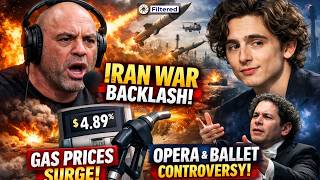
TJ Walker breaks down five news stories: Joe Rogan criticizing Trump's Iran war, gas prices jumping 20-30% from Strait of Hormuz disruptions, Timothée Chalamet's viral opera soundbite, the Pentagon labeling Anthropic a supply-chain risk, and how a $600-budget YouTube show outpaces traditional late-night TV economics.
Chapters
Ultimize. Podcaster Joe Rogan blasts the Iran war and warns Trump supporters feel betrayed. Gas prices surge as the Middle East conflict rattles global oil markets. A Timothée Chalamet quote about opera goes viral and sparks a debate about the power of the soundbite. Paul Krugman says the Pentagon may be punishing a leading AI company for political woke reasons. And Conan O'Brien argues a YouTube show with about a $600 budget proves that late-night television models are collapsing. All that and more today on Filtered. Welcome to Filtered with TJ Walker. Hi and thanks for joining me today. I'm TJ Walker. We've got a fun show for you today. Rogan blasts Trump's Iran war. The podcast giant Joe Rogan is sharply criticizing President Donald Trump over the new US war with Iran, saying the move contradicts the president's central campaign promise to avoid foreign conflicts. Speaking on his podcast with journalist Michael Schellenberger, Rogan said the decision, quote, seems so insane based on what he ran on, adding that many supporters feel betrayed Rogan said he ran on, quote, no more wars and these stupid senseless wars, end quote. And then we have one that we can't even really clearly define why we did it. Rogan also questioned whether the United States might be acting partially in Israel's interests rather than its own. Rogan's comments matter because he commands one of the largest audiences in media. Moments like this have shaped opinion before. In 1968, trusted television anchor Walter Cronkite stunned the country when he declared the Vietnam War a stalemate. Okay, so this is not good news for President Trump when someone like a Joe Rogan who supported President Trump in his election campaign basically says this seems like betrayal. He's giving permission to a lot of people out there, a lot of voters who don't like Democrats, don't like liberals, don't think of themselves as woke, don't like progressives, and yet still, still feel betrayed by President Trump. You can be against all those other things and also be against Trump and simply stay home on Election Day this fall when the Congress is up for grabs. So this could be potentially very bad news. Now, I don't want to overstate things. As of right now, and I'm recording this March 11th, 2026, President Trump still commands the support of the vast, vast majority of Republican voters. True, his overall approval ratings are down around 35%, which are incredibly low for a president, but it's not disastrous in terms of support of his own party. But Rogan, who's not seen as an intense Republican partisan but did end up supporting Trump, and it is seen as sort of an unbiased, fair spokesperson for a lot of moderates and independents out there in the country. So when he says, "This feels like a real betrayal. This is exactly what Trump said he wouldn't do," it resonates with a lot of people in the way that another talking head on MSNBC simply doesn't connect with independents and moderates. So I want to share with you a few other things Rogan says, because I think he's calling it accurately. And this is one of these times when he's not simply being steamrolled over someone who can outwit him or outsmart him and present facts or alternative facts and have Rogan simply accept it. So here's what he said. It just seems so insane based on what he ran on. I mean, this is why a lot of people feel betrayed, right? He ran on no more wars, and these stupid, senseless wars, they're all endless. It just doesn't make sense to me unless we're acting on someone's interest, like particularly Israel's interest. Now, some members of the administration have said that Israel said they're going to do this, so you might as well join us. And Rogan says, clearly Israel wanted this. Okay, so what immediately came back to me was when Walter Cronkite famously in 1968 said this about the Vietnam War. He says, it seems now more certain than ever the bloody experience of Vietnam is to end in a stalemate. To say that we are mired in stalemate seems the only realistic yet unsatisfactory conclusion. And it was around— and forgive my not having historical dates right at my fingertips— that's pretty close to the time when Johnson said, oh, I guess I can't even run for president anymore. I'm going to be so unpopular. And it essentially evaporated President Johnson's political support in the United States because so many people all of a sudden were against the Vietnam War. And no matter what Johnson did, that was the only thing anyone wanted to talk about. Forget civil rights legislation, other early accomplishments of his administration. It was war all the time. And he finally said, okay, I'm out of it. I'm not even going to run for reelection. I'm just going to focus on the war. Although that does give me an idea. What if Trump were to announce he's not running for reelection definitively and focus his efforts on the war? That might strike a lot of people as very much a fair deal. So a little more of background on Rogan, why I'm even talking about it. He has an estimated audience of 11 million listeners. Episode. That's huge. That's not quite as big as Cronkite in his heyday, when basically, you know, 30-40% of the country was watching Walter Cronkite. I was one of them, not necessarily in '68. I was at that point 5 and a half years old. But he had a huge, huge influence over the country. Rogan's influence is huge. So again, I want to be clear, 91% of MAGA voters say today, according to a YouGov Economist poll, that they support the war. 83% of Republicans do. So 17% of Republicans are not overtly supporting this war. Now, this is unusual for wars because typically when a president announces a war, there's almost universal approval. I mean, there was like 98% approval —of the country going into World War II. Circumstances a little different. We had been attacked on U.S. soil with the bombing of Pearl Harbor. Now, there are some other prominent voices, perhaps not as influential to moderates and independents as Joe Rogan, but influential in their own right. Tucker Carlson has condemned the strikes on Iran's leadership. Megyn Kelly has suggested the conflict primarily benefits Israel, not the United States. And Trump famously said, America first. Trump famously said, we're not going to do the bidding of other countries anymore. We're not going to be the American, you know, the policemen of the world. So it's confusing a lot of people. There's simply no doubt, regardless of where you are in your support or lack of support for President Trump, that there is confusion around why we are getting into this war, why now as opposed to any time in the last 49 years, and how do we get out of it? What are the goals of the war? How do we know if we've won or lost? When do we retreat? When do we escalate? When do we put boots on the ground? When do we just act like the whole thing never happened? Does this become sort of another episode of the Trump Seinfeld years, similar to George walking into the office one day and acting like he hadn't quit the day before? One can easily see how Trump could simply wake up one day and say, well, what Iran war? What are you talking about? I never waged a war in Iran, and simply attempt to gaslight the entire American public. But speaking of gas, that's really the problem of why he can't do that. And that brings us to episode— or to, excuse me, to issue 2 today, which is what's going on in gas prices. Gas prices jump as war hits oil markets. Americans are already feeling the economic effects of the Iran conflict at the gas pump. Gasoline prices have risen for 7— or excuse me, 11 straight days. Reaching a national average of $3.58 per gallon, roughly 20% higher since the strikes on Iran began. Diesel prices have climbed even faster, rising 28% to nearly $4.83 per gallon. Oil markets have been volatile as traders focus on the Strait of Hormuz, the narrow waterway that carries about one-fifth of the world's oil supply. At one point, the week's global benchmark, Brent crude, surged close to $120 a barrel before falling back near $90. History shows fuel costs quickly become political flashpoints in the United States, shaping elections and presidential approval ratings when sudden spikes hit American drivers. Okay, so Look, I'm not aware of any president who actually literally rolled back prices to where they were 4 years before they took office. That's essentially the, the promise that President Trump said he was gonna get prices back to before Biden was in office. Well, that clearly didn't happen, but in fairness to Trump, cuz I'm here as a sane, sensible centrist, nobody does that. It's really impossible to do unless you're in a severe depression, and nobody wants that. But it's far different to actually take a policy, see prices skyrocket for something like the gas pump, which people see every day, or certainly once a week. They're looking at the price, they're seeing it go up, it hits them. In the wage that just, you know, inflation on an insurance price that they may pay once a year doesn't hit them in the face weekly. To have that happen and people make a direct connection, okay, this is happening because we bombed Iran— people are making that connection. If they're not yet, they will be. It's hard to imagine where the president and his party don't really take a strong political hit at the polls for this. Certainly, if America is still at war, whether officially or unofficially, as we are now in Iran, and gas prices are 20, 25, 30, 35, maybe 100% higher than they were last month, it's, it's really hard to imagine the incumbent party, the Republican Party, not losing not just 20, 30, maybe 40, 50 seats in the US Congress. This is the sort of thing that could foment a wave election. So let's look at this a little more deeply. Many people in the Trump administration allegedly believe that somehow we were immune to this. Oh, America is no longer dependent on outsiders for oil. We are a net exporter of energy, unlike in the '70s or the '60s or even the '80s. That's true. It is true. But if you think that's going to keep the price of oil down, you simply don't understand capitalism. You don't understand commodities. You don't understand world markets. If 20% of the oil in the market is suddenly gone, There's a worldwide price for oil and it's all going to go up. If you think American producers of oil are gonna say, hey, I know I could sell my oil to Europe for $4 a gallon, but you in America would prefer having it for $3. Okay. You're an American. I'm an American. I'll sell it to you for $3. That's not how it works. That's not how big oil companies work.. It's not how natural gas companies work. They are going to try to get a market price, and it's simply supply and demand. Now, as of the beginning of the recording of this show, there have been a number of countries that are releasing their own reserve supply so that there's not this immediate shortage and spike up of prices. That'll last a little while.. But that only lasts for so long. And frankly, that's not the intended purpose of using your reserve energy supplies. It's supposed to be for when there is no energy, not just to not make a politician look bad because the price of gas went up. But that appears to be what happened. Again, here, here are the facts. US gas average price as of Wednesday, $3.58 per gallon, gone up 11 days in a row. The Brent crude is currently priced at $91 per barrel, and it had shot all the way up to $120 a barrel on Monday. So there's a lot of kind of wild activity in stock markets these days because of What's going on with energy prices? So let's look at some historical background. 1973, the oil embargo triggered a US recession and energy crisis politics. I will remember that. I remember the long gas lines in the year after and the year after. Gas shortages weakened Richard Nixon's political environment. The oil shock hurt Jimmy Carter and helped Jimmy— or excuse me, Ronald Reagan win in 1980. Yeah, everyone thinks of Jimmy Carter as this horrible failed presidency and the economy was so bad. He actually had a lot more economic growth in his term than most presidents. It just— the last year and a half was bad. If he had reversed the order and been like Reagan in his first term, he probably would have won reelection very easily. The 1990 Gulf War oil spike briefly shook markets and voters. 2008, gas prices were around $4. It shaped a lot of economic anxiety, certainly didn't help the party in power that year, which was the Republican Party. And energy costs became a big issue in the 2008 election. So politicians can gaslight, and Donald Trump is pretty good at it, but it's very hard to gaslight the American people on the price of gas because they're staring at it every day. A politician can say, who are you going to believe, me or your lying eyes? Maybe if their eyes only see it once, they can get away with that. But if their lying eyes are telling them every single day gas prices are up, pretty soon they're going to believe their own eyes. Like what you heard? Don't let the algorithm bury us. Subscribe now at substack.com/tjwalker. @tjwalkersuccess. Want direct access to me live? Want to unlock bonus episodes, behind-the-scenes takes, and full access to my premium courses? Then become a member today. Just go to tjwalker.com/members and choose your preferred platform—YouTube, Patreon, whatever works for you. This isn't just another subscription. It's a full access pass to the tools, coaching, and content that can transform your communication and career. TJWalker.com/members. I'll see you inside. A single blunt quote from an actor, Timothée Chalamet, has triggered a surprisingly large cultural debate about opera and ballet. During a CNN Variety town hall conversation with Matthew McConaughey, Chalamet said he didn't want to work in art forms where producers have to "keep this thing alive," adding that he doesn't want to work in areas where "no one cares about this anymore." The comment quickly spread across entertainment, media, and arts publications, drawing criticism from famed conductor Gustavo Dudamel speaking at Lincoln Center while announcing his first season leading the New York Philharmonic. Dudamel said the comment reflected ignorance about the role classical music plays in culture. The episode shows how modern media works. A short, emotionally charged soundbite, absolute provocative and dismissive, can dominate headlines and social media far more effectively than the longer conversations surrounding it. So this is of particular interest to me because I teach people how to speak in soundbites. I worked with politicians, the occasional Hollywood celebrity, and no, Timothée Chalamet is not my client, but I wanted to use this as a case study to help you have a better understanding of how the media world really works. So many people think the media is all about, uh, well, it's all about left-wing bias or right-wing bias, and yeah, there's some of that, but there's a much stronger bias by reporters everywhere in favor of something interesting enough to capture attention from audiences, readers, viewers, listeners. So I want to dig a little deeper so you understand this. So again, here's what he said: I don't want to be working in ballet or opera. No one cares about this anymore. So he's basically saying nobody cares about opera. Now, I saw a quote from this maybe a week ago, and I thought, oh well, who cares? But I kept seeing it again and again and again. It's a soundbite that keeps going on and on, and I wanted to use this as a learning point. So, nobody cares about it anymore. Why is that quoted? When you use the word nobody, it's an absolute. Reporters are looking for absolutes when they quote celebrities, politicians, experts. It brings clarity to the issue at hand. Reporters are afraid of being perceived as biased, so they don't want to use absolutes, but they love quoting other people saying absolutes. Nobody cares. That's emotion. Reporters are not supposed to write about their emotion, but they love quoting other people using emotion. Nobody cares about this, the opera. It's an attack. So you've got absolutes, you've got emotion, you've got attack about opera, something well known in pop culture. He's saying it as a modern-day movie star. So you put it all together and it has many, many elements of what reporters are looking for. Of all those soundbite elements, it's the attack that gets the most attention. Reporters love controversy. More so than making their side look good or another politician looking bad. They love controversy. When you attack, you generate controversy. And if in just a few words you can pack in emotion, absolutes, attacks, pop culture references, well, that's 40% of all the major soundbite categories. So you're going to get quoted. By the way, this is one reason why when you see celebrities and some politicians on talk shows, they're kind of bland. Oh yeah, he's great. I love them. Everything's wonderful. Everyone was great on the set. Uh, best movie ever. Oh, I love my— the reason they do that is because if they're positive 98% of the time and they have one thing out of their mouth and say, yeah, that director was kind of difficult to work with. But that's the only quote they're going to see. The negative soundbite quite often trumps all other soundbites. So that's what happens quite often with celebrities, other politicians, is they become sort of bland and generic because they don't want to have things like this. I'm sure Timothée Chalamet Does he really think he said anything wrong or stupid? He's just simply saying, you know, I wanna be in a field that attracts people and people wanna pay with their own money, like going to movies. I don't wanna go work in a field where everyone's always having to beg for money because the masses don't wanna go. I'm sure he still believes that, but I'm sure he wishes he hadn't said that quote that way because now he's got to be on the defensive and be a part of all these negative articles. So let that be the lesson to you. I'm not telling you never have strong opinions. I'm not telling you to not state clearly what you believe. But realize you can have 3 good messages, you can have complex messages. If one of them is an attack, you need to be prepared for that being the only quote of yours that gets in the story. By the way, if you are facing any media interviews yourself, whether you're a celebrity or whether you are a stockbroker in your small town and you're occasionally asked to weigh in on finance issues, I do have online courses on how to speak to the media. Plus, people hire me directly to do media training and crisis communications training with them. So if you're interested in that, you can go to ultimize.com. You can get a free online communication skills course there. Absolutely no charge. Go to ultimize.com. More in a moment. Filtered is brought to you by the following. Get the deeper takes I don't post anywhere else. Subscribe now at substack.com/@tjwalkersuccess and stay in the loop. For years, people have asked how they could get one-on-one coaching from me inexpensively. Well, now you can anytime, anywhere with the TJ Walker AI clone. It's like having me in your pocket, ready to help you prep for a speech, polish a pitch, or calm your nerves before a big meeting. You talk to it, it responds like I would, based on my real-world coaching of thousands of leaders and communicators. Check it out at tjwalker.ai. It's not just smart, it's personal. Want to support the show? Skip the ads and buy me a coffee. That's buymeacoffee.com/tjwalker. TJ Walker. Economist Paul Krugman says a new Pentagon decision about artificial intelligence raises serious questions about politics and national security. The Defense Department has labeled the AI company Anthropic, creator of the Claude system, a, quote, supply chain risk, and ordered military systems and contractors to stop using the technology. Krugman argues the designation appears unrelated to the legal definition of supply chain risk, which normally refers to sabotage or subversion by foreign adversaries. Instead, he says the conflict stems from Anthropic's position that its AI should not be used for fully autonomous weapons or mass domestic surveillance. Krugman argues the move could weaken national security by blocking tools many defense experts considered highly effective. The irony, he says, is that critics of diversity policies often claim merit should come first, yet this decision may sideline a widely used technology because of politics rather than performance. Now, this is an absolutely fantastic analysis from Paul Krugman, which is one reason why I pay for his Substack. I would highly recommend Paul Krugman. If you can only get one source of information beyond what you get here at Filtered, I would recommend that you read his Daily Misses because he always goes deeper. I'll admit, when I first saw this story, I thought, okay, the Pentagon has a point. They have the right to tell a military contractor that if you supply us with services, software, whatever, we get to use it any way we want, and therefore we're not going to use Anthropic. I figure, okay, that's their right, but that's only part of the story. What Krugman points out is if they had stopped there, they'd be okay. They'd be on defensible ground. But by officially labeling Anthropic a supply chain risk, They're telling the whole world and the whole tech world and the, the Amazons of the world, you can't even do business with this company because we essentially think they are going to sabotage us. Well, there's been no credible evidence whatsoever that anyone at Anthropic was trying to sabotage the U.S. military. The real reason is Pete Hegseth and his henchmen at the Defense Department don't like the political opinions of people who work at Anthropic. They don't like the fact that Anthropic says we don't want you to use our technology to do mass surveillance of Americans or to just create drones and have it go off and fight wars without a human intervention, because who knows, it could kill everyone. That's their right to have that opinion. It's Pete Hegseth's right to have a different opinion. But we're really in new territory when the government says, because you have an opinion different from ours, not only are you not allowed to work for us, but we're essentially going to try to put you out of business by saying no one who does work for the Defense Department can have any dealings with you. This is really getting very close to what happens in Putin's Russia. This is what happens in Orbán's Hungary, where you take some position that angers the dear leader and you've essentially destroyed your business. My friends, that's not free market capitalism. That is woke DEI run amok. It's just that in this case The woke policies mean that unless you are a MAGA lover and support everything MAGA does, we're going to punish you. You're not allowed to have different opinions. In this case, what it means is we're going to have affirmative action for technology companies that are less effective than Claude because we like what they say. We like their political values more. This is supposedly everything that Hegseth and Trump and company are opposed, but here they are implementing their own essentially DEI program. It's a diversity program for technology companies that aren't as good as Claude. And by all accounts, Anthropic simply is better at what it does, which is why the Defense Department is using it. There's nothing preventing the Defense Department of saying, okay, we're going to use you for all of these services because you're the best at that, and for other services where we need other things, we'll use other tech companies. There's nothing wrong with that. But to try to put this company out of business because they're not right-wing woke is an absolute travesty. And it shows that, you know, when people talk about the problems with DEI in our culture, there is a real problem, but the problem is coming from within by the people who complain about it the most. Want to communicate like a pro? Go to mediatrainingworldwide.com. Millions have already transformed their speaking skills. Why not you? This show doesn't run on a lot of corporate sponsorships or big media backing. It runs on caffeine and your support. If you like what you're hearing and want to say thanks, you can buy me a coffee. Really, just go to buymeacoffee.com/tjwalker. It's quick, it's easy, and yes, it helps cover editing creating, hosting, and staying relatively ad-free for as long as possible. BuyMeACoffee.com/TJWalker. Your $3.95 makes a real difference. Okay, Conan O'Brien in the news again. Certainly, of all the talk show hosts who are no longer staples on late night, he's probably done the best of continually staying relevant out there and producing in the new world. Conan says $600 YouTube shows shows late night's future. Conan O'Brien says the success of a simple show on YouTube convinced him that traditional late night television may be nearing the end of its dominance. Speaking with The Hollywood Reporter, O'Brien pointed to the viral interview series Hot Ones, where celebrities answer questions while eating increasingly spicy chicken wings. After appearing on the show, O'Brien said he realized how dramatically the economics of media have changed. That was the moment the scales fell from my eyes, O'Brien said. If a guy can do World Series numbers with overhead that looked to me to be about $600, and you have every big star lining up to do this show, that's when I profoundly understood that late-night shows are in trouble. In an era of on-demand viewing and viral clips, O'Brien says internet-first formats may now outcompete the traditional nightly television model. So Conan O'Brien, you know, he suffered this with his ouster from late-night TV. Let's not feel too sorry for Conan. I mean, at age 30, being an unknown, he got his own late-night TV show. He was able to replace David Letterman. He was briefly the host of The Tonight Show too, pushed out, but then had a long run on TBS. Now he's on HBO. His clips are everywhere. He has on-demand channels. He's fabulously wealthy, respected, winner of the Mark Twain Award for comedy. So he's had a fantastic career, but he is an astute observer of the industry, and I think he's put his finger on it. When you can attract a huge audience for no budget, why does a CBS need to spend $200 million on a budget or $100 million budget for a show for a year? Now, he's exaggerating slightly. The budget for the hot wings show he was referencing is more than $600, but still dramatically. I can't imagine it's even 1% of the budget The Tonight Show or a CBS Evening News show. They're able to attract audience because it's compelling, it's dramatic. You see these celebrities eating incredibly spicy chicken wings. They're getting hot, they're getting sweaty, and they do funny things. There's no doubt about it. I'm not a regular watcher of the show, but I certainly respect the producers and the host for creating something that's compelling video that attracts celebrities, that has an emotional arc to it, is compelling, and makes a lot of money and places a lot of people and entertains a lot of people, and does it all without the traditional big band, big studio audience, all the things we're taught you had to have to make a TV show big and successful. But really aren't that important. I think we're going to see a lot more of these hot wing style shows because it doesn't cost that much to try. If it doesn't work out, what have you lost? If it does work out, you can be hugely successful. Now, that's my message to you, is you don't have to try to be an entertainment show. You don't have to try to book celebrities, but figure out what you do and share it with the world, whether it's with a podcast, a video show, a YouTube show, or both. Share some bit of expertise or entertainment or way of looking at the world with others, and you never know what might take off. I'm TJ Walker. I want to appreciate you. I want to thank you. I appreciate you for spending time with me today. If you got any value out of this show, then please go to ultimize.com and pick up your free Online Personal Development or Communication Skills course. And please share this program, subscribe to it, and follow it. See you tomorrow.
More from TJ





The Breakout Cases - What Actually Caused Famous Speaking Career Breakthroughs | Ultamize

The Red Circle Sessions Finale - Build the Speaking Career You Came Here For | Ultamize

Two Stages, One Logo, Two Completely Different Realities - Main Stage vs Independent Events | Ult...

Pre-Reset - Why Repetition Builds Better Speaking Decisions | The Red Circle Sessions | Ultamize

Your Decision, Your Framework, and What Happens After - Build Your Speaking Career First | Ultamize

The Red Circle Sessions Trailer - The Speaking Career Truth Nobody on That Stage Will Tell You | ...

The Two-Minute Ultamize Reset - Your Platform, Your Audience, Your Voice | The Red Circle Sessions