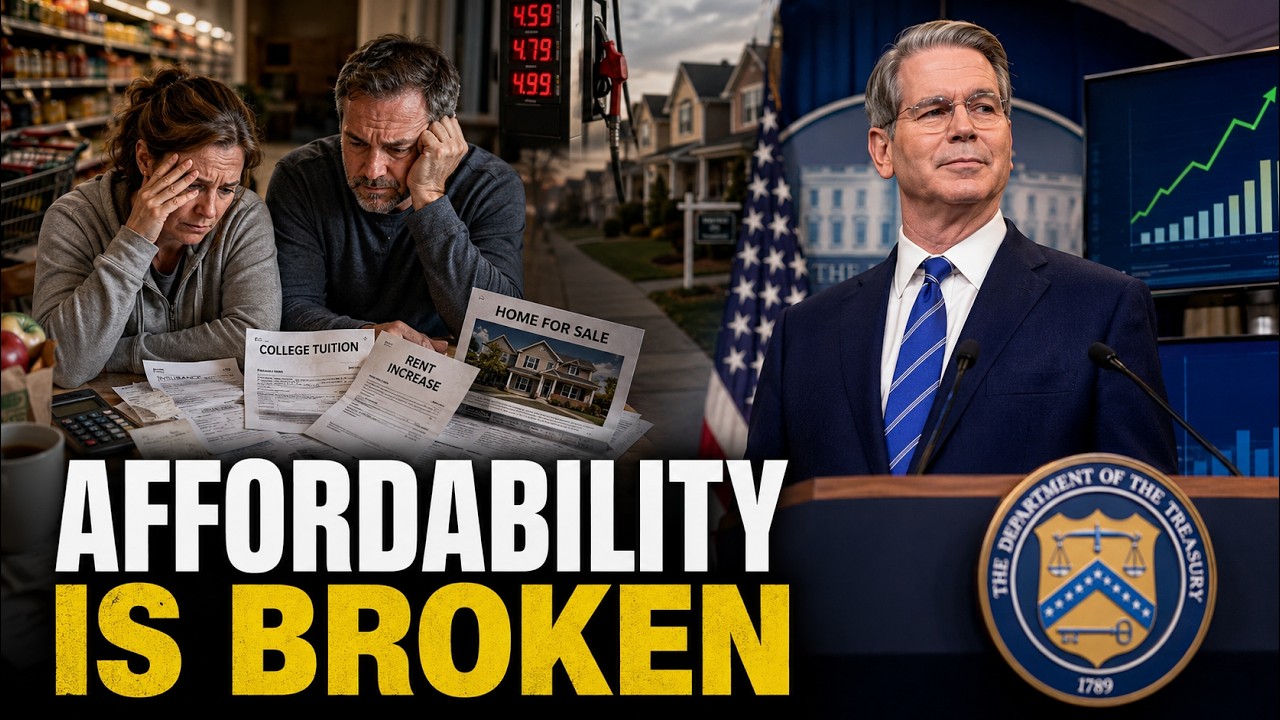
TJ Walker argues Scott Bessent's claim about wage growth misses the point: nominal raises don't buy more when rent, groceries, and gas cost far more than they did. Housing and college have outpaced inflation for years, leaving younger Americans priced out.
Chapters
Ultimize. Donald Trump's billionaire Treasury Secretary Scott Bessent has announced that the K-shaped economy is over. That's fantastic news. Can someone please tell literally everyone except Scott Bessent? Because my grocery store didn't get the memo. My insurance company didn't get the memo. The guy asking $950,000 for a starter home definitely didn't get the memo. Apparently, the only person who thinks affordability has been solved is the billionaire in charge of telling us affordability has been solved. That's like a guy on a private jet saying, I don't understand why everyone's upset about baggage fees. Now, to be fair, Scott Bessant actually has an argument. And unlike cable television, we're going to give him the strongest version of that argument before we disagree with it, because that's what honest people do. His argument is simple: workers at the bottom of the income scale have recently been seeing wages grow faster than the workers at the top. If that's true, that's genuinely good news. Every American should celebrate that. But here's the problem: people don't experience the economy through spreadsheets. They experience it through receipts. Nobody walks into the grocery store and says, Honey, these prices are outrageous. But before we panic, what did the Treasury Secretary say quarterly wage growth was among the bottom income quartile? No, nobody says that because people don't live inside economic statistics. They live inside economic reality. And that's what we're going to talk about here today. Let's separate the statistics from reality. To be fair to Secretary Bassett, let's begin with his actual argument. Economists call it a K-shaped economy. One line goes up, one line goes down. People who own appreciating assets like stocks, businesses, and expensive real estate get wealthier. People who depend primarily on wages struggle to keep up. That's the downward part. Secretary Bassett says the picture is changing. He says the economy is becoming more C-shaped because wage growth for lower-income workers has recently been stronger than wage growth at the top. If that's true, great, fantastic. I sincerely hope it's true. If lower-income workers are finally getting meaningful raises, that's something every American should be happy about. But wages are only one part of the story. Purchasing power is what people actually live. A family doesn't grade the economy with an economist report. Every family grades the economy with exactly 5 questions. Grocery test, gas test, rent test, house test, college test. If those 5 answers are getting worse, people don't care what letter economists decide to use. Now let's talk about inflation. For most of his professional career, Scott Bessant understood something that almost every mainstream economist also understood: tariffs generally increase prices. They're taxes on imported goods. Businesses absorb some of those costs, but many get passed directly to consumers. Then Donald Trump made tariffs the centerpiece of his economic agenda. Suddenly, many people who spent decades criticizing tariffs became enthusiastic supporters. That's quite a conversion. I've seen people change religions with less enthusiasm than some people change their opinions on tariffs. The real question isn't whether tariffs increase prices. The real question is who pays the price. If you're worth billions of dollars, paying a little more for appliance, clothing, or electronics doesn't change your lifestyle at all. If you're living paycheck to paycheck, every extra dollar matters. Inflation is unequal. It always has been. The same percentage hurts different people very differently. The same thing applies to gasoline. Higher oil prices don't affect everyone equally. Many affluent professionals work from home several days a week, or like I do, every day of the week. Construction workers don't. Delivery drivers don't. Nursing assistants don't. Electricians don't. The people who physically keep America running are the very people who have to buy gasoline week after week after week. When gas prices rise, They're effectively taking a pay cut. Would you like to be the sort of successful person who is dominating news, at least in your industry? Well, if so, it's time to up your skills. At ultimize.com, I've created online courses to help you do that. Now, here's the thing. No obligation. You can get a free course on communication skills, a free course on how to build better habits. All you have to do is go to ultimize.com. That's ultimize.com. Ze.com. No obligation. Go there now. Now here's where I think both political parties missed the biggest story. This didn't begin with Donald Trump, and it won't end when Donald Trump leaves office. The two biggest expenses most families face are housing and education. Both have risen dramatically, faster than overall inflation for decades. Politicians spend all day arguing about the price of eggs. Eggs matter. Milk matters. Gas matters. But groceries aren't the reason so many young Americans believe they're falling behind. Housing is. Education is. Those are the purchases that determine whether you ever build wealth. Groceries hurt this week. Housing changes your next 40 years. If you bought your first home 25 or 30 years ago, congratulations. You probably feel pretty smart. Well, maybe you are. But maybe you were also born at exactly the right time. Luck deserves a lot more credit than politicians ever admit, and I include myself in that. I'm fortunate I bought my education in a different America. I bought housing in a different time. That doesn't make me wiser than today's 25-year-olds. Makes me luckier. I've reached a point in life where gas prices don't really determine whether I can go out to dinner this weekend. Good, lucky for me. But it also means I have an obligation not to pretend my situation is typical. When a young couple tells me buying a home feels impossible, my first instinct isn't to argue with them, it's to believe them, because the numbers back them up. Housing has become dramatically less affordable. College has become dramatically less affordable. Meanwhile, politicians keep pointing at the stock market The stock market can be doing wonderfully while millions of Americans feel like they're falling behind, because little secret, 90% of Americans own little or no stock. So most Americans don't live off stock portfolios, they live off paychecks. Politicians celebrate GDP, gross domestic product. Families celebrate finally saving enough for a down payment. Those aren't the same thing. This is why politicians keep getting surprised by elections. They tell people the economy they should be experiencing instead of listening to the economy people are actually living. Scott Bassett may be right that one economic indicator has improved. I hope he's right, but one improving statistic doesn't erase years of rising housing costs, rising tuition costs, rising insurance costs, rising gas prices in part because of this imbecilic war in Iran, and the rise of so many other everyday expenses. So here's my new rule: stop telling Americans they're better off, make them better off. Because if a teacher, a firefighter, a nurse, an electrician, and a young couple working two full-time jobs still can't afford a modest home, I don't care whether economists call the economy K-shaped C-shaped or shaped like a pretzel. The American dream is still out of reach for far too many Americans. And until ordinary working people can once again afford a home, build wealth, and believe their children will have an easier life than they did, don't be surprised when people trust the price tag at the grocery store more than they trust the talking points coming out of Washington, especially from this administration. I'm TJ Walker. This is Filtered. Ultimize.