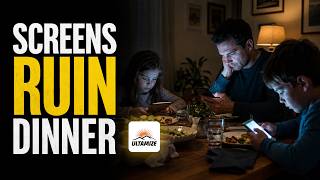
In this solo monologue, TJ Walker cites a recent JAMA Pediatrics study showing that about 70% of children aged 4‑10 and over 75% of parents use electronic media during family dinner. He argues that this widespread screen use reflects parental hypocrisy: parents forbid screens while modeling the same behavior, teaching children that phones are more interesting than people. Walker links screen‑filled meals to weakened family bonds, poorer social skills, and future anxiety in children, suggesting that the loss of face‑to‑face interaction at the dinner table contributes to broader societal issues. He acknowledges the difficulty of limiting screens, noting children’s technical savvy and the addictive design of apps, but frames the problem as one of parental responsibility and limits. Walker proposes a simple, low‑tech solution: place all devices in a bowl or basket, turn off the TV, and use the dinner time for conversation, even if it feels awkward or boring at first. He offers concrete conversation starters and emphasizes the long‑term benefits of maintaining a screen‑free ritual. The video concludes with a brief promotion of Ultimize’s free online courses on communication and habit building, directing viewers to ultimize.com. Throughout, Walker’s tone is conversational, critical, and occasionally humorous, aiming to motivate parents to reclaim dinner as a family‑connection ritual.
Chapters
Ultimize. A new study in the Journal of American Medical Association Pediatrics finds that roughly 70% of kids age 4 to 10 are using electronic media during dinner. And the number is even worse for parents. More than 75% of parents are using phones, TVs, tablets, or other media during dinner. So let's just say the quiet part out loud. politely, lovingly, and with just a hint of judgment. If your child is staring at a screen during family dinner, you have failed at family dinner. Not failed as a human being, not failed forever, but in that moment, yeah, you blew it. And if you, the parent, are staring at your own phone while telling your kid not to stare at a phone, congratulations. You're not parenting. You're running a hypocrisy internship. Your child is learning beautifully, just not what you think. Okay, let's start with the facts. A new study published in the Journal of American Medical Association Pediatrics, reported by The Independent, found that about 70% of children, some as young as 4, and just going to age 10— we're not even talking about teenagers here, but people 4 to 10— are using electronic media during dinner. That means phones, tablets, television screens, some glowing rectangle of distraction. But here's the kicker, the number is even higher for parents. More than 75% of parents in the survey said that they used media during dinner with smartphones being the most common distraction. Not exactly a big surprise. So this is not just a kid's problem. This is not those darn young people and their TikToks. This is not children today have no manners. This is parents modeling the behavior and then acting shocked, shocked when the tiny humans imitate them. That's how children work. They're not listening to your TED Talk on discipline. They're watching what you do. If you say no phones at dinner while your thumb is scrolling through Facebook, your child is not learning discipline. Mm-hmm. Your child is learning that rules are for people with smaller hands. And I know this sounds harsh, but it has to be said. If you're a parent and you allow your child to stare at a screen during dinner, you have failed at one of the most basic functions of family dinner. Why bother calling it family dinner? Why not just have everyone eat in their own room? Better yet, why not have everyone eat on the toilet in total isolation, with a tablet balanced on the sink? At least then the architecture matches the emotional experience. Family dinner is not magical because of the chicken. It's not the broccoli or the pasta. It's not the fact that someone finally remembered to buy napkins. The point of family dinner is the family. The point is to sit with other human beings, look at them, talk to them, listen to them. Mm-hmm. Argue about something stupid. Ask how their day went. Tell a story. Complain about the neighbor's dog. Laugh at something ridiculous and remind each other we are connected. If everyone is staring at a separate screen, you don't have a family dinner. You have a charging station with calories. And parents, I'm sorry, but you are the bigger problem here. You can't tell your kid not to stare at a phone while you stare at your phone. You can't say, "Dinner is family time," while checking email from someone you don't even like at a job you complain about every night. Unless you're the only emergency room surgeon available in a small town and the mayor's appendix is about to explode, you're not so important that you can't go 45 minutes without looking at your phone. You are not that important. I'm not that important. Almost nobody is that important. Yeah. Is that important. Civilization will survive without your immediate reaction to a group text about soccer snacks. Your LinkedIn connection can wait. Your fantasy football team can wait. Your cousin's vacation photos can wait. The world will continue spinning if you don't check whether someone liked your comment about patio furniture. But your kid, your kid is sitting right there. Mm-hmm. And they're learning something from you every night. They're learning either, "My parents want to know me," or they're learning, "The phone is more interesting than I am." That lands. Kids may not say it that way. They may not be able to articulate it, but they absorb the message. And then we wonder why kids can't talk to people. We wonder why teenagers are anxious. We wonder why young adults don't know how to make eye contact. We wonder why dating feels impossible to so many of them. We wonder why nobody knows how to start a conversation without glancing down every 11 seconds like they're waiting for medical test results. We're raising children to become antisocial little screen goblins and then acting surprised when they don't become charming dinner companions. And let me be clear, I'm not pretending this is easy. I have a daughter. I know the battle. I My own daughter has hacked parental controls numerous times. She's shown technical skills that frankly, if redirected, could probably get her a job at the Pentagon. So I get it. Kids can be clever. Phones are addictive. Apps are engineered by very smart people to hijack human attention. You're not weak for struggling with this. You're normal. But being normal is not an excuse to to surrender. If your kid opened your liquor cabinet and drank a gallon of whiskey while you were gone for the evening, you wouldn't say, "Well, kids these days, what can you do?" You'd do something. You'd get a lock. If the kid picked the lock and drank a gallon of vodka the next weekend, you wouldn't say, "Oh, well, youth culture." You'd get a better lock. You'd move the liquor. You'd remove the temptation. You'd take the danger seriously. Bones are not the same as whiskey. I'm not saying your iPhone is bourbon with a case, but the principle is the same. When something is powerful, addictive, and harmful when uncontrolled, which bones are, parents have to set limits. That is the job. Not because you hate your kids, because you love them. Children don't need unlimited access to screens at dinner. They need limits. They need routines. They need parents who say, "No, we're not doing that here." They need adults who are willing to be briefly unpopular. Yeah, and I get it. You'll be very unpopular. I know I am. That is the most underrated parenting skill, being willing to have your child think you are unreasonable for 12 minutes. Well, guess what? You'll survive. Mm-hmm. They'll survive. No child has ever died from hearing, "Put your phone in the basket." In fact, there's a simple idea. Put a box, a bowl, a basket, a hat, anything in the kitchen at dinner. Everyone puts their phone in it. Everyone, not just the kids, mom too, dad too, grandpa too, the teenager too. The 9-year-old who says, "But I'm expecting an important message from Madison about Roblox strategy." Mm-hmm. Yeah, that kid too. Phones in the box, TV off, table clear. What's the worst possible thing that could happen? You might have to speak to each other. You might find out your kid had a bad day. You might learn your daughter is worried about a friend. You might learn your son has a question he's been too embarrassed to ask. You might hear a funny story from school. You might discover that your child is actually interesting. Interesting. You might even discover that your spouse is still alive and not just a co-manager of household logistics. And yeah, the first few dinners may be awkward. Fine. Awkward's not fatal. You may ask, "How was your day?" and your kid may grunt. Good. That's a start. Tomorrow, you ask a better question. What was the weirdest thing that happened today in school? Who annoyed you today? What made you laugh? What's something everyone at school is talking about? What's one thing you wish adults understood? That's a conversation. That's parenting. That's family. Would you like to be the sort of successful person who is dominating news, at least in your industry? Well, if so, it's time to up your skills. At ultimize.com, I've created online courses to help you do that. Now, here's the thing. Mm-hmm. No obligation. You can get a free course on communication skills, a free course on how to build better habits. All you have to do is go to ultimize.com. That's ultimize.com. No obligation. Go there now. The experts quoted in the article make an important point. The benefit of family dinner is not just nutrition. It is not just that kids eat more vegetables. It is the built-in connection. It's the checking in, it's the shared experience. And when everyone is on a separate screen, that shared experience disappears. You can be physically together and emotionally in 5 different time zones. One person's on Instagram, one person's on YouTube, one person's texting, one person is checking email, one person is watching sports highlights. That's not a family, that's a Verizon commercial before the apocalypse. Mm-hmm. And parents who say, "Well, this is just the modern world," are giving up too easily. Yeah, the modern world is filled with screens. That's exactly why the dinner table matters more now. It may be the last protected space in the house, the last little island where the family can say for 30 or 45 minutes, "The algorithms don't get us. For this meal, we belong to each other." That may sound sentimental. Good families need some sentiment. Families need rituals. Families need habits that say, this is who we are. And if your family ritual is everyone silently chewing while staring at a device, don't be surprised when your children grow up not knowing how to sit across from another human being and talk. Forget your golden years. Forget downsizing. Forget traveling, you're going to be 90 years old bringing TV trays to your 70-year-old children in the basement because they never learned how to eat with another person. Good luck with that retirement plan. So, here's the loving challenge. Tonight, try one dinner with no screens. Not a mug, not a lifestyle brand, not a social media announcement about your new intentional family journey. Just One dinner. Put the phones in a basket. Turn off the TV. No tablets, no laptops, no just checking one thing, but eat, talk, listen. Be bored for 30 seconds if necessary. Boredom is where conversation begins. And if your kids complain, congratulations, you're doing something right. If they say— Mm-hmm. This is stupid. Say, fantastic, tell me why. Now you're talking. The study says roughly 70% of kids are using screens at dinner. Again, more than 75% of parents are doing the same thing. That means most families are getting this wrong. But this is one of the rare problems that doesn't require Congress, a billionaire, a new app, or a 14-step plan. It requires— A bowl. Put the phones in it. Then look at the people you claim to love. That's dinner. I'm TJ Walker. This is Filtered. Ultimize.