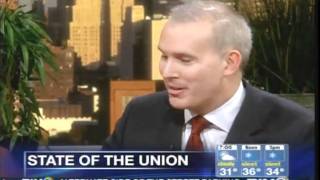
Media trainer TJ Walker breaks down Obama's 2011 State of the Union, which proposed a five-year domestic spending freeze to cut the deficit by $4.4 trillion. Walker examines how the speech mixed innovation and deficit reduction, Obama's confident tone after the Arizona shootings, and why Republicans gave two separate responses.
Chapters
A long mess. That was, it was a list right there. Lisa, thank you.
All right.
Saying the US Is facing a new Sputnik moment, President Obama delivered his State of the Union address, a speech that focused on cooperation between Democrats and Republicans and our struggling economy. President of the United States President Obama used his second State of the Union address to call for the reinvention of America's slowly recovering economy through innovation, education, and rebuilding the nation's infrastructure.
We need to out innovate, out educate, and out build the rest of the world.
The president seemed to strike a conciliatory tone addressing issues Republicans wanted to hear about.
We have to confront the fact that our government spends more than it takes in. I am proposing that starting this year, we freeze annual domestic spending for the next five years. Now, this would reduce the deficit by more than 4,400 billion dollars over the next decade.
Wisconsin Republican Paul Ryan issued his party's official response.
Depending on bureaucracy to foster innovation, competitiveness, and wise consumer choices has never worked and it won't work now.
Ryan criticized the economic policies of the president's first two years in office, as did Congresswoman Michele Bachmann. In the Tea Party's response. For two years, President Obama made promises just like the ones we heard him make this evening. Yet still we have high unemployment. In the shadow of the mass shootings in Arizona, several lawmakers try to rise above partisanship by sitting with each other instead of with their parties. But one chair sat empty for Congresswoman Gabrielle Giffords.
Joining us now with analysis on President Obama's State of the Union address is political consultant and communications expert TJ Walker. Thanks for being here this evening.
Thanks for having me.
Just so folks know what perspective you're coming from, Democrat or Republican, I work.
With people of all parties around the world. When I do work in campaigns, it's typically with Democrats.
But we're going to walk the bipartisan fence here.
But I have no ties with the Obama administration.
Let's talk about last night. He talked about investing in education, investing in jobs, investing in new technology, a lot of spending of our tax dollars to create these things. Republicans critical of him for not saying let's slash taxes or at least provide other encouragement for business to get invest in technology, invest in jobs, hire people.
That was one of the interesting things about the speech. Many people predicted he would try to shift from the left to the center. He didn't do that so much the first 47 minutes of the speech. It was a strong defense for government, for government activism, for government solves our problems.
He still Believes that even after this.
Last election, the last half an hour of the speech, he was talking about across the board, spending cuts, getting rid of earmarks, getting of rid. Cutting spending, reducing spending. So ideologically it was a mixed message. It was a little confusing. But you know what? Americans are mixed, too. Americans say, you know, get the government out of my Social Security and Medicare too. So I don't think that hurts him with the public. It does hurt him with pundits, but pundits typically don't like State of the Union addresses because they're seen as laundry lists.
This freezing of the budget, what do you think about that?
Well, he talks about that, but I do think he's open to criticism, saying, oh, wait, you talked about increased spending on education and increased spending on green technology and increase on this. So it may be lip service. Where I do think he scored points is just the sheer mechanics of his speech. He really is a good speaker. And he comes across confident, engaging, comfortable, authoritative. Nobody. Very few people look at him and say, you know what? I can't see him as the head of state. So the average independent, moderate Democrat, they can look at him and say, wow, I'm proud he's our president.
Maybe it sounds callous, but as a communication expert, you know that all this plays into it. Did he get more of a pass? Was it more set up for a perfect speech scenario for a great speaker like him? Given what happened with Congresswoman Giffords?
Any time a president gets to speak after a huge national disaster, it's a great platform for them to appear statesmanlike and above the fray. It happened for Bill Clinton after the bombings in the Midwest. It happened for Reagan after what happened with the challenger incident. So Obama definitely came across as above the fray. Statesmanlike was not getting into the debate of, oh, it's Glenn Beck's fault or Sarah Palin's fault. So he came across very authoritative and as a unifier and expressed this optimism that a lot of people would say was similar to Ronald Reagan.
Something was different at the end of the speech. We're used to the other party's response, in this case, a Republican response. And then all of a sudden, I didn't expect this. Up pops the Tea Party response.
The conservative movement Republican Party is splintering. And you had one of these odd situations where Republicans were angry at CNN for giving more airtime, not just to their official Republican response, but to the Tea Party.
It was the first. Right. First time we've had a Tea Party response.
It was. And there was. There are growing divisions and splintering within the conservative movement.
Yeah. It's interesting. You've got like two Republican responses. Thank you so much for coming in this morning. We sure appreciate it. TJ It's a 708 right now.
All right. Thank you so much, Chris. The first Guantanamo.