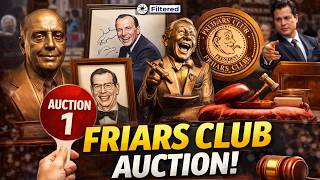
TJ Walker delivers a reflective monologue on the demise of New York’s historic Friars Club. He explains that the club’s Manhattan building fell into foreclosure and its century‑spanning comedy memorabilia were sold at the "Legends of Comedy" auction, with iconic items such as Jack Benny’s violin, a trunk of handwritten jokes, and two Frank Sinatra portraits fetching up to $64,000 each. Walker shares a personal memory of touring the club years earlier, underscoring its once‑sacred status for America’s top comedians. He attributes the club’s collapse to lingering pandemic effects, prohibitive New York real‑estate costs, and a broader cultural shift toward consuming comedy on personal devices rather than gathering in communal venues. The narrative also highlights the Friars Club’s legacy of roasts, their place in comedy history, and the paradox that, despite the loss of such institutions, more comedians are now making a living than ever before.
Chapters
The end of the Friars Club. The legendary New York Friars Club, once a gathering place for some of the biggest names in show business, has effectively reached its final curtain. In an auction titled Legends of Comedy, more than a century of memorabilia from the famed entertainment fraternity was sold after the club's Manhattan building went into foreclosure. Items ranged from Jack Benny's violin to via— to photo archives featuring stars like Barbra Streisand and Sammy Davis Jr. Two Frank Sinatra pieces brought the highest prices, each selling for $64,000. A trunk filled with handwritten jokes used by generations of comedians sold for nearly $30,000. For longtime members, the auction felt less like nostalgia and more like the funeral of a cultural institution. Many had hoped the artifacts would end up preserved in museums rather than scattered among private collectors. On a personal note, I do remember I had one opportunity to go to the Friars Club. This was probably 15, 17 years ago, and it did seem like a sacred place when you think of all of some of the most famous comedians, certainly arguably all of the most famous comedians in North America at some point spent time there, were given membership. There was a very humorous Seinfeld episode based on Jerry Seinfeld's involvement with the club. And it was a special place. I can't remember if I saw comedy there or music of some sort, but I got a full tour by a member, and I will remember that and cherish it as a sort of a window into a bygone era. I think it is important to note a couple of things. We are still suffering the consequences of the pandemic. This is the sort of thing that closed during the pandemic. It never made it back. Now, there's a chance it wouldn't have made it anyway because the age of the average friar was pretty old, but they never truly recovered from the pandemic. They did have very expensive real estate in New York City. Just the taxes alone and the upkeep, I'm sure, was tough. The other thing, and it's Sounds like I'm, I'm hitting this once again. You could argue too often. I think it's a sign of this— our cell phone. For those of you listening on the podcast, I'm holding up a cell phone. So many people would rather stay at home, watch comedy on their cell phone, text their friends, rather than go to a place, have an adult beverage, and sit around with buddies in the industry. Now, the Friars Club did start off at a time when you did not see as many comedy clubs in every town. In the country. So it was more of a meeting place. But these days, comedians, and the ones I, I know and brush shoulders with, they're either in comedy clubs, actual working comedy clubs, refining their set, trying to get paid if they're outside of New York City, practicing new content often if it's in New York City or LA. And then their downtime, they're like a lot of the rest of us, they're at home sitting in front of a screen, sitting in front of a television sitting on the couch holding a cell phone. So, so part of me that thinks it's very sad that so few Americans, and increasingly people around the world, don't have communal spots where they just get together with people, especially people they have stuff in common with, as comedians did at the Friars Club. Let's look at some more facts here. Jack Benny— I realize most of you don't know who Jack Benny is, but those of you above a certain age well remember him. He was a pillar of the entertainment community in the United States many, many, many decades ago. He had a violin he sold— that was sold, he didn't sell it, he's been dead a long time— that was sold for $22,400. Frank Sinatra portrait sold for $64,000. You may be thinking, well, you know, Frank Sinatra wasn't a comedian. He was the subject of various roasts, and Don Rickles was a common part of that whole crowd, as well as Dean Martin. These were often televised. Now Comedy Central has done a great job of reviving Roast, and I, I do enjoy Roast, and I'm a fan of Jeffrey Ross, the Roastmaster General. But you can still see on old YouTube clips, they still sell it on DVDs, these Friar Club Roasts. Some of them don't age well, I will be honest with you, but it's still an interesting time capsule. A Sinatra bronze bust also sold for $64,000. A Quentin Tarantino rose poster sold for $5,000. There was a Sinatra action figure sold for $256. You could buy a joke trunk, a trunk filled with old jokes, for $28,000. A lot of other rare celebrity photos. Again, a little bit sad. It's a beautiful building on 55th Street on the east side of New York City. Their roasts were often done at the nearby Waldorf Astoria. The Friars Club itself wasn't quite big enough to have a giant roast and a televised affair, but it was done under the auspices of the Friars Club. So Friars Club, you're a part of history, you will be missed, but fortunately there appear to be more comedians making an actual living than ever before. So your tradition of celebrating Comedy, humor, getting laughs does live on.