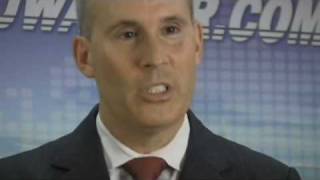
TJ Walker breaks down BP's catastrophic PR failures during the Gulf oil spill, focusing on CEO Tony Hayward's botched messaging and evasive media strategy. Hayward's claim that it wasn't BP's accident but their responsibility backfired, and his tone-deaf remarks tanked public trust and the company's bottom line.
Questions this video answers
Tony Hayward
$34 million
Chapters
A crisis. You can never plan exactly when it will happen, but you can plan on how to respond. Because if a crisis hits you, the media will be calling, TV cameras will be in your face. Well, it's official. BP is now the largest disaster ever. Largest man made disaster. What happened in the Gulf surpasses what happened with the Exxon Valdez. It's the largest recorded disaster ever. Now, not only is it a huge, huge environmental disaster, and it is an epic disaster of crisis communications. In fact, British petroleum has seen $34 million melt away in their market cap. They could see further economic disaster. Now, not only do they get low marks in how they handled this at the beginning, as far as creating the crisis, I give them extraordinarily low marks on how they handle the media operations, how they actually communicated to the world, to the media, to stakeholders, to shareholders, to customers, to the whole world. How did they respond? Well, let's take a look at their CEO, Tony Hayward. Now, he has some strengths, he does some things quite well, as we see right here.
We continue to attack this on three fronts. We're fighting it in the subsea, we're fighting it on the surface, and we are going to defend the shoreline. We continue to fight this battle on three fronts. You know, we think of this as a battle that we're fighting on three fronts of a three pronged attack three ways.
Now, you can see right here, Tony Hayward has amazing message discipline. Every single interview he says we're attacking it at three fronts. So that part is good. He also comes across as articulate, very, very smooth, polished, pleasant looking, no ums, uhs, ers, his eyes aren't darting around. So he's actually pretty good as far as the basics when it comes to the visuals. Here's the problem. When it comes to crisis communications, you have no margin of error. So even though he was very disciplined, hitting his messages again and again and again, unfortunately he got off message very, very often, as we'll see here. Right in one of the very first interviews.
Initially I was very shocked. I was angry actually about how the hell could this happen?
He was shocked, he was angry. How could this happen to little old me? It sounds as though he's making himself out to be the victim. Now, on the one hand, you can understand and have some sympathy for him as a human being. On the other hand, here's this gigantic explosion. Deaths, employees dying, untold environmental destruction. And he's acting like he's the victim as opposed to all the people who actually died, as opposed to fishermen in the area. All the people affected by the environment in Louisiana, the Gulf Coast, Florida. So it really started off on the wrong note. Him sounding that he was, number one, surprised. Oh, we weren't thinking about this. We weren't planning this. It did not come across well. It also made it look like he was looking for sympathy. He should be extending sympathy, not asking for sympathy. Off on a wrong note. Here's another mistake right here.
This is not our accident, but it's our responsibility to deal with it.
This is not our accident, but it is our responsibility to deal with it. It's our our responsibility to clean it up. Now, when you hear the whole thing, it makes perfect sense. It sounds fine. The problem is you don't necessarily hear the whole thing. Most people didn't see that full video clip. What made the headlines was not our accident, not our responsibility, the accident. And they didn't hear because it didn't get into the headlines. But it is our responsibility to clean it up. Now, you can blame reporters if you want, but if you are in the middle of a crisis, it's your job to communicate clearly. That means you have to avoid complexity. And what Tony Hayward did right there is he had a complex answer. He said, the spill wasn't our fault, wasn't our responsibility, but the cleanup is. And that had the handwriting of lawyers all over it. I'm sure lawyers were telling him, you've got to tell people it wasn't our responsibility. We don't want to be on the hook. The problem is, if you listen to lawyers during a crisis, yes, you may stay out of prison, but your market cap may go from 160 billion down to about zero. Because too often lawyers are only looking at the legal aspects, not the public relations aspect. And this was a clear, clear bungle. What Tony Hayward had to do was to look at how every single word out of his mouth, every phrase can be sliced, diced, looked at under the light, under the microscope to see how it looked. The problem is this phrase of it's not our responsibility, and the other part, but it is our responsibility to clean it up. That can be taken out of context. And in fact, it was. And it made it look like he was saying, it's not our fault. It allowed the media and the detractors of BP to say, look, BP is trying to get out of it. They're trying to weasel their way out. They don't want to be responsible. They don't want to own up. Now, yes, there are complicated legal issues dealing with jurisdiction and actual ownership. Very, very complex. Unfortunately, for bp, this became the BP spill. There was nothing they were going to do to stop that, so they might as well embrace it and communicate, given that reality. And the quote you just saw is a classic example of a CEO answering a question. He was responsive, he gave a rational, logical, linear answer and it was complex. And because of that, he completely lost control. And it was a full 24, 48 hour news cycle where everyone thought he was saying, hey, it's not our responsibility, not our fault. Horrible, horrible communication. Even though factually accurate, legally correct. Here's another example of Tony Hayward bungling a good media opportunity.
Good afternoon everyone. Thank you for being here. Let me just say a few words, then I'll take a couple of questions and then I do have to move on to.
I have to move on to do what? Have tea with the Queen. A couple of questions he's coming across here, Imperial, self important. A couple of questions. The world wants to know what's going on. The world wants to know how are you going to stop this? And he says, I'll take a couple of questions. This is a perfect example of how BP just did not get out front on this issue. They made a fundamentally flawed media strategy and they created a vacuum by making their CEO so scarce. They let other people define the story, attack BP and put them on the defensive. If you really want an example of how to get out front during a crisis, what Tony Hayward should have looked at was what Rudy Giuliani did right after 9 11, if you recall, Rudy Giuliani held press conferences virtually every single hour, day in and day out for weeks. He answered every question. He didn't say, oh, I've only got time for a couple of questions. He answered questions, he got the facts out there. He conveyed the intellectual arguments. He also conveyed the emotional arguments. He didn't act like he was too busy to answer questions. And BP just really restricted the information and they restricted access to the CEO. They also played games by giving an exclusive to one TV network and not holding full fledged press conferences often enough. The result, there's a vacuum. And when media people cannot get access to you, they give more access to all the people pointing fingers at you and saying you were wrong, you are irresponsible, you are cutting corners, you don't care about the environment. Horrible, horrible mistake. Tony Hayward and BP could have really owned this issue. They could have owned the whole framing of the issue by getting out there, giving constant updates, by winning people over, but instead by being restrictive and by being off putting, they made themselves the distant aliens who may or may not be out to rip people off, skip town. Not really. Do all they should. And they allowed themselves to be painted, the villains.