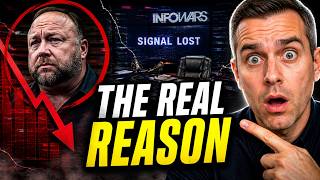
TJ Walker explains how Alex Jones lost Infowars: he repeatedly called the Sandy Hook shooting a hoax, harassed grieving parents, and courts awarded over $1.3 billion in defamation judgments. This wasn't censorship but accountability for targeted, reckless harm.
Chapters
Ultimise. After 27 years on the air, Alex Jones signed off his final, at least for now, his final Infowars broadcast. And if you only casually follow the news, you might be thinking, wait, is this a free speech issue? Is this a guy getting shut down for his opinions? Well, the answer to that is no, that's not what this is. This isn't about someone expressing a controversial opinion. This is about a long documented pattern of behavior that crossed the line from speech into targeted repeated harm against real people. So let's be clear about the facts. Families of the Sandy Hook Elementary School shooting, where 20 children, 6 educators were murdered. Let's not forget that this group won more than $1.3 billion in defamation judgments against Alex Jones. That didn't happen because he had a hot take. That happened because of what he actually did for years, not a one-time slip of the tongue. For years, he repeatedly told his audience that the Sandy Hook shooting was a hoax. Not just once, not just speculating, but over and over again he said it was staged. He said the parents were crisis actors, whatever that is. He suggested the children never died. Now think about what that means in real life. These are parents who lost their children. They buried their kids, and then they had millions of people hearing a media figure saying, you're lying, you're part of a conspiracy, your child didn't exist the way you claim. And it didn't stay on his show. His audience acted on it. Families were harassed. They received threats. Some had to move homes multiple times. Some lived in hiding. Imagine losing your child and then spending years trying to prove to strangers that your child was real. This is not free speech. This is sustained, repeated harm directed at private individuals. And the courts looked at this for years. This wasn't a quick decision. This wasn't one judge on a bad day. Multiple courts examined the evidence and concluded this wasn't accidental, this wasn't careless, this was reckless, and in many cases malicious. It was also evidence presented that he continued pushing these claims even after being told they were false, even after families begged for it to stop, even after lawsuits began. And here's where it gets even more uncomfortable. Because while all of this was happening, his platform was also selling products— supplements, survival gear, health formulas. And the more outrage, fear, and attention generated, the more the business grew. Now, you don't have to speculate about motives to see the pattern. The more extreme claims, the more attention, more audience engagement, more sales. That's how the internet works. So when people say, "Isn't this just free speech?" You have to ask yourself, at what point does speech turn into something else? Because in the United States, you absolutely have the right to express opinions. You don't have the right to knowingly spread false statements that destroy the lives of specific people, especially grieving families. Now fast forward to this week. The company behind Infowars was liquidated as a part of those judgments. There's an ongoing legal fight over who ultimately controls the brand. At one point, even The Onion— yeah, The Satirical Onion— put in a bid to take it over. But operationally, the show has shut down. The studio closed, the broadcast ended. And how did he end it? Not with an apology, not with reflection, not with acknowledgement of harm. He told his audience, the real war begins now. And from a communication standpoint, that's not random. That's how consistent, or that's consistent with how he's always framed things. Because if you frame everything as a war, then you're never wrong. You're never accountable. You're never finished. You're just moving to the next battle. But here's the reality that gets lost in that framing: this isn't a war. There are no opposing armies. There are no two sides fighting for territory. There are parents who lost children, who spent years being harassed and threatened because a powerful media figure told millions of people that they were lying. That's not abstract, that's not theoretical, that's not political, that's human. And that's why this story matters, not because a show ended, because it forces a very real question: where's the line between speech and harm? Because once you cross that line, it's no longer about ideas, it's about consequences. Let's be here, be clear now. A lot of people think that Alex Jones is about free speech. It's not. This wasn't someone just sharing an opinion. He repeatedly told millions of people that the Sandy Hook shooting was fake and that grieving parents were actors. As a result, those families were harassed, threatened, and forced to move. Imagine losing your child and then spending years trying to convince strangers your child was real. That's why the courts ruled against him. Not for speech, but for the damage that speech caused. Here's what's chilling about how Alex Jones ended his show. He did not apologize, didn't reflect. He said, "The real war begins now." That's not accidental. If everything is framed as a war, then you're never wrong. You're just under attack. But this wasn't a war. There weren't two sides. There were grieving families, and a media figure who made their lives exponentially worse. And that's why this case isn't about censorship, it's about accountability. I'm TJ Walker, this is Filtered. I appreciate you joining me. We're going to be looking at another issue in just a moment about communication. Each day I typically look at 3 stories in the news, analyze them through the filter of communication and personal development skills, because that's what I do for a living. I have 12 million online student enrollments in my personal development online courses and communication skills courses. So happy to be with you today. We're live on Facebook, LinkedIn, YouTube, Twitch, X, a couple of others, plus our friends on TikTok are joining us through a separate feed. So back in a moment, a moment with more news. Here's something I've learned after years of doing this: the people who actually improve don't necessarily hear better advice. They just stay around it longer. They keep exposing themselves to the same useful ideas until it finally clicks. Most people don't do that. So if you want to be in the small group that actually follows through, go to ultimize.com, that's ultimize.com, and get the free course. There's one on communication, one on building better habits, nothing fancy, just something you can keep coming back to. If you're already there, you're doing the hard part. Just go to ultimize.com and build on it. Ultimize.