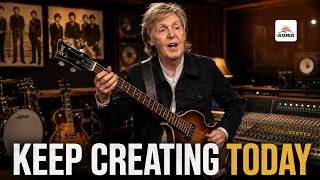
In this episode of the YouTube series "Filtered," host TJ Walker reflects on a New York Times profile of Paul McCartney to illustrate why the 83‑year‑old Beatle continues to create music. Walker argues that McCartney’s ongoing creativity is driven by intrinsic motivation—making art for the joy it brings—not by external rewards like fame, money, or social media validation. He uses McCartney’s example to critique the prevailing "retirement culture" in America, where financial security often leads to passive, disengaged lifestyles. Walker proposes that older adults should adopt low‑barrier creative projects (e.g., building a table, starting a YouTube channel, writing a family story) to stay alive and purposeful. He also links McCartney’s vitality to consistent health habits, a vegetarian diet, and movement, suggesting that physical well‑being supports sustained creativity. Throughout, Walker interweaves personal notes about an upcoming vacation and promotes his personal‑development platform Ultimize, offering free courses on communication and habit building. The central message: retirement should not mean checking out; instead, it should be a chance to pursue meaningful creation that keeps one "alive".
Chapters
Ultimize. Paul McCartney may be one of the most successful musicians in human history. There's no doubt about that, but that's not why I admire him. Full confession, he's not even in my top 10 favorite musicians. I'm more of a Robert Plant, Led Zeppelin kind of guy. Give me thunder, mysticism, and a man howling like he's trying to wake up Stonehenge. But Paul McCartney at 83 is giving all of us something more valuable than another hit song. He's giving us a model for how not to die while we're still alive. He could be sitting in a mansion being spoon-fed nostalgia by servants, reliving 1964 until the end of time. Instead, he's still creating, creating music, not because he needs money, because he needs joy. That's what jumped out at me in John Perelli's New York Times profile of McCartney today. This is not a man dying. Desperately chasing relevance. McCartney's not a man saying, "Please teenagers of TikTok, validate me." This is not a man trying to prove he can still compete with 22-year-olds with autotune, abs, and a social media strategist. He's doing it, he's creating music because the act of creating still lights him up. McCartney says, quote, "I love it. I'm addicted." He's talking about creating the music. Now that's not the whole story here. He's not addicted to applause. He's not addicted to Spotify rankings. He's not addicted to being the cute Beatle for the 9 billionth time. He's addicted to the act of making something. That's the part of Paul McCartney I salute. Because at 83, he could easily have said, I won life. I'm done. Bring me a pudding and a documentary crew. He could spend every day walking through a private museum of his own greatness. And here's the room where I keep the Screaming Girls. Here's the room where we keep the Ed Sullivan footage. Here's the room where we keep the checks. Instead, he's rehearsing, he's recording, he's showing up on Saturday Night Live, which means he has to stay up until at least 1 AM. Frankly, I'm not sure I can do that now. If someone asked me to stay up till 1 AM, I assume that's either a medical emergency or a hostage situation. Paul McCartney is 83 and doing SNL. I'm looking at the clock at 8:02 wondering if it's too late to start a movie. And the lesson here is not be Paul McCartney. You can't. I can't. Nobody can. That job is filled. The lesson is don't retire from life. Most people look at him and say, well, easy for him. He's rich. He's famous. He can do whatever he wants. Yeah, but that misses the point. In America, millions of people reach a stage where the nut The monthly nut is basically covered. Maybe the house is paid off. Maybe the rent is manageable. Maybe Social Security, for a few, a pension, savings, a 401, or part-time work keeps the lights on. They no longer have to fight every waking moment just to survive. But what do too many people do with that freedom? They sit, they watch TV, they complain about young people. They monitor the thermostat like it's a nuclear football. They forward conspiracy emails. They spend the final decades of their lives slowly, slowly turning into a comment section. McCartney's example says, why? Why not create? You don't have to write Hey Jude. You don't have to tour stadiums. You don't have to put on tight pants and pretend you enjoy airport security. Create something. Build a table, write a novel nobody asked for, start a YouTube channel about gardening, record a podcast about healthy cooking, make birdhouses, paint bad landscapes, write family stories for your grandchildren, start a neighborhood history project, teach people how to fix bicycles, create a local newsletter, compose little songs, maybe make videos about how to train your dog not to destroy civilization every time the doorbell rings. The point isn't fame, the point is aliveness. McCartney's new work is not about topping the charts. He's not sitting around saying, "How do I beat Sabrina Carpenter this week?" No, he seems liberated from that. He's making music because making music is what keeps him connected to life. That is intrinsic motivation. That's the good stuff. Extrinsic motivation is the applause, money, trophies, rankings, awards, likes, followers. Intrinsic motivation is, I did this because doing it made me feel alive, made me feel good. And once you've had enough applause for 12 lifetimes, what's left? The work itself. That's why this story matters even if you don't care about the Beatles. That's why it matters even if, like me, you lean more toward Robert Plant than Paul McCartney. The lesson is bigger than music. McCartney seems young because he never fully accepted the cultural script that says work, accumulate, retire, consume, decline, disappear. He chose a different script: create, share, move, rehearse, collaborate, remember, make something new. The article also points out something revealing. When the Rock and Roll Hall of Fame wanted artifacts from his Wings years, McCartney wouldn't give up his famous bass. Why? Because as he put it, "I'm using it today." That may be one of my favorite lines in the whole story. Not, "I used it back when it mattered." Not, "I used it when I was young." Not, "I used it when the world loved me." But, "I'm using it today." That is the entire philosophy. What are you using today? Your brain? Your voice? Your hands, your experience, your sense of humor, your memories, your hard-won wisdom, or are you treating yourself like an artifact in your own museum? Because that's the danger of retirement culture. We tell people, congratulations, you don't have to work anymore. But too many people hear, congratulations, you don't have to matter anymore. That is poison. Now, you may not need a boss, you may not need a paycheck, You might not need a title, but you still need a purpose. You still need a reason to get up in the morning. You still need a project that pulls you forward. And I do think health is a part of that. McCartney's been a long-time vegetarian. I'm not here to tell you that everybody needs to be a vegetarian. I'm not. I'm not your kale priest. But look at the man over the decades. He's not lived the standard yo-yo American diet life—gain weight, crash diet, gain weight, lose weight, crash diet, discover a new powder. Declare bread illegal, then eat a birthday cake in the garage. He seems to have treated his body as something he needs for the work. That's another lesson. Health is not about looking good in a swimsuit. At a certain point, health is about being able to stay in the game. Can you move? Can you think? Can you travel? Can you stand up? Can you stay up late enough to do the thing you love? Can you keep creating? Would you like to be the sort of successful person who is dominating news, at least in your industry? Well, if so, it's time to up your skills. At ultimize.com, I've created online courses to help you do that. Now, here's the thing, no obligation. You can get a free course on communication skills, a free course on how to build better habits. All you have to do is go to ultimize.com. That's U-L-T-A-M-I-ZE.com. Ze.com, no obligation. Go there now. McCartney's vitality doesn't seem accidental. It seems connected to habits, movement, food, curiosity, collaboration, and the refusal to spend 40 years saying, my best days are behind me. That's what I admire most, not the catalog, not the fame, not the billion dollars, not even the songs, I admire the refusal to become a monument. A lot of famous people become statues of themselves. They freeze at the moment the world loved them most. They spend the rest of their lives forcing everyone to stare at the old photograph. McCartney's still moving. He remembers the past, sure, he honors it. He talks about Liverpool, John Lennon, Wings, the old studios, the old instruments, but but he isn't living only in the past. He's taking those memories and turning them into new work. That's how memory should function, not as a prison, but as raw material. And this is where the rest of us should stop making excuses. You don't need to be rich to create. You don't need to be famous to create. You don't need a record contract, a museum exhibit, a producer, a stadium, or Ringo Starr on drums. You need a little time, a little courage, and the willingness to make something that might not be perfect. That's the other great liberation of old age. If people would accept it— what are you so afraid of? Bad reviews? People laughing? A 79-year-old starting a woodworking channel and getting 3 reviews? Or only 3 views? Well, so what? You survived childhood. Bosses, taxes, recessions, family drama, medical procedures, and decades of bad coffee. You can survive 3 views. The tragedy is not creating something and having people ignore it. The tragedy is never creating it at all. Paul McCartney doesn't need to make music anymore. That's exactly why this is beautiful. He stripped a creation down to its purest form. He does it because, in his words, it beats working. That's the dream. Not never working, finding something that feels so meaningful that effort no longer feels like punishment. So Paul McCartney, I salute you. Not because you were a Beatle, not because you wrote classics, not because of billions of people who know your name. I salute you because at 83 you're still in the arena, still curious, still creating, still rehearsing, still using the base today. And for the rest of us, that's the challenge. What are we still using today? What are we still making today? What are we still becoming today? Because if Paul McCartney can keep creating at 83, maybe the rest of us can stop acting like life ends the moment the mortgage is paid off. Maybe retirement shouldn't mean checking out. Maybe retirement should mean finally having the freedom to create the thing we should have been creating all along. Paul McCartney, I hope you have another 83 years, and I hope the rest of us learn the real lesson: don't just live long, stay alive. I'm TJ Walker. This is Filtered. Quick program note: I'm going to be taking some time off, traveling, going to be on vacation, going to New York City, seeing friends, taking my daughter to camp. So I'll be off for a few weeks, but I'll be thinking about you. There will be new content posted daily on YouTube and all the channels, but it won't be based on what's in the news. But have no fear, I will be back. This is not some big hiatus, it's just a vacation. Also, if you got anything out of the themes we discussed today, you may be interested in some of my personal development courses where I amplify these themes in greater detail. If you'd like a free course on good habits, it won't make you as rich as Paul McCartney, but it might help you live a fuller, richer life, all you have to do is go to ultimize.com to get a free course on personal development and good habits. Thanks so much. I'll see you soon. Ultimize.