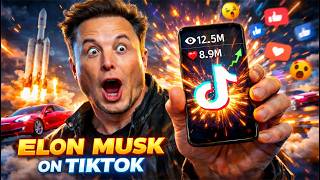
In this solo commentary, TJ Walker uses a verified TikTok post attributed to Elon Musk as a springboard to examine the current state of media fragmentation and the limits of platform ownership. He argues that even a platform owner like Musk cannot guarantee audience attention, because attention is now scattered across thousands of niche algorithmic “mini‑worlds” (TikTok, Instagram, YouTube, X, podcasts, etc.). Walker advises creators to be platform‑agnostic: master one platform first, then expand and diversify to build resilience against algorithm changes, bans, or de‑ranking. He warns that renting audience on a third‑party platform is risky, likening it to a tenant who can be evicted at any moment. Walker then promotes his own Ultimize platform and free courses as a way to distribute the same core message across every channel consistently, solving the common “consistency problem” many creators face. The takeaway is that loyalty should be to the message, not to any single platform, because in today’s fragmented media landscape, being everywhere is the only way to stay relevant.
Chapters
Ultimize. Elon Musk, he may have just done something shocking. He might be posting on TikTok. Yes, Elon Musk, the man who bought Twitter, renamed it X, and spends half his waking life posting on it, may now be hedging his bets like a nervous day trader. A verified TikTok account using his handle posted a slick video. SpaceX, Tesla, Neuralink, the whole Elon cinematic universe sent to @ad_astra, which is Latin for, "Please buy our IPO." Now, we don't even know if it's actually him, which is perfect, I guess, because we're now living in a world where the most powerful man in the media might not even be sure which accounts are his. But here's the part that actually matters, and it's not about Elon. It's about what this says about media right now, because this is the most important lesson in modern communication. Even if you own a platform, you still don't own attention, or at least not everybody's attention. Think about that. Musk owns X, hundreds of millions of followers. He can post anything he wants, anytime he wants with zero filter, and he can tell his staff, put your thumb on it and make it go further. And yet, Now, he's possibly on TikTok, possibly on Instagram. Why? Because even owning the stadium doesn't guarantee everyone shows up to your game. The world media is now so fragmented, so splintered, so atomized. There is no everyone anymore. There's no national conversation. There's no, I'll just go to one platform and reach the world. The world is gone, or at least it's splintered. Now, you have 1,000 mini worlds. A TikTok world, an Instagram world, a YouTube world, a podcast world, an X world, and they barely overlap sometimes. It's like high school, but instead of cliques, it's algorithms. And everybody thinks their lunch table is the whole universe. So what's Musk doing? He's doing what every smart communicator eventually realizes, you have to be everywhere. You have to be platform agnostic, even if you own one of the platforms. You cannot fall in love even with your own platform. You have to fall in love with distribution because ideas don't win anymore just by existing. They win by showing up repeatedly everywhere. And this is where I'll tell you something that may sound slightly self-serving, but also happens to be true. That's exactly what I try to do with Ultimize. Same ideas, same core messages distributed across every possible platform. Now, it's true, I don't have a reach as large as Elon Musk. But it is why I do video, audio, short form, long form everywhere, because I don't assume anyone will find me. I assume the opposite. I assume most people will never see my best ideas unless I chase them down across platforms like a polite but persistent salesperson. Now, here's the counterpoint, because there's always a counterpoint. Yes, you can spread yourself too thin. If you try to do everything at once, you end up being mediocre or nonexistent everywhere. You don't master anything. You don't build momentum. You don't learn the nuance of a particular platform. So there's a real argument for dominating one platform first. Get good at it. Okay, build an audience, understand the rhythm, the tone, the psychology. But, and this is the part most people miss, you cannot stay there forever because unless you're Elon Musk, You don't control the platform, and if you don't control the platform, you're renting your audience. At any moment, the landlord can change the rules, change the locks, evict you, or just decide that your content, eh, no longer interesting according to an algorithm that was designed by someone who thinks memes about cats are more important than your life's work. You can get banned, shadow banned, de-ranked, or just quietly ignored. And there's no appeal. Okay, there is an appeal, but no one will ever listen to you. There's no customer service line where you could say, 'Excuse me, I had my career yesterday.' So the real strategy is this: master one platform, then expand, then diversify, then repeat. Because in this environment, resilience beats brilliance. The people who win are not necessarily the smartest, they are the most distributed. And here's the irony, even Elon Musk, the guy who owns the platform, is acting like he doesn't trust the platform. That should tell you everything you need to know. When the landlord starts shopping for other apartments, you should probably pack a bag. Now, there's one more layer to this that's a little bit funny. Musk has spent years criticizing platforms like TikTok and Instagram, saying they're addictive, saying they make people unhappy. Saying they're basically digital mind control machines, all of which is true, and now he might be posting on them, which just proves my favorite rule of communication: everyone hates the media until they need the media. It's like people who say, "I hate networking," until they need a job. Then suddenly they love networking. "Hi, how are you? Remember me? We once met in 2007." Same thing here. You can hate the platform, You can distrust the platform, you can warn everyone about the platform, but if that's where the audience is, you go because attention is the currency and you don't get to dictate where it lives. You have to go where it already is. So the takeaway is simple. Don't build your strategy around loyalty to a platform, build it around loyalty to your message and your message, your willingness to deliver that message everywhere. Relentlessly, consistently. Because in today's world, if you're not everywhere, you're nowhere. And if even Elon Musk understands that, you probably should too. I'm gonna have a part 2 on this topic in just a moment, a very sad case of a woman who lost her entire business overnight because Instagram like that said bye-bye. I'll be honest with you, most people don't have a learning problem. They They have a consistency problem. They'll watch something, listen to something, get fired up for a day, and then life takes over and everything resets. That's exactly the gap I'm trying to fix with Ultimize. So if you're getting something out of this show right now, go to ultimize.com, U-L-T-A-M-I-Z-E, and get a free course. There's one on communication skills, one on building better habits. And the whole idea is to make this part of your daily routine, not a one-time thing. It's simple, it's free, and it actually works if you use it. Ultimize.com. Ultimize.