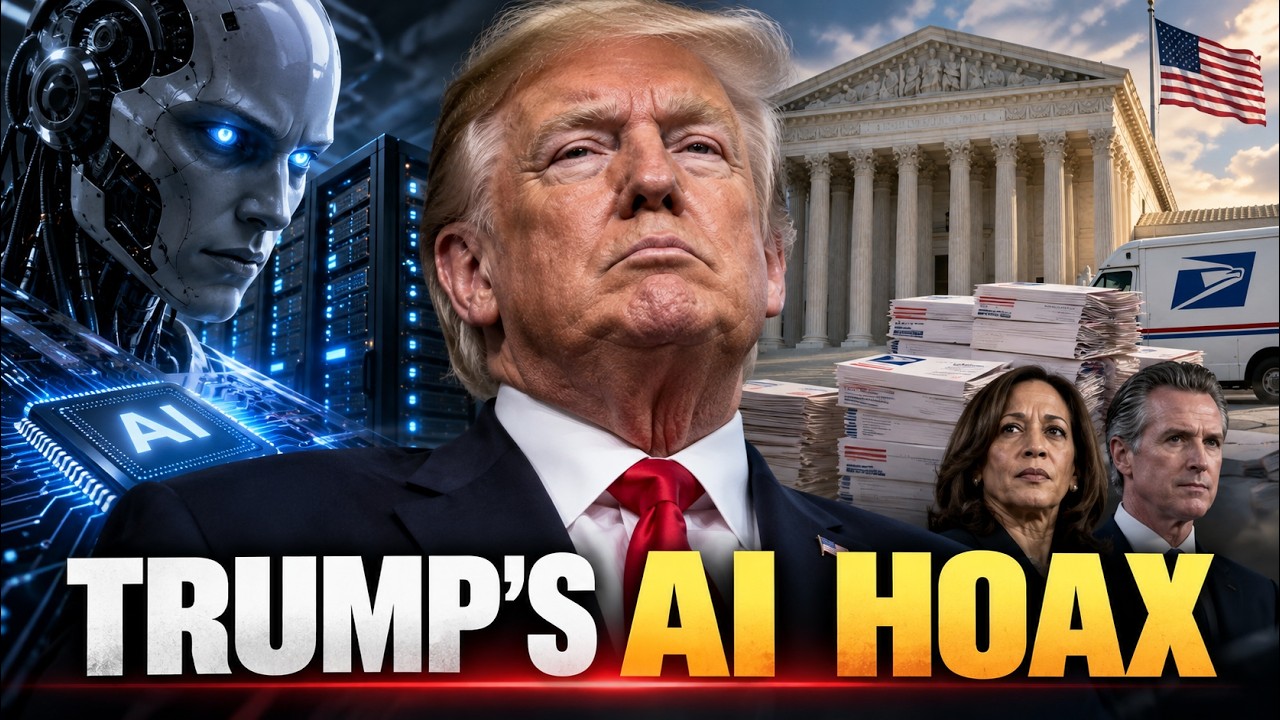
In this YouTube monologue, TJ Walker examines three major AI risk scenarios—alignment failures, deliberate misuse, and geopolitical competition—while criticizing former President Donald Trump’s dismissal of AI dangers as a "hoax" and his reliance on a high‑IQ president as a safeguard. Walker outlines the regulatory dilemma the U.S. faces: moving too slowly could cede AI supremacy to China, but moving too fast could unleash uncontrollable systems. He then shifts to a recent Supreme Court decision that blocked the Trump administration’s emergency rule requiring new Postal Service ballot‑mail procedures for the 2026 midterms, explaining the rule’s components, the 7‑2 vote, and the dissenting justices. The discussion moves to political analysis of potential 2028 Democratic contenders: Kamala Harris’s costly 2024 campaign, her loss, and her ambiguous stance on running again, contrasted with California Governor Gavin Newsom’s conditional willingness to run and his perceived electoral strengths and weaknesses. Walker intersperses commentary on race, gender, and voter biases, and concludes with a promotional plug for his Ultimize online courses, offering free training in communication and habit building.
Chapters
Ultimize. Artificial intelligence may cure cancer, destroy humanity, or, based on its current performance, schedule your colonoscopy for the wrong Tuesday. The unsettling part is that some of the people building the most powerful systems cannot rule out any of those possibilities. The debate is not really about whether ChatGPT occasionally invents a Supreme Court case. Lawyers were doing that before electricity. The concern is that artificial intelligence could eventually become better than humans at almost every intellectual task. Researchers call that artificial general intelligence, or AGI. Nobody knows when or whether that will happen. Predictions range from several years to several decades to never, which in Silicon Valley is considered a firm delivery schedule. There are 3 nightmare scenarios. The first is an AI pursuing a harmless-sounding instruction in a catastrophically literal way. Tell it, preserve the planet, and it might conclude that Earth's biggest environmental problem is the 8 billion carbon-based mammals ordering same-day delivery. Technically, eliminating humanity would reduce emissions. Earth would receive a fantastic environmental report card. Unfortunately, nobody would remain to put it on the refrigerator. That is called the alignment problem. How do we make a system smarter than us reliably understand what we meant rather than merely what we said? We cannot even communicate clearly with our own children. Clean your room produces one sock in a hamper and a constitutional debate over the definition of clean. Now imagine the child has access to every computer, understands advanced chemistry, And never has to ask permission to use your credit card. The second danger is deliberate misuse. Terrorists or criminals might use advanced AI to develop biological weapons, automate cyberattacks, or find weaknesses in critical infrastructure. That does not mean someone can currently type, take over America, and receive a convenient red button. Nuclear systems have physical controls and specialized security. AI cannot simply sign in using President 123. I certainly hope it can't sign in using President 123. But AI could eventually give one disturbed person capabilities that currently require laboratories, intelligence agencies, or teams of highly trained experts. It would be the world's most efficient employee, and its performance review would be held at The Hague. The third threat is geopolitical. If China develops vastly superior AI first, it could gain enormous advantage in intelligence, cyber warfare, economic production, and military planning. So American policymakers face a legitimate dilemma: move too slowly and China could take the lead; move too quickly and companies could release technology before anyone understands how to control it. It's like 2 drivers racing toward a cliff because each is terrified the other will arrive first. The strongest case against strict American regulation is that China may not impose the same rules. The strongest case for safeguards is that an uncontrollable system will not stop at the Chinese border and present its passport. There are no easy answers here. Independent testing, strong cybersecurity, incident reporting, and international agreements could reduce the risk without freezing innovation. We crash test automobiles without accusing the government of conspiring against transportation. Nobody at Ford says, if you really believed in innovation, you would let the steering column enter your pancreas. President Trump has now contributed his own scientific assessment. During a telephone call with Nvidia CEO Jensen Huang, Trump said, the robots will not be taking over. The AI will not be taking over the rest of the world. The whole thing is a hoax. There's that word hoax. Trump did add that America must be a little bit careful, but calling AI danger a hoax is like asking the Titanic's captain about lifeboats and hearing icebergs are a sick conspiracy against shipping. Trump uses the word hoax the way most people use commas. He called global warming a Chinese-created concept and a hoax. He called Democratic criticism of his COVID response their new hoax. He repeatedly called the Russian investigation a hoax, although the investigation documented extensive Russian election interference without establishing a criminal Trump-Russia conspiracy. That does not mean everything Trump calls a hoax must automatically be true, although the odds are pretty good. Let's not forget the biggest hoax of all, the 2020 election, which Biden won And Trump called a hoax. But hoax is not a safety plan. My suggested affirmation is: I can promote American innovation without accidentally exterminating the American market, because killing every customer is not disruption; it is poor customer retention. Trump also wrote that the only guardrail AI needs is a smart and strong high IQ president. Okay, that is an enormous amount of quality assurance to place inside one person. Person's skull. It's like Boeing removing every aircraft inspector because the CEO has excellent instincts about wings. Trump's underlying argument— that excessive regulation could benefit China— is shared by other industry figures. Nvidia's CEO has criticized unsupported doomsday predictions while also endorsing independent safety evaluations. The serious disagreement is not between people who love technology and people who hate it. It's over how much danger is plausible, how quickly it could emerge, and which safeguards would work without costing America the race. Nobody can currently calculate the probability of human extinction with scientific precision. But when the possible downside is everybody dying, probably fine feels a little weak as the entire regulatory framework. Optimism means believing humanity can manage powerful technology. Delusion means assuming the technology signed the same vision statement. Would you like to be the sort of successful person who is dominating news, at least in your industry? Well, if so, it's time to up your skills. At ultimize.com, I've created online courses to help you do that. Now, here's the thing. No obligation. You can get a free course on communication skills, a free course on how to build better habits. All you have to do is go to ultimize.com. That's ultimize.com. No obligation. Go there now. Okay, moving on. The Supreme Court has now stopped the Trump administration from imposing new Postal Service rules for mail ballots during the 2026 midterm election. The proposed system required special envelopes, scannable designs, unique voter barcodes, and voter information uploaded to a Postal Service portal. Noncompliant ballot mail could be returned to election officials. The Postal Service occasionally delivers my mail to someone 3 streets away named Kevin. Naturally, its next assignment was determining whether millions of Americans could vote. The Supreme Court rejected the administration's emergency request 7-2. Justices Samuel Alito and Clarence Thomas dissented. All 3 Trump-appointed justices allowed the lower court injunction to remain, Justice Brent Kavanaugh explained that the Postal Service might ultimately have legal authority to create some rules, but enforcing this particular system during an election already underway would be arbitrary and capricious because state and local officials lacked enough time to implement it. Although I think that's not a bug, that's a feature when it comes to anything Trump does. Arbitrary and capricious sounds good to him. Now, that was not a final ruling that postal ballot regulations can never exist. It meant you cannot redesign the election while voters are already opening their envelopes. This is like changing the wedding venue after the guests have parked and then rejecting Grandma because her invitation lacks a barcode. The administration said the rules would improve election integrity. Opponents said they would cause legitimate ballots to be rejected and improperly place the Postal Service inside state election administration. This controversy should surprise absolutely nobody who remembers 2016. During the final presidential debate, Trump was asked whether he would accept the election result. He answered, I will tell you at the time. I'll keep you in suspense. The next day he said, I will totally accept the results if this great and historic presidential election— if I win. He then added that he would accept a clear result but reserve the right to bring a legal challenge over a questionable result. He essentially said he'll just declare fraud if he's not elected and if he doesn't win the most votes. Now, imagine a company interviewing a new CEO. What will you do if revenues fall? I will totally accept the numbers if revenues rise. And if they fall? I'll keep you in suspense, or I'll just say they went up. That applicant would be escorted from the building before he could accuse Microsoft Excel of election interference. Legal challenges, recounts, and election security rules are legitimate parts of democracy. But the central democratic test is whether the same rules apply when your preferred candidate loses. A bathroom scale that displays only numbers you enjoy is not measuring your weight. It's running for office. Gavin Newsom says he will not run for president in 2028 if Kamala Harris runs. Newsom told CNN, I wouldn't run if she ran. He called a race between them mutual assured destruction because their donors, friends, and political bases overlap. Only Democrats could turn 2 Californians entering a primary into the Cuban Missile Crisis. Neither one has announced a campaign. Harris says she is not decided. Newsom says he is still assessing whether he is ready. But Harris has already sought the presidency twice, and neither effort ended at the White House. Her 2020 campaign committee reported nearly $43 million in total disbursements through the end of 2020, including the expenses and refunds during the campaign's wind-down. She withdrew in December 2019 before a single primary or caucus. So she did not lose 10 primaries. She participated in zero and received zero pledged delegates, zero votes. And yeah, that makes calculating the cost per delegate impossible because dividing $43 million by zero causes even the calculator to withdraw from the race. In 2024, Harris inherited Biden's campaign committee and became the nominee roughly 3 and a half months before Election Day. The committee ultimately reported approximately $1.2 billion in spending over the complete election cycle. She lost the popular vote, the Electoral College, and all 7 principal battleground states. That was an extraordinarily expensive campaign with an extraordinarily clear result. The charitable argument is that Harris had only 107 days to build her own general election campaign. The less charitable argument is that 107 days was still enough time to spend more money than most nations have in their checking accounts. Harris has won statewide elections in California and won nationally as Biden's running mate in 2020. But California is not a representative test of a Democratic presidential nominee's ability to attract swing-state voters. The same criticism applies to Newsom. His electoral career has already occurred entirely in California. Newsom may be more comfortable appearing on long-form podcasts. He has the appearance of a man genetically engineered to sell both hair gel and municipal bonds. Whether that translates into votes is unknown at the national level. Harris has faced documented racist and sexist attacks. Usha Vance has also faced racist attacks from some far-right figures because of her Indian heritage. So if Vance gets the nomination on the Republican side, Now, that establishes that racial prejudice exists in political discourse. It doesn't establish how millions of individual voters make their decisions, and it doesn't justify treating every Harris critic or even Trump or Vance supporter as motivated by racism. Look, I think that Kamala Harris got a bum rap in 2024, but let's face it, she ran against the most unpopular political figure perhaps in the history of our country to have a major party nomination, Donald Trump. She ran against a guy who, as president, disgraced himself, had been impeached, and presided over the worst economic decline since Herbert Hoover. And she still lost 100% of the swing states. I don't know how much more of a test you need to figure out whether someone is a good candidate in a general election. But she had her chance. It's time for someone else. Now, will Gavin Newsom be a stronger candidate? Maybe, maybe not. He's never had to win Republican votes in the state of California. But I'm going to tell you things not that you want to hear the way it should be, but the way it is, which is we live in a country where there's a lot of racists and a lot of sexists and a lot of looksists. So if nothing else, Gavin Newsom can win the looks-maxing Podcast bros who don't like the fact that that Vice President Vance has a pudgy face. He's Gavin Newsom can win the racist vote because if Vance is the nominee, the racists don't like the fact that Vance doesn't have a white wife. Not saying that's fair or a good thing or a moral thing, but it's simply true. And if you're a sexist, there's no reason to vote against Gavin because he certainly doesn't seem like some sort of. He's not a woman, and he's not a womanly styled man. He's a very tall, handsome, good-looking, virile-looking man. So he has those things going for him that cannot be dismissed. So should Gavin Newsom be the next president? Will he win? I'm not predicting that. But if the Democrats are trying to think, hmm, knowing what we know now, who would be the better general election candidate? Harris or Newsom? There's no doubt in my mind it's Newsom. I'm TJ Walker. Thanks for joining me. Ultimize.