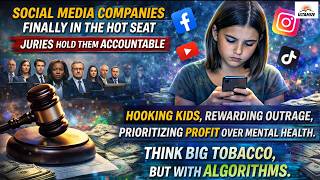
In this commentary, TJ Walker highlights two recent jury verdicts—$6 million awarded to a young woman in Los Angeles and a $375 million penalty against Meta in New Mexico—that hold social‑media platforms legally accountable for harming children. He argues that these verdicts expose a failure of Congress to regulate the industry and draws a stark parallel between the engineered addictiveness of platforms (infinite scroll, autoplay, AI‑driven reinforcement) and the tactics historically used by Big Tobacco. Walker critiques the common defenses offered by Meta and YouTube—claims that mental‑health impacts are complex or that platforms are neutral—labeling them as the same “product‑choice” rhetoric once used by cigarette makers. He explains that the business model of attention, outrage, and ad revenue incentivizes designs that trap kids, leading to real harms such as body‑dysmorphia and self‑harm ideation. While acknowledging that current penalties are modest compared to the companies’ market caps, he calls for dramatically larger fines—10‑20 % of market value—to force genuine reform, asserting that platforms could remain profitable without the addictive features. The piece is a persuasive, alarm‑raising call for stronger legal and financial accountability to protect children.
Chapters
Ultimize. Let me start with something that should terrify every parent, and frankly, anyone with a brain. According to the Times, two juries just did something Congress has failed to do for more than a decade. They actually held social media companies accountable for harming kids. We're not talking about vague concerns. We're talking about real verdicts, real money, and real damage. Well, almost real money, not real to these companies. Here are the facts. In Los Angeles, a jury awarded $6 million to a young woman who said platforms like Meta and YouTube hooked her with addictive features starting at age 6. And in New Mexico, we talked about this yesterday, a jury hit Meta with a $375 million penalty for failing to protect children from predators. Let me repeat that. Not maybe harmful, not needs a little more study. A jury looked at the evidence and said this caused real harm. And here's the key quote that should make every executive in Silicon Valley lose sleep: "That's not a blogger. That's a child safety advocate summarizing what juries just validated." Now, the company's pushback— Meta says mental health is complex. Well, yeah. YouTube says the case misunderstands their platform. Well, maybe, maybe not. And hey, I'm on YouTube now. Let me not be a hypocrite, but there are problems. With YouTube and Facebook. When they say this is complex and you don't understand, that's exactly what big tobacco said for decades. Let's talk about big tobacco for a second. They said no proven link to cancer. We're just providing a product people choose to smoke. Sound familiar? Because today we have no proven link to mental health harm. Talking about what social media companies say. We're just a platform. Users choose what they consume. It's the same script, just with better lighting and more emojis. But here's where this gets even worse. Cigarettes damage lungs. Social media, it's rewiring brains. The jury in Los Angeles didn't focus on content. They focused on design. Infinite scroll, autoplay, algorithmic reinforcement. That's not neutral. That's engineered addiction. And here's the devastating comparison. Tobacco companies made something addictive. These companies made something addictive and then optimized it in real time using AI to make it even more addictive. It's like giving cigarette companies a dashboard saying, hey, if you tweak the nicotine 3% higher for this 13-year-old, she'll smoke 22% more. That's essentially what this is. And the legal system is finally catching up. One legal expert put it this way. This is tough. This is a problem. Because these are not just apps, they are behavior engineering systems. Now, here's where I'm going to push this further than most commentators, because people say, well, what do you want to do, shut them down? No, that's lazy thinking. These companies could still be wildly profitable and not do this. They could stop rewarding outrage over truth, stop amplifying the most extreme voices, stop designing features that trap kids for hours. They could still make billions. They just might make slightly fewer billions. And apparently that's unacceptable. Let's be honest about what's really going on. A business model is simple: attention, addiction, ad revenue. And the fastest way to get attention? Not truth, not nuance. It's outrage. It's lies. It's fear. It's tribalism. It's saying anybody who disagrees with me isn't a real citizen. They're from another continent or another planet, or they're a space alien. It's when you say, because someone has a difference in public policy from me, they are now therefore a child molester. That is what gets outrage, that's what gets attention, and that's what makes these companies rich. They don't say, here's something accurate. They say, here's something that will keep you from putting your phone down. Now we're seeing the consequences. Kids starting at age 6, body dysmorphia, self-harm ideation, and parents sitting in courtrooms listening to verdicts about their children. And here's the part that should really worry Silicon Valley. It's just not going to be ignored this time. Now, what's really going to happen here? Do I live in some fantasy world where Congress is just going to take over? No, but there are juries and the juries are increasingly giving cash awards. But $6 million is nothing. That's, that's less than you or me finding a penny on the ground. Even the $370 million that was fined to Meta earlier this week, it's insignificant. But at some point, penalties are going to have to get real. It's going to have to be 10%, 20% of the market cap of these companies. Then and only then are we likely to see real reform. Ultimize.