TJ WALKER - THE HABIT INFLUENCER - Personal Development | LIVE STREAM
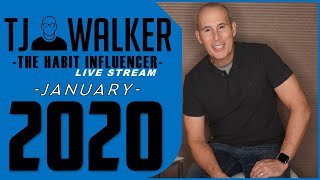
TJ Walker discusses building habits around communication and decision-making. He covers how to become a great communicator through speech practice and learning new words daily, and breaks down risk perception using transportation death statistics to show why we fear planes more than cars.
Chapters
Across all platforms. Happy to be here with you, but it is a learning process. We had a slight problem today, had to do a restart. So if you were there right from the beginning, we apologize for causing the delay. But now that you're here, we are ready to dive right in with a great show. As always, this is the show about habits. How to build stronger habits in your life, how to build personal habits so that you achieve more personal fulfillment, and how to minimize bad habits. I'm not an expert on addiction. We don't deal a lot with addiction here. But for everyday bad habits, procrastination, lack of fulfillment in your career, we do try to come up with highly specific actions that you can take to improve your life right away. Coming up on the show, we'll be talking about the stages of confidence when it comes to communication. Communication is one of the pillars of success, I think, in any life. And we'll be talking about the degrees of being confident in a particular speech, your speaking skills in general, and then more broadly your identity as a great communicator. We'll be talking about that in topic 1 today in topic A, topic B, we'll be looking at Are you rational? So much of the news with the horrible news about Kobe Bryant going down in the helicopter losing his life, People are all of a sudden panicked about helicopters, kind of like being panicked about shark attacks. We'll be looking at the actual data and confronting this issue. Are you. Am I rational? We all like to think we're rational. We might not be in topic C. Stop looking at your phone. It might not bother you when you're on your phone, but it probably bothers you if your kids, if your date, if your friends you haven't seen in six months come over and you're trying to have a conversation on their. On their phone. The whole time we'll be talking about this whole issue of telephone addiction, what you can do about it and where this is heading for society. And topic D be sharing with you 39 daily personal habits I have that I use to attempt to be more creative. Now, I'm not Picasso, but I do make a living and a pretty nice living off of my creative energies. I'm not punching a time clock at a law firm or accounting firm. Not that there's anything wrong with that. I'm not doing backbreaking work digging ditches. I'm not doing manual labor. I, I do make a living from my creativity and I also enjoy being creative. So I'll be sharing with you 39 habits I do on a daily basis to become more creative. We'll also be looking at top news stories from around the globe. We'll have suggestions for you on eight top social media habits that any successful person should try to acquire. We'll be looking at other research on how to minimize and avoid telephone addiction. And we'll be looking at 17 simple daily habits that separate high achievers from everybody else. Plus, looking at the legacy of Andrew Carnegie and all of the thousands of libraries he created around the world, specifically in the United States, but also around the world. And we'll be putting a spotlight on our top new online course of the month, which is the complete PowerPoint presentation skills course. There'll be a link to everything I just mentioned in the Show Notes, so if you're interested in more information on any of those, you can go to the Show Notes. If you don't see it, we might not have that on TikTok right now. You will see it in the Show Notes on our Facebook page, well as our YouTube channel special hello and apologies to our friends on TikTok. We've once again had some technical problems with the main feed. That's why you are seeing me through my cell phone today at an odd angle rather than me looking right at you. So Josh, appreciate your patience. Alexis, Sarah and others on TikTok. Thanks for joining. Those of you joining us on Facebook, YouTube and all the other platforms, very happy you are here. If you haven't yet been to our Facebook page, just go to facebook.com and type in TJ Walker, Personal Development Trainer. I typically post freebies, extras, certain benefits to people who join our community there and like that page. So if you don't really care where you're watching, you do have a Facebook account. I would strongly urge you take a look at that specific Facebook page and perhaps experience the show from there. All that plus your calls, your emails, your videos, you can communicate any way you want with us. So you can send an email tjwalker.com you can post comments on any social media platform. We have comments every single day coming through on Instagram, through TikTok, Facebook, YouTube and we share them all. So you can ask questions, you can poke holes in something I say, you can introduce topics yourself. We are here as a community. It's not just me as some expert lecturing down to followers. No, I'm not above you. We are just all members of a community here. All here with the purpose of building our habits and developing stronger and stronger habits. This leads to topic A. Are you making the transition from being Confident about a particular speech or presentation, to being confident about your speaking abilities in general, to the final level, which is having an identity of being a great communicator. If you really want to make the total transformation in your own personal development, you've got to think of that arc. You might not be there yet. The starting point for most people, the starting point for people in my courses, my online courses, typically, is I'm not very good at this at all, or I'm nervous about speaking or I'm uncomfortable speaking. I've got to give a speech, I've got to give a job interview, I've got to give a PowerPoint presentation. How can I improve? How can I get to a base level of competence? So that's the first phase for everyone in any form of communication. Before a Pulitzer Prize winning novelist writes a great novel, that person had to go to first grade and learn how to write letters and capital letters and periods and commas. You have to learn the fundamental building blocks of writing before you can build confidence in your writing abilities. It's exactly the same thing with spoken communication. The first step is learning the fundamentals, the basics, and then you focus on individual speeches and presentations and talks, PowerPoints, and you work on that. And in my courses with you and my other students around the world, I teach you step by step. How can you prepare a specific speech, a specific presentation, how can you rehearse that speech? How can you get to the point where you're completely comfortable and confident that that specific speech you have to give tonight or tomorrow, our next week, is going to be not just competent, but great? Of course, the number one secret I always stress is practice your speech on video until you love what you see, the style and the substance. That's the first big threshold. Sadly, the vast majority of the world never gets there. They always get to the point point before they practice on video and they're just throwing things out there. They're not quite sure if it's any good or not. They sort of hope, well, maybe it'll go okay, or maybe it'll be a good vibe today, maybe the room will be on. But they never really get to that first true stage one level of competence, preparing for that particular speech. But, but then you go to the next phase and the next phase is telling yourself, okay, I've given 2, 3, 4, 5, 10 speeches. My last 10 speeches, my last 10 YouTube videos, my last 10 Facebook Live presentations have all gone well. I have a system. I'm preparing, I'm getting more comfortable, more confident. I'M getting better results and they're going well. They're consistently going well. That's the next step. But the final stage comes after you have been doing that for a while. And it might not be the first week, the first month, the first year, or sometimes in even the first decade. But eventually, if you practice the daily habits of good communication long enough, a transformation takes place. You no longer think about this is a good speech you're going to give, or in general, your speeches are good. You go to a higher level and that higher level plane is forging a new identity for yourself. And your identity is I'm a great communicator. I am an excellent communicator. When I have ideas I want to communicate with the world, I can do it. And it just doesn't matter if it's standing, sitting, talking to one person, talking to 20, 50 or a thousand. It doesn't matter if it's YouTube Live or an online video for Facebook. It doesn't matter. I am an effective communicator. That is my identity. That's who I am. That is my identity. But it's not an identity I was born with. It wasn't born with those habits. I was born shy, never said much at all. Quiet. I created this identity for myself because I decided I wanted to have the habit of being a good speaker. There were things I wanted to do in my life with media, politics, student activities, where I just decided it's going to be a lot easier if I can be a strong communicator. And I'm telling you I had no base level skills. I was the worst kid in my cub Scout troop trying to sell magazines and door to door peanut brittle sales to raise money. I had no natural communication abilities whatsoever. But I embraced the habit of practicing speeches, practicing presentations, getting to the point where I was comfortable doing it as frequently as possible, and then getting to the point where I wasn't worried about any one's speech or series of speeches or new environment of speaking because I just had an identity. That I am a great communicator doesn't mean everybody loves me. You might not love me, but I am confident that I'm coming across the best I can and that I am very competent at it. This is where I believe you want to be. It's where I believe you can be. If you decide you want the habits of being a great speaker, a strong communicator every single time. Not just today, not just for the next 10 speeches, but your core identity, it can be yours. I'm hoping that your identity, if not already, is that of a great communicator. It will be soon. By the way, I have a special bonus for you today. Thanks so much for listening. If you look in the notes below, you'll see a link to my latest course which will help you become a great communicator. It is the complete PowerPoint and presentation skills masterclass that there is a discount link below. A coupon will give you a massive discount. So I urge you check out that course if you ever think you might have to do a PowerPoint it will help you greatly. Okay, I'm TJ Walker. Thanks for joining me. Quick note to my producer Marceau, that's the segment we want to use that we're going to share with our Udemy students for tomorrow. Those who couldn't join us live so going to have that on our YouTube channel tomorrow. Typically for those of you joining us, sometimes you may watch a part of this and think oh I'll come back and catch it later. We don't typically put the full video of the two hour show on YouTube or Facebook. We do post it a few other places. The reason for this is we are also posting produced 7 to 10 minute videos every day. And if you put more than one video on some of these platforms then the platforms think nobody wants to watch your stuff because you're deluding your audience. Diluting it sounds like I said diluting. I hope I'm not diluting my audiences. You are diluting your audience. And by the way, one of the hallmarks of a confident communicator we were just talking about is not that you're so confident you never make a mistake. I just made a mistake 30 seconds ago. Didn't let it bother me. Kept on going. Occasionally will laugh at it. I've made numerous mistakes in the last 12 minutes. But you know what? Don't let it bother me. And when you as a speaker, don't let it bother you, typically the audience won't notice either. Quick tip 4 you we are here today to talk to discuss habits, how to form better habits, stronger habits to lead happier, more productive, more successful, more fulfilled lives. Success on your terms. You don't have to become a billionaire. You can be a huge success and have a net worth of $5,000. You can be a huge failure and be a billionaire. It's about success on your terms. Special hello and again apologies to our friends on TikTok. We love TikTok. I love TikTok. I post videos there every single day. But we are having some technical problems, so we can't link to you through our regular connection. So that's why you're seeing sort of a side angle of me through my cell phone. Let's check in with some of our good friends on Instagram. Hatas has joined us. Good to see you, Hadas. Fortune Tribes, our good friend is with us. The watermark matches your shirt and I am wearing a black turtleneck. I typically tell people don't wear black because it's hard to tell where the arms start and the body ends. And it can make you look heavier on video. In real life, black can be slimming, but on video black can make you look heavier. But it's sort of a cold day. I had on a nice warm turtleneck and I thought I'm just going to keep it on. Even at the risk of people saying I look like Steve Job for some reason. I've had a lot of people on TikTok especially, but a lot of other websites lately saying I look like Steve Jobs. And sometimes I write back and I say, do you mean the good looking young Steve jobs in the 1970s who had a perfect head of hair, or do you mean the old, sickly, scrawny, near death Steve Jobs who was six months before passing away? No one's answered which one? I think I know which one. At some level, I think every, every white guy who's not overweight and is over 50 and is balding and wears a turtleneck kind of looks the same. We all kind of look alike. I guess I can say that. And so they all look like Steve Jobs at some level? I guess so. I'm not offended by that. But Fortune, thank you for mentioning that. I'm just telling my feelings and joking. Don't take it seriously now. No, no offense taken whatsoever, sir. There's a producer for your show. That's great. I thought you're making your own video editing. First time and hearing producer for an Instagram live. Yes, and my. My colleague and producer Marceau is with us. We'll ask him to come on camera one of these days. He's in another location today he's working out of studios either in Brooklyn or Philadelphia. I'm in Long Island, New York, so we're not physically that far away from each other. But thanks to the beauty of the Internet, we don't have to be together in a downtown Manhattan TV studio somewhere. It's a little easier, more efficient, less costly than having a big studio. And for those of you who don't know and care at all, this is a studio in my home. This is my living room, although we're not in my living room. This is a video loop, a TV screen. I'm in a 9 foot by 12 foot or 6 foot by 12 foot closet in the first floor of my home in Long Island, New York. I have carpeted walls, cameras mounted on the wall and lights, but it's really just a relatively simple room. So, Fortune, thanks so much. Good to hear from you. As always, Unorthodox has joined us. Benamel Jr has joined us. Sai says hello and you're enjoying the thousand one ways of public speaking. That's great. I'm glad you're enjoying that book, Jonan. And I think I. Did I miss another comment from Fortune? Did we, did we scroll the wrong way or too quickly or did I miss something? Marceau, let's just take. Okay. Hattus has joined us. Okay. Let's check in with our friends on Facebook. I see Peggy has joined us. Speaking on videos is getting much easier. That's Peggy, one of, also one of my students. And so my online courses, I believe on the UDEMY platform has her own online courses that are about to. To go live. I was incredibly shy up until about 10 years ago. Now I speak to groups and organizations and, and make videos. I remember the first video I made for one of your courses. It was so rehearsed. I'm glad to see I've come a long way. You've helped so much. Well, Peggy, thanks so much. Appreciate that. And Peggy's a great example. You can learn at any age. And Peggy, I hope I'm not spilling the beans, but you're not 10 years old. So the fact that you learned 10 years ago, you were certainly an adult at the time. A lot of times people think that you're either born with it or not. No, you can learn how to be a great speaker at age 30, 40, 50, 60. I personally trained people 80 years old and they still got better. So you can learn it absolutely any age. My good friend Merlee has joined us. Merlee, thanks so much for stopping by and please have. Merlee is saying, please have a look at kids. Karen Sudmeyer's page. Anything Murali recommends, I take seriously. Murali is one of the top personal development experts in the world, especially well known in the South Indian community of Kerala. Merlee coming to us today, I believe, from Geneva. So good to hear from you. Your community has been so great to my community. So many of Murli's tens of thousands of followers have been some of the initial Students of mine in my own online courses. So it's great to connect with fellow personal development leaders out there. Merlee, good to hear from you. And Marceau, do we have any other comments? Scrolling down, Peggy says, oh, there's still some cracking and popping in our audio today. Okay. Ah, okay, great. Well, Peggy, we do appreciate, by the way, I love praise as much as anyone, and I love it when people tell me, tj, you're the greatest ever. And the show's great and it's fantastic. I do love that. I'm not saying don't tell us that, but I specifically want to know if you do hear a problem. If you hear cracking with the microphone, that means it's disruptive to other people. So please let me know if you find the background music too loud or too soft. Let me know. If the scrolling is too much and distracting, let me know. Because ultimately, this show is not for me and Marceau. The show is for you. So it bothers you. I do want to know it. We want to know what works, too. I don't just want criticism, but I want both. I want a full range. And this is true for anything in life. You want to improve. So often when I do public speaking workshops, media training workshops, personal development workshops, people stand up, they speak, they share their goals. We record it, watch it. And the first instinct is always the same. They'll say, tj, tell me what I did wrong. Rip me apart. Go ahead. I'm here to learn. And I always say, time out. No offense, but I'm the one who knows how these skills are learned. Number two, the first thing I'm going to do is ask you to isolate what you like, what works, and then I'm going to tell you what works. It's always good to focus on the positive first. Build your strengths, build on what works. Do more of what works, works. I find that that works well, whether it's for me, for any individual. When you're training people, coaching people, mentoring someone, focus on what is working well so we can build on that. It also opens people up so much more warmly and broadly to other suggestions, to criticisms. If you just start off with, this is horrible, this is no good, this is rotten, and this has got to change. Intellectually, you might be right, but emotionally, people shut down and it's not productive. Let's say hello to some of our friends. Some new good folks have joined us on TikTok today. Funkindope has joined us. Great name and I appreciate the four thumbs up. Funk Marlinson has joined us as well. Email has joined us. Penguin Box has joined us too. Penguin, good to see you. Thanks so much for joining us as well as Alexis. And we're trying to fix some of our issues with TikTok. That's why you're watching me through our phone today. We'd fixed that earlier in the week, but we're having a few connection problems with our main Internet interface, with our camera and all the platforms we're on. So hope you don't mind seeing me sort of ignoring you looking off in space. That's why. But we're very much glad you're here. Any questions you have, comments, suggestions you have for topics to be discussed, believe me, we're not ignoring you. You are on the same plane with everyone else and all of your thoughts will be noted and respected. So thanks so much for joining us today. Today. We've got a lot of top news stories today and top blogs. Part of what I do to help you save time is I try to look at every single major blog post in the world every day that relates to habits. I try to look at every major news story, every piece of research that comes out that relates to habits, and then distill the very best information for you. That's what we're about here. A lot of people very sad. I know, Marceau, you were about the passing of Kobe Bryant over the weekend in that horrific helicopter crash. And I know that I'm no smarter than anyone else. Most of the time my first thought is, boy, oh boy, those helicopters, they sure are dangerous. Almost glad I can't afford to commute on a helicopter on a regular basis. And of course, I feel very sorry for his family and friends. But then I have asked myself, is that really true? Is it really true that helicopters are more dangerous than automobiles or planes? That leads us to topic B for the show today. Are you rational? Are you a rational human being? Part of being a human being is that we are not supposed to simply be animals, just grabbing for food, just reacting, just responding to cues. We shouldn't be able to use our intellect to think clearly and discern what is real, what is important, versus what seems to be. If you see someone dancing up and down and doing a rain dance and then it rains, most people, most of the viewers of this show, presumably, you would not necessarily conclude that the jumping up and down for the rain dance created the rain. The two actions were correlated, meaning they happened at the same time, but there was no causation involved. That's how rational people like to think. Rational people like to know There are facts, that there is evidence for what they do, decisions they make. Now, we as human beings are inherently irrational. Love is irrational. Let me just say right up front, I'm irrational. And maybe I'm even more irrational than the average person. I don't know. But I can tell you this as a habit. I aspire to being rational. I have aspirations to try to look at the world, to interpret data, to have influence over my actions based on rational thought. So was I rational when I turned to my wife after the news of Kobe Bryant saying, wow, those helicopters sure are dangerous. I'm glad we don't ever have to fly in helicopters. It turns out if you look at the data, no, I was completely irrational. So I have some statistics here on deaths per mile of transportation. The safest of all is the one that feels the scariest for most people. On a regular basis, airlines. Hundreds of millions of miles are traveled each year by people around the globe. And in general, only a few hundred people ever die in an airplane crash. Certainly, on average, the last 20 years, it's fewer than 1,000 people die. So. So you could basically never be safer than in an airplane. You could be in your own bathtub and be more likely to die. So that's what we got to fight is this desire to be irrational, this tendency because, hey, I'm that way too. When I'm in a plane and there's turbulence, there's a part of me that thinks, oh, no, I could be. And I'm a pretty relaxed, comfortable flyer, and I fly a lot, and I never think about being afraid of flying, or I never avoid flying, except when there is that extreme turbulence. There is a part of me that thinks, oh, no, the plane is falling apart. It turns out that is completely irrational. You're never going to be safer even in your own bed. More people die falling out of their beds each year than getting killed in airplanes. So that's the benchmark, that's the death. If you had to have a death index, that's the one meaning virtually no deaths. The next thing, in terms of safety, intercity rail, Amtrak, it's 20 times more dangerous than being on an airplane. And again, an airplane is, statistically speaking, the safest place you could ever be. Next up from that, a scheduled charter flight, 34 times more dangerous, more death inducing than being on a regular airplane. After that, mass transit, rail and bus, 49 times as dangerous as being on an airplane. Then we have non scheduled chartered flights. This is one where you just sort of, you know, get a guy and you go fly somewhere 59 times more dangerous. Here's where we get to helicopters. 63 times more dangerous than being in an airplane. Okay, so you're thinking, well, T.J. what are you complaining about? Sounds like we got it right. Helicopters are, are really dangerous. Right, Next, general aviation. Things like private planes. 271 times more dangerous than commercial airlines. Now here's the next category. Driving in a car. 453 times more dangerous than being in an airplane. And that's roughly nine times more dangerous than being in a helicopter. That's right. So regardless of how we feel about any one celebrity in the news, and it's sad when any human being dies, anytime you hear about someone dying in a helicopter, if you are rational, you have to think their chances of dying would have been 900 times more in a car. Obviously, in any one situation, that helicopter went down and you knew it in advance, you wouldn't do it. But in general, you can never ever rationally say, I'm not going in the helicopter, I am going to take a car. I've certainly heard of couples say, oh, we're not going to fly in the same airplane. Well, if the plane goes down, we don't want our kids to be orphaned. So they drive in the same car to the airport and then they fly in different planes. I understand the desire not to want your children to become orphans. I don't want my child to become an orphan. But if you're a rational, sane human being, the rational thing to do would be take two different cabs or two different Ubers to the airport and then ride the same plane together. It feels dangerous, and yet it isn't. Here's why this is so important. Does it really matter if you and I avoid helicopters? Probably not. But the significance for this, I believe, is if you want to be a fully realized human being, if you want to reach your full potential, it is extraordinarily important that you protect and preserve your ability to think clearly, rationally about the world, to make decisions based on, on rational information. It's very hard to create, for example, new scientific discoveries if you don't have respect for what the actual science is. If you don't understand previous software programs, how can you build on them to make them better? How can you protect your own health if you don't really care about being rational? You open yourself up to every kind of flimflam man saying, buy this shark, this smoked shark, green shark cartilage for a thousand dollars an ounce because the FDA doesn't want you to have it, but it will cure you of cancer and every other disease. If you believe in rationality, if you believe in evidence, you would say, oh, time out. I'm not going to buy that shark cartilage until you can show me some independent double blind tests conducted in a scientific manner proving its efficacy. Folks, there are a lot of problems with western medicine, but double blind testing is not one of them. Evidence based decision making is not one of them. You want to talk about pharmaceutical industries and horrible marketing practices for sleep pills? Yeah, I'm with you. Those are all bad things quite often. But the idea of being rational, of looking for facts, trying to be objective, trying to figure out what is cause and effect, what is a true factor in death, what is a real risk and what isn't. That is the hallmark of a sane, rational person who is in a better position to be successful. And again, I don't want to sound holier than thou. I can be as irrational as the next Skydiving is statistically much safer. Fewer deaths than scuba diving. I've been scuba diving. I've never gone skydiving. Why have I not gone skydiving? Because I had a close friend who went skydiving and her parachute did open up fully. It went into a spin, it crushed her face and destroyed her short term memory and it just scares me to think about it. But it's not rational for me to avoid that. When I'm in a really tall building and it has floor to ceiling glass windows, it makes me nervous to stand right at the edge. There's a part of me that feels like, oh, I could fall or what if a plane crashes into it? Well, completely irrational. So I'm irrational as anyone else at some level. But I do try to make the habit of at least trying to be rational, especially when it comes to big decisions about my health, my life, my career, my relationships, my. Are you rational? Do you even think it's a good thing to be rational? Think about it. If you're not rational, then we're little more than animals. I'm TJ Walker. Thanks for joining me today. We have a lot of show left, a lot of fun, your questions, your comments, some other big, big think pieces I've come up with and a lot more. Plus your suggestions. Let's first check in with our friends on Facebook. Peggy says I'm 61 and proud of it. So Peggy, yeah, so if you learned 10 years ago you were 51 years old, that's great. That's fantastic. That's the perfect time to learn a new skill. I think any age is the perfect time to learn a new skill and some skills are frankly a lot easier to learn at later ages than others. Public speaking communication skills are, I think, skills that are relatively easy to learn at any point in life. So Peggy, congratulations for that. Ajmal writes. I want to thank you for the time. I've learned so much from your videos and the public speaking class I'm taking from you. So Ajmal, thanks so much. Sai has joined us as well. Ajmal, I am curious, what is the number one thing you have learned from the public speaking class While you're thinking of that, we're going to take a quick 30 second break because I forgot to leave my door open in the studio and it's now getting really hot. We'll be back in just 30 seconds. We are back. I'm TJ Walker. This is the habit in influencers. So happy you could join us today. We're here every day, Monday through Friday 1 to 3pm Talking about habits, how to build, cultivate, strengthen good habits in our life and how to minimize reduce habits that are getting in our way. We're not restricted to just dietary habits or exercise habits. This is about every major sphere in life. How to build stronger financial habits so you're financially healthy. How does build stronger relationship habits so you're happy with friends, family, loved ones, how to build stronger sleep habits and crucial part of health. Something we do talk about from time to time, better diet, exercise habits, better habits at becoming creative so that you reach your full potential. So we have a broad portfolio here. On the one hand, everything we look at through the lens of this one word, habits. But on the other side, on the other hand, it's a broad, to me it's so much broader than what CNN gets to look at because we get to look at every aspect of your life and my life. So that's what makes it fun and exciting and limitless. Source of ideas and topics here. Now Ajmal, we were talking to you and I appreciate very much you sharing that you got a lot out of my public speaking course and that's wonderful. But I do want to follow up and ask you what specifically did you learn from the public speaking course? It's nice to get general phrase but I want to practice what I preach and in every one of my communication skills courses, public speaking courses, media training courses, I always suggest the very same thing to people, which is anytime someone gives you praise after a speech, a presentation, a briefing, an interview, don't just say thanks. That's what most People do, of course. You should be gracious and say, thanks, but then follow up, say, oh, appreciate you telling me that. Can you tell me what specifically did you learn? What stood out? What do you remember? Quite often it's not what you expected. Quite often it's a particular story, a particular example, a vignette that made a certain idea come alive. It just crystallized it. It allowed the audience member to really see what you're talking about, and that's why it had such impact. So what great speakers do is they use each and every single speech they ever give as a mini focus group to make the next speech presentation a little bit better. In the software world, they would call this iteration. You're constantly trying to make things a little bit better. You would listen to your users on what they found buggy in your software program, and then the next version, it would get better. That's what Steve Jobs. I've got my Steve Jobs looking turtleneck on today. As we were talking about earlier, that's what Steve Jobs did with the iPhone. That's why you have so many iPhones, is they're getting feedback from users and improving it now. This is heresy to say this. A lot of people think I'm crazy for saying this. I bought the first iPhone. Guess what? Was it about 2007? I wasn't one of these people who stood and waited in line, but I did get it probably two weeks after it came out. It was horrible. I was typing like this, banging away. I couldn't type on the glass. It was very buggy, horribly designed. At that point, I actually threw it away and I went back to an old phone. I'd been using, a Palm Trio, which I don't think is even around anymore. It wasn't until the second version, the third version of the Apple iPhone, where they made it much, much easier to type on glass. My point there is it doesn't matter what field you're in, whether you're a speaker, software designer, a creator, ask people what they like, what they don't like, get feedback, and that is how you will improve in anything you do. One of the best habits you can ever develop is the idea of improving. How can you improve on a daily basis? One of the topics we'll talk about in hour two of the program today, I'll go into detail of about 39 different habits I do every single day to try to improve my own creativity. But one habit I'll share with you right now is I try to learn a new word every single day. It's not Because I want to use a bigger vocabulary to show off and make you think I'm smart. But by spending sometimes as little as five seconds reading a new word, reading a definition, I'm trying to send a signal to my brain. Hey, brain, you better still keep learning. You can keep learning. You're gonna learn right now. And you're open to learning new ideas every day. To me, that's the importance of it. And the beauty of it is it's such a small little bite. Who doesn't have five seconds? Okay, maybe I spend 10 seconds. There are a million different free apps websites you can go to learn a new word every day. Now, if I were really ambitious, I'd probably try to learn a new word each day in another language, like Chinese or Spanish. But I am focusing on more English words. I want you to think about how can you learn to make something a little bit better in yourself every single day? It is a very, very crucial skill. Very important, important habit to have. I wanted to share with you something that I have some mixed feelings about. This was a story that caught my idea, my eye on a personal. A personal development website. And I'm not quite sure how I feel about it, but I just wanted to share with you. It's about something called a Burning Bowl. Burning bowl ceremony incinerates bad thoughts and habits. This is on a website, al.com 1 I'm not familiar with. But it starts out, it's a new year with new hopes and new dreams. Write them all down and burn them all up. And the author talks about when a writer started the Burning bowl ceremony about 40 years ago. There were young children scattered in the corners of the house or reading a book out loud at the sticky kitchen table. There were noises that had to be shushed so the ceremony could begin. Now these children have all grown up, but they still do the same thing. Here's what actually goes on. You need a circle of friends. Friends. Three pieces of paper, a pen or pencil, and a fire. You need a few minutes to think. On the first paper, you write down what you want to let go of in the new year. An old hurt, A bad habit. A bit of envy that nags at you when you thought it had gone. An insecurity you wish you'd left back in your teens. On the second sheet of paper, you do this. You write down what you want to call into your life. More acceptance for people. More patience. More kindness. A new exercise plan. A new routine. Get up at sunrise. On the last page, you write what you're grateful for. This list gets longer at each ceremony, when people can't see the endless years stretching on and on like they used to. Already one in this writer's original group of friends had passed away. So when the papers are all full of words, the women take turns throwing them into the fire. Some use a poker to make sure the paper meets the flame. Then the words burn and turn into smoke and ashes. The chimney takes the promises up through the roof into the late afternoon sky, and it's over. So this is supposed to, you know, they have cover, dish, dinner, have fun, a little bit of a celebration. And I guess to many people, this is meaningful. To me, the big meaning here is it's just a way of sitting down with friends and being reflective, perhaps thinking about things much deeper. The symbolism of burning it, seeing your angst, your troubles go up in flames can make you feel better. What do you think of this? Is this a technique you would try? Would you find this useful? Does it seem silly, cheesy? One person's meaningful ceremony can be another person's sort of cheesy, trite, meaningless symbolism. There's no one right or wrong answer. If it helps you sit down and really reflect on big issues in life, things that are bringing you down, what you want to get rid of hurts and get you to force your thoughts about it, to reflect in a serious way, then I'm all for it. Is it a bit gimmicky? Maybe. But here's the thing about gimmicks. If it works for you, it's a good gimmick. People like to automatically say, oh, it's a gimmick. Is therefore bad. Well, no, not all gimmicks are bad. Some gimmicks are great if they motivate you to a desired action and it creates an outcome that's favorable to you. So weigh in. And by the way, this is from the AL.com stands for Alabama.com. so it's definitely not a website I think I've been to before, although I have lived in Alabama more than 30 years ago. One of my first jobs out of college was working as a campaign manager for the Lieutenant Governor of Alabama, Bill Baxley. I happen to live in the home of a former United States senator in Anniston, Alabama, former Senator Donald Stewart. I was 22 years old and I was told, you know, come on down here, son. You're going to be George Wallace in his own state. The guy I was working for, this was 1985, 35 years ago. And the guy I was working for, the Lieutenant Governor was running against at the time the incumbent Governor George Wallace. Well, George Wallace got sick, decided not to run. The guy I worked for, let's just say, had some had a few scandalous happenings and it didn't work out well and I was sort of run out of the state. But it was an interesting, interesting six month period of my life living in Anniston, Alabama. And then later in Birmingham, Alabama, which by the way is a beautiful city, beautiful little mountain ridge all the way around. It seemed like every single restaurant and bar had a beautiful scenic view of the nightlife of the city. So it is a beautiful city. We won't talk about the politics and the culture on the program here, but if you do get a chance to spend a day or two in Birmingham, I do think you would find it an intriguing city architecturally and from a geography standpoint. So that's alabama.com I'm TJ Walker. You are listening to and watching the Habit Influencer. This is the program where we talk about how to forge and create new habits, better habits, stronger habits. Not to make your spouse happy or your kids happy, but how to make you happy. Now ideally it will make other people in your life happier too and foster better relations everywhere. But this is about personal habits. I am intrigued by public policy issues of how do you get an entire society to drastically reduce smoking, for example. I'm intrigued by that and I've read books by Cass, Sustine, other experts. But this show is primarily not about influencing the public. It is about changing habits in yourself. Although there is some relationship when people, for example, who work at power companies want you to reduce your energy consumption, what they found is just giving you lower cost doesn't necessarily work. Asking you to do it doesn't necessarily work. Telling you it's good for the environment doesn't change your habit. The thing that changes people's habits is showing them that they are not doing as well as their neighbors. You've reduced your energy by 10% but all of your neighbors have reduced reduced their energy consumption 20% and their bills are 20% lower than yours. That's when energy companies have found is the best way to create change in the habits at a mass level comparison to others. So while I might tell you don't compare yourself to others, it'll depress you. There are times when it is good to compare yourself to others if it motivates you to make positive change. I remember way back, sorry if this sounds like I'm an old timer reminiscing about the old days But I do remember back in the 1980s, good friend of mine wrote his first book and you may be familiar with the name Don Yeager. He's now written about 30 books on history, sports, politics, but he wrote a book. I went to his book signing and I thought, well, he's no smarter than I am. Why is he writing a book and I'm not? And the very next day I sat down and wrote the first chapter in my first book. It's a book on politics. It's not in print now, but it motivated me. So I do think there are times when comparing yourself to others if you do it in a positive context. If you, if you say I'm just as good as that person, I should be accomplishing just as much, I should work hard in the same way and I can get some of the same rewards, positive attention there. That can be a good thing. Comparisons can be a trap because there are times it can just make you depressed. This person is taller, thinner, more beautiful than I am. No one will ever love me because I'm not tall, thin and beautiful. That can be a trap that can just chip away at people's self esteem. That's not what I'm talking about. You live in your dream house, that's X number of dollars. But comparing yourself to a billionaire who lives in a hundred thousand square foot home thinking, why can't I have that? That's not particularly productive. That is unlikely to help you at all. But what will help is sharing more communication. And that's what I want from you in hour two of the Habit Influencer. I'm TJ Walker, I'm your host. We're here every day for you 1 to 3pm on Facebook, YouTube, Twitch mixer and dozens of other live streaming sites. So by the way, when you're on one of these sites, sometimes it'll tell you five people watching and you may be thinking, wow, only five people watching. Maybe this isn't real. Maybe I should go elsewhere. Do keep in mind we're on almost 20 different platforms. So when you aggregate it together, it's not an insignificant audience. And I'm very happy for all of you. It doesn't matter if you are one of a thousand people watching and YouTube are one of five people watching on TikTok. We're happy you're here. Every one of you is important. Every one of you has great ideas to share and you have equal footing here in this habits community. I'm TJ Walker. We'll be back at three minutes past the hour, so don't go away. I'm not going away. We're just going to take a quick break to regroup, get a little more water, and we'll be back at three past the hour. Yeah, I don't know what the problem was with that. With that music. It's always giving us some type of. So am I going to be able to use my Am I going to be able to use my phone this time, or do we have to use my phone to go into TikTok? Are you able to connect to TikTok? Oh, hold on. It's almost giving me a problem. The site itself has given me a problem earlier. Well, I guess I'm just going to use my phone. I'll have both and they'll just. It'll be shrocky for them because I'll be shaking my hand, but I just don't know what else to do. I just broke my microphone. Drop this. That's the problem with this complexity as I'm dropping them. Tripod. I don't think I permanently broke it, but does it still sound okay to you? Hang on.
More from TJ





The Breakout Cases - What Actually Caused Famous Speaking Career Breakthroughs | Ultamize

The Red Circle Sessions Finale - Build the Speaking Career You Came Here For | Ultamize

Two Stages, One Logo, Two Completely Different Realities - Main Stage vs Independent Events | Ult...

Pre-Reset - Why Repetition Builds Better Speaking Decisions | The Red Circle Sessions | Ultamize

Your Decision, Your Framework, and What Happens After - Build Your Speaking Career First | Ultamize

The Red Circle Sessions Trailer - The Speaking Career Truth Nobody on That Stage Will Tell You | ...

The Two-Minute Ultamize Reset - Your Platform, Your Audience, Your Voice | The Red Circle Sessions