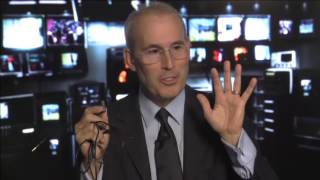
TJ Walker (host) gives practical, low-cost guidance for making Skype video interviews look and sound professional. Key advice covers camera placement (lens a few inches above eyes, use books or mount camera), lighting (avoid backlit windows; add front light), audio (use earbuds/headset or inexpensive lavalier mic; consider professional earpiece), and on-camera presence (look at the camera, keep natural movement). Walker emphasizes that these inexpensive changes (often under $50) increase the likelihood of repeat bookings and save time versus traveling to a studio.
Chapters
Hi, TJ Walker here. I wanted to give you a quick update on the latest when it comes to doing media interviews through Skype video. I've noticed in just the last six months, more and more TV networks all over the world, even local TV stations, are willing to conduct interviews with people like you and me through Skype video. There used to be this sense of, oh, Skype isn't good enough. But now so many stations are saying, sure, fine, faster for you, faster for us. So don't let this opportunity slip through your fingers. Increasingly, I'm having clients of mine send me videos of their Skype interviews. And here's the thing, they may have great content, but they're really hurting themselves by not following a few basic rules when it comes to Skype video interviews. And here's rule number one. When you're doing a Skype video interview, perfectly fine to use a laptop. Any laptop will do. But here's the thing. Most people, when they're using a laptop or even a desktop, their camera lens is down here. So it's kind of looking up their nose. That is the least flattering position for anyone. And then the other problem with that is you capture the light above you, so it's. Your face is dark and it's sort of shooting up into your nose, and then you just see the lights above. It doesn't have to be that way. By the way, all the tips I'm going to give you today either cost nothing or can be done for less than 50 bucks, even the advanced tips. So if you do the interview, here's the thing you want to the lens of the camera, the webcam, a couple of inches above your own eyes. So you would want the laptop basically this height. Now, how do you do that? Do you have to build a big fancy studio? No, just get a stack of books. Just stack your books up so that your computer, your monitor, wherever that little I is for the webcam and is a couple of inches above your eyes and you'll look much more professional. Now, I'm not using a webcam. I'm using a professional camera. It's mounted on the wall, but it's mounted a couple of inches above my eyes. That's because I want the angle to look better and to look more like a network news broadcast. Something professional. So that's the first big rule. The second big rule, lighting. You don't have to go out and get a bunch of big fancy lights, but you don't want to have a window behind you, because if there's more light behind you than in front of you. Then your face is going to get all dark and murky looking and the light becomes so bright it messes up all the lighting for the camera. So don't have your webcam facing a window. And if you've got to pull the shades down, if nothing else, you want more light in front of you to light up your face. You can even just take a lampshade off of a lamp and put it six feet in front of you. I've done that before and it works perfectly fine. So that's really the second big tip. Third big tip is the better the audio quality, the better the whole interview will be. The more the network, the TV producers, editors will want to deal with you in the future, the longer they're likely to keep you on the air. Now the way to do that, there's a cheap way, a way that costs nothing, and then there's a way that adds a little expense. The cheap way is just use the earbuds if you're using an iPhone or any other cell phone. Because the microphone here, if it rests where it normally would, is going to be much closer to your mouth than the built in microphone on your laptop or any other desktop. So the closer you are to the microphone, the better it's going to be. So please don't forget that tip. The other thing about wearing the headphone is you can now have earplugs. That means you're not going to have to have your speakers on loud. If you have your speakers on, then what the person is saying and what you're saying is bouncing back into the microphone and it can cause echo and distortion. So you don't really want to have your speakers on your computer blaring out going into your microphone. You want to be able to hear the reporter or the host talking to you through ears. So this, if you already have a headset, should cost you nothing. And the microphone on the earbuds are actually pretty good. Now, if you want to take it a step up, here's where I'm going to suggest you spend a little money. You don't have to, but it will dramatically improve the quality of your interviews. All you really need is a very simple lav mic and you can get this from Amazon and you just plug it into your computer one end and you clip this onto your jacket or a tie or any article of clothing that's near your mouth. Now the microphone is capturing you just a few inches away rather than two feet away like with your laptop. This is what I'll Link to this one in the description below. This is a Sony. I purchased it from Amazon for about 15 bucks. And I'm not a representative of Sony. I'm not getting an affiliate fee. You, you can get any lav mic, I don't care which one. But pretty much any lav mic that's clipped close to you is going to be better quality than a built in microphone to any laptop. So search around. But for 15 bucks, if you're going to do more than one interview a year, why not spend a few dollars now to make it even higher quality? Something that I use is just like what professional broadcasters use, the ifp, the earpiece. You put it in like this. You then clip it to the back of your shirt or jacket. This snakes around behind. So this allows me to hear the reporter, but without having any big headsets or sort of ridiculous looking iPhone earbuds coming down, which just doesn't look very professional. Again, better than nothing. But this costs less than $30. So if you're talking about getting the earpiece that you just plug into your speaker hole on your computer or your laptop and getting a microphone, that's really all you need. We're talking about less than $50. I'll link to the earpiece as well on Amazon. Again, I'm not recommending any particular brand, but you'll come across much better that way. Next step, make sure you're looking right at the camera, but you don't want to freeze your head. Sometimes people look at the camera but their head is so frozen you want to keep moving your head, keep moving your face, keep moving your hands. If you look away for a moment, better to look down for a second. You can look thoughtful looking down. If you're looking up, you'll look scared, sort of like you're searching, grasping for information that does not come across well at all. So try to look at the camera. Don't look at the screen. You might see the reporter interviewing you. You typically don't for these sorts of interviews. But imagine if right now you see me looking like this. The whole time I'm looking at the monitor, I can see myself, but from your perspective, it looks like I'm reading a script. I'm not reading a script, but it looks like I'm reading a script or I'm nervous or something. It's disorienting. So you just need to look at the camera. Remember, continue to move your hands, move your face, move your body a little. Don't be frozen, but don't be sort of shifting back and forth in your seat doing anything that seems nervous. You follow these tips. What you'll find is your Skype interviews can look as good, almost as good as if you were in the studio or had a fancy satellite hookup. They can sound as good as if you were there. And reporters, international news networks, other places will want to interview you even more often if they know you can give them something that looks professional and sounds professional. So this will help you reach your message to a bigger audience on a regular basis more frequently. And it's going to save you a massive amount of time. I live right outside New York City these days and have a studio in my home office, so I'm not that far away from major news networks and TV stations. But for me to have to leave my home, drive or get in a train or have a limo pick me up and take me to a studio and back is going to be four hours out of my day. By doing interviews through satellite video through the Skype satellite, not the expensive ones, then all through the Internet. What used to take me four hours, I can now do the whole thing in 15 minutes and it's just massively massive. Much more convenient. So please follow these tips and you'll get a lot more mileage out of your Skype video interviews. You'll get more time and more interview requests. Thanks.