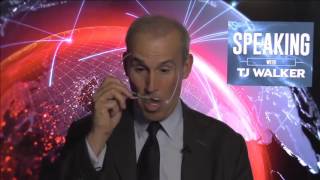
TJ Walker explains when to wear glasses during speeches and interviews. If you always wear them, keep them on for consistency. If you only need them for reading, skip them on stage and use larger font notes instead. He cites John McLaughlin and Sally Jesse Raphael as examples of how glasses shape how audiences perceive you.
Questions this video answers
July 16, 2016.
Approximately $18.
Chapters
Should you wear glasses when giving a speech or presentation?
Speaking the show about effective speaking in public to the media, at work and in life. Speaking with TJ Walker.
This is a common question I get from my public speaking and presentation workshop students trainees as well as my media training workshop trainees. And the answers are a little bit different for each one. Let me address it specifically. First of all, there's no problem wearing glasses. If you want to give a speech. There are some things I do need you to think about. There are many, many wildly successful communicators who wear glasses. John McLaughlin, one of the longest serving talk show hosts in America, always wears glasses. Those of you old enough to remember in the 80s and 90s the wildly successful talk show host Sally Jesse Raphael had big, trademark huge red glasses. So there's no problem wearing glasses. Teddy Roosevelt wore glasses. Didn't hurt his ability to communicate by speaking. So here are the rules of thumb I'd ask you to think about. For starters, if you always wear glasses, then wear glasses when you're giving a speech or doing a media interview. If you only wear glasses when you read, then in general, I wouldn't use glasses when you're giving a speech or presentation. Now timeout here and apologies for those of you listening on the audio podcast I'm wearing glasses right now. Those of you watching on YouTube, Flickr, Vimeo and the other video sources, you can see the glasses now. These glasses. I only use these glasses for doing TV interviews. Excuse me, not interviews, TV production, video production, creating podcasts, things like this. The reason I'm using these glasses is I do need glasses to read. And since I don't do any post production on these podcasts or shows, I have to look at the keyboard to hit F1. So the opening credits go in with my mouse. I have to hit the record unrecord button on my screen and there's no easy way of making those bigger. So that's why I'm wearing glasses. Now. I'm taking these glasses off now and I'm putting on what I normally use for reading. Now these are just big clunky plastic glasses that you get a six pack for on Amazon for $18. I tend to buy inexpensive reading glasses because I break them and I lose them. But I don't wear these glasses for videos or certainly for speeches because they're so big. They dominate. They call attention to themselves. Their shadows frame the face. They make it harder to see the eyes. As a general rule, I find that the more your audience can see your eyes, the better. The old expression don't trust someone who won't look you in the eyes. If people can't see your eyes, it's harder for them to to get a sense that they trust you. So that's why I favor if you're going to wear glasses, wear glasses that don't have thick frames on them and cause a lot of shade covering up your eye. Of course there are exceptions and there are examples of successful broadcasters who do have big glasses. But if you're not already really successful and you don't always, always wear glasses, I would ask you to think about if you're going to have to wear them, then have them relatively small frames so they're not casting shadows over your eyes. I'm going to give you more tips on glasses do's and don'ts what to think about when it comes to speaking to live audiences and the media in just a moment.
Speaking is brought to you by Media Training Worldwide. For all of your media training and public speaking training needs, go to mediatrainingworldwide.com.
When I'm giving a speech, I never wear glasses. Is it because I'm vain? Well, maybe a little. But I also don't want to have to take them on and off. Glasses like the ones I'm wearing for this video podcast can slide down. I'm just more comfortable when I'm in front of people speaking not wearing glasses because I don't wear glasses other than when I'm reading and when I'm giving a speech, I'm not reading. Now, it is true that I use notes, but here's the whole key to not needing to put your glasses on and off during a speech and calling attention to it. Whatever it is in your notes, whether it is a short poem, a quote, or a few bullet points, just take two seconds and increase the font size before you print it out. Whether it's 18 or 20 or 22 point font, there's some font that you can read without glasses. The idea that you have to print it out exactly as it is on screen is completely ridiculous. So even though I need glasses for reading, and even though I read at least a little bit when I'm giving a speech because I'm looking at notes, no one ever sees me wearing glasses when I'm giving a presentation or speech because I took the time to increase the font size. That also means there's not this awkwardness in the middle of the speech to be fumbling around looking for glasses. Where did I put those? Finding them, pulling them out, then putting them on my eyes and then bending down. All of that is wasting time on the mechanics of seeing. You're better off not doing that. Now let's focus on media interviews. If you always wear your glasses, then by all means wear glasses for media interviews. But a couple of things. Get your glasses glare proofed. You can go to any lenscraft or any other reputable glass place and ask them for glare reduction or glare proofing. Your glasses, they can either coat the ones you have, or the ones the new ones you buy can have a lot less glare on it. That way there will be less reflection from the light in the TV studio. I want to address one big issue. What I do have from time to time is people come to me who basically always wear glasses and then want to take their glasses off for a speech or for a media interview. And my advice is consistent. Don't do that. Have a consistent image. One of the values of doing TV interviews, of doing speeches, is that you build a personal brand. And I know that's an overused term and it's. That doesn't always mean that much, but what it does mean is consistency. You know, McDonald's arches look the same. The McDonald's french fries are the same regardless of where you eat them. You want to look the same whether someone sees you up on a stage, sees you on a TV newscast, a video, podcast, or in person. Part of the value of having that consistent image is if someone does see you give a speech and you're at a trade conference, they see you the next day at the restaurant or at a cocktail party, they recognize it's the same person. They can come up to you and say, oh, I enjoyed your speech last night. The part about. And they see it's the same person. If you have glasses one time and not the other, it can cause confusion. You want to fuse that image. You also don't want to look a lot better on stage than you do in person. You want things to look the same. In the political world, there's something known as the Ottinger effect. Dick Ottinger was a United States congressman from a very affluent Scarsdale section north of New York City, representing that area in the early 70s, he ran for the US Senate and had such wildly dynamic TV commercials that it was like the second coming of JFK. He was seen as this exciting, charismatic politician. If you just watch the commercials. Unfortunately, in real life, he was considered low energy, studious, a bit dull. So the problem was every single time people met him in real life at a campaign rally, there was the sense of ugh didn't live up to expectations. So his real image didn't match his media image. You don't want that because it just pushes people away. You want there to be a consistency there. Of course you can look a little bit better. I have makeup on right now, so I look a little bit better. But you don't want it to be wildly different. That's why I say try to be consistent. If you never wear glasses, don't all of a sudden put on fake glasses with plain glass to look smart. That's ridiculous. If you always wear glasses, then keep your glasses on. But I do recommend glasses that have, for the most part, wireless frames, or at least no big heavy plastic around it so you don't have the shadows on you and they're less noticeable, less obtrusive. You want people to notice your face and your message, not necessarily the style of your glasses. Again, there's always exceptions. Seth Godin, who's a lot more of a successful speaker than I am, has big, colorful plastic glasses and it fits his image of being a purple cow standing out, being different. So there's always exceptions. Just make sure you've given real thought to it. I'm TJ Walker. Thanks for joining me today. May all of your presentations. And oh, I should mention one other thing. If you can't see your audience without glasses, by all means, put your glasses on. You need to see them carefully. Hope all your presentations in life are successful. See you tomorrow.
Speaking with TJ Walker is the number one rated daily streaming TV and radio show devoted to all aspects of speaking and communication. If you received value from this show, then please subscribe to it@mediatrainingworldwide.com Please review.