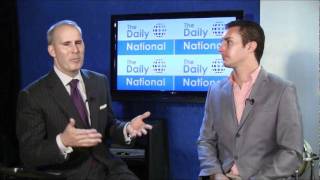
A live-stream conversation (TJ Walker with media trainer Mike Baco) analyzing Steve Jobs' public-speaking legacy after his retirement announcement. They emphasize Jobs' simplicity (one idea per slide, minimal text, memorable demos like pulling a product from an envelope), audience connection (making technical topics understandable to non-experts), stage presence (walking the stage, rehearsing), and resilience to technical problems. The hosts argue these techniques are learnable and broadly applicable to executives and presenters.
Chapters
T.J. i'm T.J. walker. Welcome to the Daily National. In the news, Steve Jobs is retiring, stepping down as active CEO of Apple. With us to dissect this, Mike Baco, our media training expert here at the Daily National. Now, Mike, we'll leave it to others to dissect his business legacy. We're going to focus on his public speaking legacy, his oratorical legacy. People do think he was a great speaker. Why?
I think you have to go to the simplicity of his message and the way that he presented it. Everyone has this image of him in the jeans and the black shirt, standing in front of the black curtain. But you know what, that works. That's memorable. So much of the emphasis now on presentations are having fancy slides, having fancy demonstrations and videos. You know, what was the star in his presentations, the products that he was launching. Everyone remembers him pulling out the Air Mac Pro from the envelope. Everyone remembers.
Let's talk about that a minute because, you know, here's a guy, first or second largest company in the world, every sort of resource available to him. He could have teams of people creating special effects, PowerPoint or as he would call it, keynote slides with his own system, every kind of razzle dazzle. But when he wanted to display how thin the Air Mac was, he didn't put up a big slide with a bullet point, you know, 18 of an inch thick. He brought out an envelope, pulled it out of the envelope, that demonstration. And as you talk about all the time with your clients, and as I do too, always demonstrate something rather than just putting up a slide or, you know, handing somebody a piece of paper. That was one of his great strengths. Also, when he did use the PowerPoint presentation again, Apple calls it Keynote, he followed a few basic rules, which is number one, he only had one idea per slide. Generally if you wanted to talk about an iPhone, he showed just a picture of an iPhone. If it was text, it was a one sentence summary. It was never a whole bunch of bullet points. What else stood out for you when you saw him speak?
Just the way that he connected with his audience. Again, you're talking about a lot of technical issues, a lot of people technically savvy in the audience, but he put it in a way that everyone could understand. He knew that his main audience were the people that were in the Mac conference audience, but there was also the consumer at home. So the way that he was able to describe things in a way that a grandma or a 13 year old kid saving up his allowance to buy that new iPhone or that new Mac Computer could very easily understand. So he understood his audience.
And he.
And he showed.
It's frankly a big fat lie that people say, oh, I'm a technical person. I have to give a technical presentation. And it doesn't get much more technical than being the CEO of Apple. And yet he didn't get bogged down in tech speak. And in jargon, he was able to simplify because a lot of the audience, let's face it, they were really, really knowledgeable techies hearing his presentations, but he didn't speak to them in purely technical terms. He always took the time to say, so what would I do with this iPad? Let me open it up. Oh, now I can read the New York Times on it. Something that absolutely anyone could understand. That's the hallmark of good speakers everywhere, is they may know 10 billion technical details. And no one doubts that Steve Jobs knows all the technical details. But you then have to use your judgment onto what is truly important so you can focus on one thing at a time.
And.
And Steve Jobs did that brilliantly. Another thing he did well is he simply walked around the stage and seemed comfortable and relaxed. He didn't just get one of these lecterns and stand behind the lectern the way a lot of pompous, scared CEOs did. Now, we're not trainers. You've never trained Steve Jobs. I haven't either. So we're not trying to take credit for anything. I have been told by those close to him that he put so much importance on his presentations that he spends entire day, sometimes a couple of days, rehearsing his presentations. So for all of you CEOs or executives out there who say, oh, I'd love to do better presenting, but there's no time. Baloney. There's always time for something that's important. If you can be the CEO of the largest, or depending on the day or the hour of the day, the second largest company in the world. And you can spend a day or two rehearsing. Anyone else can too. So it's that rehearsal. And what I like about the way he presented is he always connected at the human level and realized, okay, here's what the average person wants. The average techie really would like 1001 functions and gizmos on an iPhone or an iPad or an ipod. The average person doesn't. So part of what made him, I believe, a great CEO of a consumer electronics company is the fact that he never let the techie people drive things. Because, let's face it, he wasn't the first person to come up with an MP3 player. He wasn't the first person to come up with a little tablet. He did it better because of simplifying it. That helped him as a CEO, but it also helped him massively as a public speaker and as a presenter. Anything else you liked about it?
One other thing, and it didn't happen often, but when he did have technical issues, the entire presentation didn't go down the drain. It was something that he acknowledged and then moved on to. And part of that simplicity of his message and of his presentation was that he was able to move from some technical issue onto the next point without having the entire PowerPoint slide or the entire presentation go down the toilet. A lot of people think, well, if my slides aren't working or if the light goes out or something goes wrong, that's my entire speech. I wouldn't know what to do. He was able to segue into other areas of his speech and those few times that technical issues did come up, he was able to move on quite well.
So what I really like about Steve Jobs, on the one hand, he may have, not may, he has some sort of brilliant business genius in him that I don't have, you don't have, probably most of you don't have. Many of us are just never going to have the impact on business and modern technology consumer culture that Steve Jobs has had. Not once, not twice, but multiple times. But anyone can be as good of a public speaker as Steve Jobs is. The things he does, frankly, anyone can do. Walking around rather than staying put. Focusing on one idea at a time instead of putting up a PowerPoint slide with 20 ideas, communicating in a visual way, a demonstration way rather than bullet points and text, and narrowing the number of messages in a presentation to a handful rather than 75. Connecting at not just the intellectual technical level, but at the emotional gut level. Those are things, frankly, all great speakers do, not just Steve Jobs and anyone can do if they want to. Mike Baco, our media training expert here at the Daily national, thanks for joining us today. I'm T.J. walker.