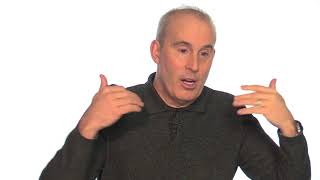
TJ Walker debunks three myths about body language: that you should keep your hands still, that power poses build lasting confidence, and that 93% of communication is nonverbal. He argues gestures help, poses don't stick, and both what you say and how you say it matter.
Questions this video answers
TJ Walker
April 29, 2018
Chapters
I'm a big believer in teaching by positive example, focusing on what you should do, not what you shouldn't do. But I do want to address what I consider to be the three big myths when it comes to body language in the workplace and body language in general. The number one myth out there, and I hear this every single week when I'm conducting public speaking, media training workshops with clients, individuals, groups all over the world. Someone will bring this up. And the issue is hands. What do you do with your hands when you're speaking? Presenting in a briefing, talking on Skype, video, or zoom? The big myth out there is that somehow it's distracting to move your hands, and it's more professional to hold your hands down. Nothing can could be further from the truth. Now, I monitor audiences all over the world. I test audiences. And what I have found, regardless of the culture, regardless of the industry, is that people respond much more favorably to an individual in a business situation. Speaking, presenting, talking. When that person moves his or her hands. The second you freeze your hands, you freeze your arms, body, your vocal cords, and you are going to sound more nervous, stiff, monotone, and you're going to look stiff. So huge, huge myth out there. Now, in theory, is it possible to be wildly gesticulating and distracting? It's possible. All I can tell you is that for 30 years, I've trained 10,000 people all over the globe from six continents. I've never yet had anyone wildly moving their hands too much. But every week, sometimes every day in a week, I have people stand up to give a presentation, and they do this or this, or grab a lectern. Their hands are frozen. They look stiff, uncomfortable, nervous. So I want you to get rid of this notion that somehow you're not supposed to move your hands. Have I ever seen someone move hands too much? Yeah. Will Ferrell in a movie where he's being interviewed after winning a race car. He's like, I don't know what to do with my. It's funny if you're a comed, but it's not a problem that affects people in real life. The second big myth out there, that there are certain poses you can take to make yourself more comfortable. Confident, commanding. The most pernicious of all is this one floating around on the Internet. I won't talk about the proponent by name, but she says, if you just stand with your arms and your hands on your hips like Wonder Woman, you'll be filled with so much confidence, it'll help you in any presentation. This is complete nonsense. In my professional view. Because if you don't have anything interesting to say, and then when you get in front of people for that speech or talk or presentation or job interview, you then tense your body up again. Standing like this for a minute isn't going to do anything. So get rid of that notion. And the solution we'll talk about later in this course. You got to practice speaking, presenting, talking, asking questions on video. It's not as popular as standing like Wonder Woman, but it really does solve the problem. Now, the number one myth out there when it comes to body language. Drumroll. I guess the number one myth is that somehow 93% of all communication is your body language, your voice, what you do with your body, only 7% your words, your content. This is a myth that's been going around for decades. It has been widely debunked. It all stems from a study at UCLA by a Professor Morabian. And he was studying something very different. His results have been perverted. So called body language experts, public speaking experts ever since, purports to show that how you move your body, what you do with your voice is infinitely more important than what you say and that your actual content, your actual words are only 7% widely debunked. If you hear any so called public speaking expert talk about this, you know they are a complete fool. I'm going to put the citation below and you can also google this and you can see what I'm talking about. Here's the ultimate test. If you doubt me, if really everything is body language and your voice and content is only 7%, that means you could give a sales presentation to someone who doesn't speak your language. They would still understand 93% of what you're talking about. That's obviously patently absurd. They wouldn't understand anything you're talking about if you're speaking to them in a language they don't understand. Now, I obviously think body language is important or I wouldn't be teaching this course. But I want you to really keep things in perspective. It's not more important than your actual ideas and your substance. You have to have both in any, any form of communication. It's never just about style. It's never just about substance. It's always both. For example, let's say you're desperate to hire some new employee in your organization and I write you a beautiful cover letter. Everything you want to see, everything you like, everything. Beautiful paper, great punctuation. But you look at my resume and I have no relevant work experience in your industry. And I've never held a job for more than two weeks. Are you likely to hire me? Probably not. In that case, I'll have great style but no substance. On the flip side, if I have a beautiful resume, everything you're looking for in your industry, but I send you a cover letter filled with misspellings, typos, poor grammar, no space between the words, what are you going to do? Chances are you're going to take my resume and my cover letter and throw it in the trash. In this case, my style will overwhelm my substance. So I believe in all forms of communication. Writing, speaking, talking. It's never this false dichotomy of style versus substance. You have to have both. This course is going to help you with the body language side of things. But realize you've got to have great substance if you really want to communicate. And ultimately, that's what is going to have a huge impact on your career. Body language can help, but without the substance, without good messages, none of this will matter.