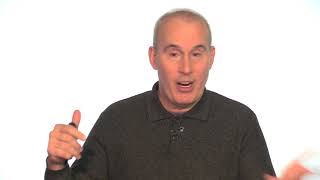
TJ Walker breaks down public speaking body language, debunking the myth that 93% of communication is nonverbal. He argues substance and style both matter, and teaches how to use movement and appear relaxed. Record yourself without audio to spot stiffness and improve.
Chapters
Now we are going to proceed to the part of the course where you are going to learn how to. Wait a minute. Time out. Would you want to watch someone like that on video or in real life? My messages might have been fine, but my body language distractions. It destroys the ability to communicate. I know a lot of you are uncomfortable in certain circumstances. Most of my clients say, well, T.J. i'm really comfortable in small groups, but I get nervous in front of large groups. Other people say, well, T.J. i'm perfectly fine speaking to large groups where I can't even see the people don't know them. It's when I'm speaking to four colleagues, I get nervous. Everyone's different. But I want to give you the tools you need so you know exactly how you come across. Because as you saw at the beginning, you know half of you are about to remove yourself from the course, give it a one star rating. Because it doesn't matter how good the information is, if the body language is awful, no one's going to pay attention. Now there's this huge myth out there spread by a lot of frankly ignorant body language experts that claims to say that 93% of communication is your body language and your voice simply not true. You can look it up on the Internet, but body language is important. If you're doing something distracting, think of it this way. People always ask me what's more important, style or substance? False choice. If you want to communicate, you always have to do both. You always have to have good substance and a good style. Think of it this way. If you need to hire someone in your organization, I have the perfect resume, everything you're looking for. But I send you a cover letter filled with misspellings, typos, poor grammar, dirty paper. Are you going to hire me? Probably not. On the other hand, if I have the perfect cover letter for you, everything you want to hear. Nice paper, great spelling, punctuation, everything's perfect. But then you look at my resume. I have no relevant experience to your field. In fact, I've never held any job other than two weeks as a lifeguard. Are you going to hire me? Probably not. In either case, it's either the style or the substance that is going to destroy my ability to get that job to communicate with you on what I want to do, get a job. So remember, it's never just about style. It's never just about substance. You have to have both. Now, lower on. In this whole course, I've got an entire course just on body language for public speaking. So you can always get more in depth. But here's the big picture. When you're speaking, you need to move. Your head needs to move, your face needs to move, your body needs to move, and yes, your hands need to move. One of the biggest myths out there is that somehow it's wrong to move your hands. You'll be wildly distracting. Well, yeah, if I did this the whole time, it would be. But I've worked with thousands of people all over the globe for years. I've never yet had anyone who moved their hands so much it was distracting. Yet every week, sometimes every day in a week, I have people who do this. Grabbing papers or they're holding a lectern. They look stiff, scared, nervous, frozen and uncomfortable. What does a little bunny rabbit do when it sees you and it's afraid you're going to eat it? It freezes. Well, that's what human beings do as well. When they're scared and nervous. They tighten up their body. And your audience can see that. Your audience can perceive that. Let me tell you a little trick I play my clients in real life. They come in, I ask them to stand up and speak. They speak. And nine times out of 10, once I turn the camera on and the bright lights and I say, go, they visibly tense up. Their bodies just stop moving. And maybe they still move a little, but it's 50% less than normal. Their face becomes more serious. And then we'll watch the video in a moment. But before that, when they're finished, I say, okay, great, thanks. I turn the light off of my camera. I drop the mic on the floor. I sit back, but the camera is still rolling. And I say to them, so how did that feel? And the vast majority of the time, they say, oh, tj, that was awful. I didn't like that. I wasn't comfortable. So then we watched the first video. And I'll ask them, what did you like? What did you not like? Well, tj, I just seem nervous, I seem uncomfortable, I seem tense. And then I ask, would you like to see somebody better than you? Someone much more confident, comfortable, relaxed? They say, sure. They think I'm going to show them some international celebrity, a prime minister from Europe or South America, or a TV star well known. And. And instead I just pushed the video of where they were speaking. And they didn't realize they were on camera. And they see now their face is moving, their eyebrows are moving, their body moves front and back, their hands are moving. Here's the real secret when it comes to body language. You don't need to learn how to act when you're giving a speech, you need to learn how to stop acting. The problem most people have when they're giving a speech, a presentation, a talk, and it hits some threshold taking them out of their comfort zone. You may be comfortable talking to one person because you talk to that one person every day, but now you're speaking to 10 people, and you don't know all of them or one of them is your boss. Maybe you're comfortable speaking to 10 people, but now you got to speak to 100 people or a thousand. When people go out of their comfort zone, they start to act natural. And the natural thing to do is to be scared. When we're scared, we tense our body, our hands stop moving, our body stops moving, our arms stop moving, our face becomes less expressive, and that makes us look and sound scared and bored and boring. So the secret, as I mentioned, is not learning how to act for the stage. It's learning how to stop acting, stop acting scared. Now, it's not enough for me to say, well, just act natural. Again, it's natural to be scared if you're in a situation where you're uncomfortable. So I get it. I'm sympathetic to you. We've all been there. I have been there. The key is we have to act the way we do when we're just completely comfortable, confident, and relaxed. The best speakers in the world, frankly, speak the very same. Whether they're talking to one person, 100 or 10 million, they don't change. So if you want a role model for yourself when it comes to your body language, you just need to speak the way you normally do. When you're completely comfortable, relaxed, and you're talking with one friend about your favorite sporting event or the Olympics, and you're in a completely relaxed environment, that's the body language you need when you're speaking. That will serve you well the vast majority of the time. And that's why you need to practice on video. And you may even want to do what I do in my own training. Ask a colleague or friend or family member to actually record you sometime when you're not aware of it and play it back and look at it. You'll be surprised. I'll have people tell me, oh, tj, I never move my hands when I speak. I couldn't possibly do that. And they're moving their hands the whole time. I'll just record them and play it back. So we can go into all kinds of minutiae as it relates to body language. But far and away the most important thing is don't act scared and frozen and stiff and move. So that's what I want you to do. Now, I'm not going to ask you to post the video yet. I don't want to scare you off. I will be doing that later. But what I would ask is just stand up or sit down. Pull your cell phone out and just practice talking about something that relates to what you do in business or professional life or civic life. Just record yourself speaking and then watch it without any audio and tell me what you think. So again, you don't have to post the video here in the discussion section, but I do want you to do it. Privacy of your own home or office. Record yourself speaking and then just watch it. Be careful though. If you do it the way you normally speak, your head's going to move. That's a good thing. You'll see your hands moving. That's a good thing. You want to see movement. If all you see is you're going to look like a hostage video. No one wants to listen to someone give a business or civic presentation or speech if they look like they're in a hostage video. So do that now. I want to make this really easy, not threatening at all. You're going to be tempted to just click to the next video lecture. I'm begging you if you want to get the most out of this course, please. It can be 20 seconds long. Speak. Ideally put your cell phone on a shelf or wall or use a webcam so you can free up both hands. Just speak about something, watch it without the audio, figure out what you like, don't like, and post a sentence or two summary right here in the discussion.