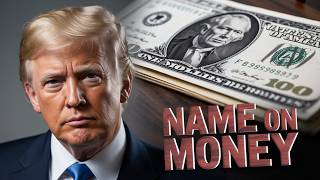
TJ Walker argues that Trump's plan to put his name on U.S. currency breaks a century-old tradition and mirrors tactics used by authoritarian leaders like Saddam Hussein and Stalin. He warns the move erodes democratic norms and predicts future campaigns will strip Trump's name from federal assets.
Chapters
Ultimize. According to the Times, President Donald Trump is set to become the first sitting president in American history to have his signature placed on U.S. currency. That's right, things like a dollar bill. Let me say that again slowly. The guy currently running the country wants his name on our money. Not after he's dead, not as a historical figure, but right now while he's still in office. If you're wondering whether this is normal, the answer is no. If you're wondering whether this is controversial, the answer is yes. If you're wondering whether this is the kind of thing that makes historians pour a drink at noon, the answer is absolutely. Because for over a century, US currency has followed a very simple, boring, stable tradition. You put institutional names on it, the Treasury Secretary, the Treasury. You do not turn it into a personal branding exercise. You do not turn the dollar bill into a business card. You do not treat the currency of the United States like it's a piece of merch at a gift shop. But here we are. And the justifications being offered is that this is to honor America's 250th anniversary. Nothing says celebrating democracy like putting the current leader's name on the money. That's always gone well historically. Let me walk you through how this usually plays out. Saddam Hussein put his face and name on Iraqi currency and everywhere else. Nicolae Ceaușescu plastered his image and identity across national symbols. Joseph Stalin made sure his presence was stamped on everything from posters to buildings to the cultural fabric of the country. And then something interesting happened. They died or they were removed, and suddenly governments had to suspend or had to spend years, sometimes decades, scraping off their names, their faces, their symbols from everything. Statues torn down, currency redesigned, buildings renamed, history rewritten. Because when you attach one person's ego to national institutions, you create a cleanup problem for the next generation. It's like graffiti, but with a federal budget. Now let me be clear, I'm not saying we are living in Iraq or Romania or the Soviet Union. Yet anyway. I am saying this is the kind of behavior that those systems normalize, and it's the opposite of what a stable, boring, durable democracy is supposed to do. In a democracy, the system is supposed to outlast the individual. The office is bigger than the person. The country is bigger than the leader. The money belongs to the nation, not the brand. But this fits perfectly with a broader pattern. Because it's not just the money. This is part of a much larger effort to stamp one name on everything. There have been pushes for coins with his face. That is supposedly a thing now. Thankfully, I haven't gotten that at any restaurant for change yet. There have been many efforts to rename big institutions like the Kennedy Center. There are buildings, programs, initiatives all being nudged toward one central theme: me, me, me, it's the political equivalent of someone writing their name in wet cement everywhere they go. From a communication standpoint, it's actually fascinating because it reveals the core strategy. If you repeat a name enough times in enough places, it becomes synonymous with the country itself. That's branding, that's not government, that's marketing. Here's where it gets almost funny, I guess, because the same people who will tell you that government should be small, limited, and restrained, are suddenly very excited about turning the US dollar into a commemorative souvenir. Imagine explaining this to James Madison. Hey, we built this constitutional system to avoid kings, and now we're putting the king's autograph on the money. He would not be amused. He'd probably ask if we'd all suffered a collective head injury. Now, let's talk about the practical side. Currency is one of the most enduring symbols a country has. It circulates, it lasts, it travels across borders, it's seen by millions of people every day. And traditionally, we've been very careful about keeping it institutional, not personal, because once you open the door to personal branding on currency, where does it stop? Does every president now get their signature? Do we rotate signatures like seasonal flavors at Starbucks? Do we start doing limited edition bills? The Pumpkin Spice Presidency, collect all 5. This is how serious institutions turn into jokes. And here's the long-term political reality. There's going to be a candidate in 2028, and I can already hear their ad. I will sign an executive order on day one removing Donald Trump's name from every federal asset, every building, every coin, every bill, every program, every plaque. And that message is going to resonate with a lot of voters because there is a deep instinct in this country that says we do not belong to one person. We're not a brand extension of a single individual. We are a system, and systems are supposed to be boring, predictable, stable, free of ego. Now, here's where I want to bring this back to something I talk about all the time— communication— because this is actually a masterclass in messaging. If you want to make yourself the story, put your name everywhere. If you want to make the institution the story, remove yourself from it. Great leaders understand this. They elevate the system. They do not turn the system into a mirror. This does the opposite. This says the system is me, me, me. And that is where a lot of people across the political spectrum start to get very uncomfortable. Not because of policy, although there's plenty of bad policies here, not because of ideology, but because of tone, because of symbolism, because it feels like something we're not supposed to be. And yes, I'm going to say it. It feels tacky. It is tacky. It feels small. It feels like turning the most powerful country in the world into a piece of personal merchandise. And if you think I'm exaggerating, just wait, because history has a very predictable pattern with this kind of thing. Eventually, the pendulum swings. Eventually, the reaction comes. When it does, there will be enormous effort spent undoing all of this renaming, redesigning, replacing, scraping names off things literally and figuratively, because that's what happens when ego gets baked into institutions. The next generation has to come in with a chisel. So yes, from a historical perspective, from a philosophical perspective, from a governance perspective, from a communications perspective, this is a terrible idea. It solves no real problem. It creates unnecessary controversy. And it risks turning something sacred into something trivial, all so one name can be seen a little more often. And that might be the most revealing part of all. Okay, related to this, I'm doing this live on Friday morning, February 27th. Tomorrow, February 28th, is the next No King's Day rally if you're in the United States. I will be attending one in Palm Beach County. I urge you to do so regardless of where you are on the political spectrum. I'm here as a sane, sensible centrist. If you're a liberal Democrat, a conservative Republican, a libertarian, a centrist, a moderate, and you actually believe in what the founders of our nation believed in, which is we're not about kings, we're about limited power, diffuse power shared between presidents, courts, the House of Representatives, and the Senate. If you actually believe in that, then I urge you, find where the No Kings rally is in your community tomorrow and show up. It's nonviolent protest, it's peaceful, and it's time to send a message to Washington, to the White House, and to the world that the United States does not want or believe in kings. Ultimatize.