Trump Shooting Conspiracies, Global War Fallout & California Billionaire Tax
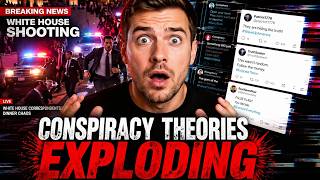
In this episode of his show "Filtered," TJ Walker dismantles the viral conspiracy that a White House press secretary’s joke about "shots being fired" signaled a staged assassination attempt on Donald Trump. He argues that large, secretive plots are implausible because human beings cannot keep such massive secrets, citing the Clinton‑Lewinsky scandal as proof. Walker then pivots to what he calls the real conspiracies: openly operating forces like the healthcare lobby and the NRA that shape policy without secrecy. He connects this to a broader critique of Donald Trump’s historical pattern of creating ventures, extracting wealth, and allowing them to collapse—illustrated by his failed casinos, airlines, vodka, steaks, and university—suggesting that the current U.S.‑Iran conflict is another large‑scale version of that playbook, where the United States ignites a global energy crisis while remaining insulated due to domestic energy production. The fallout includes soaring fuel and food prices, factory shutdowns, and job losses worldwide. Walker then examines a California proposal to levy a one‑time 5 % tax on individuals worth over $1.1 billion, acknowledging its progressive intent but warning that residency‑based taxation is easily evaded by mobile billionaires. He advocates for asset‑ and behavior‑based taxes—targeting high‑value real estate, luxury goods, yachts, private jets, and high‑end consumption—as a more enforceable way to capture wealth. Throughout, he intersperses calls to action for his Ultimize learning platform, urging listeners to turn insights into habits. The episode blends conspiracy debunking, geopolitical analysis, fiscal policy critique, and personal branding.
Chapters
Ultimize. You know what fascinates me about conspiracy theorists? It's not their curiosity, it's not their skepticism, it's their ability to believe two completely contradictory things at the same time. Because on the one hand, the government is so supposedly incompetent it can't run a basic DMV without losing your paperwork, your patience, and possibly your will to live. But on the other hand, that same government is so brilliantly organized it can coordinate massive secret plots involving hundreds of people with flawless precision and zero leaks. Sorry, but that's not critical thinking. That's magical thinking with a Wi-Fi connection. Let's talk about this latest theory. The White House press secretary makes a throwaway line before Saturday night's correspondents' dinner that shots will be fired. She did say that before the show started, and it's clearly a joke. It's just an expression meaning that there will be verbal attacks. Clearly a joke, maybe not a great one, but still just a joke. And suddenly people online are acting like they cracked the Da Vinci Code. Aha, she knew about a staged assassination attempt. Really? That's where we're going with this. That's like hearing someone say, I'm gonna kill that presentation tomorrow, and calling the police to report a premeditated murder. This is the problem with conspiracy culture. Every word becomes a clue, every coincidence becomes proof, and every bad joke becomes a federal crime. There's no context, there's no common sense, just a desperate need to feel like you're the smartest person in the room because you figured it out, but you didn't figure out anything. Yeah, you just ignored reality and replaced it with a storyline that makes you feel clever. Okay, now let me say something that will shock absolutely no one who's watched me for more than 5 minutes. I'm not exactly a fan of Donald Trump. I've criticized him relentlessly, enthusiastically, professionally at this point. But even I don't think he staged an assassination attempt. Not recently, not Saturday night, and not back in 2024 in Pennsylvania. And the reason is simple. Human beings are terrible at keeping secrets. If you want proof, let's revisit the Clinton Lewinsky scandal. If there were ever a situation where someone might want absolute secrecy, it was a sitting president having an affair. For that matter, Monica Lewinsky wanted to keep it secret. You don't think Bill Clinton had access to every resource imaginable to keep that quiet? Intelligence agencies, legal teams, political operatives. And yet somehow it all came out. Well, why? Because people like to talk. They leak, they brag, they slip up, they send emails they shouldn't. They tell one friend who tells another friend who tells the the entire country. That's how human beings work. So when I hear people say Trump staged an assassination attempt, I have to ask, do you understand how many people would have to be involved in that? You need shooters, security, medical staff, campaign insiders, law enforcement, probably media coordination. And you're telling me not one person leaks? Not one text message? Not one disgruntled participant? Not one idiot posting anonymously online. We can't even keep a surprise birthday party secret, and now we're pulling off precision political theater with live ammunition? And by the way, this is Donald Trump we're talking about, a guy who thrives on chaos, improvisation, and saying the quiet part out loud. We're supposed to believe he's secretly orchestrating some Ocean's Eleven-style operation where a bullet perfectly grazes his ear for dramatic effect? That's not a theory, that's a screenplay, and not even a good one. And here's where it gets even more ridiculous. The same people who think Trump is either wildly incompetent or dangerously reckless suddenly believe he's a strategic genius capable of coordinating a flawless multi-layer deception. This is a man who couldn't anticipate that escalating tensions with Iran might disrupt global oil routes And now he's apparently directing sniper choreography like he's Steven Spielberg. Okay, just a light graze on the ear. We want sympathy, but not too much sympathy. That's absurd. Now, to be fair, because reality still exists, there are conspiracies in the world, real ones. I'm not denying that, but they're not the flashy cinematic nonsense people obsess over. They're boring, they're systemic, and they happen right out in the open. Take healthcare, for example. If a conspiracy is powerful people coordinating to enrich themselves while making millions suffer, then yes, the American healthcare system qualifies. Prices are dramatically higher, about 100% higher than they are in other developed countries. Outcomes are often worse, and yet the system persist. No secret meetings in a volcano lair, just lobbying incentives and complexity. Or gun policy— another conspiracy. Organizations like the NRA don't need secrecy. They operate publicly, influence legislation, shape public opinion, and block reform. It's not hidden, it's normalized. And that leads to the biggest conspiracy of all. The conspiracy industry. Because while people are busy obsessing over imaginary plots, they're being distracted from the very real forces shaping their lives: wages, healthcare, education, infrastructure. These aren't hidden, they're just ignored. And the real tragedy is how effective the distraction is. You have millions of people, especially in struggling regions— I'm talking to you Alabama, Mississippi, West Virginia, Kentucky— consistently voting against their own economic interests because they've been conditioned to fear phantom conspiracies instead of examining actual policy. That's not random, that's not organic, that's influence. So no, the press secretary for the White House didn't secretly reveal a plot. Trump didn't stage a Hollywood-style assassination attempt. And no, there isn't a perfectly coordinated secret operation involving hundreds of people who all managed to stay silent, because if there were, someone would have leaked it by now, probably on social media, probably for attention, maybe for a book deal, and definitely with a lot of bad grammar. If you want to be skeptical, great, but be skeptical of all the things that deserve it, because if your theory requires perfect coordination zero leaks, and genius-level execution from people you also claim are incompetent fools, then you don't have a theory, you have a fantasy. I'm TJ Walker. This is Filtered. There's more to come. Let me ask you something. How many times have you heard a great idea and thought, that's really useful, and then never used it again? It happens to all of us because without repetition, even the best ideas just fade. So instead of just collecting more information, do something different. Go to ultimize.com, U-L-T-A-M-I-Z-E dot com, and grab the free course. You can start with communication skills or building better habits, but the key is it's designed to reinforce the message so it actually sticks. If you're already listening or watching this, you're halfway there. Just go to ultimize.com and and take the next step. Now let's talk about something real. Not fantasy, not Reddit fan fiction dressed up as geopolitics. Let's talk about what's actually happening in the world right now. Because while people are busy decoding jokes from press secretaries like it's the Zapruder film, the United States has managed to light a match in the Middle East, and the rest of the world is watching their economies burn. In just a couple of months, this conflict with Iran has already started wrecking global supply chains. Factories shutting down in Asia, flights canceled across Europe, fuel shortages in multiple countries. Workers are losing jobs. People lining up for energy like it's bread lines in the Soviet Union, only with worse Wi-Fi. And here's the part that should make you a little uncomfortable: the country that started the fire were Mostly fine. That's right. The US gas prices are up. Sure. Nobody's thrilled about that, but unemployment still low here in the US. Consumer spending is still strong compared to the rest of the world. We're basically sitting there saying, wow, that's terrible. Somebody should really do something about that while holding the gasoline can and the matches. Why? Because the US produces more energy than it consumes. We're insulated. We've got a buffer. It's like setting your neighbor's house on fire, but you already installed a sprinkler system in your own yard. Meanwhile, other countries, they don't have that luxury. Higher fuel costs means higher fertilizer costs, which means higher food prices, which means more poverty, hunger. Entire economies start slowing down. Flights get canceled, factories shut down, and eventually real people, millions of them, start getting pushed closer to the edge. So yeah, the US looks strong right now, but that's not because this was a brilliant strategy. It's because we're the last domino to fall. So here's what's really happening. Stripped of all the nonsense, the United States starts a conflict that disrupts global energy markets, and suddenly countries all over the world are dealing with fuel shortages, rising food prices, and economic slowdowns. Factories shut down, flights get canceled, workers lose jobs. It's not theory, that's reality. Meanwhile, here in the US, we're mostly okay for now. Not because we're smarter or more strategic, oh no, but because we produce a lot of our own energy. So we're isolated. It's like we set off an explosion in the global economy and everyone else feels the blast while we're standing there saying, huh. That's weird. Things seem fine. But here's the punchline. This doesn't last. Eventually, higher costs ripple back. Prices go up. Growth slows. And suddenly we're not watching the fire anymore. We're in it. This isn't strength. It's delay. And if you're thinking, oh, wow, that really sounds reckless. Yeah, it is. But it's also familiar because this isn't a new behavior. This is the same playbook Donald Trump has been running his entire life. Go look at his casinos. Atlantic City was supposed to be his empire. Instead, it became a master class on how to extract money while everything collapses around you. Multiple bankruptcies, investors wiped out, bondholders crushed, and through it all, Trump kept getting paid. Oh yeah, he paid himself. At one point he was paying himself tens of millions of dollars a year, every year, while describing the job, oh, it's basically a part-time job. Look how smart I am. Imagine being so bad at running a business that it goes bankrupt and still paying yourself like you're Steve Jobs launching the iPhone. That's not business genius, that's looting with a press release. And it's not just casinos. Trump Airlines gone. Trump vodka, apparently even Russians said Yet Trump Steaks disappeared faster than a salad at a Texas barbecue. Trump University shut down and forced to pay millions in settlements. This is a pattern. Start something, hype it, extract value, let it collapse, move on. The difference now? The asset isn't a casino. It's not a failed airline, not a bottle of vodka nobody asked for. It's the global economy. And the same strategy is playing out in real time. Create instability, disrupt systems, take what you can while it still looks like success, and let everyone else deal with the fallout. So when people ask, is this chaos intentional? I don't think it's some secret master plan. I think it's something much simpler and honestly more dangerous. It's a habit. This is how Trump operates. This is what he's always done. The only difference now is the scale. Before, it was investors in Atlantic City. Now it's entire countries. Before, it was a few bankrupt businesses. Now it's global supply chains. Before, it was other people losing their money. Now it's millions of people paying— billions of people paying higher prices for food, fuel and basic survival. But hey, don't worry, I'm sure somewhere out there someone is still trying to figure out what a press secretary's joke really means. I'll be honest with you, most people don't have a learning problem, they have a consistency problem. They'll watch something, listen to something, get fired up for a day, and then life takes over and everything resets. That's exactly the gap I'm trying to fix with Ultimai. So if you're getting something out of this show right now, Go to ultimize.com, U-L-T-A-M-I-Z-E, and get a free course. There's one on communication skills, one on building better habits, and the whole idea is to make this part of your daily routine, not a one-time thing. It's simple, it's free, and it actually works if you use it. ultimize.com. Let's start with the actual proposal because this is one of those ideas that sounds fantastic in a headline. There's a plan in California to impose a one-time 5% tax on people worth more than $1.1 billion. The goal is to raise tens of billions of dollars, mostly for healthcare. And look, I'm not opposed to the premise. I like progressive taxation and I like people having healthcare. If you're sitting on a billion dollars, you should be contributing more. That's not envy, that's math. You've benefited from a system that includes infrastructure, legal protections, an educated workforce, and stable markets. It's reasonable to ask you to give more back into the system. But here's where good intentions collide with reality. The modern billionaire is not tied to one place. This is not 1879. They are structurally mobile. They don't think in terms of where do I live? They think in terms of where am I treated best financially? And the moment you introduce a policy that creates a large one-time hit based on residency, you're basically inviting them to reconsider that question or that answer to that question. Not emotionally, not politically, financially. And that's a game they're extremely good at playing because they don't just have options. They have advisors, attorneys, entire teams whose job it is to find those options. If you really want to tax billionaires effectively, you have to stop thinking about where they live and start thinking about how they live. Because residency is flexible. Wealthy people can change that with paperwork. But behavior is harder to find. When someone buys a $20 or $30 million home, a $5 million yacht, or spends six figures on luxury goods, that's not something you can quietly relocate on a tax form. It's visible. Even with LLCs, it's visible, it's measurable. And that's where smart policy can actually work. Instead of chasing billionaires from state to state, you tax the things they do and the things they own. Because if your entire strategy depends on them staying put and paying voluntarily, you're not designing a tax system, you're just crossing your fingers. There's another layer to this that people don't always like to admit. Even billionaires who support higher taxes in theory don't love losing control over their money in practice. They'll write enormous checks to causes they care about where their name gets on it. They'll fund hospitals, universities, climate initiatives. But once money goes into a general tax pool, they don't get to decide where it goes. And whether you're liberal, conservative, or somewhere in between, there's always a concern that at some point that money gets used for something you fundamentally disagree with, like a statue for Trump. That hesitation matters because when you combine that mindset with the ability to relocate wealth and residency, you create a very predictable outcome— avoidance. And it's not illegal, not dramatic, it's just quietly effective. And that's the risk with a policy like this. Not that it won't raise any money, but that it won't raise as much as expected while creating strong incentives for people to restructure their finances in ways that reduce future tax revenue, which is the opposite of what you're trying to accomplish. So what's the smarter approach? You shift from location-based taxation to asset-based and behavior-based taxation. Real estate is an obvious starting point. A home valued at $10 million or more isn't a basic necessity. It's a high-end asset. And unlike a mailing address, that property is physically anchored. It exists in a place. Same with large luxury items, boats, planes, collections of high-value assets. These are things that signal wealth in a tangible way. They're harder to obscure, harder to move, and easier to evaluate. Then there's spending. High-end consumption is where enormous amounts of wealth quietly circulate. Luxury goods, fine dining, art, exclusive services. They are consistent, trackable expressions of wealth. And important, they happen repeatedly, which means you're not relying on a single one-time event. You're creating an ongoing revenue stream tied to behavior. You can also layer in thresholds, not blanket taxes, but targeted ones above a certain level of spending or ownership, additional taxation could kick in. That's a system that adjusts naturally to how wealth is actually used. Now, yes, you can have a little fun with this. You could design a third home threshold because at that point you're not solving a housing problem, you're collecting scenery. Or a high-performance vehicle tier where the faster and more expensive the car, the higher the the tax with no ending point. If it's a $2 million car, you spend more on tax than a $1 million car. These ideas might sound playful, but they're serious about something. There are dozens of ways to design a system that captures wealth more effectively without relying on assumptions where someone claims to live. Because ultimately, the goal isn't to make a statement, it's to generate revenue. And if your policy is easy to avoid, it doesn't matter how good it sounds. It won't deliver the results you need. So yeah, ask more from those who have the most, but do it in a way that reflects how wealth actually operates today. Because otherwise, you're not taxing billionaires more, you're just giving them another puzzle to solve. OK, so I'm going to anger pretty much everyone today. Many progressives, liberals, they'll say, oh, TJ Walker, you're shilling for billionaires. Aren't you awful? That's not what I'm doing. But now everyone to the right of center is going to get angry with me because I will point out, if you want to tax billionaires, you're going to have to do what Thomas Piketty, the famed left-wing economist, has said. You're going to have to have world government because billionaires can have 10 homes in 6 continents. So unless they are taxed at the worldwide level, it's too easy to play whack-a-mole and for them to always be one step ahead. 'Cause here's the thing, most people do reside in one state. They spend a lot more days in one state, in one city, than they do anyplace, even if they have to travel for work. That's the vast, vast majority of people. Billionaires aren't like that. Between jetting off to Davos, vacation homes, going to celebrity wealthy friends' weddings in Morocco, They're constantly all over the place. So from their perspective, they're thinking, ah, you know what? Yeah, I consider my Beverly Hills mansion or my Palo Alto estate my main residence, but let me add it up. I only spent 99 nights there. I spent, you know, 266 days other places, other mansions. Why should I give all my money? To these guys in California. That's, that's their rationale. And here's the thing, it's, it's legal what they're doing. We've already seen a mass exodus of billionaires from California to where I live in South Florida. Take it from me, we don't need any more here. So I'm very sympathetic to wanting more tax dollars, needing more tax dollars, but Until we have world government, which is not going to be anytime soon, there's going to have to be more creative ways of doing it. Because the real tragedy is you could end up reducing the tax burden for billionaires and wealthy people if you single them out based on residence. I'm TJ Walker. Thanks for joining me. Hope you're having a great Monday. See you tomorrow. Okay, my TikTok
More from TJ





The Breakout Cases - What Actually Caused Famous Speaking Career Breakthroughs | Ultamize

The Red Circle Sessions Finale - Build the Speaking Career You Came Here For | Ultamize

Two Stages, One Logo, Two Completely Different Realities - Main Stage vs Independent Events | Ult...

Pre-Reset - Why Repetition Builds Better Speaking Decisions | The Red Circle Sessions | Ultamize

Your Decision, Your Framework, and What Happens After - Build Your Speaking Career First | Ultamize

The Red Circle Sessions Trailer - The Speaking Career Truth Nobody on That Stage Will Tell You | ...

The Two-Minute Ultamize Reset - Your Platform, Your Audience, Your Voice | The Red Circle Sessions