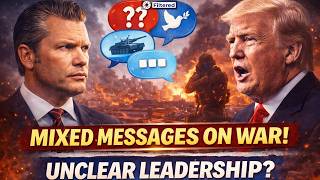
In this commentary, TJ Walker examines the contradictory messages coming from President Donald Trump and Defense Secretary Pete Haigseth regarding the status of an ongoing war. Trump has described the conflict as "very complete," implying near‑completion, while Haigseth warned that the war is only just beginning, suggesting a prolonged fight. Walker argues that such mixed signals create confusion for allies, financial markets, and the American public, undermining strategic clarity. He critiques Trump’s usual communication discipline, noting that the rapid, hourly shifts in his statements now produce a whiplash effect, destabilizing market expectations and fueling higher oil and gas prices. Walker also highlights the role of media, citing the Drudge Report’s juxtaposed headlines as a clear illustration of the contradiction. Throughout, he contends that the president appears uncertain about the war’s goals, which he views as a serious concern for both domestic and global audiences.
Chapters
Trump and Defense Secretary send mixed signals on war. Confusion is growing over the Trump administration's message about the war effort. President Donald Trump recently described the conflict as, quote, very complete, suggesting the military operation has largely achieved its objectives. But Defense Secretary Pete Haigseth offered a sharply different assessment. Speaking about the same conflict, he warned that it's only beginning. Those two statements point in opposite directions. One suggests the war may already be nearing its conclusion. The other signals a longer and potentially expanding conflict ahead. In wartime, presidents often emphasize progress and success to reassure the public and allies. Military leaders, however, frequently stress the challenges that may still lie ahead. When these messages diverge, it can create uncertainty about strategy and long-term goals for allies, financial markets, and the American public. Clear communication about the direction of a conflict is crucial in shaping expectations about how long the fighting may last. So this is bizarre. I've talked about this yesterday. I'll say it again. President Trump, for all his flaws, I have given him praise in the past for his ability to communicate. When he says, this is what I think is bad, bad, bad, you know it. When he says, this is good and this is what I want to do, you know it. You might not agree with it, but you know it. He is in general a strong communicator. Arguably, it's his number one strength, not by conventional rhetorical oratorical standards, but by his ability to communicate through social media, sound bites, and posts on social media, you know where he stands on a lot of things. So it is a bit odd where it's not just every week things are changing about the war. It's not even every day, it's every hour. So earlier this week he said basically, oh, we're pretty much complete. We're wrapping up here. That's it, folks. And all of a sudden the markets take off. Everyone's breathing a sigh of relief. And then an hour after the market closes, it's, ah, no, not really. We don't really know when this is ever going to end. And who knows, it could be months. It's whiplash. There's massive, massive confusion. Now, sometimes in government, and I— full disclosure, I do not work with this administration, but I have worked with political leaders all over the world at very high levels, sometimes with presidents and prime ministers, members of parliament. Sometimes there is a problem with communication because of the complexity of an issue. Sometimes there are warring factions about, well, we should do this, and another group of advisors say we should do this, and the leader hasn't really decided, therefore you can't communicate. Sometimes that's the situation, but by all accounts dribbling out of this administration, that's not what's happening. What's happening is the president himself has no idea what he's trying to do, where we're going with this, what the goals are. You can't have a sense of getting to a destination if you don't know where you're going. If you just get in your car and you drive, you can't really get anywhere if you don't have a destination in mind. You also can't get lost if you don't really care where you go. And that's what concerns many Americans and people around the world who are affected by this, which is pretty much everybody. A lot of commentators initially said, well, this shouldn't affect the United States. Well, we have oil surpluses, we have energy surpluses, we're no longer energy dependent. And that completely shows ignorance of how world markets are effective. There's one world market. Oil, natural gas, it's a commodity. So, if 20% disappears overnight, the demand for oil worldwide market just goes up. And American consumers or American producers of oil aren't going to say, hey, let's give all of our American customers a break. We could charge 20% more, but hey, let's just keep selling it. No, that's not how it works. So, Americans had better get ready for higher gas prices and higher oil prices, and it's already started. So, one of the things that Trump has often been good at is message discipline, where he says one thing and then all of his minions just repeat it again and again and again. But that doesn't really work when the president himself says different things every couple of hours. And then it's easy for the media to say, well, Trump said this this morning, but he said something else this afternoon. And then his Secretary of Defense half an hour later said what Trump said in the morning. Therefore, he's contradicting what he said in the afternoon. What's going on? Sorry, friends, that's not the media spreading fake news. That's the media trying to do its job and inform Americans and the world of what is really going on. And to me, the classic Classic example of this mixed messaging, looking at it on the Drudge Report just this morning. I'm going to pull that up again. You may love the Drudge Report, you may hate it, but it's just classic in that the headlines, Trump war effort very complete, heck Seth, it's only beginning. I mean, just that contrast of the two headlines really says it all.