Trump’s World Pushback, Vance vs Pope, and the Success Habit Elite Use
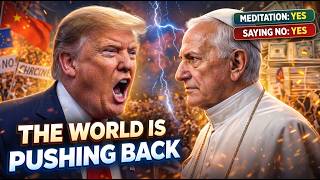
TJ Walker examines Trump's contradictory foreign policy messaging, from tariff threats to NATO wavering, and argues it erodes U.S. credibility with allies. He critiques J.D. Vance's public attack on Pope Francis as an example of the administration silencing independent moral voices. Walker then highlights two habits Tim Ferriss says high-performers share: meditation and the discipline to say no.
Chapters
Ultimize. According to reporting from outlets like the New York Times, Reuters, and CNN, U.S. allies have raised concerns in recent weeks about a series of mixed signals coming from Washington, ranging from renewed threats of broad tariffs on allied countries to wavering commitments on NATO defense obligations to praise for authoritarian leaders while publicly criticizing longstanding democratic partners. Okay, let me translate that into plain English. Our allies don't know what we stand for anymore. One day we're threatening Europe with tariffs, the next day we're telling them they might be on their own if something happens militarily. Then in the same breath, we're praising strongmen leaders in countries that aren't exactly known for free elections or free speech. If you're sitting in Berlin or Paris or Tokyo, you're not thinking, wow, what a bold new strategy. You're thinking, What's going on over there? This guy Trump is freaking crazy. And here's where it gets really bad from a communication standpoint. Consistency is the foundation of credibility. And right now, the United States sounds like a company whose CEO changes the mission statement every 24 hours depending on who he talked to last. You cannot threaten allies economically, question whether you'll defend them militarily, and then expect them to trust you diplomatically. That's not strategy, that's chaos. Take the NATO issue. We've had repeated statements suggesting that the US might not defend allies who don't meet certain spending thresholds. Now you can argue about defense spending, that's fair, but saying it like that publicly, bluntly, unpredictably, you're not negotiating. You're signaling unreliability. Frankly, you're signaling that you're a crazy cuckoo loon who can't be depended on. And once allies start to think you might not show up, they start making plans that don't include you. And you've got trade threatening sweeping tariffs, not just on rivals, but on allies, Canada, Europe, Asia. At some point, everyone's looking around saying, oh wait, are we allies or customers? And are we about to get hit with another large bill? That's not how alliances work. That's how you treat competitors. And then there's the rhetoric, praising authoritarian leaders, attacking democratic ones. If you flip that script even once, it's news. If you do it repeatedly, it becomes a pattern. And patterns are what shape global perception. So now the perception is this: America isn't just unpredictable, America is inconsistent in its values. And sadly, Trump defines America, even though most Americans don't agree with what he's doing anymore, if they ever did. He does define America to the rest of the world. Now, here's the part that should really concern you. According to multiple reports, world leaders are increasingly handling these situations quietly behind closed doors rather than confronting them publicly. Why? Because they're trying not to escalate. That's not respect. That's risk management. That's the geopolitical version of dealing with someone you think might overreact because they're a toddler. Meanwhile, markets are reacting to uncertainty about trade policy, alliances, and global stability creates volatility. And guess what? Investors hate unpredictability. And right now, unpredictability is the brand of America, or is certainly with Trump. But the most dangerous part of all this isn't even the policy, it's how it's being communicated to you. You keep hearing phrases like unconventional, outside the norm, a shift in strategy. No, let's use accurate language: contradictory messaging, mixed signals, unclear commitments, frankly stupid decisions. Imbecilic decisions. That's what's happening. Let me make this simple. If your doctor said, today I recommend surgery, but tomorrow I might say you're fine, and next week I might try something completely different, maybe a new vitamin regimen based on my mood, you don't say, wow, what an innovative thinker, what a creative doctor. You say, give me a different doctor. And yet with global leadership, we're being told this is just politics. It's just not politics. It's not. It's communication breakdown at the highest level. It's arguably sanity breakdown because leadership at its core is about reducing uncertainty, and right now the United States is increasing it. So what happens next? Allies hedge. They build backup plans. They form new partnerships, and slowly, quietly, they start preparing for a world where the United States is no longer the reliable center of the system. Now here's the takeaway for you, because this isn't just about governments. This is about how communication works everywhere. If you're inconsistent, if your message changes depending on the day, if people don't know where you stand, they stop trusting you. Not because they hate you, although they might, because they can't rely on you. And in business, in leadership, and in life, reliability builds brilliance every single time. Right now, the biggest issue isn't whether people agree or disagree with specific policies, although most policies out of Washington, I can understand you disagree with it. It's that no one at home or abroad can predict what comes next. And when people can't predict you, they stop trusting you. When they stop trusting you, they start planning around you. The other big problem here is There's this thing called normalcy bias. You've heard of confirmation bias, where you glom onto any information that confirms what you already believe. Self-interest bias, where you're looking for things that automatically help you. There's also a normalcy bias where people are conditioned. The news media are especially guilty of this, of saying, okay, today and yesterday is kind of— whatever happened is kind of normal compared to the last 3 months, 6 months, year, 10 years, and it's all kind of normal. This is not normal. What's happened in the last week in the White House isn't normal. It's frankly insanity. Arguably, most things that have happened in Trump's first term, not normal, not sane, not rational, not making the world better for Americans or anyone else in the world. So be careful about normalcy bias. Sometimes— it's never happened in the United States before— but sometimes you have to be open to the idea of, okay, someone who was popularly elected has now become insane, is a blithering idiot, and needs to be removed from office. I'll be honest with you, most people don't have a learning problem. They have a consistency problem. They'll watch something, listen to something, get fired up for a day, and then life takes over and everything resets. That's exactly the gap I'm trying to fix with Ultimize. So if you're getting something out of this show right now, go to ultimize.com, U-L-T-A-M-I-Z-E, and get a free course. There's one on communication skills, one on building better habits. And the whole idea is to make this part of your daily routine, not a one-time thing. It's simple, it's free, and it actually works if you use it. Ultimize.com. According to reporting from Reuters and the Associated Press, Vice President J.D. Vance told a Turning Point USA crowd that Pope Leo should be, quote, careful when speaking about theology. After the Pope condemned those who today drop bombs, Vance defended the Iran bombing by invoking World War while Trump had already attacked the Pope as weak on crime and terrible for foreign policy. And Pope Leo responded that he had, quote, no fear of the Trump administration. Now let me say what half the country is already thinking: J.D. Vance has been a Catholic for about 5 minutes now, and he's giving performance notes to the Pope? Really? This is like a guy who just joined Planet Fitness last Thursday lecturing LeBron James on footwork. The arrogance is unbelievable. The Pope is the Pope. J.D. Vance is a politician with a podcast voice and a book tour. And somehow Vance has decided that the successor to St. Peter needed a little coaching from the vice president of the United States on theology. Really? What next? Is Vance going to explain Judaism to Chuck Schumer? Is Vance going to tell his wife how to be a better Hindu? Maybe he should just hold a seminar for the Dalai Lama on mindfulness. Or better yet, maybe he should give his own boss a crash course in Christianity. Because if we're suddenly doing biblical literalism, I have a fun one for the class. Leviticus 20:10 says that if a man commits adultery with another man's wife, both the adulterer and adulteress are to be put to death. In the King James Version, it says they shall surely be put to death. That ought to make staff meetings a little awkward in the Oval Office. Imagine Vance marching into the White House and saying, "Sir, before I lecture the Pope again, I just want to review some additional theological guidance." Because this is the problem with these people. They treat religion like a buffet. They load up on the parts that flatter their politics, and then they quietly slide past the things that might inconvenience the boss. Kind of like when you and I go for the desserts and we pass the salad portion. And from a communication standpoint, this is what makes Vance so dangerous and so ridiculous at the same time. He's confused confidence with authority. Those are not the same thing. A man can be a very confident person and still be a fool. Every drunk guy at a sports bar is confident. That does not make him the Pope. And what makes this even dumber is that Pope Leo wasn't trying to win an argument on cable news. He was doing what popes traditionally do: speaking in moral language about war, violence, and peace. You know, pope stuff. That's literally the job description. So for Vance to say the Pope should be more careful when talking about theology is like telling a cardiologist to be more careful when discussing the heart. No, JD, this is his lane. You wandered into it because you thought the costume fit. And here's the deeper issue: this administration cannot handle criticism from any source that has moral standing that they don't control. That's why Trump attacks judges, generals, reporters, universities, and now the Pope. Because the one thing authoritarians cannot tolerate is an independent voice with real legitimacy. And Pope Leo has something Trump and Vance can never manufacture with a slogan, a meme, or a royal crowd, a rally crowd. That's moral authority, at least for people who follow that particular religion. That's why they're rattled. That's why Trump lashes out. That's why Vance starts doing amateur theology night at Turning Point USA. Because when you can't beat the message, you try to belittle the messenger. So here's the bottom line: if J.D. Vance wants to spend his time lecturing the Pope on theology, fine, but then he should also be prepared to explain why his own political movement treats the Sermon on the Mount like a liberal activist woke document. And if he really wants to be the administration's in-house theologian, maybe start with the basics. Humility would be a good chapter one, because nothing says spiritual depth quite like a 5-year Catholic convert wagging his finger at the Pope while working for a man who posted an AI image of himself looking like Jesus. Okay, to be clear, I'm not suggesting the Pope gets a free ride. I don't agree with probably most things most popes say. I'm not a fan of popes. But J.D. Vance by saying he is officially a Catholic convert is by definition saying he's a fan of the Pope. He's saying he believes the Popes are infallible. You can't have it both ways. You can't say, I'm now a part of this religion and I follow all of their doctrines and I really buy into it and I buy into the idea that the Pope's infallible, oh, except for when I have a different policy that I like. Now, if you want to have a policy debate with the Pope, I guess you can, but don't tell the Pope that he can't make a theological positioning statement. It's like telling a magician, okay, you can come entertain, but you better not show any magic. Well, no, that's what they do. Here's something I've learned after years of doing this: the people who actually improve don't necessarily hear better advice. They just stay around it longer. They keep exposing themselves to the same useful ideas until it finally clicks. Most people don't do that. So if you want to be in the small group that actually follows through, go to ultimize.com, that's ultimize.com, and get the free course. There's one on communication, one on building better habits, nothing fancy, just something you can keep coming back to. If you're already there, you're doing the hard part. Just go to ultimize.com and build on it. According to CNBC's Make It, entrepreneur and author Tim Ferriss, an early investor in companies like Facebook, Uber, and Twitter, and the creator of The Tim Ferriss Show podcast, has spent more than a decade interviewing hundreds of top performers across business, sports, and entertainment. And he says two highly specific traits show up again and again: some form of regular meditation and the ability to say no. Now, I have to admit something. When Ferriss came out with The 4-Hour Workweek back in about 2007, I got him wrong. I got him completely wrong. I read the book and I thought, this is career pornography, career fantasy, you know, the kind of book you read on a plane and think, yeah, yeah, sure. Let me just outsource my life to a guy in Bali and retire by Tuesday. But if you go back and read it now, it feels less like fantasy and more like a practical instruction manual that just showed up 10, 15 years too early. Ferriss wasn't crazy. He was just early in a lot of trends that really dominate our modern life. And that's a big difference. Now, having said that, let's not turn him into a saint because Ferriss, like a lot of people in the world, has pushed plenty of questionable ideas. There's a lot of his supplement talk, this Athletic Greens stuff, which has no scientific evidence it's healthy for you or healthier than actually eating real fruit and vegetables. A lot of optimization hacks that sound scientific but don't exactly come with overwhelming evidence. And sometimes it distracts people from the most obvious solution in the world: eat real food, sleep, move your body. And he does encourage people to do that, but you don't need a chemistry set to be healthy. And then there's his diet stuff, the whole don't eat anything white, avoid carbs 6 days a week, and then go wild and pig out on the 7th day idea. Okay, confession, I tried that and it did work, and I did lose weight a decade or so ago for about 6 months. But guess what? Nobody could stay on that diet long term. If you had the discipline to stay on a diet like that long-term, you'd never be overweight in the first place. So for most people, it just doesn't work except the short-term. That's not a lifestyle, that's a phase. And anything that feels like a phase usually doesn't last. But here's where I give Ferriss real credit. He did in fact change my mind on something important, meditation. Now he's getting news coverage today on CNBC for his belief that that's One of the Two Things Consistent Among All Successful People. But he was preaching this and uncovering this with his interviews a decade ago. About 9 years ago, I started doing it largely because Ferriss kept pointing out that virtually every high performer, successful people, doesn't matter if they're movie stars, Broadway producers, tech billionaires, everyone he interviewed had some version of meditation in their life. And I figured, all right, If this many successful people are doing it, maybe I should at least test it again. So I did. And I've been doing it almost every day since. And here's the thing, even if you don't believe in any of the deeper benefits, even if you think it's just sitting quietly doing nothing, there's still no downside. It's 10 minutes a day where you're not staring at your phone, not consuming nonsense, not reacting to other people's agendas. Just that alone time makes it worthwhile. I know it does for me and a lot of Tim Ferriss's guests. But the second idea Ferriss talks about might actually be even more important. It's the ability to say no. This is the one nobody talks about, or they don't talk about very often because saying yes feels good. It feels productive. It feels like opportunity. But saying yes to everything is the fastest way to accomplish nothing. Nothing. Warren Buffett has a famous line. The difference between successful people and really successful people is that successful people say, the really successful people say no to almost everything. Think about that. Buffett doesn't do 50 things. He doesn't do 10 things. He essentially does one thing. He studies businesses. And once in a very long while, every 1,000 businesses he looks at, He decides to buy it. That's it. I can tell you from my own experience on a smaller scale, any success I've had didn't come from doing more things. It came from doing less, from narrowing my focus, from finally saying no to distractions and all sorts of side projects and random opportunities, things I could do but weren't my primary focus. And focusing almost entirely on one core competency is what worked for me. In my case, creating online courses. That's it. No magic, just focus. So on balance, I think Tim Ferriss has been a positive force. His podcast was a trailblazer, still is. He helped normalize conversations about habits, performance, and self-experimentation long before it became mainstream. And to his credit, he hasn't spent his time chasing political trends or trying to ingratiate himself with whatever movement happens to be the loudest at the time. I.e., he didn't become one of the MAGA tech bros, pro-podcasting bros. So yeah, he's not perfect. Some of his ideas are questionable. Some of the optimization culture he helped popularize can sometimes go off the rails. But at the core, there are a couple of ideas he got absolutely right. Focus matters. Saying no to most things matters. And taking a few minutes every day to quiet your mind is probably one of the simplest, highest-return habits you can build. And in a world that's constantly trying to sell you more, distract you more, and pull your attention in 1,000 different directions, The real edge might just be this: do less, but do it better. I also think it's important to note that we live in a culture that says, you know, all these motivation people, success people, health people, they're forgetting the fact to mention that they're doing well because they're rich and they can buy everything. Here are two things that require nothing, cost nothing. It costs nothing to meditate. And it costs nothing to say no most of the time to opportunities that take you outside of your main core competency. I'm TJ Walker. Thanks for joining me. I'll be back tomorrow, same time.
More from TJ





The Breakout Cases - What Actually Caused Famous Speaking Career Breakthroughs | Ultamize

The Red Circle Sessions Finale - Build the Speaking Career You Came Here For | Ultamize

Two Stages, One Logo, Two Completely Different Realities - Main Stage vs Independent Events | Ult...

Pre-Reset - Why Repetition Builds Better Speaking Decisions | The Red Circle Sessions | Ultamize

Your Decision, Your Framework, and What Happens After - Build Your Speaking Career First | Ultamize

The Red Circle Sessions Trailer - The Speaking Career Truth Nobody on That Stage Will Tell You | ...

The Two-Minute Ultamize Reset - Your Platform, Your Audience, Your Voice | The Red Circle Sessions