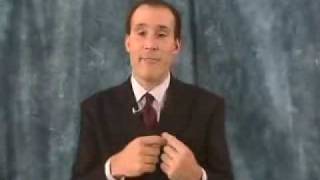
TJ Walker (Media Training Worldwide) gives a short instructional talk on overcoming the fear of public speaking. He argues that fear is rational when speakers are unprepared and that preparation—practice, videotaping yourself, and knowing your material—reduces fear. He advises using stories instead of memorizing many facts, practicing extensively, and delivering as a one-to-one conversation (hold eye contact ~5 seconds). The clip closes with a CTA to Media Training Worldwide (3ws.mediatrainingworldwide.com).
Questions this video answers
October 23, 2009.
3ws.mediatrainingworldwide.com (Media Training Worldwide).
Chapters
Please don't make me give a speech anything but that. Sound familiar? Do you fear giving a public speech? Well, you're not alone. It's the number one fear people have. But should you be afraid to give a speech? Well, actually, yes, you should be afraid because if you don't prepare adequately, you're going to look scared, you're going to look timid, you're going to give a very poor reflection on yourself, your company, and anyone you're involved with. So it's entirely rational to be afraid of giving speeches, especially if you don't prepare for it. Most people who are afraid to give speeches are afraid because they don't prepare or they don't prepare in the right way. Think about it. If I asked you right now, dictate a memo that's going to go to 5,000 people in your company or to all of your clients or to people you know all around the world. You have to dictate the memo once you can't read it, you can't proof it, you can't spell check it, you can't have anyone else do that. You have to dictate it once it goes out as is. Would that scare you? You bet it would scare you. You'd be, oh, my God, the grammar might be messed up, typing might. There might be typos, there could be all sorts of mistakes. I'll embarrass myself, I'll look foolish. Exactly. So you would never think of dictating a press release or a letter, sending it out to the whole world without spell checking it, editing it, and reviewing it. But once you know how to do all those things, it doesn't bother you to send out a letter to your clients, your colleagues, people in your company, because you know how to do those steps. Well, there are steps involved with giving a speech. You don't wing it. Anyone who says, oh, I just want to come across spontaneous, wing it. That's the stupidest advice you could ever hear. The people who seem the most spontaneous are the ones who practiced hour after hour after hour. The amount of fear that you have goes up. It's inversely proportioned to the amount of preparation you have. The more you prepare for your speech, the less fear you have. Now, a part of the fear is how. How do I look? How am I going to come across? Well, this morning, before you got ready to go to the office, you didn't just throw on clothes, sort of guess and comb your hair. You probably looked in a mirror. Why did you do that? You don't have to look at yourself throughout the day. You could go an entire day without looking at yourself. Why do you look in a mirror? Well, you want to see how other people view you. Well, if you're going to prepare for a speech, you need to see how other people will see you. The way to do that, videotape yourself. Now, this can be done at home. You don't need some fancy $50,000 movie camera. There could be a 200 home video camera right there in closet. You can use it. Have your son, your daughter, your wife, your husband videotape you before your next speech. And then watch yourself. Oh, I don't want to look at myself. Too bad. You've got to look at yourself. You don't leave the office, you don't leave home in the morning without looking at yourself in the mirror. You want to see, yes, I combed my hair straight. Yes, my tie is on. Yes, I didn't walk out without my pants. You look at the mirror for those reasons. For the very same reason, you need to look at a videotape of yourself. That will do a tremendous amount of reducing your fears. Because what do you fear? You fear the unknown. If you don't really know how you're coming across, it makes sense to be afraid. But if you're watching yourself on video and you like what you see, or you're at least comfortable with it, then it's not going to make sense to be afraid. Now the other thing that makes people afraid is they're so focused on memorizing a whole bunch of facts and figures. Well, that makes perfect sense to be afraid. I can't memorize 500 facts. You probably can't either. And if I'm trying to memorize all that, that's when I'm going to have my brain freeze and my eyes are going to look bug eyed. I'm going to look scared. If I look scared, I'm going to feel scared. It only makes sense because I know I look scared to everyone else. What you want to do when you're giving a speech is tell stories. Forget the 552 facts. You can hand that out in a fact sheet before the speech, after the speech. Instead, tell a story about what you're trying to communicate. Major point, an abstract point, major accomplishment of your firm. Flesh it out. Talk about real conversations with real clients, real customers. Dialogue, people, places. Get away from the abstractions. Talk about real things people can visualize. Do it in a conversational way. You really want to eliminate your fears. Don't give public speeches anymore. When people give a public speech. They're very stiff and thank you very much for having me here today. They're looking at the whole audience, all the ones, their eyes are scanning back and forth and you can just see that tear. But really good speakers do who come across completely comfortable, relaxed, fearless. They don't give a speech to 100 people or a thousand people. They just talk to one person at a time. They lock eyes, hold that eye contact for a good five seconds and then they go to the next person. You can do that now. You're doing what you do all day long. You're just having a conversation with one person that makes you more comfortable, more relaxed. It's going to make the audience more relaxed too. So do that. Know your material. Practice, practice, practice and your fears will get smaller every day. Good luck. For more help, go to Media Training Worldwide, go to our website, 3ws.mediatrainingworldwide.com.