Unlocking Professional Growth with AI: Bhavneet Chahal on Revolutionizing Online Learning
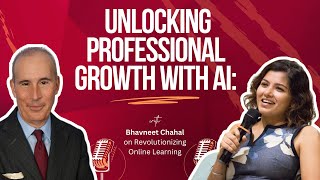
Interview (live YouTube) with Bhavneet Chahal, CEO and founder of GoSkills, about the company’s origin (started 2013 from insights at Groupon), product strategy (focused, curated library of ~100+ bite-sized business/tech courses with Excel as the most popular), and growth path (Groupon deals → SEO → direct e-commerce; LMS work begun 2015; 2018 added SCORM import and a course authoring tool). The conversation emphasizes learner experience (micro-lessons, quizzes, exercises), GoSkills’ remote team (~25 people across ~15 countries), and the company’s AI roadmap: a text-based learning assistant now and planned avatar/video “clones” and immersive AR/VR experiences in the future.
Questions this video answers
2013
Over 100 courses
Microsoft Excel (Excel 365) course
2015
SCORM import support and a course authoring tool
Chapters
And you don't know what you don't know until you see someone else's spreadsheet and you see pivot tables and macros and all sorts of things. And then you realize, oh, okay, I actually don't know too much about this.
You've specialized more. You're not trying to have 100,000 courses. Tell us about your strategy and how you're different from others in the marketplace.
Yeah, so we do have a strong technology focus and business skills focus.
Is the fact that Google isn't as dominant changing what you're doing.
That's a really great question and it's literally what we're thinking about right now. You know what the leaders in the space are saying, but I don't have the answer yet. It's this short form in 20 years time, unless, well, it's not going to be in the same form. It's not going to be the blue links and links to websites. It'll be very contextual, it'll be personalized. And so we need to figure that one out. Do you have any thoughts, tj?
I'm grappling with this every single day. I mean, the biggest thing I work on is how can I enhance my courses to make them really stand out.
We are investing in AI learning assistants and our aim is to get to where you are different personalities that suit your learning style.
Well, have I got a course for you. If you want everyone at Go Skills to get up on this and you're going to be able to get it at absolutely no charge. I personally find text chatbots very uninteresting. I mean my bank had that a decade ago. Doesn't seem very high tech or interactive and video based. Online learning is about seeing an instructor, a real person.
The reason we're starting with the tech space is because it's just more of a proof of concept.
The world of online training. You've heard of Udemy, you've heard of Coursera. They're all these big gigantic platforms. LinkedIn learning. Well, believe it or not, there are a number of other online training platforms that are wildly successful that have millions of students that have been around a long time you might not have heard of today. I'm very happy to have with us the founder of one of those websites by Pav Chahal has started Go Skills. She did it on her own bootstrapped. She didn't go out and raise $100 billion like some did. She built it with her own hands and with her team. We're very excited to have you, Bob. Thanks for joining us today.
Hi. Thank you for having me.
I'm very excited and full disclosure, I've been very fortunate and happy to be a part of the go skills community. Now, I just looked at my record, it's been nine years since my first course got on there, and happy to be a part of it. But tell us about your journey. Now, you have a background in marketing, you worked with Groupon, and certainly that's well known to American audiences, audiences around the world. How did you first come across the idea of creating online learning? Because you were one of the early ones, way back a decade ago. More than a decade ago.
Yeah. Yeah. So we started in 2013. We actually started because I was working at Groupon in Sydney, Australia, and my role there was to analyze the top selling deals in Australia and the top selling product category was online courses. And really, I got to say that.
Surprises me because, you know, I get Groupon all the time and it's typically restaurants and my family uses it or maybe a discount on a show. I've never even heard of an American buying a course through Groupon. So walk me through why is there such a difference there?
Yeah, so Groupon was separated in different product categories. So there was local deals, which is the restaurants, the massages, things like that, which was restricted by your geography. Then there was the products, which was anything that could be delivered nationwide. Obviously, if you're sending something nationwide, it's going to be. It'll sell so much more because you're not restricted by that local geography. I was in the product team, which was that vertical and within that vertical online courses, whenever we had a deal, it sold like hotcakes. It was just really, really popular. So, yeah, so that was my insight from my time at Groupon.
And then you say, I've seen them do it. Why do I want to help them do it? Why not enter the field myself? Is that the aha moment for you?
Kind of. Kind of. So I purchased one of these very popular courses myself and I was a little bit surprised at the quality of the courses.
So.
So I purchased an Excel course and I received a very long course. It was full of PDFs, there were very long videos, and the website itself looked old and a bit clunky. And I was a little bit surprised that this course was so popular because I could see how much they were making and I could see how much demand there was for this course.
Let's take a look at what a good course site looks like. This is goskills.com. i'm on right now? Yes, I'm in the course selection and I see right off the top it's the Microsoft Excel 365. Has that been a popular course for you?
That's been our most popular course, yes. So we actually started off selling Excel courses and yeah, it's still our most popular course today.
And why is that? I mean, I think of Excel but I also think of, you know, go Google has its own version of it. Why has that become so popular? And you do have a lot of technical stuff, but thankfully for me, you have the so called soft skills that involve things like presentation skills and things like that.
Yeah, I think Excel is so popular because it's just so widely used. Like every business uses Excel and it's one of those programs where you're not taught how to use it. You are kind of when you start a job, you're kind of thrown into something and you're told, use Excel for this. And there's no course in Excel at university or at high school and you're expected to know what to do. And you don't know what you don't know until you see someone else's spreadsheet and you see pivot tables and macros and all sorts of things and then you realize, oh, okay, I actually don't know too much about this. And so that's when people start to search for Excel courses online and they hopefully find us.
Tell us about your journey. You started relatively early, but companies like Udemy had already been around for a few years. There was a time when Silicon Valley was doling out tens, if not hundreds of millions of dollars in venture capital to online training companies. My understanding is almost all of them went out of business. Udemy did go public, but not at any, they don't have any valuation where really anyone was very excited about making money. They didn't, they, you know, they raised what, 400 million and their, their market cap is only a billion. So the investors didn't make much money. In retrospect, are you glad you said no to that so you didn't have to worry about investors expectations?
Yeah, in retrospect, yes, we never needed to raise money. So back to the Groupon story. So I saw this demand, thought that what they were selling was not that great, decided to create our own Excel course and we wanted, right from the beginning we were very focused on the learner experience. So we found an Excel instructor, Ken Pauls, who is based in Canada. He, he's a Microsoft mvp. We asked him to create bite sized courses for us. My Co founder, who's based in New Zealand, created all the technology to put the courses online. And I went back to Groupon and said, hey, I've got this Excel course. It's better than what you've got on your platform for XYZ reasons. Would you like to try it? They did, and it did very well on the Groupon platform. And then because it did well there, we could sell our Excel courses to Groupons all over the world. And as a small startup, that basically gave us a cash injection into our business because Groupon takes a cut on sales as opposed to us paying some sort of.
But they don't take equity, thankfully for you.
No, exactly. No equity. There's no upfront marketing fee. Um, it's just. It's a high. It's a big cut on your sales. But, but, you know, as a, as a startup, it was great exposure for us and we knew we had a great product and it did very well. So that's why we never needed to raise money. We, we just got a lot of revenue from selling to Groupons and also other daily deal websites all over the world.
Our special guest Today is the CEO and founder of GoSkills. You can find more@goskills.com it is Bob Chahal. We're very happy she's here with us. You've specialized more. You're not trying to have 100,000 courses. Tell us about your strategy and how you're different from others in the marketplace.
Yeah, so we do have a strong technology focus and business skills focus. We didn't want to compete with Coursera and the universities and the MOOCs, which were very popular at the time. So those are the massive open online courses. So we wanted to focus on practical business skills, things that you need to know in your job that you're not taught at school or university. Things like Excel training, project management, Lean, Six Sigma. You might need to be certified in these things for your job, but it's not a degree.
If you have questions for Bob or anything you want to know about GO skills, feel free to post the questions in the comments section. We are broadcasting live today on Facebook, YouTube, Twitter, X and all the other places. You can actually join us on screen if you have a question for her as well. I meant to ask you about the marketing. Trends change all the time in marketing. Are you still finding. Is Groupon your main marketing arm or the other sites or how has that evolved for you?
Yeah, that's a great question. No, even when we started the group on the daily deals industry, was already starting to taper down. But what was very fortunate for us was that because we had all these high value Groupon links coming to our website, we started to rank very well on Google search results because we were getting links from highly credible websites to our small little startup site. That's when we discovered the world of SEO search engine optimization. We evolved our platform to become less of a supplier to group on and more of an E commerce site ourselves.
Your own brand?
Yeah, exactly. Our own brand. Our own SEO strategy. People could purchase directly from our site and sign up. Whereas when we first started it was all about entering your coupon code to get access to your Groupon deal.
I mean, marketing has always changed. It's changing faster and faster these days with AI and more people gravitating towards using ChatGPT as a search engine, which I didn't even know till yesterday and now it's all I'm using is the chat GPT as a search engine. How has that changed your strategy? Is the fact that Google isn't as dominant, changing what you're doing?
That's a really great question and it's literally what we're thinking about right now. It's really hard to know how to optimize for AI search and I think there's going to be a lot of trial and error. We're trying to keep abreast of, you know, what the leaders in the space are saying, but I don't have the answer yet. It's this short form. Yeah, we know that we need to be there. I don't think people are going to be searching on Google in 20 years time unless. Well, it's not going to be in the same form. It's not going to be the blue links and links to websites. It'll be very contextual, it'll be personalized and so we need to figure that one out. Do you have any thoughts, tj?
I'm grappling with this every single day. I mean the biggest thing I work on is how can I, how can I enhance my courses to make them really stand out? Because you know, everyone can say, oh, I've got great content. And I think I have great content. What I try to stress now is there's really three legs to the content. There's the videos on demand, the past. That's the first C. There is the second C which I offer to all of my students, although sometimes it doesn't filter down into every single platform. But a part of what I offer is the fact that my students can access me Live every single Thursday from 10 to 11. So they can even show up on screen with me. So I have a Facebook group just for online students, regardless of what platform they're on. So that's one way I'm trying to differentiate myself. But by far the most powerful way I'm trying to differentiate myself is with a video clone. So every single thing that I say in any of my courses on Go Skills or any other platform has been ingested into an AI clone. And I'm now in the process of integrating the clone into every single course. So I say, look, you know, the first C is the content and the videos you already see. Yeah, you've got that. No big deal because everyone, everyone can say that. The second piece is the community, where you can talk to me live. I'm a real person, office hours, just like a top university would have. But the third component is this clone, which is available 24 hours a day, seven days a week, and now it's in virtually every language. It's in the 32 most popular languages in the world. So that's the thing I'm frankly most excited about. From not just a marketing aim, but actually delivering great content.
I'm TJ's clone.
How may I help you? Oh, and I hit the speaker the wrong way. So let me. Let me change my speaker. One second. Just give you a taste of it because I would like your sense of whether you think your community. Let me put this back on the right. I am interested in whether you think your community would find this interesting or if this is still 10 years out or is this gimmicky?
Not at all. I love it.
There's no one perfect answer. I certainly don't have all the answers. So let me, let me play it now and just give you just a tiny little demo. Would be fascinated by your opinion. Again, we have the CEO of Go Skills with us today. I hit start the call. It's in video, audio or text. We'll try the video version and it's in multiple languages.
Hi, I'm TJ's clone.
How may I help you? Hi, TJ. My name is Bob. I am the CEO of Go Skills and I have an opportunity to go on CNBC tomorrow to talk about trends in online education and. And to promote my own company, goskills.com. what advice do you have for me on messages I could use to resonate how to come across well to this business community and just tips on my set and how to look more professional and confident.
Hey, Bob, great to hear about your CNBC opportunity. Let's dive into making sure you shine first when it comes to your message. Focus on the transformative power of online education. Share a compelling story about how go skills has impacted learners lives. Maybe highlight a specific success story that illustrates the broader trend. This personal touch can really resonate with viewers. Now, about your presence. Confidence is key. Make sure your posture is upright and open. It conveys authority and approachability. Practice your key points until they feel natural so you can deliver them smoothly without sounding rehearsed for your set. Aim for a clean professional background. Avoid anything too busy or distracting. Good lighting is crucial. Make sure you're thinking, what do you.
Think of my lighting back here? Is that that accent lighting too distracting?
Hey Bob, I see what you're working with here. The blue accent lighting adds a modern touch.
Okay, so I just wanted you to see it can actually see me and give feedback and.
Incredible. So does it coach you too? Like can you?
Yeah, so I can actually, I can ask my clone to be the CNBC interview and interview me and then give me critiques so it can go back and forth and then at the end I get a video of it as well so I can look at it again. So this is my own thought of what is the future of online education? For now it is. I'm packaging it with all of my courses, but in the future I think people are going to want to purchase directly access or membership or subscriptions to digital clones. So the mistake earlier when you couldn't hear it, that wasn't the clone's problem, that was my fault. So I have to take the blame for that. But just wondering, are you experimenting with clones yet as companions for any of your courses? And do you think this is a part of the future? Is this just a gimmick?
I think it's absolutely part of the future. We're not experimenting with clones yet, but we are building an AI learning assistant for our platform where we can. It's similar to what you have without the clone component yet, but at the moment it's a very basic chatbot that you can speak to get answers. We fed all of our course content into it. For example, with the Excel course, we sometimes get questions, like very specific questions about the formulas or things within the course content that people might email us about and then we send that to the instructor. The instructor replies might be a bit of delay. Our AI learning assistant will be able to answer your questions directly from the course content. The next step obviously is to create some sort of avatar as you have, where you can Talk directly to the instructor and interrupt it as it's giving a course and ask it questions. Our thought around that would be. Well, we're not really sure yet. I'm curious to know how you would approach it as a course provider. Would we need to license your likeness to be able to present your courses?
Well, here's what I'm doing right now is typically around the third lecture of any of my online course. I tell people, hey, good news. This course isn't just about good content. You can now talk to me live and I show them my Facebook page. And you can connect with us on streamyard just as you and I are today with one click. But in the future, you can also reach out any time of day or night, 24 7, and in virtually any language. Just go to TJ Walker AI and you don't even have to give an email address. You don't even have to give your name. You can text me questions and there's no charge. Now what I have is a paywall. So after eight minutes of Q A, if they're using the video, a paywall comes up, says, hey, looks like you like this. How about paying something like $9 a month or something relatively inexpensive? So I'm not charging any extra for it with my course. I'm just building it in. And we should point out, I am an online instructor with GoSkills and proud to have been one of your faculty members since 2000. I just looked at my notes since 2015, so we're coming up on 10 years. And my new course on how to create a digital clone is scheduled to be on your platform as well. And this clone is in it. The course on how to make a clone has a clone companion to go with it. Otherwise it would be a bit hypocritical for me not to have a clone for my own course on how to have a clone. So that's how I see it, is taking something new. Which the concept of a digital clone kind of blows some people's minds, connecting it with something people already know, they're already aware of. Because people are used to online courses. They've been using go skills courses for a decade. People have. I mean, I've had online courses since 1998, which was way too early. Be glad you didn't start back then. I lost hundreds of thousands of dollars, but it's. It's something people are used to. So I find it's always easier to make someone understand something new by connecting it with something that they're already familiar with. That's my thought.
But I love that you're always ahead of the curve, tj I absolutely think that that is the future. We are investing in AI learning assistants and our aim is to get to where you are to have various clones for all of our courses that you can talk to, relate to, interact with. In the future. It could even have different personalities that suit your learning style.
Well, have I got a course for you. If you want everyone at Go Skills to get up on this and you're going to be able to get it at absolutely no charge because it's, I hope it's going to be on your platform, but it has been, it has been sent to you. So help me with this because I see other, other people in the space, bigger players. They are video online platforms. They're starting to embrace AI, but they tend to start off with the text format, the chatbot. I personally find text chatbots very uninteresting. I mean my bank had that a decade ago. Doesn't seem very high tech or interactive. And video based online learning is about seeing as an instructor, a real person, seeing hearing their real voice. So to me the logical extension if you're going to use AI at the fullest is a video based interactive clone where it seems like you're talking to a real instructor. So I'm a bit mystified as to why others in the space want to start with the text, which in my Mind is a 10 year ago technology when the video is around. Because I'm no tech, I'm no tech genius. I don't know anything about technology. I just found a platform where all I had to do is type, click and upload and I'm able to make the clone on another platform.
Yeah.
So I'm wondering what other signals do you need from the marketplace to get the sense that people are trading, are thinking about these clones seriously as a tool for learning and for coaching and for tutoring.
Yeah. The reason we're starting with the tech space is because it's just more of a proof of concept. Before we invest so much in the technology on our platform, we want to see if students like it, what questions they ask and if our AI answers them truthfully. Because that's still a little bit of a concern with hallucinations and giving correct answers. That's the main reason we're starting small but with the aim of going to video also. I think we don't just have one course, you know, we have over 100 courses on our platform to scale that we want to start and we want to go in steps, and the easiest is text. And I know it's old technology or it seems like old technology because, you know, we've been talking to chatbots for a long time, but the underlying AI technology is not. And so we hope that you get better answers, you get relevant information and correct information. And once that's proved, proven, and we see that there is demand for that type of interaction, the next level is video.
So in our pipeline, when you have a chatbot, one brain that builds from all of your courses, like so, for example, mine is not pulling from ChatGPT. It's not pulling from the Internet. It's only giving information based on my own brain, specifically from the writings from my books. The videos of every one of my 300 courses has gone into it. Every YouTube video I do, every tweet, it goes into that. So when it answers, it's only pulling from my information. The only thing that's a little bit different there is like, for example, the answer I just gave it used impact as a verb, which I hate. I would never do in real life. So it didn't mimic everything, but. But that's not a substantive mistake. That's just a stylistic thing. So I'm wondering, are you going to plan on. I mean, in theory, you could have an AI chatbot that only takes the data from any individual course and answers from that, as opposed to one that pulls from everything.
I think we're doing both. So it could have the wider context as well as definitely the data from our course. And I think that's just to give it a wider. Hopefully it will give a better answer if you do ask something that's slightly outside of scope. Our courses are very specific, you know, for a very specific audience, and we have very specific lessons. And you might ask a question that's just slightly outside of that, and so we want to be able to cater to that as well.
We're speaking with the CEO and founder of Ghostskills, a highly successful and specialized online education company. They specialize in technology, things like Excel. They're highly selective. They have, you said 100 courses and just a dozen or so instructors. I've been very fortunate and. And proud and happy to be one of those. Tell us about your curation process. Because we live in a world where so many people say more is more, and Udemy brags about we have 80,000 courses. How did you come upon the strategy of limiting it to 100? I mean, there's certainly the philosophy is, you know, less is more, and Leonardo da Vinci went on to become the most famous painter in the world. He only did 25 paintings. Van Gogh only did a few. So how did you stumble across this strategy? And what is the magic number?
Yeah, that's a great question. So we purposely didn't go down the route of Udemy, where it's a platform for anyone to sign up, create content, and sell their content. I personally found it quite overwhelming when I went onto some of those sites and I just searched for an Excel course, and I get hundreds of results. And then you have to wade through reviews and content to see what actually works for you. We wanted to target a very specific audience, so working professionals, busy working professionals. And we created all of our course content based on what you would need in your job to. To succeed. And so we only have one Excel course. The. The Excel courses that you see on the website are different versions, but it's still the same Excel course.
Someone comes to you, they don't have to spend two days looking for the perfect one. If they pick the subject, they put their trust in you. You've already vetted tons of courses. They're only getting a great option from you.
Exactly. They're only getting. Yeah, exactly. And then looking for the instructor is also a big part of this process. So, you know, instead of just getting anyone that can teach online, we look for someone who's not just an expert, someone who has experience teaching, but someone who's also very good at coming across well on video. And getting that combination of three, those three factors is really, really difficult. You're amazing at it, tj. Thank you. But it's bit of a unicorn. And so we spend a lot of time looking for the right instructors that, that are charismatic, that are really good at teaching, have tons of experience teaching, and come across very well on video.
We do have a number of online instructors, subject matter experts, who watch this either live or on demand. Is there anything you're looking for right now? Do you need instructors in any particular niche? How do you like to be approached? Because you're not like you. To me, I can't just push a button, upload, hit, publish, and there I am. How do you like to. How do you like someone to pitch you, number one? Number two, are there other things you're looking for? Are you looking for marketers or other technologists right now?
Yeah. So we're always looking for great instructors. In particular, we're looking for AI based courses. So if you, if you've got a specialty in AI, please contact us and you can just email us infooskills.com that's a managed inbox. We see every email that comes through there. And in terms of. Did you mean like in terms of hiring people or do you mean just instructors?
Are you in need now? Are you looking for software engineers, for example, or how else can we help you?
If you're a great. Net software engineer, please email us too. And we're actually currently looking for an SEO copywriter. So if you're in that space as well, just email us.
Okay. And how big is your company now? What kind of headcount do you have?
We're about 25 people and we're fully remote. We've been remote from day one. We've got people across 15 countries.
And so you didn't have to go through that awkward transition of people coming to an office, sending them home, and then asking them to come back and getting people angry that Amazon and other companies, banks are going through right now.
I know, yeah. No, it was really interesting to watch that during the pandemic. And I was on a few podcasts then to talk about how to manage remote workers. But yeah, we've been remote since 2013. I was in Australia, France, my co founder was in New Zealand. So we never had an office and we just grew that way. So we just hired the best people from around the world.
And you mentioned your customers. Young professionals need tech skills. Are they paying out of their own pocket or are you finding most of your growth through corporate accounts where a company will pay per head and people have unlimited access to your courses?
Great question. So when we first started by selling on Groupons, it was individuals looking to upskill. And then over the years we noticed that corporates were purchasing our courses in bulk, you know, like 10, 20, 50 licenses. And we started to build out an LMS, a learning management system in 2015 to support and.
Excuse me one minute, I'm gonna. I have to switch to one thing we always do in this show, which is give our guests an opportunity to pitch, pitch, promote without questions and to promote anything you want without questions. I got to take a second. I take my contact out. Something's happened in my contact. So I want you just to talk for the next second. Next 90 seconds to promote away on anything you want. Starting now.
Okay, Please come to go. Skills for online education courses and a learning management system. We specialize in bite sized courses for working professionals. We sell to both individuals as well as companies looking to upskill their teams. Our unique selling point in this space is that we really focus on the learner experience. We really care about providing an amazing learner experience that is, that includes bite sized courses, a gamified experience and a personalized learning experience.
Great. Well, thank you for covering for me. That hasn't happened in about 30 years and something just got in my contact and it was all of a sudden painful. So that's live show. The show must go on. I've had lights and microphones fall on me before in traditional TV studios, so you never really know what will happen when you go live. But that's part of what makes it fun and exciting as well. So what are your long term plans? Do you hope to be acquired by and I realize some of this may be confidential or none of my business, but do you want to just continue to grow at a steady pace? Do you want to be acquired at some point? What's an end game for a business like this?
Right now we just have so many plans to keep growing. I started telling you about the learning management system that we're building. So we started building that in 2015 and started selling to corporates and it just opened up this different world for us. In 2018, we introduced more features for the LMS one, including SCOM courses so people can import their own courses into our learning management system to deliver internal training. Then in 2018 we introduced a course authoring tool so businesses can create their own courses on our platform to deliver internal training again. And we're continuing to build out that part of the business which we're really excited about. So yeah, we just have a lot of ideas and a lot of. We're still very much in the phase of we want to grow, we want to see where we can take this. We're opening up new markets and we want to keep growing for as long as we can.
What's been the toughest part of your entrepreneurial journey? I've been an entrepreneur most of my life and I've had some successes and wins. Those have been great. I've had a lot of failures. Numerous, numerous talk shows, TV shows, radio shows, websites go bust. Was there ever a moment where you thought, wow, I don't know if I'm going to be able to keep the lights on this month. Were there down times or has it been just steady, positive progress?
We've just, we have had steady progress. We haven't had, you know, rocket, rocket style growth. But yeah, just very steady, slow progress which makes me feel quite comfortable. There are times where, you know, I would love to hire a bigger team, spend more on marketing and advertising and we, we don't have the resources for that. So that's when, you know, I do feel like, oh, you know, if we had taken on some external funding, that would have been nice to grow faster.
Is marketing the biggest expense aside from.
Salaries.
Or salaries for people on marketing? I mean, my perception of the industry, a company like Udemy is, you know, they, I don't know if it's 75 out of every hundred dollars, but a huge percentage of the money they spent was on advertising.
Yeah.
Which frankly, I'm on a lot of platforms, but that is a dominant platform. And they spent a lot of money advertising me. And they would, they would spend money. Presumably they spent 20 or more dollars for some ad, got a click, they gave me a couple dollars. But they still lost money on that particular sale. They were building market share, building a database they could afford. I mean, there's still deficit spending. They could afford to because they had venture capital and now they have public markets. You know, they're a publicly traded company, so they can get, they can get bonds and all sorts of additional revenue relatively cheaply. But as a private company, you don't do that. So I'm just curious, is that where the largest expense is, outside just the overhead for the engineer?
I think so. I think, yeah, I think we do spend the most on, on marketing activities. And if, if I did have more to play with, that's where I would invest it because we know we've got something that works and it's just a matter of getting it out to more eyeballs.
What's your own personal favorite course on your platform or any other platform? And not counting mine, of course. Yeah, we'll put you in that position. But what, what course have you taken that you thought, wow, that was really useful.
Aside from your clone calls, which I thought was really cool.
Thank you.
I mean, I hate to say it, but I found the Excel course the most useful for me and my work. So. Yeah, it's just everyone uses it. I'm not an expert in Excel. I didn't know how to do pivot tables or macros. And I do keep referring back to that course as I, as I use the application.
And what feedback do you get from your client? Why do clients keep coming back to you year after year? Because they. Presumably, if it's a big company, they're pitched every day by a lot of major, major online education companies. What are they telling you is unique about your service?
Yeah, I think it's the fact that we really focus on the learner experience. So all our courses are bite Sized so they're only three to six minutes long. Each lesson comes with a quiz and an exercise and some written content. Including yours. All of your content. You know, we've augmented to create those additional materials. A lot of the companies out there, like the learning management system companies, they focus a lot on administrative tools, how to help the manager provide training to learners, but they kind of neglect the learner experience and we really care about that. And I think that I want to.
Make sure I'm hearing you correctly. You're saying the entire course is three to six minutes long or each lecture, each lesson. So, lesson, what's the typical length of a course that your clients enjoy?
About 20 to 30 lessons.
Okay, so we're looking at around an hour, sometimes a little less, sometimes a little more. That seems to be the sweet spot.
Yeah, I would say so, yeah. How about with your courses? So.
Here'S what I have found is that on one hand you have everyone saying, oh, attention spans are shorter, shorter, shorter. The average attention span is eight seconds, like a goldfish, on the one hand. On the other hand, you see the most successful movies of all time are like James Cameron's three hour movies. And some people love novels that are this thick. So I have found personally, the more you tell, the more you sell. Quite often I'm on a sales call and it's over in 10 minutes. Often I didn't make the sale. If I'm talking to someone for 80 minutes, I've made the sale. Now what's different about online education is increasingly on many of the platforms I'm on, they have a sort of a Spotify model where the instructor is given a piece of the pie based on how many minutes long the course is. So that puts an incredible incentive on me to make the longest course possible.
Yeah.
So I'm making courses and I have mixed feelings about it. It's not necessarily the best interest of the student. Although if you want more, you got more. I typically try to structure my courses where the first hour covers all the really, really important stuff that you'd want. And if you had to leave after the first hour, you've got a good grounding. But then I may have another 29 hours to go really deep into every little nuance so that you essentially have a lifetime library to answer all your questions. That's what I've done. That is typically ended up working well for the students because they appreciate all the value and for me, because I get now, you know, 10 times, 30 times more minutes, therefore 30 times more revenue. But that Admittedly is skewed based on, on the compensation structure. How much of your structure is based on the minutes that filter to the instructors versus just someone bought the course?
It's not based on minutes, it's based on lessons. So it doesn't actually matter on our platform if a lesson is a few minutes or very long. Even with your courses, we've broken things down into very short lessons. So yeah, that's the. And it's because we have that philosophy of, you know, micro learning, bite sized, get what you want in three to five minutes. Because our audience is, you know, they're busy, they're busy working professionals and don't want to stay for so long. But I totally hear you in terms of the compensation, compensation structure of other platforms. YouTube is the same and yeah, I don't know what.
They want to hold eyeballs on the platform as long as possible. And yet YouTube Shorts has been one of their biggest growth areas.
Exactly.
Which is where some of our viewers will be watching our conversation in a few weeks when we chop up interesting sound bites that will go on YouTube shorts. Often more people will see that. Yeah, but I, but I, you know, I want both. There's a, there's a place for both. I would certainly love to have certain 10 second snippets of this to go viral and have millions, but I'd also love to have maybe 20 of the right people watching the entire thing that end up wanting to be regular customers of GO Skills and regular students of, of the TJ Walker courses or the TJ Walker clone. So I think you want a mix of both. And you know, that's, that's a part of marketing. There's always different mixes of long form, short form. This platform, that platform. I know that you post regularly on LinkedIn and other platforms. Is there any one social media platform that you find resonates the most with your customers from the standpoint of they're already customers and it's nice for them to be reminded of you versus other platforms that are maybe bringing in customers for the first time.
Yeah, we found a lot of success with YouTube. We post a lot of our free courses and free tutorials there and we have challenges, for example, that we post on YouTube and people love it. They love getting engaged. We have an Excel challenge that goes out once a month and you know.
Excel Challenge, that sounds like something I would fail miserably at. But perhaps I should take your course.
I'll give you a good price. Yeah, so it's a monthly challenge. We create, you know, a Scenario and give you the workbook and people can submit their answers in our Slack community and I think a week or two later we provide the solution. And that's all on YouTube as well. So, yeah, we found YouTube to be great for customer acquisition. And then.
And is this from organic content? Are you doing advertising or a mix of. Of both.
We, we do a mix of both, but a lot, a lot of it is organic. Yeah. And then.
I'm sorry, go ahead.
I was going to say, and then in terms of retaining customers, we found LinkedIn really useful as well. We do post a lot on LinkedIn to target our business customers.
And with your YouTube, how much time and effort and energy is spent editing, polishing. I mean, you, you know, you can spend $100,000 a month editing and polishing videos on YouTube to try to hit algorithms the right way and go viral. How much of your team's energy is spent crafting the YouTube and then promoting it in order to get the biggest audience and the right audience?
Yeah, we have an amazing social media manager who seems to just churn out tons of content, videos and shorts very quickly. I don't know how much time she spends on this, but she's highly.
Well, let's give a shout out to her. Who is it?
Maria.
Okay. We won't say her last name because we don't want anyone to steal her away from. But that's great that you've got that.
Yeah, so she's amazing. And, and we do, we do turn out a lot of content because she's just, she's just incredible with, with all the social channels and do these chat.
These challenges work on LinkedIn as well? Because I would, I would think that would be a lot. Where a lot of your audience is as well, since it's so business focused.
Yeah, yeah, yeah, we do have. Yeah. So LinkedIn. We don't really, we don't really acquire new customers from LinkedIn. It's just more re. Engaging with our existing audience. But we found that YouTube is helpful for new customer acquisition.
Okay, that's great to know. Well, Bob, we really appreciate your time and insights. I would like sort of your final thoughts on. On future trends in online education because I certainly am wrong. Frequently I've been way too early. Sometimes I'm too late to the game with certain trends. I'm sort of placing my bet on this clone thing as being kind of the next big thing in online education. Right now you make your money selling courses, but I'm wondering, are you looking down the road where there's 5, 10, 15 years. It's something else that's still going to be in the online education space, but has a different look and feel than the traditional video based course.
That's a great question. So in the immediate future, I think you're right, these avatar based instructors, it would be great to see more of that. But 10 to 15 years down the line, I mean, I would love to see something a lot more immersive where you're in some sort of, you know, AR environment or. Yeah, like even a classroom environment, but you know, in augmented reality or virtual reality. Yeah, I think that would be incredible. You can play out real life scenarios and you know, just create a totally immersive learning environment. I think that would be lovely to see.
Great. Well, I hope to see it with you there and with me there and all of us watching as a part of it. Online education has been fantastic to you and me for the last 15 years. Certainly hoping for another 15, 30 or more. Bob, Goskills. Com is the website. Check it out. Especially if you need tech skills, things like Excel. But remember, they have great soft skills. I hear they have a good public speaking course. Thanks so much, Bob for being our guest today.
Thank you so much, tj. It's been wonderful.
More from TJ





The Breakout Cases - What Actually Caused Famous Speaking Career Breakthroughs | Ultamize

The Red Circle Sessions Finale - Build the Speaking Career You Came Here For | Ultamize

Two Stages, One Logo, Two Completely Different Realities - Main Stage vs Independent Events | Ult...

Pre-Reset - Why Repetition Builds Better Speaking Decisions | The Red Circle Sessions | Ultamize

Your Decision, Your Framework, and What Happens After - Build Your Speaking Career First | Ultamize

The Red Circle Sessions Trailer - The Speaking Career Truth Nobody on That Stage Will Tell You | ...

The Two-Minute Ultamize Reset - Your Platform, Your Audience, Your Voice | The Red Circle Sessions