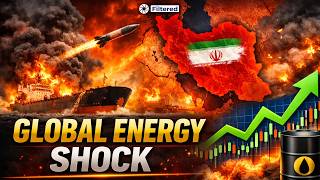
TJ Walker argues the expanding war with Iran shows how Middle East conflicts spiral beyond their goals. Iranian attacks on shipping have spiked oil prices, strained Europe's economy, and killed U.S. soldiers, yet Americans see no clear purpose. Walker criticizes the Trump administration for contradictory statements and miscalculating Iran's resolve.
Chapters
War and unintended consequences. Oh boy, this is not looking good. The widening war with Iran is becoming a classic lesson in why Middle East wars so often spin far beyond their original rationale. The initial bombing campaign may have showcased overwhelming force, but the aftermath is exposing the real danger, consequences that no one can neatly contain. Iran has responded by threatening shipping in the Strait of Hormuz. Not just threatening, they've been stopping it. It's a choke point for about 1/5 of the world's oil. Tankers have been attacked, mines are appearing in the water, and energy prices have surged. Europe's already fragile industry, especially in Germany, is taking another blow from rising fuel costs. American forces are now facing the prospect of dangerous escort and mine-clearing missions. Even as US service members continue to die in operations tied to the conflict. This is the recurring pattern. Starting a war is the easy part. The hard part is everything that follows: inflation, retaliation, accidents, alliance strain, and a strategy vacuum where military force outruns political planning. Okay, this is an ugly mess, folks. There is a reason, I believe, that this war, and it is a war, is the least popular war that has been waged by Americans in more than half a century. There's virtually no political support for it. The vast, vast majority of Americans are saying, why are we here? Look, our soldiers are dying. My gas is going way up. Interest rates are up. Trying to get a mortgage is now harder. This has all happened in the last 2 weeks. Why are we doing this? Typically, political leaders explain it. That's what leadership is. You're a political leader of a country, no one expects you to actually be on a horse or in a tank fighting the war. What they expect you to do is to use reason and use your communication powers to explain to people what are we doing, why are we doing it, what do we hope actually is accomplished, how do we win this thing, how do we end this thing? Now that's a handful of questions. If you think you've heard an answer, congratulations to you, because no one else that I've talked to has heard answers to any of those questions. And yes, let me do the obligatory throat clearing. Yes, Iran, bad guys. The regime running Iran since 1979, horrific, horrible to women, horrible to citizens, horrible to dissenters, horrible if you believe in democracy, horrible for the region. Great for terrorism. I get all that, but may I remind you, the world is filled with political leaders that Americans don't particularly like. There are easily, by the strictest of definitions, half a dozen theocracies in the world. If you don't like Iran, why aren't you going after the other theocracies? That's funny. I don't see Trump sending in bombers to Saudi Arabia. If, if theocracy is so bad, why not there? If we like democracy and that's the only good form of government, why aren't we going and attacking every monarchy in the world? There's still plenty of those. Obviously, that would strike most people as nonsensical. The United States is not simply going to wage war against dozens of countries just because we don't like their political leadership. And that seems to be what's happening here. So here's the big calculus that I think the Trump administration missed out on. They thought, well, we have more power, we can bomb them, and they'll just say, oh well, we give up. It is true the United States has a stronger military and can bomb buildings, but what they didn't factor in is what if they don't care about buildings? What if the mullahs running Iran don't care about buildings? They still have control over the populace. Maybe there was a bunch of strong dissenters that could have been a part of a spontaneous uprising to take over, But because of the timing of how the US did that, those were largely killed. Those people were killed by Iranian powers. So there doesn't seem to be any faction in waiting ready to take over this country. So again, what's the goal? Now, to be fair, President Trump has stated his goals for Iran. But also to be fair, they change every day, sometimes every hour. They certainly change what's coming out of his mouth, what's coming out of the Defense Department's mouth, what's coming out of The Secretary of State's mouth. All of it's different. And now we see the world is slowly, and sometimes not so slowly, turning into chaos. Oil prices skyrocketing, chaos in economies with economic planning for manufacturing in places like Europe. We see Americans fueling jets have faltered and been attacked. We see the loss of human American human life. Now, for those of you who voted for Donald Trump, you may well remember his message in 2016, his message in 2020, his message in 2024. "No more of these ridiculous endless wars." He said it, and to give him credit, he pretty much did that in his first term of office. But now it seems like every other day he's attacking someone. And while it may have, at least for now, seemed quick and painless with what happened in Venezuela, This is a bigger deal. Venezuela is a small, relatively insignificant country. Iran is a large country, a geopolitically significant country in its region and the world. And you know what else is significant to the modern world? As much as I love solar power and wind power, guess what? Oil is still really important. Oh, but TJ Walker, the United States is energy independent now. We don't need their oil. It's not how it works, friends. There is a worldwide marketplace for the commodity known as oil. And if all of a sudden 20% of it isn't there anymore, it's gonna cause massive demand, massive spikes up in prices everywhere. That's simply the way things work. So every single day there seems to be some unintended consequence. Oops, we didn't think about that. Oops, we didn't think about that. So my real message here for you is be humble, learn from other people, listen to people. Doesn't matter if you're the president of a country, as a president of a one-person consulting firm. Before you take drastic action, especially if it has a huge impact on human beings' lives, maybe ask opinions from people and maybe ask opinions from people who don't always agree with you. Bring in other voices, get countering opinions, have a little self-awareness, realize that maybe you don't know everything. If we had political leaders who had that attitude, we might not be in this mess. Now, to be fair, maybe there's some magic solution and 2 weeks from now the war is over and we have some new regime in power in Iran that is respectful of sovereignty of other nations, that doesn't promote terrorism, that respects human rights of their citizens, and no more death anywhere. Maybe it happens. And maybe the moon is made of blue cheese and is quite tasty.