Warren Buffett’s Surprising Exit: What He Really Thinks Now
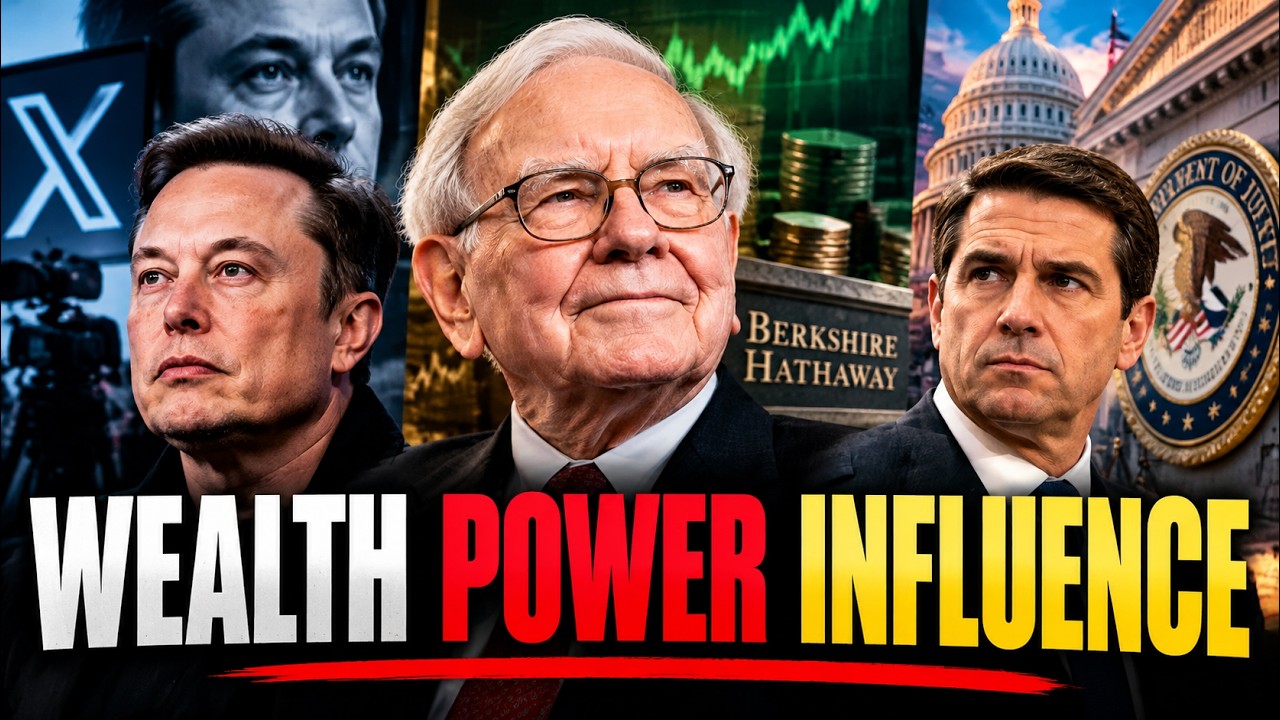
TJ Walker argues Buffett's final advice is right: most people should skip stock picking and invest in a low-cost S&P 500 index fund instead. Walker's own math shows the index often beats even Berkshire Hathaway over multiple time horizons. He also covers Berkshire's succession plan, media reputation management, and the Hatch Act debate around Attorney General Todd Blanche.
Chapters
Ultimize. Warren Buffett made the greatest stock-picking fortune in history. His advice to you is stop picking stocks. That's like LeBron James saying, honestly, just take the stairs. Buffett stepped down as chairman of Berkshire Hathaway at 96 this week. He turned a dying textile company into a conglomerate worth roughly $1 trillion. From 1965 through 2024, Berkshire compounded at about twice the annual rate of the S&P 500. That's not beating the market. That's taking the market behind Dairy Queen and stealing its lunch money. But Buffett has repeatedly said that most ordinary investors should use a low-cost S&P 500 index fund. His instructions for the money left to his wife were simple. 90% in a low-cost S&P 500 index fund and 10% in short-term government bonds. Not Berkshire Hathaway. Apparently, Warren Buffett's final stock tip is do not try to be Warren Buffett. And the recent numbers make his advice look annoyingly sensible. I compared Berkshire Class B shares with an S&P 500 fund, including reinvested dividends through yesterday's close. $1,000,000 invested 1 year ago grew to about $1,038,000 in Berkshire. In the index fund, $1,164,000. The simpler choice finished roughly $126,000 ahead. That is an expensive way to receive a complimentary box of See's candies. Over 5 years, it's nearly a tie, about $1,080,000. $1,840,000 in Berkshire versus $1,843,000 in the index. After 5 years of reading annual reports and telling people what free cash flow means, the index investor made an extra $2,800 by ignoring you. Over 10 years, Berkshire grew to roughly $3,506,000. The index fund reached $4,000,000. $174,000. The difference, approximately $668,000. You could spend 10 years analyzing stocks or 10 minutes buying the index and the remaining 9 years, 11 months, and 29 days developing a personality. These particular periods do not guarantee that the index always wins, as I mentioned. Over 60 years, Warren Buffett beat the index by a lot. Markets do not sign guarantees, especially for people with YouTube channels. They demonstrate Buffett's deeper point. Even choosing the company built by history's greatest investor did not reliably beat owning the whole large company market. S&P's SPIVA research says more than 90% of actively managed large company funds underperformed The S&P 500 over its longest current measurement period. These are professionals. They have analysts, research departments, and expensive shoes that make decisive noises in hallways. Most still lose to the fund that does almost nothing. Investors hate this because we have an action bias. If we watch CNBC, study charts, trade 6 times, and shout rotation during lunch, it feels as though we worked. But investing is one area where knowing less, doing less, and paying less can produce more. The financial industry cannot build a luxury conference around buy one inexpensive fund and stop calling us forever. There are no exciting index fund emergencies. Breaking news, America still contains approximately 500 large-cap companies. Our panel will go home now. This is about long-term money, not next month's mortgage, emergency savings, or tuition due Tuesday. An index can fall hard. The lesson is not daily safety. It's that diversification, low fees, and patience give most people better odds than constant cleverness or chasing the hot new manager or hot new company tip. Buffett spent 60 years proving he was exceptional. And then told the rest of us not to pretend we are. That may be the most valuable investment lesson. His son Howard is now chairman, and the founder selected his son deserves at least one raised eyebrow. But Howard's not a failed musician. That confuses him with his brother Peter, who is an accomplished musician. Howard is a farmer, a philanthropist, a former Archer Daniels Midland executive, and Berkshire director since 1993. Still, no company announces, after a worldwide search, we selected the founder's son, and watches every corporate governance expert remain hydrated. The key distinction is that Howard is a non-executive chairman. Greg Abel runs Berkshire as CEO. Howard's job is to protect the culture and help ensure the right CEO remains. He's not being handed the railroad. He's being handed the family thermostat and told, Do not let anyone turn this into crypto. Would you like to be the sort of successful person who is dominating news, at least in your industry? Well, if so, it's time to up your skills. At ultimize.com, I've created online courses to help you do that. Now, here's the thing, no obligation. You can get a free course on communication skills, a free course on how to build better habits. All you have to do is go to ultimize.com. That's U-L-T-A-M-I-Z-E.com. ZE.com. No obligation. Go there now. Moving on. The devastating new 4-hour Elon Musk documentary may destroy his reputation for almost an entire weekend. Alex Gibney is a respected director. I expect the film to be rigorous, disturbing, and persuasive. Anyone who watches all 4 hours may emerge convinced that Musk is unstable, dangerous, and needs a hobby that does not involve Mars. Then Monday will arrive. Musk will launch something, insult somebody, rename a feature on X, and appear on a 3-hour podcast titled What They Don't Want You to Know About Seed Oils. The documentary will become yesterday's scandal, which now has the shelf life of sushi at a gas station. Extreme fame gives you the power to bury a scandal beneath your next 12 headlines. The modern reputation strategy is not rebuttal. It is volume. Do not win the argument. Fill the internet until the argument needs parking. Universal was reportedly reconsidering the documentary's international release, although the studio now says it still plans to release it. Musk calls the film a hit piece and has threatened legal action, although he claims he's never seen it. He also presents himself as a defender of free expression. Free speech is absolute, although 4 consecutive hours of it may require an attorney. Trying to bury the film creates curiosity. Releasing it creates a progress bar. 4 hours is not a movie. 4 hours is a hostage negotiation with a concession stand. But if it's interesting, okay. Remember Jeff Bezos? The National Enquirer exposed his affair and threatened to publish intimate photographs. Strike that. They did publish intimate photographs. Wildly embarrassing photographs. Bezos publicly accused the company of extortion. It was enormous news. Today, people remember Amazon, the Washington Post, and Bezos returning from space dressed like he had misplaced the rest of his cowboy costume. Nobody remembers the Amazon scandal with all the horrible, nasty pictures of him. The scandal did not vanish because it was unimportant. It vanished beneath newer identities, businesses, and headlines. Musk can generate international news before breakfast. He owns X and commands the podcast bro imagination. A single exposé cannot compete with a person operating his own 24-hour network inside everyone's phone. My communication advice to the filmmakers: divide the documentary into 48 5-minute scandals and release one every morning. Do not make a documentary about the attention economy. Use it. Moving on. The New York Times reports that Attorney General Todd Blanche has appeared at Republican political events, including the party's midterm convention and a Senate campaign rally. The Justice Department says he appeared in his personal capacity, that ethics officials reviewed the events, and that expenses were handled according to federal rules. Okay. Former department ethics officials argue The appearances break a post-Watergate norm separating Justice Department leadership from campaign politics. Legal experts disagree about whether the conduct clearly violates the Hatch Act. So the facts are not especially mysterious. The disputed phrase is personal capacity. Okay. Personal capacity is Washington's version of business casual. Everybody agrees it exists. Nobody agrees exactly what it covers. An attorney general can hold political views. The controversy is whether appearing at campaign events changes how the public perceives federal law enforcement. That question applies regardless of party, because any precedent available to one Republican attorney general may later be cited by a Democratic attorney general and then cited back again. Washington may have invented a boomerang with subpoena power. For decades, attorneys general from both parties generally avoided speaking at party conventions and campaign rallies. In 2022, Merrick Garland imposed an especially strict ban on political activity by Justice Department appointees. Pam Bondi rescinded that policy in March, leaving the less restrictive and sometimes ambiguous Hatch Act standards. Blanche's critics say the Justice Department must not only act fairly but appear politically independent. His department responds that the events were personal and ethically clear. That produces a genuinely difficult institutional question: where does the individual politician end and the nation's chief federal prosecutor begin? Taken to its logical extreme, either party could eventually decide that the most efficient attorney general is its opposition research director. The same person could identify an allegation, discuss an investigation, and reserve the studio for a campaign commercial. No awkward handoffs. Excellent workflow. One party might appreciate that arrangement while it controls the department. The other party might appreciate it after the next transfer of power. The historical norm existed because prosecutorial authority outlasted campaign enthusiasm. Once a broader practice becomes accepted, it does not automatically disappear when control changes hands. That's why this is not only a Todd Blanche story, It's a question about the rules every future Attorney General from either party will inherit. The most useful test is also the least exciting sentence ever placed on a vision board: apply the same standards when the parties switch. It's not catchy. Neither is a subpoena. I'm TJ Walker. Have a great weekend. Ultimize.
More from TJ





The Breakout Cases - What Actually Caused Famous Speaking Career Breakthroughs | Ultamize

The Red Circle Sessions Finale - Build the Speaking Career You Came Here For | Ultamize

Two Stages, One Logo, Two Completely Different Realities - Main Stage vs Independent Events | Ult...

Pre-Reset - Why Repetition Builds Better Speaking Decisions | The Red Circle Sessions | Ultamize

Your Decision, Your Framework, and What Happens After - Build Your Speaking Career First | Ultamize

The Red Circle Sessions Trailer - The Speaking Career Truth Nobody on That Stage Will Tell You | ...

The Two-Minute Ultamize Reset - Your Platform, Your Audience, Your Voice | The Red Circle Sessions