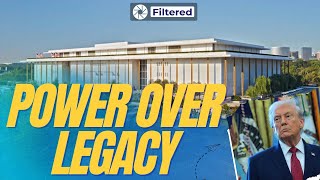
TJ Walker argues that renaming the Kennedy Center to include Trump's name conflates a cultural memorial with a personal brand, undermines institutional norms, and risks politicizing public institutions. He also shares public speaking advice: keep sentences short, use repetition, and speak from an outline with stories rather than written text.
Chapters
Okay, it's happening. There is, in fact, no longer a Kennedy center in Washington, D.C. no, that's gone. It's now the Trump Kennedy Center. Believe it or not, this happened quickly. On Friday, Trump's name was added right there on the marble. It's now the Donald Trump and John F. Kennedy Memorial center for the Performing Arts. Folks, this is really getting out of hand. You know, the John F. Kennedy center for Performing Arts was built as a memorial to the 35th president who was assassinated in 1963. Correct me if I'm wrong, I thought memorials were usually after you were dead. President Trump, and I'm not wishing any ill on him or any other political figure, to my knowledge, is not dead. So the time for memorials is after you've passed away, after time for people to reflect on what you're about, what you stood for. John F. Kennedy was known as someone who had a real passion for the arts, an interest for the arts, cultivated the arts during his tenure as president, not just as someone who brought Kid Rock to the White House or the Incredible Hulk. So on Friday morning, the workers began hauling up large letters spelling out Mr. Trump's full name and adding it to the white marble facade of the building. Now, Trump was able to do this, of course, because he picked, hand picked, the members of the board of trustees. They got together in Palm beach and voted to rename it. Now, members of the Kennedy family are obviously pretty outraged by this. Beyond that, there's the unmitigated gall where Trump is gaslighting you and me. Here's what he said Thursday. He said he was, quote, surprised and honored that the center's board, where he's, the chairman, had thought to do this for him, almost as if it were just coming out of the blue. Now, the New York Times has reported this, but it's been reported everywhere to act surprised when everybody knew it was his idea. Why is this so bad? You can say, well, T.J. he's got his own style. And, you know, some people don't like Kennedy. He was seen as a big Democrat. Why does he get it? Okay, Ken Kennedy didn't do it for himself. It was done many years later. And the fact that this was done so quickly, the board votes one day, the next day, the name has changed. That seems a little too cute. It sidestepped all the normal legal channels. This typically, is something that comes from Congress. Once again, Trump shows he has absolute contempt for Congress. Even though he controls the Congress. The board has vast conflicts of interest problems, especially when he names himself the chairman. It Blurs the line between a national cultural institution and a personal brand. The Kennedy center is not a private building with naming rights. He's turning everything into a cheesy casino. I mean, I hope the Kennedy center doesn't go bankrupt because Donald Trump's daddy's not around to bail them out anymore. This is a precedent center. So if, if every president can come in and put their name on everything, then what's to stop other presidents from doing this for every library, every museum, every research center? So again, it was supposed to be a memorial, not a co branding opportunity. It's institutionally corrosive what's happening here. Cultural spaces are supposed to be a place of neutrality, artists, donors coming together. Nobody feels neutral about anything when the name Trump is bandied about and he's still alive. And again, I'm not wishing him ill will, but if he truly were some great patron of the arts, people would legitimately believe that and feel that cross parties and they could have maybe added his name 50 years from now or at some point. This is really inviting a tug of war so every, every new president of a different party can come in and scrape all names off of the, of the previous administration. This undermines the philanthropy and trust among donors. A lot of people across the political spectrum have donated to the Kennedy center who are not going to donate anymore. They're going to be. I'm not giving anything that's glorifies this goon, this thug, this mob leader. This would be dictator Donald Trump. They're just not going to do it. So it's really going to harm the finances of this center. It's politicizing art. Yeah. You understand John F. Kennedy had politics, but he's been gone a long time, dead a long time. No one goes to perform at the Kennedy center thinking they are endorsing the Bay of Pigs fiasco or any other policy of the Kennedy administration. This harms the United States reputation internationally because frankly, it makes us look like a banana republic, like an African dictatorship, like a third world dictatorship. It really makes us look cheesy and sleazy and it looks like we're in on this whole cult of personality. It's bad governance practice. Let's look at some other places that do that and just ask ourselves, is this who we want to identify with? Turkmenistan? You probably haven't been there on vacation. I haven't either. But there the, the great leader there who came to power, he renamed months, he renamed January after himself. He renamed the month of April after his mother. And he plastered his name and imagery on civic life. So if you think Turkmenistan is a good role model for the United States, you should by all means endorse the Trump Kennedy Center. Let's look at North Korea, the Kim Dynasty, portraits, monuments everywhere, fusing the concept of the country, the nation. And dear leader. We're not that far away from that. Let's head on over to Africa. Africa. Another dictator there in Zaire, Mobutu Siko, named the country and cities and built a personality cult around his personal image and authority. And then let's head on up to Europe. How about Romania for a role model? Nicolae Ceausescu. He. He cultivated his image everywhere, statues everywhere. This concept of he was the state, he's the leader, he is everything. And let's not. How can we forget Iraq? Our good friend Saddam Hussein, who was great this, had all sorts of gigantic statues of himself everywhere. Put his name on everything. He wanted to really solidify his image, the symbol everywhere. This is where we're headed. Not to mention the sheer waste of time and money. It galls me that the idea that people who say, I'm in favor of getting rid of government waste, let's bring in Elon Musk to take a chainsaw to things, are the first ones who. Who love wasting money on needless things. Needless signs, the workers changing all the signs. It reminds me of the. The millions and millions of dollars that are going to be wasted. Changing all the signs and stationery for the U.S. defense Department, which is now comically, or not so comically, going to be called the Department of War. Look, folks, I understand you have to have a big ego to run for president. We don't have a lot of shrinking violets becoming President of the United States. But the idea that every single building, every single policy has to have your name. How far away are we from the US Mint? Being ordered to scrape George Washington, to scrape Ben Franklin off of our currency and turn all of our money orange with, you know, whose face on top of the. How can you have more impact every time you speak? It's time for questions from you. This one comes from Diana, who's a student in my soft skills course. Question. I would like to speak cohesively and in long sentences, which are impactful and add a great impression. Where should I start? Start with being interesting for your audience. And this may surprise you. It's not what you asked for, but I'm going to give you what I think helps you reach your real goal. Having an impact. Don't try to have long sentences. Long sentences can Work for the written word, for text, a book, an article, a story. But when you're speaking, a long sentence means you'll just kind of run out of breath. You don't want long sentences. Great speakers have short sentences, often 10 words or less, one idea at a time. If you're writing a novel or a book or report, you can have commas, you can have semicolons, villains. You can have complex sentences. The eye can comprehend that the ear really can't. It's much better, more effective for people to be able to hear you explain one idea at a time. Use repetition. Repeat what you just said. Yeah, really repeat what you just said. Kind of like I did there. It might not read well, but it will have a bigger impact on your audience. So I urge you. In most situations, I don't even recommend people write out their speeches. Instead, come up with an outline of the concepts you're trying to convey. Then think of examples to make that idea come alive. Think of actual stories to make it come alive, and then talk it out in a comfortable, conversational way. I've spent a lot of my time over the years studying the greatest speakers in the world. It doesn't matter if you like Winston Churchill or Ronald Reagan or Bill Clinton. They all have one thing in common. They spoke with short sentences, sentence fragments, and lots of repetition. And that's how you will ultimately have a bigger impact on your audience. Remember, it's not about you. The second you're thinking, I want to be seen as having impact, the audience is going to sense that you care more about yourself than you care about them. Focus exclusively on making ideas interesting, understandable, and memorable to your audience. That's how you ultimately have the biggest impact.