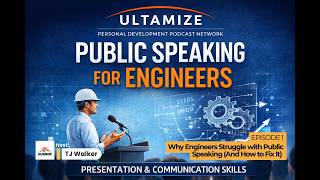
TJ Walker explains why engineers cram too much into presentations and miss the point: a talk's job is to get a specific result, not transfer all information. He proposes treating your presentation like an engineered system: define the goal, design it, test it by asking people what they remember, measure what worked, and iterate.
Chapters
Ultimize. After your next presentation, ask one person who heard you the following question: What do you remember? Not what they liked, not whether you did a good job. Just ask, what do you remember? Because that answer is your real performance data, and most engineers never collect it. You're entering Public Speaking for Engineers, produced by Ultimize. I'm your host, TJ Walker. Let's start with something important. Engineers are not bad at communication because they lack intelligence. In fact, the very skills that make you a strong engineer are often the same ones that hurt you when you present. You've been trained to value completeness. You want all the variables accounted for. You want all the edge cases covered. You want every assumption explained and every detail documented. Fine, I get it. That's exactly what makes you good in engineering. It's also precisely what makes most engineering presentations ineffective. Because your audience is not trying to rebuild your system. They're trying to understand what truly matters. And when you give them everything, they often walk away with nothing. This is the core problem. Most engineers treat presentations like documentation. They think the goal is to transfer as much information as possible. Sorry, it's not. Not. So they include everything, all the background, all the data, all the caveats, all the logic, and they assume that if they said everything correctly, the job is done. But communication doesn't work that way. The goal of a presentation is not to say everything. The goal is to get a specific result. That result might be approval for a budget, alignment with your goals, funding for your project, understanding A decision. If your audience doesn't understand your key point, remember it, and act on it, then the presentation failed no matter how accurate it was. Now here's where we shift to an engineering mindset. In engineering, you don't assume something works. You test it. You measure the output. You analyze the results. You refine the system. You don't say, well, I built it, so it must work. You validate it. But when it comes to presentations, most engineers completely abandon that mindset. They prepare once, they deliver once, and they move on. No testing, no measurement, no iteration. That means they never actually know if their communication worked. From this point forward, that changes. Every presentation you give is now a system. You are designing it and testing it, and the output is not Did I say everything correctly? Oh no. The output is, did the audience understand my key points, remember them, and take the actions I wanted? And the only way to know that is through evidence. You need feedback that reflects reality, not your assumptions. Simple, practical things. Ask someone in the audience what they remember. Notice where people look confused. Pay attention to when attention drops. Track whether your idea actually gets accepted. That is your data. And once you start collecting the data, you'll see patterns. You'll notice that when you include too much detail, people disengage. You'll notice that when your message is not clear at the beginning, people never quite catch up. You'll notice that your slides often compete with you instead of supporting you and your ideas. And most important, you'll notice that clarity beats completeness every time. This is one of the hardest adjustments for most engineers because it feels wrong. It feels like you're leaving things out. It feels like you're oversimplifying. It feels like you're not being precise enough, but your audience doesn't need everything. If they did, they'd already have your job. They need the right things in the right order, at the right level of detail. That is design. And that is where we begin treating communication as an engineering problem. You define the objective, you design the system to achieve that objective, you test it in the real world, and then you improve it based on what actually happens, not what you assume should happen. The last part is critical because most people never improve their presentations. They They just repeat them. They keep using the same slides, the same structure, the same habits, and they assume that if it didn't work, the audience just didn't get it. But if you take an engineering approach, that assumption disappears. If the audience didn't understand, the system failed. And if the system failed, you improve the system, not the audience. That is how you gain a massive advantage. Because most engineers never do this. They rely on guesswork. You will rely on evidence, and over time that creates a huge gap. Your presentations become clearer. Your ideas get accepted faster. You become someone people listen to, not because you changed your personality or became charismatic or dynamic, but because you changed your system. Throughout this series, we're going to rebuild your approach step by step. We're going to simplify your thinking. We're going to structure your message. We're going to eliminate the habits that just don't work. And most important, we're going to make sure everything you do is grounded in results, not theory, not guesswork, not assumptions, but results. In the next episode, we're going to tackle one of the biggest mistakes engineers make. Why explaining more actually makes people understand less. And how to fix it. You know, there's one thing I always find interesting. People will listen to a podcast like this, get ideas, maybe even feel a little motivated, and then just move on with their day. Nothing actually changes. And I get it. Information alone doesn't do it. Repetition does. That's actually why we built Ultimize. So if you're getting any value from this, just go to ultimize.com. That's spelled U-L-T-A-M-I-Z-E dot com. There's a free course waiting for you there. You can start with communication skills, but the whole idea is simple. Don't just hear something once, actually build it into your life. Again, it's free. Go to ultimize.com.