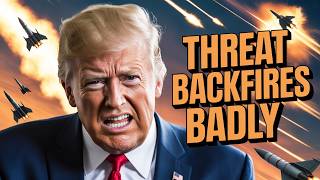
TJ Walker reads a Trump post threatening Iran's civilian infrastructure and argues it meets the FBI definition of terrorism. The language mixes profanity, caps-lock, and a sarcastic "Praise be to Allah," undermining diplomatic credibility and signaling rogue-state behavior to allies.
Chapters
Ultimize. The President of the United States just threatened to destroy another country's infrastructure and did it in a way that reads less like diplomacy and more like a late-night rant from someone who just discovered the caps lock button. Let me read this slowly, edited for family discretion, because every word matters. Here's what the President of the United States put out on social media. Tuesday will be power plant day and bridge day all wrapped in one in Iran. There will be nothing like it. Open the effing strait. And I cleaned that up for family listening and viewing, but yeah, the President of the United States using the F-word in official communication to the world. You crazy. Now he uses another obscenity to question the parentage of people. He is criticizing. Or you'll be living in hell. Just watch. All caps. Praise be to Allah. That's from the President of the United States. It's not a parody account. This was from the President of the United States. Now, most coverage is focusing on whether this sounds unhinged. Well, that's the easy take. That's the headline. But the more serious argument And this is where it gets uncomfortable. It's coming from people who are not comedians, not partisans screaming on cable news, but serious thinkers. One of them is Paul Krugman, a Nobel Prize-winning economist, points out something that should make you stop in your tracks. He starts with the definition from US Immigration and Customs Enforcement. That's right, ICE. Terrorism, according to ICE, is, quote, violence or the threat of violence against people or property to further a particular ideology. Then Krugman recommends read the post again. Threatening to destroy power plants, bridges, civilian infrastructure— that's not aggressive rhetoric. By definition, that is a threat of violence against people and property to achieve a political goal. And here's the part people don't want to say out loud. Once you accept the definition, the argument comes very hard to dismiss. Now, I'm not saying that lightly. It's a heavy word. It should be used carefully. But terrorism, yeah, the United States has become a rogue nation headed by a terrorist. I realize that's not polite to say. That makes someone seem like they are partisan, but it's just objective fact if you believe in things like international law and centrist, middle-of-the-road political analysis from people around the world. That's exactly why this is so serious, because this is someone throwing the word around casually. I'm not throwing it around. Krugman isn't throwing it around. It's an argument built on the government's own definition. Larger point is more chilling. This isn't framed as hitting military targets. This is about civilian infrastructure, the systems that keep ordinary people alive— electricity, transportation, daily life. You take those things out, you're not just sending a message, you're creating suffering. And that's where the argument shifts from tough talk to something far more dangerous. War crimes, or at the very least, language that sounds like someone who doesn't even recognize the distinction anymore. Now let's talk about something that almost no one is focusing on but might be the most reckless, stupid part of the entire message. Praise be to Allah. That's what the president put mockingly in his social media post. That line's doing a lot of damage because what is that? It's not diplomacy, it's not respect, it's not even coherent. It reads like mockery, like sarcasm, like someone trying to be clever about religion in the middle of threatening mass destruction. And here's the problem: religion is not a throwaway punchline in global politics. People have gone to war over religion. For thousands of years, empires have risen and fallen over it. Entire regions are defined by it. And when the president of the United States appears to casually mock a religious phrase associated with over a billion people while simultaneously threatening violence, that's not just offensive, it's incendiary. That's the kind of thing that doesn't just create a bad news cycle, that creates generational resentment. You don't get to walk that back with a clarification tweet. You don't get to fix that with a press secretary saying, "Oh, what he really meant was all religions are fine." No, because in communication, perception is reality, and the perception here is that the most powerful leader in the world is casually mixing threats of destruction with what sounds like a mocking reference to religion. That's not strength, that's gasoline. Because this is where Americans often miss the story. We think this is about Democrats versus Republicans, cable news versus cable news, left versus right. The rest of the world is not watching it that way. They're watching it as, what is the United States becoming? And increasingly, the answer is not comforting. You see it in international coverage, in diplomatic language, and the subtle shifts of tone. Countries don't come out and say, quote, "The US is acting like a rogue state." They don't say that out loud, but they start acting like it. They hedge, they distance, they prepare. Because if you're an ally and you see this message, you're not thinking, "Oh yes, strategic brilliance." You're thinking, "Are we tied to someone who might escalate unpredictability?" Are we tied to a crazy man? If you're an adversary, you're thinking something even more dangerous. Is this real, or is this someone bluffing? Because instability cuts both ways. It can scare people, or it can invite miscalculation. And miscalculation is how wars start. Now let's talk about the tone of this message. Power plant day, bridge day. What is that? This sounds like a bad promotion at a theme park. Come on down, it's infrastructure destruction weekend. Kids eat free. This is not how serious leaders talk about military action. There's no gravity. There's no precision. There's no sense that the person writing this understands the weight of what they're describing. This is not the language of someone managing risk. This is the language of someone performing outrage. And that distinction matters because real power doesn't need to shout. Real power doesn't need profanity or obscenity. Real power doesn't need 3 exclamation points to convince anyone it's serious. When you have actual power, your words get quieter, not louder. More precise, not more chaotic. This is the opposite of that. And here's the final communication breakdown. When a leader communicates in a way that makes people question their stability, everything else collapses. All policy debates become secondary. All alliances become conditional. All trust becomes fragile. Because influence, the ability to get other people to do what you want, depends on one core belief. That you're rational, that you are predictable, that you understand consequences. The moment that belief cracks, you lose leverage. Not slowly, immediately. And right now, you don't just have political opponents questioning that. You have serious analysts, you have international observers, and you have arguments based on definitions, not opinions, that place this kind of rhetoric in extremely dangerous category. This should not be normal. This should not be routine. And the most alarming part of all is that we're starting to treat it like it is. Okay, troubling news. I was about to say out of the Middle East. It's really out of Washington, frankly. And people underestimate how big a problem this is. When I talk to People I know in the international community, having worked for decades with United Nations officials, again, they're reluctant to say it publicly, but privately they're all saying the same thing. The United States is now a rogue nation. You don't have a president, you have a terrorist who's taken over the head of your government. Granted, he was elected, but he's acting and behaving just like a terrorist, and it's scary times. You know, there's one thing I always find interesting. People will listen to a podcast like this, get ideas, maybe even feel a little motivated, and then just move on with their day. Nothing actually changes. And I get it. Information alone doesn't do it. Repetition does. That's actually why we built Ultimize. So, if you're getting any value from this, just go to ultimize.com. That's spelled ultimize.com. There's a free course waiting for you there. You can start with communication skills. You can start with building better habits, but the whole idea is simple. Don't just hear something once, actually build it into your life. Again, it's free. Go to ultimize.com. Ultimize.