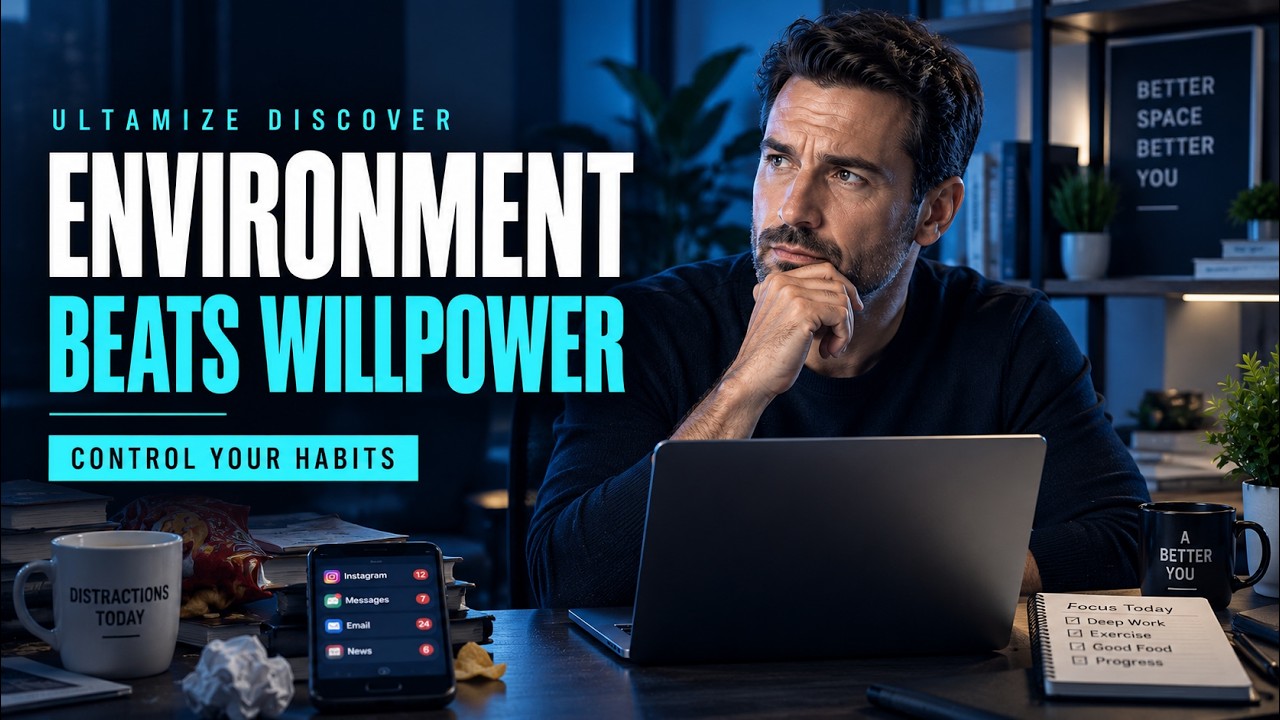
In this instructional video, TJ Walker explains that personal productivity hinges less on willpower or sheer discipline and more on the design of one’s environment. He begins by urging viewers to choose a single, most important task each day and commit to completing it before anything else, arguing that multitasking and long to‑do lists hijack the day. Walker introduces the concept of “friction” – the tiny amount of effort required to start or continue a task – and shows how even minimal resistance (searching for files, deciding what to do next, or reaching for a phone) can cause procrastination. He demonstrates how to deliberately lower friction for high‑value actions (pre‑opening documents, defining the next step, clearing the workspace) while raising friction for distractions (moving the phone away, closing unrelated tabs). Visibility is highlighted as a powerful cue: whatever is in front of us automatically draws attention and shapes behavior. By arranging the workspace so that the desired task is the most visible and accessible, the brain is nudged toward productive action without relying on motivation. Walker frames these changes as a systematic, repeatable “environment design” rather than a matter of personal discipline, promising that consistent application leads to momentum, focus, and measurable results. The video concludes with a call to action to explore free courses on ultimize.com for deeper habit‑building strategies.
Chapters
Today on Ultimize Discover, you're getting a short practical sample from the Ultimize universe. Use this on its own, take one idea and apply it today, or go deeper at ultimize.com. Ultimize is the world's largest personal development podcast, audiobook, and online learning network. Ultimize. If you want to take control of your day immediately, here's a simple move you can use right now. Before you check your phone tomorrow, decide the one task that actually matters most and commit to finishing it before anything else. Not 10 tasks, not a to-do list. One. Most people never do this, and it's why their days get hijacked before they even begin. Hi, I'm TJ Walker, and in this course, I'm going to show you how to stop reacting to your schedule and start controlling it. This isn't about motivation. It's not about waking up at 5:00 AM or becoming a completely different person. It's about practical systems you can use every single day to take back control of your time, your focus, and your results. For example, I'll show you how to design your day so that distractions don't stand a chance. You'll see how to structure your schedule so important work actually gets done instead of pushed aside. And you'll learn how to eliminate the constant feeling of being busy but not really productive. Most people think they need more discipline. They don't. They need a better system. I'll walk you through exactly how to build one that works even on your worst days. If you've ever felt like your day gets away from you, like you're consistently busy but not moving forward, this course will change that. Enroll now and start taking control of your schedule immediately. If you want to start working faster and procrastinate less, do this. Before you stop working today, set up your next task so it's ready to begin the moment you sit down tomorrow. Instead of closing everything and telling yourself, I'll figure it out tomorrow, leave your document open, your notes visible, and your next step clearly defined. That way, when you sit down, you don't have to think. You just begin. This is the concept of friction. Friction is the small amount of effort required to start or continue something. And even very small amounts of friction can stop you from taking action. For example, if you sit down to work and you have to decide what to do, open the right file, find your notes, and figure out where you left off, that's multiple points of friction. Each one adds a little resistance, and that resistance leads to delay. But if everything is already set up, if the document is open, if your next step is clear, if your tools are ready, Starting becomes much, much easier. And when starting is easy, you start more often. Most people unintentionally create friction for the things they want to do, and they remove friction from the things they want to avoid. For example, your phone is always within reach, always on, always easy to access. That means checking it requires almost no effort. But starting an important task might require multiple steps. Opening files, finding information, deciding what to do first. So what happens? You check your phone, not because you chose to, but because it's easier. This is the pattern you need to reverse. You want to reduce friction for the actions that matter and increase friction for the actions that waste your time. For example, if you want to focus more, Make your workspace ready before you begin. Remove unnecessary items, close unrelated tabs, open only what you need. If you want to stop checking your phones constantly, move it further away or put it somewhere less accessible. If you want to start tasks faster, define the exact next step so there is no hesitation when you begin. These changes seem small, But they have a powerful effect when they influence your behavior at the moment of action. Think about how many times you delay something simply because it feels like, ah, too much effort to start. For example, you know you should begin a task, but you think, I'll do it in 10 minutes, or I'll do it at the top of the hour. Then you check something else to waste time, then something else, and now you've lost momentum. That is friction at work. But when the path is clear and easy, you move forward. If you sit down and the document's already open and the next step is clear, you're much more likely to start immediately. This creates momentum, and momentum is critical because once you start, continuing becomes easier. The hardest part of most tasks isn't doing the work, it's starting the work. So your goal is to make starting as easy as possible. For example, break your task into smaller steps so that the first action feels simple. Prepare your workspace in advance so there's nothing in your way. Remove distractions before they appear so you don't have to deal with them. Each of these reduces friction, and when friction is low, action becomes more consistent. This is the shift. Stop relying on motivation to get started. Start designing your environment and your task so that starting is easy. Because when something is easy to start, you're going to start more often. And when you start more often, you make more progress, not because you pushed yourself harder, but because you removed the barriers that were slowing you down in the first place. If you want to improve your focus immediately, change what is visible in front of you before you start working. Not later, not after you get distracted, before you begin. For example, if you sit down at your desk and your phone is visible— sorry to harp on that again, but it really is the biggest time waster in the history of humanity— if your inbox is open and multiple tabs are already on your screen, Your environment is already pulling your attention in different directions before you even start. If you sit down and the only thing visible is the exact task you need to work on, your brain has a much easier time staying focused. That's the power of your environment. That's what I'm doing right now. Right now I am focused on speaking to you, glancing at my notes, Looking at the script and just talking to you. I've got 3 computer screens. I've got a phone, but the phone's not in this room. Nothing on the computer screens other than my program showing me I'm recording this for you. It's not because I have great discipline. It's because I don't have great discipline. I do that. It allows me to focus and be so much more productive. Most people think their behavior comes from their intentions. It doesn't. In reality, their behavior is heavily influenced by what is right in front of them. For example, if a bowl of candy is sitting on a table, people eat it, not because they plan to, but because it's there. The same thing happens with your time. If distractions are visible, you engage with them. If important work is visible, you engage with that. Visibility drives behavior. If your email's open on your screen, you'll check it. It's human nature. Might be something really interesting, even if you told yourself you wouldn't. If your phone is lighting up next to you, you're going to glance at it, even if you're in the middle of something important. If your work document is buried under other tabs, you delay starting because it's not immediately in front of you. These are small details, but they have a large impact because they influence what you do Without requiring a decision. This is why your environment matters more than you think. You're not just working from your desk, you're working inside a system of cues. Everything you see is telling your brain what to do next, and if those cues are pointing you toward distraction, that's where your time will go. The solution is not to fight harder against those cues. The solution is to change them. Before you start working, close every tab that's not directly related to your task. That'll help a lot. Now your screen is aligned with your goal. Another example, remove your phone from your desk so it's no longer part of your immediate environment. I know, I know, I've said it before, and yet, be honest, your phone's still around right now, isn't it? I want you to open the exact document or tool you need before you begin, so it's the first thing you see. These changes are simple, but they're powerful because they shape your behavior automatically. You don't have to decide to focus as often. The environment makes focusing easier. Think about how much of your day is influenced by what's directly in front of you. For example, when you walk into a kitchen and see food, you. When you walk into a room with a television on, you, you look at it. One reason when I go to restaurants, I like to go to a restaurant where there is no TV. It's too easy to be distracted by it. When you sit down at your desk and you see your phone, your inbox, and all these distractions, your attention spreads out. This isn't random. This is how the brain works. It responds to what's visible. And available. So if you want to change your behavior, you need to change what's visible and available. If you want to read more, for example, put a book where you can see it. If you want to focus more, remove visible distractions from your workplace. If you want to start tasks faster, make sure the task is already set up and ready. These adjustments reduce friction and increase clarity. And when friction is low and clarity is high, action becomes easier. This is the key shift. Stop thinking of your environment as neutral. It's not neutral. It's actively influencing you all the time. Once you understand that, you can start using it to your advantage. You can design your environment so the right actions are the easiest actions. And when the right actions are the easiest actions, you end up doing them more consistently, not because you are forcing yourself, but because your environment is guiding you. That is how you take control of your time at a deeper level, not just by deciding what to do, but by shaping the environment that determines what you actually do. By the way, quick question for you. Have you ever noticed how easy it is to consume content and how hard it is to actually do anything with it? I mean, you can listen to 100 episodes, read 10 books, and your habits are exactly the same. That's the gap most people never close. So if you're listening to this and thinking, yeah, I want to actually improve, go to ultimize.com. We've got free courses there for you, either on communication skills or building better habits, and it's designed to get you to actually use what you're learning, not just hear it once. No cost. No catch, just go to ultimize.com and start. Ultimize.