Why Your Goals Aren't Working (And How to Fix Them)
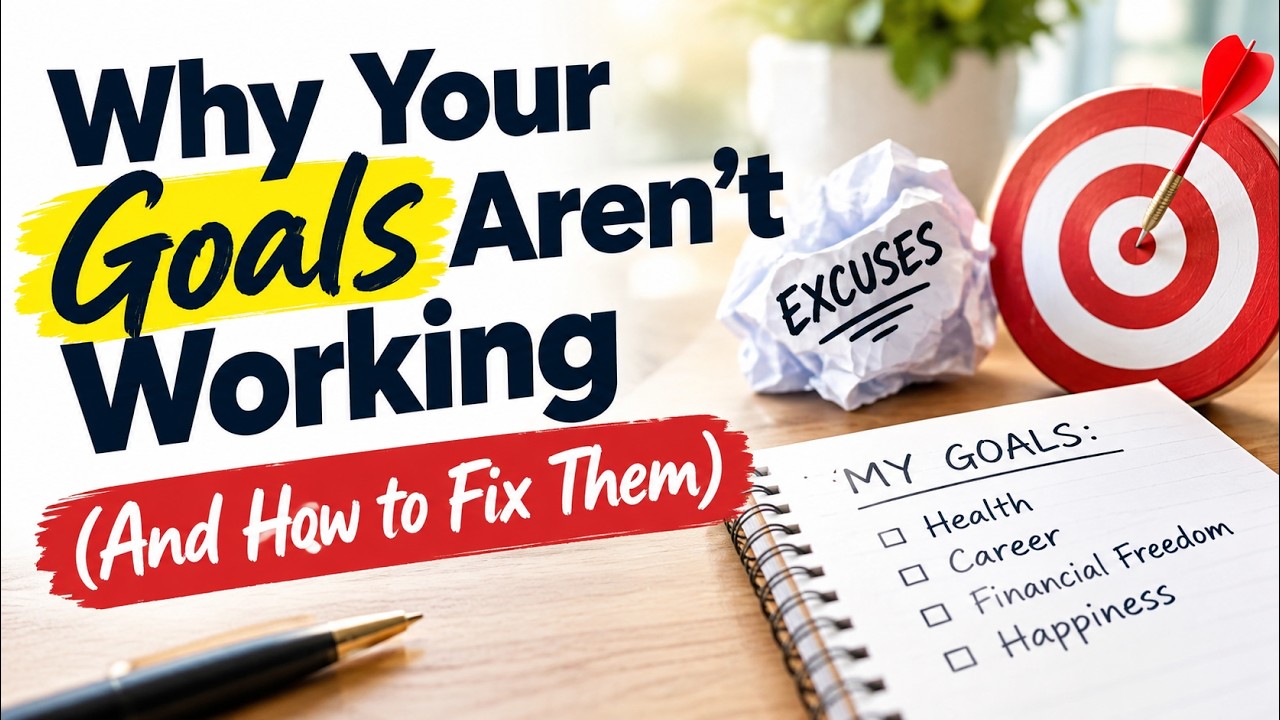
TJ Walker argues most goals fail because they're vague wishes, not strategic choices. He teaches a framework: finish each goal with "so that" to expose your real motive, then treat it like a business decision with real trade-offs in time, attention, and identity. Three questions help: What exactly? What would be different? What must I say no to?
Chapters
Today on Ultimize Discover, you're getting a short practical sample from the Ultimize universe. Use this on its own. Take one idea and apply it today. Or go deeper at ultimize.com. Ultimize is the world's largest personal development podcast, audiobook, and online learning network. Ultimize. Take one goal you've been carrying around and add the words so that. To the end of it. I want to make more money so that— I want to grow my business so that— I want a better title so that— I want more visibility so that— Don't let yourself stop at the impressive phrase. Finish the sentence. That one little phrase forces the real motive to come out of hiding. Sometimes you discover a strong, honest reason. Sometimes you'll discover you don't actually want the goal. You only like the way it sounded. Welcome to Strategic Goal Design for Modern Professionals. Build your career, business, and life by design. I'm TJ Walker, and this course is designed for ambitious adults who don't need more generic motivation. You probably already have ambition. You probably already work hard. The bigger issue is whether your goals are strategically chosen, clearly defined, internally meaningful, and worthy of the life energy they require. This course isn't about collecting inspirational slogans. It's not about creating a giant fantasy list of everything that would sound nice if life had no trade-offs. It's also not primarily about accomplishing goals after they've already been chosen. That matters, of course, but this course is focused on the step that comes first: choosing better goals in the first place. We're going to look at goals as strategic decisions. We'll examine inherited goals, vague goals, status-driven goals, career goals, business goals, contradictory goals, and the difference between goals that look good from the outside and goals that actually fit from the inside. We'll also use the Ultimize 2-Minute Reset as a short reinforcement tool because hearing good ideas once usually isn't enough to change how you think, choose, and act. By the end of this course, I want you to have fewer Clearer, stronger goals. Not more noise, not more pressure, not another complicated life management system, but a sharper sense of what deserves your time, your energy, your attention, and your ambition. So take that one goal and finish the sentence, so that— let that real reason speak. Then let's begin designing goals on purpose. Join me. Goals are business decisions about your life energy. A goal is not just something you want. A goal is a decision about where your life energy is going. That may sound a little intense. Oh, good. It should sound intense because when you set a goal, you're not just writing a nice sentence in a notebook. You're making an allocation. You're deciding where your time goes. Where your attention goes, where your best thinking goes, where your stress goes, where your calendar goes, where your reputation goes, where your relationships may get squeezed, where your health may get tested, where your money may get invested, where your identity starts to move. That's why I like to think of goals as business decisions about your life energy—not wishes, not slogans, not Fantasies. Allocations. Every serious business has limited resources— limited cash, limited staff, limited time, limited attention from leadership, limited ability to pursue every opportunity. And if a business tries to do everything, it usually does everything badly. The same is true for human life. You have limited peak energy. You have limited deep focus. You have limited emotional bandwidth. You have limited hours where you're sharp, alert, creative, persuasive, and able to do your best work. And yet most people set goals as if they have unlimited capacity. I want to grow my business. I want to get in amazing shape. I want to spend more time with my family. I want to build a personal brand. I want to write a book. Learn Spanish, travel more, sleep more. I want to make more money. I want to reduce stress. I want to be more present. Wonderful. Excellent. Beautiful. Also, let's be candid, possibly ridiculous. Not because any one of those goals is bad. Most of them sound great. The problem is that every goal sends a bill. Every goal costs something. And the cost is not always money. In fact, money is often the least interesting cost. The real cost is your attention. The real cost is consistency, opportunity. The real cost is what you can't do because you said yes to this. That's where strategic goal setting begins, not with the fantasy, but with the allocation. If you say your goal is to write a book this year, Sounds wonderful, sounds impressive. Hey, I love books, I've written books, I recommend writing books, but what does that goal actually mean? It means some mornings when you could be checking email, you're writing. It means some evenings when you could be watching a show, you're editing. It means some weekends when you could do nothing, you're thinking about chapters. It means other projects may move more slowly. It means you may have to say no to a few meetings, a few opportunities, a few distractions, and possibly no to a few people who think your availability should belong to them. Now, now the goal's more real, not less attractive. It's just more real. That's the test. A goal becomes serious when you understand the allocation it requires and you still say, yeah, That's worth it. If you don't do that, you're not really setting goals. You're collecting attractive intentions. And attractive intentions are everywhere. The modern world is a goal-generating machine. Every platform, every app, every ad, every influencer, every business book, every podcast clip, every success story is quietly suggesting another possible goal for you. Hey, why don't you build this, buy this, look like this, earn this, become this, optimize this, scale this, post this, track this, monetize this? Why don't you wake up at 4:30 in the morning and become so disciplined that even your coffee feels inadequate? It never ends. And if you don't decide what deserves your life energy, the world will happily decide for you. Now, that's not a conspiracy. That's just how incentives work. Every company wants a piece of your attention. Every industry wants you to define success in a way that benefits that industry. The fitness industry wants you to care about one set of goals. The financial industry wants you to care about another set. The social media platforms want you to care about visibility, reactions, comments, and reach. Your profession may want you to care about titles, credentials, rankings, awards, and status. Your family may have its own definition. Your friends may have another. Your younger self may still be carrying around an old definition that made sense at 22 but makes absolutely no sense now. So you need to become much more deliberate. Before you commit to a goal, ask: What life energy will this require? Will this goal deserve my best morning hours? Will it deserve 6 months of focus? Will it deserve uncomfortable conversations? Will it deserve saying no to good opportunities? Will it deserve less time for something else? Will it deserve the emotional cost? Will it deserve the identity shift? Because every goal is a trade. You're always trading something. The problem is that most people notice the prize before they notice the trade. They see the title, they don't see the calendar. They see the revenue, they don't see the pressure. They see the audience, they don't see the maintenance. They see the bigger business. They don't see the extra meetings. Yeah, they see the prestige. They don't see the loss of freedom. That's why I want to be successful is not a goal. It's too vague to guide a trade. Successful how? Successful by whose scoreboard? Successful at what cost? Successful in public but miserable in private? Successful with money but no time. Successful with freedom but less status. Successful with impact but more criticism. Successful with a larger team but less creative control. None of those answers is automatically right or wrong. That's the point. You, you have to choose. A good goal is not simply impressive. A good goal is coherent. It fits the person pursuing it. It fits the life they actually want to build. It fits their values, their season of life, their energy, their responsibilities, their temperament, and their definition of success. This is where a lot of smart people get into trouble. They set goals based on admiration. They admire someone's business, so they assume they want that business. They admire someone's wealth, so they assume they want that wealth. They admire someone's freedom, so they assume they want that career path. They admire someone's visibility, so they assume they want that public role. But admiration is not a strategy. You could admire an Olympic athlete without wanting the training schedule. You could admire a billionaire without wanting the lawsuits, scrutiny, pressure, and a calendar. You can admire a famous creator without wanting to feed the content machine every single day. You can admire a CEO without wanting to manage hundreds or thousands of people. That's maturity. You can respect a goal without choosing it. You can celebrate someone else's success without making it your assignment. So here's the practical move. When you think of a goal, don't just write down the outcome. Write down the energy cost, not in some complicated way, but just ask yourself, what will this goal require from me on a normal Tuesday? That's the magic question. Not on the exciting launch day, not at the Academy Awards ceremony, not when the big check clears, not when everyone is applauding, but a normal Tuesday. Tuesday. What will this goal require from me when I'm tired, busy, slightly annoyed, behind on email, and nobody's impressed yet? That's where goals become real. If the normal Tuesday version still feels worth it, you may have a real goal. If the normal Tuesday version makes you think, oh no, I just wanted the applause, well, that's useful information. It's not failure. It doesn't mean you're a bad person, but it's information. And this is the point of strategic goal design. You're not trying to eliminate ambition. I like ambition. I'm ambitious. Ambition is energy. Ambition is movement. Ambition is the refusal to just sleepwalk through life. But ambition without strategy becomes noise. Ambition without selection becomes overload. Ambition without self-knowledge becomes a very efficient way to build a life that looks good to other people and yet feels wrong to you. So from this point forward, treat every goal like an investment decision. You're investing life energy. You're investing attention. You're investing time you'll never ever get back. That doesn't mean you should become timid. It means the opposite. It means you should become bold about the goals that truly matter and ruthless about the goals that don't. Because the question is not, can I want this? Of course you can want it. The better question is, does this deserve my life energy? When the answer is yes, the goal becomes stronger. When the answer is no, you've just saved yourself months, years, maybe decades of chasing the wrong thing. And that's not laziness. That is strategy. Vague goals are wishes wearing business clothes. They sound responsible. They sound impressive. They sound like the sort of thing a serious adult should say. I want to be successful. I want to make more money. I want to grow my business. I want to have more freedom. I want to be healthier. I don't want to be a thought leader. Oh, I've thought that one. These all sound fine. They may even be true, but as goals, they're still too foggy to guide a serious life decision. The problem with a vague goal is not that it's bad. The problem is that it doesn't make any demands on your thinking. It lets you feel ambitious without forcing you to choose, and real goal setting requires choosing. The moment you make a goal specific, you have to face trade-offs. You have to face details. You have to face what the goal actually means on a normal day, in a normal week, with your real calendar, your real energy, your real responsibilities, and your real personality. Take the goal, I want to make more money. Perfectly understandable. I've never met anyone who said, TJ, my biggest problem is that I have too much financial breathing room. Although, yeah, a lot of money can cause problems. Still, more money in general can reduce stress. More money can create choices. More money can support family, travel, giving, comfort, security, education, philanthropy, business growth, and peace of mind. So, believe me, I'm not against money goals. I'm against lazy money goals. More money is not specific enough to guide your decisions. How much more? By when? From what source? With what cost? With what risk? With what impact on your time, health, relationships, and freedom? If a consultant says, I want to make more money, that could mean raising fees by 20%. It could mean taking on more clients. It could mean creating a scalable product. It could mean hiring a team. It could mean becoming a speaker. It could mean moving into corporate contracts. It could mean working fewer hours but with higher value clients. Those are not the same goal. They all sit under the vague fuzzy banner of make more money, but each one creates a different life. One gives you leverage, one gives you pressure, one gives you visibility. One gives you management headaches. One gives you more freedom. One gives you less freedom and a nicer-looking tax return. That's why specificity matters. It really matters. Not because the goal-setting police are going to show up at your door with a clipboard. Excuse me, sir, this ambition is insufficiently measurable. No, specificity matters because it reveals the shape of the life you're choosing. A vague goal hides the consequences. A specific goal exposes them. The same is true with, I want to be successful. Successful at what? Successful according to whom? Successful in a way that gives you more control, or successful in a way that makes you permanently available to everyone? Successful because you love to work, or successful because strangers admire the label? Successful because your life feels stronger, or successful because people who barely know you assume you must be doing well? These are very different scoreboards. This is where a lot of professionals get into trouble. They use words that feel clear because everyone says them. Success, growth, impact, freedom, leadership, influence, wealth, balance. But familiar words are not always clear words. In fact, familiar words are often the most dangerous because they slide past the brain without being examined in detail. You say, I want growth, and everybody nods. But growth of what? Revenue? Team size? Profit margin? Reputation? Skills? Audience? Personal maturity? Peace of mind? Free time? You can grow one of those while shrinking another. I once spoke with a business owner who kept saying he wanted to scale. That was the word— scale. Everything was scale. It sounded modern. It sounded sophisticated. It sounded like something you'd hear on a podcast from a guy with a microphone that cost more than my first car. But when we actually talked through what scaling meant for him, he realized he didn't want a bigger company. He didn't want more employees. He didn't want more meetings. He didn't want more operational complexity. What he really wanted was more predictable income from fewer, better clients. That's not the same thing as scale. That's a different goal, a better goal for him, but he almost missed it because he was using the fashionable word instead of the accurate word. This matters because language shapes ambition. If your language is vague, your goal will be vague. If your goal is vague, your actions will scatter. If your actions scatter, your life starts filling up with activity that may look productive from the outside but doesn't necessarily point anywhere. You're busy. You're moving. You're answering emails. You're taking calls. You're buying software. You're making plans. You're reading posts about people who wake up at 4:14 in the morning And do breathwork on a mountain. But the whole time, the core goal is still cloudy. So here's the test. Take any goal you have and make it pass through 3 questions. First, what exactly do I mean? Second, what would be different in my life if this goal were achieved? Third, what would I have to say no to In order to make it real? Those 3 questions immediately improve the quality of your goal setting, not because they make the goal easy, because they make it honest. Now, what exactly do I mean? Forces definition. What would be different? It forces reality. What would I say no to? That forces strategy. A goal that cannot survive those 3 questions is probably not ready yet. It may still be a desire, might be a fantasy, it might still be an emotional signal. That's fine, don't throw it away, just don't pretend it's a finished goal. Let's use, I want more freedom. That's a wonderful phrase. Almost everybody likes freedom. Hard to be against freedom. Even people who want to control everyone else usually describe it as protecting freedom. Freedom. But what does freedom mean for you? Is it freedom from financial anxiety? Freedom from a boss? Freedom from meetings? Freedom from travel? Freedom to travel? Freedom to create? Freedom to be invisible? Freedom to be publicly known but privately protected? Freedom to work deeply for 4 hours a day? Freedom to build something large and lead a team? Different people use the same word and mean completely different lives. And this is where intrinsic and extrinsic goals start to matter. We'll go deeper into this later, but for now, understand the basic distinction. Some goals are driven mostly by external reward— approval, status, applause, ranking, comparison, visible symbols of success. from the outside. Other goals are driven more by internal fit, meaning for you, curiosity, autonomy, mastery, contribution, health, relationships, creative satisfaction, the feeling that your life actually belongs to you. Now, external rewards are not evil. I like applause. I like money. I like recognition. I'm not here pretending to be a monk who accidentally wandered into a studio. But if the entire goal is built on external validation, it might not satisfy you even if you reach it. That's why vague goals are especially dangerous. They often hide the difference between what you truly value and what you merely want other people to notice. I want to be respected may really mean, I want to do excellent work that helps people, or it may mean, I want people who ignored me years ago to finally feel inferior. One of those is more sustainable than the other. Also, one of them makes Thanksgiving slightly more awkward. The goal-setting work is to translate vague ambition into clear direction, not to kill ambition, not to become smaller, not to say, who am I to want something big? No, no, that's not the point. Want big things if they're truly yours. Want difficult things if they matter to you. Want wealth, achievement, influence, mastery, contribution, creativity, independence, whatever genuinely fits you. But don't leave the goal in fog. Fog makes everything look larger, softer, and more magical than it really is. A useful goal should be clear enough to guide behavior. It should help you make decisions. It should help you say yes. It should help you say no. Oh wow, that's a big one. It really should be able to help you say no. It should help you know when you're on track and when you're just entertaining yourself with the vague fuzzy feeling of ambition, because that feeling can become addictive. Planning feels good. Imagining feels good. Announcing feels good. Buying the notebook feels good. Creating the spreadsheet feels good. But none of that means the goal is clear. So before you move forward, take one goal you've been carrying around and sharpen it. Don't ask whether it sounds impressive. Ask Ask whether it's clear. Don't ask whether other people would approve. Ask whether it tells you what to do differently. Don't ask whether it looks good in a sentence. Ask whether it would create a life you actually want to live. Because vague goals are easy to admire and hard to use. Strategic goals are harder to create but much easier to live by. By the way, quick question for you. Have you ever noticed how easy it is to consume content and how hard it is to actually do anything with it? I mean, you can listen to 100 episodes, read 10 books, and your habits are exactly the same. That's the gap most people never close. So if you're listening to this and thinking, yeah, I want to actually improve, go to ultimize.com. We've got free courses there for you, either on communication skills or building better habits. And it's designed to get you to actually use what you're learning, not just hear it once. No cost, no catch, just go to ultimize.com and start. Ultimize.
More from TJ





The Breakout Cases - What Actually Caused Famous Speaking Career Breakthroughs | Ultamize

The Red Circle Sessions Finale - Build the Speaking Career You Came Here For | Ultamize

Two Stages, One Logo, Two Completely Different Realities - Main Stage vs Independent Events | Ult...

Pre-Reset - Why Repetition Builds Better Speaking Decisions | The Red Circle Sessions | Ultamize

Your Decision, Your Framework, and What Happens After - Build Your Speaking Career First | Ultamize

The Red Circle Sessions Trailer - The Speaking Career Truth Nobody on That Stage Will Tell You | ...

The Two-Minute Ultamize Reset - Your Platform, Your Audience, Your Voice | The Red Circle Sessions