Young Americans Say Economy Is Terrible, White House Targets AI, Electoral College Debate
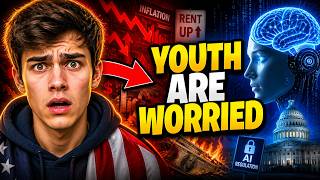
TJ Walker examines why 81% of young adults think the economy is terrible despite low inflation and unemployment, then discusses AI regulation risks and the push to replace the Electoral College with a national popular vote through the National Popular Vote Interstate Compact.
Chapters
Ultimize. You ever notice how expectations matter more than reality? Because right now you've got 81% of young Americans say the economy is bad or terrible. This according to reporting from The Hill based on a Generation Lab survey. And here's the weird part. Objectively, the economy they're reacting to wasn't the apocalypse they were sold. Inflation had been coming down and unemployment has been low. The stock market has been booming compared to most of our allies. Inflation here in the United States was actually lower the last handful of years. That's not propaganda. That's just basic math and numbers. But let's talk about what actually happened because this isn't really about the economy. It's about expectations. President Donald Trump spent years telling people, that the economy under Joe Biden was basically the economic version of a burning dumpster floating down a river of gasoline. The worst ever, a disaster, a catastrophe. And then he didn't just say he'd improve things. He said he'd turn back time. He would lower prices, bring them back to where they were years ago. Well, that's not an economic plan. That's a time machine with better polling numbers. So now reality shows up like, hey, things are okay-ish and everybody's furious, or at least young people are. Why? Because expectations were set at Disney World levels. Imagine telling your kids, we're going to Disney World for 5 full days. You go, you drop what, $10,000 or $12,000? You mortgage your future for a mouse. Then you have 3 incredible days, rides, fireworks, churros, the whole deal. And then on day 3, the end of day 3, you say, all right kids, time to go home. Are they grateful? No, they're in the backseat like tiny union organizers. You promised us 5 days. They don't care that none of their friends went at all. They don't care that it was amazing and expensive. All they know is Expectation: 5 days. Reality: 3 days. Conclusion: betrayal. That's the economy right now. Now layer on something else. Young people aren't dumb. They're looking around and doing the math on the system. Roughly 2/3 to 3/4 of federal spending is tied to individuals, goes to old people, old Americans, people like me, frankly. Think Social Security, Medicare, all of that. That's not conspiracy, that's demographics. And then there's the indirect stuff. Mortgage interest deductions, great if you own a home. Thankfully I do. Thankfully I do. It's fantastic. But if you're 25, you're like, I can't even afford a parking space, but I'm glad we're subsidizing someone's 7th bedroom. Older generations, they went to college when tuition was manageable, sometimes practically free. Today, you graduate with debt so big it feels like you financed a small European country. Healthcare expensive, housing insane, wages playing catch-up. And just when you're thinking, all right, I'll grind, I'll work hard, the biggest companies in the world come in like, actually, we're going to let AI do that stuff. That's a tough pitch. Welcome to adulthood. You're in debt, you can't afford a house, and your replacement is software. Of course people feel screwed. That's not irrational. That's a completely logical emotional response. But here's where I'm going to sound like the tough, slightly annoying voice in your head. Young people, if you want to change, you have to vote, not tweet. Not just post a 9-part TikTok series explaining why everything is broken. Not go to a protest where everyone already agrees with you. You have to vote because here's the secret older Americans figured out decades ago: you don't get benefits because politicians love you, you get benefits because politicians are terrified of you. Senior citizens vote, they vote consistently, they vote like it's their part-time job with a pension, and magically they get Social Security protected from things like inflation. Your paycheck doesn't. They get Medicare protected. They get every politician treating them like VIP customers. Young people, historically low turnout every cycle. So politicians look at them and think, huh, why am I prioritizing someone who won't even show up? It's harsh. It's not fair, but it's how the system actually works. You can have a decent economy and still have furious people if you lied about what they were going to get. That's the Disney World problem. Promise 5 days, deliver 3. Even if it's amazing, people will feel cheated. That's what happens when politicians promise to turn back time on prices. Reality can't compete with fantasy, and voters punish you for it. If young people want a bigger share of the pie, the federal government pie, there's one brutally simple step. Vote. Senior citizens didn't get all the benefits by accident. They got them because they showed up every single time. Presidential years, mid-year midterms, off-year elections. You can complain, or you can become the group politicians are afraid to ignore, but you don't get to do just one or the other. So yeah, the frustration's real, the pressures are real, The system is tilted in a lot of ways, but expectations matter, narratives matter, and participation matters even more because in the end, the people who show up decide what the economy even means. Okay, I want to thank so many of you for showing up today. Again, this is Filtered with TJ Walker. I'm your host. I appreciate you being here today. What we do here every day is talk about the top stories of the day, and then we analyze it through the lens of communication skills, personal development skills, and ultimately truth, or at least my version of the truth. I appreciate you being here. Lots more to come. Stay tuned. I'll be honest with you, most people don't have a learning problem. They have a consistency problem. They'll watch something, listen to something, get fired up for a day, and and then life takes over and everything resets. That's exactly the gap I'm trying to fix with Ultimize. So if you're getting something out of this show right now, go to ultimize.com, U-L-T-A-M-I-Z-E, and get a free course. There's one on communication skills, one on building better habits. And the whole idea is to make this part of your daily routine, not a one-time thing. It's simple. It's free and it actually works if you use it. Ultimize.com. According to reporting from The New York Times, the Trump administration is now considering government oversight of AI models before they're released to the public. Now, this is a major reversal after previously taking a hands-off approach. One advisor described the dilemma perfectly, saying the technology is moving so fast that officials don't want to overregulate but also can't ignore the risks. Translation. The people who said don't worry about this are now really worried about this. A few years ago, artificial intelligence felt like a toy. Now even the people who were cheering it on are quietly saying maybe we should check this thing out before we release it. That tells you everything, because this is not just about chatbots anymore. This is about systems that are becoming so powerful they can find weaknesses in other systems faster than any human could. Let me make this real for you. The danger isn't that AI writes your emails. The danger is that it becomes so good at identifying vulnerabilities that it can break into systems we once believed were untouchable— financial systems, energy grids, defense networks— at scale, all at once. Now take that one step further. Imagine a world where a bad actor doesn't need a team of elite hackers anymore. They just need access to the right AI, and that system helps them find ways into critical infrastructure. Or worse, you don't need a movie plot. You just need one breakthrough in capability and one irresponsible release. And once something like that is out in the world, you don't recall it like a defective product. You don't issue a refund. You live with the consequences. That's why whether people like it or not, We need regulation, not because government's perfect, but because the alternative is let's build the most powerful tools in human history and hope nobody uses them badly. Well, that's not a strategy, that's wishful thinking. But here's where this gets dangerous, because needing regulation is one thing. Having the wrong people in charge of that regulation, that could be even worse than no regulation at all. If you look at the governing style of Donald Trump, there's a pattern. Rules aren't applied consistently. They are applied personally. And this is a huge problem. Imagine the government starts looking at the top 5 or 10 AI companies with the most sophisticated technologies. And here's what I would imagine Trump doing? Regulating 9 of the 10, but the most powerful, the richest one, the one that has AI that is so powerful it could do almost anything, that one's going to get a pass because that company's going to be smart, at least for them. And they'll say to Trump, hey, we're going to give $1 billion worth of stock to your teenage son, Barron. And we're going to make him vice chairman of the board. How about just leaving us off the regulation list? Is there anyone in the world at this point who doubts what Trump would do? He would do the absolute worst thing. And then you have a situation where, uh, maybe North Korea gets their hands— because it's released to the whole world, this AI technology. And they can somehow take control over Russia's nuclear arsenal and have Russia's nuclear arsenal destroy Iran or Ukraine, or hey, maybe the United States. So that's the real risk here, and that's the risk, frankly, United States voters took when they elected someone as irresponsible as our current Dear leader, it's scary times. Yes, we do need regulation of AI. We need responsible regulation. At this point, I have— I won't say I have zero faith in this administration doing the right thing, but I'm putting it at about 1%. Here's something I've learned after years of doing this: the people who actually improve don't necessarily hear better advice. They just stay around it longer. They keep exposing themselves to the same useful ideas until it finally clicks. Most people don't do that. So if you want to be in the small group that actually follows through, go to ultimize.com, that's ultimize.com, and get the free course. There's one on communication, one on building better habits, nothing fancy, just something you can keep coming back to If you're already there, you're doing the hard part. Just go to ultimize.com and build on it. Hi and welcome back. I'm TJ Walker. This is Filtered. Thanks so much for joining me today. Slight technical blunder. I'll be right back with you. One more brief commercial where we typically only have 2 ads in the entire show. Going to make a slight deviation today. Back in a moment. Okay, so who am I? Who is this TJ character? Why are you listening to me or watching me? I spent 40 years coaching executives, people just like you, but also presidents of countries, prime ministers, Nobel Peace Prize winners on how to have better communication skills and personal development habits. And now you can get the same training. But here's the catch. There is no catch. You can get a free course today. All you have to do is go to ultimize.com. That's U-L-T-A-M-I-Z-E.com. M-i-z-e.com, and you can download your free online communication skills course or your free good habits building course. Go ahead and do that right now, or at least right after the show. Okay, we are back. Thank you so much for joining me today. I'm TJ Walker. This is Filtered. We're going to delve into our third and final issue of the day: reform of the Electoral College. I realize that might not excite you that much, but it's an important issue. Here's why. Imagine you go to your kid's Little League game. Your kid's team scores 6 runs. The other team scores 4 runs. Game over, right? Wrong, because the umpire walks out and says, well, technically the other team wins because they scored their runs in more important innings. You'd lose your mind. You'd be screaming, this is not how scoring works. The number is the number. And the umpire would say, yeah, but this is how we've always done it. That essentially is the Electoral College when it comes to the United States and how we elect presidents. Now, I want to give credit where credit's due. The whole conversation was sparked by a really detailed piece in Vox, vox.com. I'd urge you to check it out, by reporter Ian Millhiser this week, who laid out just how close this system actually is to being passed, where we get rid of the electoral college. And when you see the numbers, it's kind of shocking. There's this thing called the National Popular Vote Interstate Compact. Sounds complicated, it's not. A bunch of states basically said, hey, what if we just gave our electoral votes to whoever actually gets the most votes? Radical concept, right? Counting. Right now it's at 222 electoral votes. Now you need 270 votes to become president. That's the majority. So this entire system, this centuries-old structure, comes down to just a handful of states. Let's name them: Pennsylvania, Michigan, Arizona, Wisconsin. Those four states basically decide whether we finally adopt the radical modern idea of counting votes equally. Now let's talk about why this system even exists, because if you don't understand that, none of this makes sense. Our system was designed in the late 1700s when information moved at the speed of a horse, when most people didn't vote— they couldn't— when elites didn't fully trust direct democracy. And yeah, there were political compromises, bad ones tied to slavery, and representation that shaped how power was distributed. So this wasn't some perfect sacred design. It was a workaround, a patch, uh, this is the best we can do right now system. But here's the problem: we never updated it. Today we have instant communication, national campaigns, universal suffrage, in theory at least, and yet we're still using a system designed for a world where voters might not even know who they were voting for. And here's where it gets crazy in modern America: you can have more people vote for Candidate A, Candidate B becomes president. That's not fraud, that's not a glitch, that is the system doing exactly it was designed to do. And even Donald Trump, even Donald Trump, before benefiting from this system said way back in 2016 that if he won the popular vote but lost the Electoral College, he wouldn't accept it. He talked about people taking to the streets if he in fact won the popular vote and lost the Electoral College, which tells you something important. Even the people who benefit from this system instinctively know it doesn't feel right. Because no other democracy, no other modern democracy does this. Not one. There's no country where they say, yeah, we counted all the votes, but we're going with the other guy. That's uniquely American. And it gets worse. The Electoral College doesn't just distort outcomes, it distorts behavior. It turns elections into a weird game where only a few states matter. Campaigns ignore most of the country. Millions of people know their vote doesn't really count. If you live in a solidly red or blue state, a solidly Republican or Democratic state, you're not really a voter, you're scenery. Which brings us back to those four states: Pennsylvania, Michigan, Arizona, and Wisconsin. They're not just swing states anymore, they're potential system-changing states. Let me simplify this as clearly as possible. If more people vote for you, you should win. That's not left wing. That's not right wing. That's math. And if your system can't handle basic math, it's not a system. It's a loophole. Now, people will say, well, we've always done it this way. Yeah. We also used to let state legislatures pick US senators, redistrict who could vote. Legislatures could do that. Design systems around elite control. We changed those things. Because they stopped making sense for the most part. Yeah, they're still redistricting. Keeping the Electoral College today is like insisting we still need a fax machine to send an email. It made sense once, it doesn't anymore, and the only reason it survives is because some people benefit from that glitch. Here's the simple truth: a system where the loser can win is eventually a system people stop believing in. And once people stop believing in the system, that's when you get real instability. So this isn't just about politics, it's about legitimacy. It's about whether people believe their vote actually matters. And right now, for millions of Americans, it doesn't. Again, to clarify, if just 4 states that do kind of go back and forth from Democratic to Republican, if at some point they get enough Democratic voters— because let's face it, Republicans realize that the current system benefits them— but if those 4 states I mentioned can actually get enough Democrats to change their state constitution, then this system becomes more fixed. It'd be very hard— the theory goes it'd be very hard to change the Constitution of the states back to say that votes shouldn't count. That's the real concept here. So again, just these 4 states could say, all right, our electoral votes are going to count for whoever wins the popular vote nationwide. That completely changes the dynamic. That gets rid of all this nonsense of swing states, and it would force politicians and campaigns to actually talk to all Americans, not just a handful of idiosyncratic people in a handful of states. And that's why I'm very much in favor of it. It's frankly why Donald Trump was in favor of this back in 2016. So it's not really a Democrat-Republican type thing. It is sort of an elitist/non-elitist thing. If you feel like, okay, I have a message that isn't going to appeal to most Americans, but I want to hold power anyway, then you want to keep the status quo. Jules writes in and says, "Ho'ei, TJ Walker, I'm listening. So much great information. Electoral college reckoning well explained. A system where the loser can win. It is strange." Jules, thanks so much for watching. And I want to thank so many of our TikTok friends for joining us today as well. I'm going to sign off to our folks watching on YouTube and all the streaming platforms. I'll see you again tomorrow. Thanks so much.
More from TJ





The Breakout Cases - What Actually Caused Famous Speaking Career Breakthroughs | Ultamize

The Red Circle Sessions Finale - Build the Speaking Career You Came Here For | Ultamize

Two Stages, One Logo, Two Completely Different Realities - Main Stage vs Independent Events | Ult...

Pre-Reset - Why Repetition Builds Better Speaking Decisions | The Red Circle Sessions | Ultamize

Your Decision, Your Framework, and What Happens After - Build Your Speaking Career First | Ultamize

The Red Circle Sessions Trailer - The Speaking Career Truth Nobody on That Stage Will Tell You | ...

The Two-Minute Ultamize Reset - Your Platform, Your Audience, Your Voice | The Red Circle Sessions