Your Preparation Is Making You Afraid to Speak!
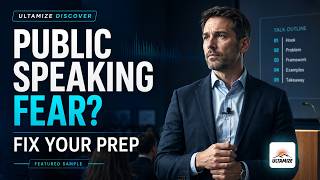
TJ Walker argues that speaking anxiety stems from uncertainty, not nerves, and that traditional relaxation advice masks the real problem. His system uses video practice, a three-part speech structure, and quick micro-exercises to build concrete evidence you can deliver, which kills the fear at its source.
Chapters
Ultimize. Most advice about fear or nervousness about public speaking starts with your feelings. Relax, breathe, visualize success. But let me ask you something. If you are terrified about walking naked through Times Square, would you want a therapist telling you to feel calm, or would you rather have clothes? Because the real problem wouldn't be anxiety, The real problem would be that you're not prepared, you're not dressed. Public speaking works the same way. Most people fear speaking because of two very simple uncertainties. First, they don't know how they actually come across when they speak. Second, they're afraid they might be boring, awkward, or embarrassing in front of others. This podcast is built around a simple idea. Fear disappears when uncertainty disappears. And today, removing that uncertainty is easier than ever. All you need is something you already carry in your pocket— a camera, your phone. In this short limited series podcast, I'll show you the simple method professionals use to eliminate speaking fear: practicing on video, watching yourself improve, and gathering real feedback. No therapy, not that there's anything wrong with that, you can get that elsewhere. No breathing exercises, just practical preparation that builds confidence logically. This entire series is designed to be binged in one setting. In about 90 minutes, you'll learn a simple system to prepare for speeches, presentations, and talks with real confidence. And the final episode is a short 3-minute reset you can listen to every time before you have to speak or present. It's your own personal confidence insurance policy. So if you've ever been afraid of public speaking, or if you simply want to present your ideas more clearly and confidently, this podcast is for you. You're now entering Fear of Public Speaking: A Practical Cure Powered by Ultimize, the world's largest personal development podcasting network. I'm your host, TJ Walker. Let's get started. Why most public speaking advice fails. Okay, let me tell you a big secret right up front. This is the same approach I've used with presidents of countries, prime ministers, Nobel Peace Prize winners, CEOs, and leaders all over the world. For more than 40 years, I've trained people at the very highest level who had one thing in common: they were afraid of public speaking. They were nervous. Some were terrified. Some were scared about doing interviews. Some were uncomfortable speaking in front of large audiences. But the training I gave them always came down to something extremely simple. In fact, when you hear it, it might sound a little silly, but by the end of this podcast, it will make perfect sense. Here it is. The number one way to get over your fear of public speaking is to practice speaking on video and watch it until you like your own style and substance. That's it. Now, sometimes I might work with someone 8 hours a day for a week or 2 weeks preparing them for a major speech or media interview, but at the core of all of that training, is the same simple process. We record them speaking. We watch the video. We figure out what we like, what we don't like. We improve something. Then we record again. We repeat the process until they like what they see, every aspect of it. Now, when people first hear this, they sometimes think, "Sounds intimidating. Oh, I'm not going to watch myself." But it's actually easier today than at any time in history because everyone listening to this podcast or watching it already has the tool needed to do it: your phone. Over the course of this series, I'm going to show you exactly how to use that simple tool to dramatically reduce or even eliminate the fear of public speaking, because the real cause of speaking fear is usually very simple. It's uncertainty. Uncertainty about how you come across. Uncertainty about whether your message will work. Uncertainty about whether people will find you interesting or really boring. But when you practice speaking on video and watch yourself improve, that uncertainty begins to disappear. You see exactly how you look. You hear exactly how you sound. You refine your message, you improve your delivery, and eventually you reach a point where you actually like what you see. And once that happens, something powerful changes. If you know in advance that your audience will see someone who looks comfortable and confident, and if you know in advance that your message is clear and useful, it becomes very difficult to truly be nervous. Let me give you a simple example. Imagine you have 3 close friends from high school. Every time the 4 of you go out for dinner together, the evening is the same. Everyone's laughing, the conversation flows easily, the stories get better as the night goes on. All of you have a great time. If someone invites you to dinner again with those same 3 friends, do you feel nervous? Typically not. You already know how the evening will go. You already know the conversation will be good. You already know you communicate well with those people. There's no uncertainty. Public speaking can work the same way. When you know your talk works, when you know your message is clear, when you've seen yourself deliver it well, the speaking situation becomes far less intimidating because you already know the performance works. Now, before we go any further, let me quickly introduce the show. You're now entering Fear of Public Speaking: A Practical Cure, powered by Ultimize, the world's largest personal development podcasting network. I'm your host, TJ Walker. Now, let's get back to the central idea of this podcast. Most traditional public speaking advice focuses on your emotions. You hear things like, "Take deep breaths," Relax, visualize success, picture the audience in their underwear— terrible advice, by the way. Some of that advice might make you feel slightly calmer for a few minutes, but it doesn't actually remove the real cause of speaking fear or nervousness about speaking, because if you're still uncertain about how you come across, the anxiety will return. Let me give you another quick example. Imagine you had to send your resume to your dream employer in exactly 1 hour. The job's perfect for you, but you're nervous about sending the resume. In that situation, what would you prefer? Would you want someone helping you meditate? Would you want someone telling you to relax and visualize success? Or would you rather open the resume and make it better? Most people would choose the practical option. You want to run spell check. You want to fix the grammar. You might ask a smart friend to look at it to give you feedback. You would improve the document, and as the resume improves, your anxiety would naturally decrease, not because someone hypnotized you, but because you now have evidence. You're looking at the document. Now the document is strong. Public speaking works exactly the same way. Confidence grows from Evidence. Evidence that your message works. Evidence that your delivery works. Evidence that you communicate clearly. And video practice gives you that evidence. When you watch yourself speaking, you immediately learn things. You might discover that your voice sounds stronger than you expected after you've listened to it a bunch of times. You're not going to like it at first. You might notice you speak a little too quickly. You might realize one explanation needs to be clearer. All of that information is incredibly valuable because once you see it, you can improve it, and every improvement reduces uncertainty. Over the next several episodes in this podcast, I'm going to show you how to use this simple process to prepare speeches, presentations, talks, briefings with much more confidence. You'll learn how to structure your ideas, how to practice effectively, how to test your message, and how to improve your delivery. But before we finish this episode, I want you to take one small step. Take out your phone right now. Record yourself speaking for 2 minutes about any topic you know well. It might be something you do at work, hobby you enjoy, or an idea you care about. Just speak naturally. Then watch the video. Don't judge yourself too harshly. Just observe. What do you like? What would you improve? Then try it again. That simple exercise is the beginning of a system that has helped leaders all over the world become more confident communicators. In the next episode, we're going to explore one of the biggest mistakes people make when preparing speeches. They treat speeches like written documents instead of spoken performances, and fixing that mistake can dramatically reduce speaking anxiety. One reason many people fear public speaking is that they believe they must remember a long, complicated speech. They imagine standing in front of an audience trying to recall dozens of sentences in exactly the right order. That would make anyone nervous. But here's the good news: great presentations rarely require long scripts. In fact, the best presentations are usually built around a very simple structure: a clear beginning, a few key ideas—3, 4, 5 ideas at most—and a strong ending. Let's start with the beginning. When you start speaking, the audience is trying to answer one basic question: Why should I listen to this versus scrolling my cell phone. That's what they're thinking. If the beginning is confusing or slow, the audience quickly loses interest. But if the beginning clearly explains what they'll gain from listening, people will become curious. A simple way to do this is to start with a problem your audience understands. For example, many people fear public speaking because they don't know how they come across when they talk. Immediately the audience recognizes the issue. They think, "Yeah, that's exactly the problem." Another approach is to start with an example or image. Earlier in this podcast, we talked about walking naked through Times Square. That image grabs attention instantly. It creates curiosity, and curiosity makes people listen. Once the audience understands the problem, the middle of your presentation becomes much easier. This is where you share your key ideas, and here is where many speakers make another mistake. They get greedy. They try to include too many ideas. When speakers overload their presentation with information, two things happen: the audience becomes overwhelmed and the speaker becomes anxious because now there's too much to remember. Instead, try something much simpler. Limit yourself to just 3, 4, 5 points. These ideas that support your message, that's what you want to focus on. Just a handful of ideas, things the audience should remember after you finish speaking. 3, 4, 5 ideas at most. It's powerful because it's easy for both the speaker and the audience. Think about how often this pattern appears in everyday communication. Quite often people focus on just 3 goals or 3 lessons or 3 steps or 3 recommendations. When you organize your speech around just a few points, the structure becomes easy to remember. And when the structure is easy to remember, the speaker feels more relaxed. Now let's talk about the ending. Many presentations fade out awkwardly. Uh, that's it, any questions? And they walk off. You don't want to be like that. The speaker reaches the final slide and simply stops talking or says, "That's it." A strong ending is much better. A good ending reminds the audience of the key messages, and it reinforces the main idea one more time, and it leaves the audience with something clear to remember. In this podcast, for example, the central message appears again and again: fear of public speaking usually comes from uncertainty. And uncertainty disappears when you practice speaking on video and watch yourself improve. Repeating that message at the end makes the idea stick. Now, here is something important. When you prepare a speech using this simple structure: clear opening, 3, 4, 5 ideas at most, strong closing, you don't need to memorize every sentence. You only need to remember the structure. The opening. What's your first point? What's a story or an example for that? What's your second point? Story and example for that. What's your third point? Story and example for that. And if you have one or two more, fine. Then closing. And because you practice the speech several times on video, the words begin to feel natural. Each repetition makes the delivery smoother. The structure acts like a map. Even if you change a few words, you always know where you're going. That reduces anxiety dramatically because the fear of forgetting something becomes much smaller. You always know the next idea. Let's quickly imagine how this structure might work in a real presentation. Suppose you need to speak to your team about improving customer service. Your opening might describe a problem customers actually experience. Then your 3 points might be: first, respond to customers quickly. Give an example of when that's done the right way and the wrong way. Second, communicate clearly. Give an example. Tell a story of when that worked out well and when it didn't work out well. Third, follow up to make sure the problem was solved. Again, example, example, example. Tell stories. Based on real-life experiences you've had or colleagues have had. Finally, your ending reminds the audience that these 3 habits can dramatically improve the customer experience. Notice something important: the entire presentation can be delivered without memorizing a long script. You can do what I do—just put everything on a simple half-sheet of paper, large bullet points you glance down occasionally. Now combine this structure with the video practice we discussed earlier. Record yourself explaining the opening, watch it, improve it, record again. Then practice explaining your points, watch it, improve it, repeat. Finally, practice the ending. Within a short time, the entire presentation begins to feel comfortable, not because you've memorized every word. I never memorize anything. You don't need to. You want it to sound Conversational. Remember the core ideas. Focus on the ideas, but don't try to memorize everything word for word. It's going to come across much better because you understand the structure and you've already practiced the performance. Once again, preparation replaces uncertainty, and when uncertainty disappears, fear shrinks. Before we finish this episode, I want you to try another quick exercise. Think about a short presentation you might give in the future. It could be something at work, a class discussion, a meeting, or even explaining an idea to a group of friends. Now outline that presentation using this simple structure: opening, 3, 4, 5 points at most, your closing. Don't worry about writing perfect sentences, just the actual point, 2 or 3 words, another few words to remind you of the story to tell. And the example. Just capture the ideas. Then record yourself explaining it for 2 or 3 minutes. Watch the video. Notice what works. Notice what you would change. Then try it again. Every repetition will make the presentation stronger. In the next episode, we're going to talk about something extremely useful for speakers: how to get feedback from others in a way that helps you improve quickly. And builds real confidence before you ever step in front of a live audience. By the way, quick question for you. Have you ever noticed how easy it is to consume content and how hard it is to actually do anything with it? I mean, you can listen to 100 episodes, read 10 books, and your habits are exactly the same. That's the gap most people never close. So if you're listening to this and thinking, yeah, I want to actually improve Go to ultimize.com. We've got free courses there for you, either on communication skills or building better habits, and it's designed to get you to actually use what you're learning, not just hear it once. No cost, no catch. Just go to ultimize.com and start. Ultimize.
More from TJ





The Breakout Cases - What Actually Caused Famous Speaking Career Breakthroughs | Ultamize

The Red Circle Sessions Finale - Build the Speaking Career You Came Here For | Ultamize

Two Stages, One Logo, Two Completely Different Realities - Main Stage vs Independent Events | Ult...

Pre-Reset - Why Repetition Builds Better Speaking Decisions | The Red Circle Sessions | Ultamize

Your Decision, Your Framework, and What Happens After - Build Your Speaking Career First | Ultamize

The Red Circle Sessions Trailer - The Speaking Career Truth Nobody on That Stage Will Tell You | ...

The Two-Minute Ultamize Reset - Your Platform, Your Audience, Your Voice | The Red Circle Sessions