YouTube Becomes Biggest Media Company | Wall Street “Finance Bros” Backlash
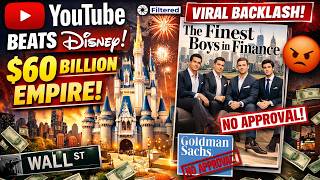
YouTube generated $62 billion in 2025 revenue, surpassing Disney to become the world's largest media company. TJ Walker breaks down how the platform's ad and subscription models have reshaped entertainment, requiring creators to treat skill-building as a lifelong apprenticeship. He also covers a Wall Street backlash after Interview magazine's "Finest Boys in Finance" spread, and mixed messaging from Trump and Defense Secretary Hegseth on military conflicts.
Chapters
Ultimize. YouTube quietly surpasses Disney to become the largest media company in the world. A flashy magazine feature called "The Finest Boys in Finance" turns 4 young Wall Street professionals into social media punchlines. A Tennessee congressman sparks outrage after declaring that Muslims, quote, "don't belong" in American society. Mixed messages from the Trump administration about war. The president says the conflict is very complete while his defense secretary warns, quote, it's only beginning. And finally, new polling shows most Americans oppose the Iran war, something rarely seen at the start of a war. All that and more today on Filtered. Welcome to Filtered with TJ Walker. Hi, and thanks for joining me. Let's dive in. YouTube becomes the largest media company, a major milestone in the media world. YouTube has officially become the largest media company on the planet. According to research firm Moffett Nathanson, the Google-owned platform generated about $62 billion in revenue in 2025, edging past the traditional media business of Disney. This reflects a huge transformation in how entertainment works. Instead of relying primarily on television networks and movie studios, audiences increasingly watch video online—well, stuff like this—often created by independent creators like me. Advertising remains a major driver of YouTube's revenue, bringing in more than $40 billion a year, but the platform is also expanding its subscription business. Through services like YouTube Premium, YouTube Music, and YouTube TV. The company says it has now paid out more than $100 billion to creators, music companies, and media partners, and people like me, although I didn't get that much of it. For Hollywood and traditional broadcasters, it's a powerful reminder that the center of media has shifted from studios and networks to global digital platforms. Okay, this isn't a huge shock. Those of you who watch this regularly know that I often talk about milestones that, that YouTube has reached and how the whole world of entertainment media continues to evolve. It wasn't that long ago where the people at Netflix kind of referred to YouTube as the farm team, the training ground, the minor leagues. They're not doing that anymore. They're much more humble about it. I still don't think most of Hollywood understands what's really going on. And the, the Ellison-Nepo baby that has unlimited billions of dollars to buy old-school media companies and movie studios, I think, you know, 5 or 10 years from now, he's going to be a billionaire. Um, but let's not forget, he can be a billionaire and still lose about 50 or $80 billion, which I think is what is going to happen there. Let's look at some more of the facts regarding YouTube. They did pass $62 billion in revenue in 2025. This surpasses Disney media revenue of $60.9 billion. Now Disney's been around for 100 years. I think of Disney, I think of Disney World and Disneyland and Mickey Mouse and these iconic iconic media features and intellectual property. Goofy, Minnie Mouse, you name it, they have it all. And now YouTube is bigger, at least in terms of revenue, but arguably in cultural significance too. YouTube is currently valued at between half a billion dollars— excuse me, half a trillion dollars. And $560 billion. Now it's hard to tell exactly because they are owned, they're completely owned by Google. I almost said YouTube, by Google. So they're not a standalone company, but if they were, they'd be worth almost half a trillion dollars. The Netflix market cap is at about $409 billion. So Yes, they do appear in sort of every significant way to be larger than Netflix. The fourth quarter ad revenue hit $11.4 billion. Annual ad revenue exceeds $40 billion. And again, they have other sources of revenue, subscription, ad-free versions, things like that. They have paid a significant amount of money to creators. Now before you say, TJ, you're making it sound easy, it's get rich quick. No, it's not get rich quick. When you look at most people who make money on YouTube, quite often they did a 5-year apprenticeship without making any money. And that's basically what MrBeast did. So let's not overglamorize this. 90— it's something like 97% of all people, all creators across all social media platforms make peanuts. I mean, maybe a few thousand dollars or less. So it's still heavily, heavily skewed towards the most successful creators. Nothing's really changing that, but the ones that are successful are becoming really successful. The other trend I think we're going to continue to see is people leaving traditional media, especially if they already have some fame or notoriety. You look at how Trevor Noah went from hosting a daily show, having a full-time job, having to show up every day hosting The Daily Show, to being able to travel the world, do gigs wherever he wants, do his podcast basically when he feels like it, and he's making tons more money, tens of millions of dollars more hosting podcasts. I think that is the model we're going to see increasingly. So, Someone like a Stephen Colbert is going to do better than ever in this new world. The problem, of course, is people who want some kind of a traditional route of you get out of college, you go to work in a small TV market for barely enough to live and survive, and you work your way up bigger markets, then to a network and on. That career trajectory, I think, is going to be gone. And the people who just want to go be a production assistant at a big TV network, that's going to be gone. I think the new career path is you need to decide what's something you're willing to work on for the next 5 years without making a penny. I think we're going to have to go back to looking at this as an apprenticeship route, something that was common, you know, hundreds and hundreds of years ago. And it's still common in certain companies, or certain, excuse me, in certain countries. So that's the route. Now, I think the easiest time to do that is when you're in high school and college and no one's expecting you to make a living, but you could be 50 years old and decide you have a passion for blacksmithing and making video content about making horseshoes. And you're perfectly fine not making any money on that for the next 5 years. And you're just producing new videos every day, for 5 years, or maybe one fantastic high-quality video a week for 5 years, and only then will you make money or even expect to make money. I think we're going to see more and more of that. Neal Mohan, the CEO of YouTube, said this: There are two really fundamental things we do for creators— help them build an audience and help them build businesses. Yes, it is true Again, for maybe 1% of the people actually build a business. Now, anyone can get an audience. Your audience might be 3 people watching your video, but that's better than just sitting at home and yelling out the window. So it does help create audiences. Michael Nathanson, one of the analysts, said, we strongly believe that YouTube will be the beneficiary of both the structural tailwinds and headwinds facing technology and media companies. That's a polite way of saying traditional Hollywood is going down the tubes. Everything is too expensive, it's too bureaucratic. This idea that you can't make a movie without spending tens of millions of dollars and having every kind of grip and unionized labor. And folks, I'm not anti-union, but it's just not working in the world of media anymore. Sorry, it's just not. So what he's saying is essentially the old media companies with their high cost structure are going to be out of business. You used to be able to justify high cost because there was such limitation in distribution. Yeah, you could spend $100 million making a movie if you could distribute it to 2,000 screens, and nobody else had any option for watching new entertainment. That's what life was like when I was a kid. That's what life was like when I was a young man. You wanted new entertainment, you had to wait until a new movie came out. Otherwise, you're watching reruns on network TV. There was no internet, there was no TikTok, no, there was no Facebook video. All that world has changed, and unfortunately Many of the funders of Hollywood productions, the buyers of these companies, the people who like to go to the Oscars and feel important are still living in the world that I grew up in. They're my age or older. And I don't think they've come to grips with the fact that there's simply a new reality. And I don't think we're that far away from YouTube just destroying and putting out of business all of Los Angeles and all of Hollywood. Maybe there are a few, a few remnants left, but not much. Okay, what a way to make this. What's the implication for you and your career? You gotta read the room. You gotta see what's going on in your industry. And you have to adapt. You can't just cling to the past. You can't say, technology, stop. I want to go back to the way things were. I certainly know a lot of people in my own industry of presentation skills training and media training saying, ah, you know, these ebooks, who wants to mess with that? Online training, why would I do that and sell that for $100 if I can get people to pay $5,000 for a day of my time? And after the pandemic, most of them were unemployed or retired because they didn't adapt to new technology. Now, I'll be the first to confess, I'm not really particularly skilled at technology. I never learned how to code. I never even saw a computer when I was in college, much less took a computer science programming course. But when I needed to, out of fear, I have forced myself to learn new technology. Way back in the 1990s, this is before podcasting, I was approached by an internet— they called it internet radio— and I took apart my computer and had to install a second soundboard so one of them could dial AOL with the old sound, and the other one could call somebody on a regular phone and I could interview them. I had my entire computer taken apart on my studio apartment floor for a week, but I figured it out, not because I'm a tech genius, but because I just told myself, I've got to do this or I could become irrelevant. And that, unfortunately, I think is the attitude you're going to have to have, and everyone's going to have to have if they want to survive. Because the old world isn't coming back. It just isn't. So, you've got to learn technology. You have to constantly recreate your career. And you've got to devote yourself to lifelong learning. That's one of the reasons why I do a show like this is it forces me to learn about a lot of different issues. Every single day and to show up prepared for you. I think that's what it takes for building a career. If you're interested in enhancing your own career, I do have online courses on how to build a successful career and a lot of other personal development courses. So if you're interested, you can get a free course of mine on good habits building, which can help your career, just by going to ultimizeyourcareer.com. Tjwalker.com and you can sign up for a free online personal development habits building course or communication skills course. There's lots more to come. Stay tuned.
We'll be right back after this break. Want to advertise here?
You better be legit. No crypto, no junk food, no supplements. Go to tjwalker.com/advertise.
Most people can't afford a full-time coach, and even if you could, good luck finding one who's available when you need them. That's why I created the TJ Walker AI Clone. It's built on my 40+ years of real-world coaching and training. You get my exact advice, style, and frameworks instantly. Ask it how to handle a tough question, get feedback on your elevator pitch, rehearse your next big talk. This is the next generation of communication coaching. It's smarter than an app. More personal than a course and always ready. Start using it today at tjwalker.ai.
You'll wonder how you ever did without it.
Want to advertise to ambitious upscale professionals who actually care about communication success and results? Go to tjwalker.com/advertise. And no, we don't take ads for crypto, supplements, or junk If you've ever struggled with nerves, unclear messaging, or just not being taken seriously, this is for you. I created the TJ Walker Success Library as a crash course in professional-level communication. You get 5 downloadable books for just $9.95 that walk you through public speaking, media training, persuasion, effective communication, confidence building, and daily practice routines. This is the same training I've delivered to presidents, CEOs, and leaders in 45 nations, boiled down and instantly accessible. Go to tjwalker.com/books and download them now.
Wall Street fashion spread sparks backlash. A glossy magazine spread featuring 4 young Wall Street professionals has triggered a fierce online backlash. The magazine Interview published a feature called "Meet the Finest Boys in Finance." It profiled 3 junior bankers and an AI analyst, all between the ages of 23 and 25, posing in luxury brands like Rolex, Hermès, and Loro Piana. Full disclosure, I've worked with Loro Piana before in media training. The men discussed nightlife, workouts, dating spots, and spending habits around Manhattan. One casually admitted spending $3,000 on a Moncler jacket he didn't need. Social media quickly pounced, mocking the group as flashy and out of touch. The controversy grew large enough that Goldman Sachs released a statement saying its communications team did not approve the interviews. The episode highlights an unwritten rule in high finance: junior bankers are expected to stay discreet and avoid publicity. In an industry that values discretion and hierarchy, becoming a viral internet character is usually the last thing a young banker wants. Now, this is a story that pops up every 10 years or so, and there's always some new generation that doesn't quite get it. Now, look, I'll be honest. My general advice to people anytime, anywhere is speak to the media. It could open up new doors. It could get attention to your product, your service, new job opportunities, sell your books, whatever. In general, I favor speaking to the media. However, there's a big but. If you're a junior person and you work for a large corporation, especially in a staid and conservative industry like finance, you're best to keep your mouth shut because it is so easy to irritate people. This is how people lose jobs. Famously, and I remember it at the time, one of the most renowned finance media experts in the world, Jim Cramer, host of CNBC's Mad Money, was fired from Goldman Sachs for being quoted in a story in 1987. So, it happens every 10 or 15 years like clockwork. Someone who is a young master of the universe gets asked to pose for some pictures, answer some questions by a reporter, and they end up not necessarily saying anything stupid, but it just enrages everyone else in their corporation, makes people worried that the poor folk are gonna come with pitchforks and come after the rich oligarchs who run big banks. And predictably, they're either taken to the woodshed or they're fired. Now, I don't have enough information about these people, or if one of them even works at Goldman Sachs. The fact that Goldman Sachs is saying, "We didn't approve these interviews," sure makes it sound like at least some of the people featured in this interview magazine worked for Goldman. If they haven't cleared out their desk by now, they best be dusting off their resumes. So the fashion shoot happened at Delmonico's in New York. Here's the thing, when you work for a big bank, they're very, very structured. They're very regulated. They all have big corporate communications departments. They don't want you talking to the media. Somewhere your first day of work, you signed something if you worked at many of these big banks, and you'll never, ever, ever speak to anyone in the media without pre-approval from your communications department. So they probably already have grounds for being canned. So here's what Hank Medina, a former financial analyst, said, "It seemed a little excessive, very flashy. The fact that it was finance bros just made it more cringeworthy." It's one thing if you're a fashion model for GQ and nobody knows you through anything other than being a fashion model. But if you're in finance and you're doing this, it just makes people go, "Ugh." This is weird. I've seen this, as I mentioned, many, many times. So what do you do if you are approached by a reporter and you don't want to be quoted, and you don't even want to be quoted saying no comment? Because here's the problem many people make. They say no comment, no comment, and then that's the story. They're quoted saying no comment. What I recommend, what I teach in my online and in-person media training course, is you tell the reporter, "I would love to speak to you if you could first just speak to our head of corporate communications, Ann Smith," or whatever her name is, "and I'd be happy to connect you with her now." That way you don't look defensive, whether it's a good story or a bad story. That way you don't look like you are hostile to the reporter, and the reporter can't use that. They can't quote that you were cooperative and helpful. And then of course, if they actually take the time to call the director of communications, they're going to say, are you crazy? We're not going to let you talk to this, you know, 23-year-old TJ Snot. No way. Then it's not your problem. You've covered your, you know what. So why is it that banks want to do that? Part of it is just they fear legal repercussions, that you could say something that would be against the regulatory environment and be patently against the law. You could be spreading insider information. They don't want that. Part of it is they don't want their clients offended because banks really stress discretion with their clients. So They want their clients to understand there's a culture in our institution of we're very discreet. We're not talking on the record to the media, and we're not even talking on background to the media. That's a part of what financial institutions are trying to reinforce. So that's really my advice to you. And it's not just for young people. You could be 58 years old If you are not explicitly authorized to speak to the media and you work for a bank, an insurance company, a large financial services company, a hedge fund, you better be careful. Now, you could say, "Well, TJ, I'm a balloonist in my off hours and they're doing a story about me being a balloonist and I'm not wearing the banker's insignia or logo." Okay, just make sure they don't identify you by the place where you work. If you want to have something generic like, and TJ works in the financial services arena when he's not out ballooning, something like that, you're probably okay. All right, so what's the real message here? Be careful with the media. I don't want you to treat them as an enemy. That's not going to help you. But at certain stages of your career, when you work for a much larger organization, don't speak to them without pre-approval from your communications office. If you want to know more about how the media world works, then I do have an online media training course for you and also in-person workshops. That's why people often Call me and hire me to do in-person media training workshops and seminars, whether you're a finance person or running for the president of a country. You can find out more by going to ultimize.com. More in just a moment. Hey, if you're enjoying this kind of take and want to hear more stories filtered through the lens of communication, make sure you're following the show whether you're watching or listening.
New episodes drop every single day. And if there's a little notification option where you are now, go ahead and turn it on.
It helps you stay in the loop. Congressman faces backlash over anti-Muslim remark. A Republican congressman from Tennessee is facing widespread criticism after posting an inflammatory message about Muslims online. Representative Andy Ogles wrote on social media that, quote, Muslims don't belong in American society. He followed the statement with another post claiming pluralism is a lie. The remarks triggered immediate condemnation from Democrats and civil rights organizations. House Minority Leader Hakeem Jeffries called the comment disgusting and said rhetoric like that has no place in Congress. Even one prominent Republican ally of President Trump, diplomat Richard Grenell criticized the message and warned against attacks on the First Amendment. That's the one before the Second Amendment that says there will be no establishment of religion in America. Ogles did not retract the statement and continued defending his position online. The controversy comes as anti-Muslim rhetoric has periodically surfaced in American politics since the September 11th attacks back in 2001. Advocacy groups note that roughly 3.5 million Muslims live in the United States, working as doctors, entrepreneurs, soldiers, and first responders across the country. Okay, so in the past, most people, by the time they get elected to a high office, which the United States Congress is considered a pretty influential position, Even if they think these things, they don't say it out loud. They don't write it publicly. They might tell their friends who belong to the same religion they do this, but it's a bit unusual to publicly write it and defend it and say to the whole world, "Yes, I'm a bigot. If you don't have a religious worldview exactly like mine, you're not an American. Now that is the attitude of certain nations. There are certain nations that are theocracies. They are run by clerics. Iran, where that's the attitude. You better have the same religion as everyone else or you better shut up or leave. And that's typically what we've been against Arguably, that's why the United States was created, to get away from that sort of thuggish theocracy. It always strikes me as comical that the people who beat their chest aloud as talking about this as founded as a Christian nation seemingly know nothing about the founders of our nations. Most of our founders were not overtly Christian in any sense. Many of them were deists, and they had some general sense of maybe there was kind of a sort of a powerful being, we'll call him God, who kind of started things, but now it's all up to humans to run things. That's a pretty accurate assessment of how most, not all, most of our founding fathers, their vision of religion. And then of course there's my favorite, Thomas Paine, who thought that religion was essentially nonsense. He wrote an entire book on it, "The Age of Reason," where he ripped apart line by line showing what he believed was the idiocy, illogic, and nonsense of the Christian Bible. One of our founders, we arguably would not have the United States of America if Thomas Paine had not written Common Sense, which ignited widespread appeal for the revolution. So there you have it. House Minority Leader Hakeem Jeffries called this member of Congress a malignant clown. That seems pretty accurate. Ogles previously urged deporting New York City Mayor Zoran Mondani. I'm sure this plays well in rural Tennessee. I guess the question I have is, and let me pose this question to you because I have friends who are Muslim and voted for the mega Republican Party, Donald Trump. My question to you is, how many members of a party are going to have to tell you you don't belong here before you start voting against members of that party, especially at their highest rungs, who are empowering. You know, I'm not a Muslim. I can say it doesn't affect me, but I'm still affected by it and offended by it because I actually happen to be a conservative who believes in the United States Constitution. I'm a sane, sensible centrist, and I believe in the rule of law, and I believe that the First Amendment, meaning there should be no establishment of religion or religious clauses or requirements for citizenship, I happen to believe that. So in that sense, I'm a conservative. When are you going to stand up to these theocrats? Because there's nothing American about it. And there's nothing conservative about it, and there's certainly nothing traditional about it. I'm TJ Walker. This is Filtered. There's more to come. Like what you heard?
Don't let the algorithm bury us. Subscribe now at substack.com/@tjwalkersuccess. Want direct access to me live? Want to unlock bonus episodes, behind-the-scenes takes, and full access to my premium courses? Then become a member today.
Just go to tjwalker.com/members and choose your preferred platform—YouTube, Patreon, whatever works for you.
This isn't just another subscription. It's a full-access pass to the tools, coaching, and content that can transform your communication and career. TJ Walker tjwalker.com/members. I'll see you inside. Before we dive in, quick question: are your communication skills helping or hurting your career? Fix that in 20 minutes a day. Visit mediatrainingworldwide.com. Real skills, real results.
Trump and Defense Secretary send mixed signals on war. Confusion is growing over the Trump administration's message about the war effort. President Donald Trump recently described the conflict as, quote, very complete, suggesting the military operation has largely achieved its objectives. But Defense Secretary Pete Hegseth offered a sharply different assessment. Speaking about the same conflict, he warned that it's only beginning. Those two statements point in opposite directions. One suggests the war may already be nearing its conclusion. The other signals a longer and potentially expanding conflict ahead. In wartime, presidents often emphasize progress and success to reassure the public and allies. Military leaders, however, frequently stress the challenges that may still lie ahead. When these messages diverge, It can create uncertainty about strategy and long-term goals for allies, financial markets, and the American public. Clear communication about the direction of a conflict is crucial in shaping expectations about how long the fighting may last. So this is bizarre. I've talked about this yesterday. I'll say it again. President Trump, for all his flaws, I have given him praise in the past. For his ability to communicate. When he says, this is what I think is bad, bad, bad, you know it. When he says, this is good and this is what I want to do, you know it. You might not agree with it, but you know it. He is in general a strong communicator. Arguably, it's his number one strength, not by conventional rhetorical oratorical standards, But by his ability to communicate through social media, sound bites, and posts on social media, you know where he stands on a lot of things. So it is a bit odd where it's not just every week things are changing about the war. It's not even every day, it's every hour. So earlier this week he said basically, oh, we're pretty much complete. We're wrapping up here. That's it, folks. And all of a sudden the markets take off. Everyone's breathing a sigh of relief. And then an hour after the market closes, it's, ah, no, not really. We don't really know when this is ever gonna end. And who knows, it could be months. It's whiplash. There's massive, massive confusion. Now, sometimes in government, and full disclosure, I do not work with this administration, but I have worked with political leaders all over the world at very high levels, sometimes with presidents and prime ministers, members of parliament. Sometimes there is a problem with communication because of the complexity of an issue. Sometimes there are warring factions about, well, we should do this, and another group of advisors say we should do this, and the leader hasn't really decided, therefore you can't communicate. Sometimes that's the situation, but by all accounts dribbling out of this administration, that's not what's happening. What's happening is the president himself has no idea what he's trying to do, where we're going with this, what the goals are. You can't have a sense of getting to a destination if you don't know where you're going. If you just get in your car and you drive, you can't really get anywhere if you don't have a destination in mind. You also can't get lost if you don't really care where you go. And that's what concerns many Americans and people around the world who are affected by this, which is pretty much everybody. A lot of Commentators initially said, well, this shouldn't affect the United States. Well, we have oil surpluses, we have energy surpluses, we're no longer energy dependent. And that completely shows ignorance of how world markets are effective. There's one world market. Oil, natural gas, it's a commodity. So if 20% disappears overnight, the demand for oil worldwide market just goes up. And American consumers or American producers of oil aren't going to say, hey, let's give all of our American customers a break. We could charge 20% more, but hey, let's just keep selling it. No, that's not how it works. So Americans had better get ready for higher gas prices and higher oil prices. It's already started. So one of the things that Trump has often been good at is message discipline, where he says one thing and then all of his minions just repeat it again and again and again. But that doesn't really work when the president himself says different things every couple of hours. And then it's easy for the media to say, well, Trump said this this morning, but he said said something else this afternoon, and then his Secretary of Defense half an hour later said what Trump said in the morning, therefore he's contradicting what he said in the afternoon. What's going on? Sorry, friends, that's not the media spreading fake news. That's the media trying to do its job and inform Americans and the world of what is really going on. And to me, the classic Classic example of this mixed messaging, looking at it on the Drudge Report just this morning. I'm gonna pull that up again. Now, you may love the Drudge Report, you may hate it, but it's just classic in that the headlines, Trump war effort very complete, Hank Seth, it's only beginning. I mean, just that contrast of the two headlines. Really says it all, which does lead me to our next story today, uh, is very much related because of this communication issue. So the next issue: most Americans oppose Iran attacks. New polling suggests Americans are unusually skeptical about the US attacks on Iran. Several surveys conducted in the first days after the strike show support ranging from about 27% to roughly 50%, meaning most Americans oppose the action, or remain undecided. That level of support is far lower than what the country historically showed at the start of major conflicts. After the attack on Pearl Harbor in 1941, 97% of Americans supported entering World War II. Following the September 11th attacks, support for the war in Afghanistan reached 92%. Even the Iraq War, which later became deeply unpopular, began with a 76% approval rating. Political scientists say the difference reflects a more polarized country and a public shaped by two decades of Middle East wars. Without the traditional rally-around-the-flag effect, presidents today may find it far harder to build an early public consensus for military action. Okay, I can kind of buy into the idea that for any president today, it's going to be harder to get buy-in from people of an opposing party. It's short of being attacked on US soil, like what happened with Pearl Harbor. It's going to be very difficult to have bipartisan support at high levels for any war. But this is different. This is profoundly different. You have virtually no Democrats support, something like 7% of Democrats, and huge swaths of the Republican Party opposing this. But nearly all people who call themselves independents are saying, this isn't what we voted for, this isn't what we signed up for. President Trump, to his credit, first term, when he was running, said, I'm going to keep America out of wars. And that is one promise arguably he kept in his first term. He ran on that same platform in 2024. And now it seems like every other day he's bombing something, causing some military act, going to war. So it has a lot of his own supporters genuinely confused.. It has a lot of his detractors saying, well, we always thought he was a lunatic and would do crazy stuff. We're surprised he didn't do it earlier. But yeah, this is exactly why we said Donald Trump is unfit to be president, is an utter menace, because he, he just starts things without any thought. He is clueless. He's non-strategic. He just creates chaos. And he expects the rest of the world to clean it up. So that's, that's been the position of Democrats, moderates, centrists, liberals, and progressives for a long time. This seems to be bringing together every single thing that they thought was, was horrific about Trump. Let's look at some more data. Even at Fox, only 50% of Republicans are supporting these attacks. And I haven't seen how they wrote that poll, but as you know, they tend to fiddle with things to make the president look good. Most recently, earlier this week, they edited footage to show him not wearing his hat when dead soldiers from the war that Trump started, their bodies were brought home. It's usually a solemn occasion. Presidents don't wear hats. They certainly don't wear baseball caps at an occasion like this. And Fox showed old footage of him not wearing a hat. They claim it was a mistake. But again, even during the Bush era, which seems like a million years ago but was only a couple of decades ago, 92% supported the Afghanistan War, 76% approved the Iraq War, the Persian Gulf war back under the first George Bush had 82% approval. Now, why is that? In part because President Herbert Walker Bush took the time to go around to the whole world and make the case. Saddam Hussein took over another sovereign nation. He invaded Kuwait. We want the entire world to go in. And stop that in the name of protecting international law and sovereignty. He got approval from other countries all over the world. He got approval from the United States Congress. He sold it to the American people. That's what presidents are supposed to do. Now, I will say that the Libya intervention under Barack Obama's tenure only had a 47% approval. And in that case, it seems like the American public was pretty smart because as bad as Gaddafi was, and he's nobody's dream leader of a nation, the implosion of that country since then, nobody really thinks that was a good idea. So maybe, not always, but maybe the public is onto something when they weigh in. Not always. I mean, When you look at Afghanistan and Iraq, the public now are saying, "Hey, we were wrong. We shouldn't have done these things." There tends to be in the Middle East all sorts of ramifications that weren't obvious when you started. It's fun and easy to beat your chest and say, "Hey, we're going to win. We're going to be greeted as liberators." How many times have we heard that? And 20 years later, You're kind of still there. Now, one thing I guess you could say it's a good thing about Trump in this situation is he's not going to do anything that causes him political pain for the long term, even if he thought it was best for the world. So that's sort of the one saving grace. It's hard to imagine Donald Trump putting American soldiers' boots on the ground in this region of the world. Regardless of whether you think that's a good idea or not, it's just hard to imagine him doing that because he would perceive it as so unpopular. That doesn't mean he can't wreak chaos around the world. It doesn't mean he can't create World War III. So if you have a better sense of why exactly we are in Iran, please let me know. And yes, there are good reasons, but if the reasons change every single day or every single hour, why should Americans trust their political leaders? I understand the regime in Iran has been anti-America for half a century, and it's been ugly. I understand that. I understand they torture their people and have done horrible things.. But what's the goal? They've just installed the former cleric leader with his son. What's the actual goal? Because just throwing— going in with a bunch of bombs doesn't necessarily change things. And if you loved all the problems with refugees flooding Europe and the rest of the world from Syria imploding, you're gonna love Iran. Imploding. This could get messy for absolutely everyone. I'm TJ Walker. This is Filtered. I want to thank you for spending time with me today. This is the show where every day we look at the top stories and then filter them through the lens of personal development and communication skills. So we look at top business, economic, technology, cultural, political stories of the day and filter them through that lens. If you got anything of value out of today and want to perhaps learn more, then tune in tomorrow and watch us or listen to us then. You can also get one of my free online courses on habit building or communication skills. All you have to do is go to ultimise.com. Thanks so much. See you tomorrow.
More from TJ





The Breakout Cases - What Actually Caused Famous Speaking Career Breakthroughs | Ultamize

The Red Circle Sessions Finale - Build the Speaking Career You Came Here For | Ultamize

Two Stages, One Logo, Two Completely Different Realities - Main Stage vs Independent Events | Ult...

Pre-Reset - Why Repetition Builds Better Speaking Decisions | The Red Circle Sessions | Ultamize

Your Decision, Your Framework, and What Happens After - Build Your Speaking Career First | Ultamize

The Red Circle Sessions Trailer - The Speaking Career Truth Nobody on That Stage Will Tell You | ...

The Two-Minute Ultamize Reset - Your Platform, Your Audience, Your Voice | The Red Circle Sessions